
Einheit 2.8 (online)
 Übung 1: Was machen diese Leute in ihrer Freizeit? Click the appropriate verb to finish each sentence.
 In der Freizeit. Read the texts.
 |
|
 |
 |
|
 |
 |
|
 |
 Was machen diese Leute gern?
Übung 2: Was machen diese Leute in ihrer Freizeit?
 Grammatik
Expressing likes and dislikes: “gern”/”nicht gern”/”auch gern”
Have you been curious about the little word “gern” being used throughout the lesson? We use a verb + “gern” to express that you like doing something:
Helga spielt gern Fußball. – Helga likes to play soccer.
Lexa und Emilia reisen gern im Sommer. – Lexa and Emilia like to travel in the summer.
To express that you do not like doing something, we use a verb + “nicht gern”:
Jonas geht nicht gern am Nachmittag ins Fitnessstudio. – Jonas doesn’t like to go to the gym in the afternoon.
Houssem tanzt nicht gern. – Houssem doesn’t like to dance.
To agree with a statement of liking or disliking to do something, we use “auch gern“ or “auch nicht gern“:
Helga spielt gern Fußball. – Helga likes to play soccer.
Tom spielt auch gern Fußball. – Tom also likes to play soccer.
Jonas geht nicht gern ins Fitnessstudio. – Jonas doesn’t like to go to the gym.
Max geht auch nicht gern ins Fitnessstudio. – Max also doesn’t like to go to the gym.
Read the sentences above again. Where are the “gern“/”nicht gern“/”auch gern“/”auch nicht gern” placed? They are always after the conjugated verb and before the complement (if there is one;-)! However, in a sentence with inverted word order, these will come after the subject.
Am Samstag spiele ich gern Fußball. – On Saturday, I like to play soccer.
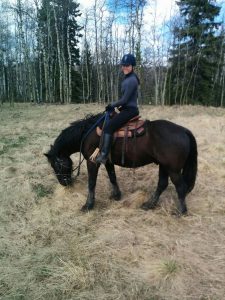
Am Sonntagnachmittag reitet Sasha gern. – On Sunday afternoon, Sasha likes to ride horseback.
*Achtung* “gern” is NOT a verb! You cannot write: “Ich gern Pizza” and think you are saying “I like Pizza”. You always need a conjugated verb to go with the “gern“. There is a verb in German that means “to like”, but we will only learn that in Einheit 4.
*Achtung* As you have seen in lesson as well as earlier in this unit, German verbs are sometimes a combination of a noun verb or verb verb:
Fußball spielen – Luca spielt am Wochenende Fußball.
Musik hören – Karolina hört gern Musik.
Fotos machen – Houssem macht gern Fotos.
ins Konzert gehen – Houssem geht heute Abend ins Konzert.
Sport machen – Sasha macht gern nachmittags Sport.
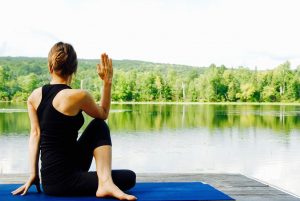
Yoga machen – Emilia macht montags Yoga.
essen gehen – Houssem geht mit Freunden essen.
Please note that you conjugate the verb in the second position and put the other verb or noun at the end of your sentence. It is the complement that gives you more information about the verb. You can review word order here.
Lerntipps! Learn these verb combinations (Golf spielen, einen Blog schreiben) together just like you would learn das Buch or die Lampe. You can use similar tips to memorize these verbs that you learned in 2.2 to memorize nouns and their gender.
Grammatik
Conjugation of Verbs (2)
In Einheit 1.8 we first learned about verb conjugation. The verbs we learned in 1.8 had their verb stems plus the ending “-en” (kommen, wohnen, heißen, etc). In the last few lessons you learned new verbs such as: wandern and klettern. You will notice that these verbs end in “-n” only. Please see the verb conjugation pattern below.
Since 1.8 we have also encountered verbs that don’t follow the typical conjugation pattern for various reasons. Here are few of them:
Verbs whose stem ends in an s-sound (-s, -ß, -z, -ss) do not add an -s in the du-form:
Wie heißt du? – Ich heiße Isabelle.
Tanzt du heute Abend?
Reist du oft nach Deutschland?
Verbs whose stem ends in -t or -d add an -e between the stem and the -st ending for the du-form and between the stem and the -t in the er/sie/es-form and ihr-form:
Du reitest am Donnerstag.
Er arbeitet morgen früh.
Ihr findet den Kurs interessant.
This also applies to some other verbs such as regnen (Es regnet.) and öffnen (Sie öffnet das Buch.).
Compare the following conjugations:
| Pronomen | spielen (regular conjugation) | wandern | tanzen | reisen | reiten |
| ich | spiele | wandere | tanze | reise | reite |
| du | spielst | wanderst | tanzt | reist | reitest |
| er/sie/es | spielt | wandert | tanzt | reist | reitet |
| wir | spielen | wandern | tanzen | reisen | reiten |
| ihr | spielt | wandert | tanzt | reist | reitet |
| sie/Sie | spielen | wandern | tanzen | reisen | reiten |
Please note that the underlined portion of the infinitive is the “verb stem”.
Übung 3
 Wortschatz in Quizlet:
 Was wissen Sie jetzt? Klicken Sie hier für “Online Practice” 2.8.
 Quiz! Das Quiz ist in der nächsten Unterrichtsstunde.
Extra Practice (optional):
 Deutschtrainer
If you want to practice vocabulary from todays lesson, click on the topic below. Watch the video and then click on “start” under the video and do the exercises.
Sporting Activities
Hobbies
German Grammar
If you want extra practice on the grammar concept learned today, click the topic below:
What is a verb?
Basic verb conjugation
Media Attributions
- star © IO-Images is licensed under a Public Domain license
- book © IO-Images is licensed under a Public Domain license
- Sasha © ckost is licensed under a All Rights Reserved license
- Sasha reiten © ckost is licensed under a All Rights Reserved license
- portrait © Mücahit Duman is licensed under a Public Domain license
- delicious © Pexels is licensed under a Public Domain license
- holly-mandarich-7MrXw_o7Eo4-unsplash © Holly Mandarich is licensed under a Public Domain license
- yoga © Evita Ochel is licensed under a Public Domain license
- presentation icon © quinntheislander adapted by Solomon Hajramezan is licensed under a Public Domain license
- light-bulb © IO-Images is licensed under a Public Domain license
- link © IO-Images is licensed under a Public Domain license
- check mark © janjf93 adapted by Solomon Hajramezan is licensed under a Public Domain license
- exclamation © IO-Images is licensed under a Public Domain license
- play © IO-Images is licensed under a Public Domain license