
2 Chapter 2: Achieving Career Success in a Changing Environment
Learning Objectives
LEARNING OUTCOMES
Upon completion of this chapter, you should understand:
- Reflect on your personal strengths, values, and experiences to support career development.
- Conduct a personal SWOT analysis to guide future professional decisions.
- Develop a realistic and adaptable career plan based on your goals and self-assessment.
- Identify potential career paths and evaluate them for personal and professional alignment.
- Set achievable goals and create an action plan for short- and long-term success.
- Understand the foundational role of professional relationships in career planning. (Note: Networking strategies will be explored in detail in Chapter 3.)
NOTE: Throughout this text, the term finance professional and financial advisor will be used interchangeably to represent the advising role. In the finance industry, you will encounter many different titled roles that may vary by financial institution and location.
Planning for the Future
Ask any advisor/finance professional about their success, and they will tell you that being as prepared as possible can help you be ready for whatever comes your way. It is vital that new advisors/professionals plan for their future, and there are many books and articles you can find on this topic. In this chapter, we will cover how to develop a career plan and a business plan for your book of business.
Self-Discovery.

Image generated using the prompt “Create an image of a College Student learning about Self Discovery” sourced from OpenAI, 2025.
-
Improved Decision-Making: Finance professionals frequently make high-stakes decisions that require clear judgment. Self-awareness allows them to understand their own biases and avoid letting these biases cloud their judgment, leading to better decision-making.
-
Effective Communication: Self-awareness promotes a better understanding of one’s communication style and how it is perceived by others, leading to more effective interactions with clients, colleagues, and superiors.
-
Emotional Intelligence: Understanding one’s emotions is an aspect of self-awareness contributing to emotional Intelligence. Emotional Intelligence can help finance professionals manage stress, maintain composure in challenging situations, and relate better with others – all crucial for career advancement. (Refer to Chapter 6 for more in-depth content on Emotional Intelligence)
-
Continuous Learning and Improvement: A self-aware finance professional can better identify their strengths and areas for improvement. This recognition leads to targeted skill development and continuous learning, a key aspect for staying relevant and thriving in the rapidly evolving finance field.
-
Leadership: Finance professionals must often lead teams as they move up the career ladder. Self-awareness enables them to understand their leadership style, strengths, and weaknesses, making them more effective leaders.
Career Plan
Part 1: Knowing Yourself
This part may seem simple, but, in fact, it may be the most difficult part to complete. You should do a wholesome self-reflection. It is best to be as honest as possible, as knowing yourself helps you identify what opportunities you should explore and what challenges you will need to overcome to achieve your career goals. In order to do this you should complete a Personal SWOT Analysis.
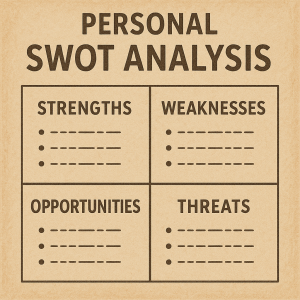
Strengths
Weaknesses
Opportunities
Threats
Strengths:
- What am I enjoying doing?
- What are my unique skills?
- What are skills that I have, but others don’t?
- What do others see as my strengths?
Weaknesses:
- What stopped me from achieving my goal?
- What do I need to improve to achieve my goal?
- What are my bad habits?
Opportunities:
- How can my network help me with my future career?
- How can my skills fill the need in the industry I want to work in?
- Is there any significant change in the industry that I can take advantage of?
Threats:
- Is my personality hurting my career path?
- Are my peers doing a better job than I am in the same position?
- Are there any skills that my competitors have that I don’t?
- Is my financial situation impact my goal?
Example of a Student Personal SWOT Analysis Plan: Student SWOT Analysis example
Part 2: Explore Possibilities
After you have completed your self-reflections and SWOT analysis, you should research the career path(s) you identified that you are most interested in. Here, you can list all your chosen career pathway(s). Research will help you determine what prerequisites and requirements are needed to achieve each career path. Make note of the time required to achieve these career paths. Some career paths will have licensing requirements combined with a certain amount of work experience. Having realistic timelines and expectations will help you be more successful in achieving your goals.
Part 3: Making Choices
-
What are the perceived barriers/obstacles? How can they be overcome?
-
What commitments do you have outside of work/personally?
-
What is the level of involvement required?
-
Which of my options fits best with my desired employer’s needs?
Part 4: Make it Happen
To achieve your goals, you need to have an agreed upon course of action. Work with your mentor to establish a clear understanding of what steps you will be taking and the time commitment required to meet the relevant timeframes. Then develop a course of action/action plan.
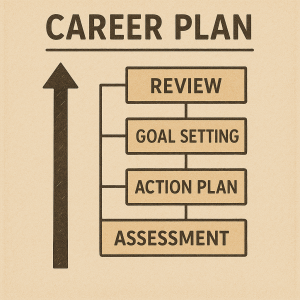
Image generated using the prompt “Create and Image of a Career Development Plan,” sourced from OpenAI, 2025.
Example of a Student Development Plan: Student- Development Plan
Finally, in order to hold yourself accountable to your career plan, review it with your mentor or other trusted person. Listen to their feedback, make any necessary adjustments and have them sign off on your plan as a way to solidify the commitment. Commit to a time in the future to review where you are on the path to your goals. Remember, this is your plan; you can change or revise it as needed.
As part of your career planning, it is valuable to begin identifying key individuals in your network who can offer guidance, information, or future opportunities. Building your professional network is a strategic skill that will benefit your practice over the long term. Networking will be explored further in Chapter 3 as a core part of building and sustaining your book of business.
Importance of Professional relationships
As you plan your career path, identifying key people in your network can offer valuable insight, mentorship, and opportunities. Building these professional relationships is a strategic skill essential for long-term success, and it will be explored in greater depth in Chapter 3.
Summary
In summary, this chapter highlights the importance of self-awareness and intentional career planning for finance professionals. Using tools like a personal SWOT analysis and development plans, readers are guided through a four-step process:
-
Know Yourself – Identify strengths, weaknesses, opportunities, and threats.
-
Explore Possibilities – Research potential career paths and their requirements.
-
Make Choices – Set clear, achievable goals that align with personal and professional aspirations.
-
Make it Happen – Create and follow a realistic action plan with support from a mentor.
The chapter emphasizes emotional intelligence, goal-setting, and the value of networking, which is explored further in Chapter 3.
References
Media Attributions
- cfc4ec8a-7282-42c9-abfe-61fb636013e6
- adfeae20-1593-4388-ad21-f62acefd7642
- 56e95b07-c091-40f6-86f0-0f21746fe004