"

3 Chapter 3: Maintaining and Growing Your Book of Business/Professional Practice

Learning Objectives

LEARNING GOALS

Upon completion of this chapter, you should understand:

  • Explain the importance of treating your book of business as your own professional practice.
  • Identify how financial advisors allocate their time and the activities that drive success.
  • Apply effective strategies to build, grow, and maintain a client base.
  • Develop and nurture Centres of Influence (COIs) to support business development
  • How to use social media for professional visibility and client acquisition.
  • Utilize networking strategies to expand your reach and acquire new clients.
  • Recognize the traits and habits of successful financial advisors.
  • what traits successful financial advisors possess.
  • Create a personalized business plan that outlines your goals, strategies, and focus areas.


Establishing Your Own Business/Professional Practice

In order to be successful in your role, you need to build your business. Whether you work for a bank, finance company or your own financial planning firm, you need to view your client portfolio as your own business. This chapter will address maintaining your client relationships and strategies on how to grow your business to ensure your success.
A book of business is the list of clients maintained by someone who provides specialized professional services, such as financial services. Ideally, the professional regularly adds clients and customers to keep their book of business growing (Kolakowski, 2020).
It may not have occurred to you that advisors and planners look at their book of business as their own business. Cultivating your book of business to maintain and add new clients is critical to being a successful business advisor. It is likely the organization where you are employed will have a system to collect all of your client information that you can refer to and update as needed. Financial planners who have their own practice will need to purchase a CRM system or build their own system for collecting important client data.
A book of business includes the basics: client name and contact information. A really good book of business houses additional information, so the advisor can recall details from previous meetings with a client. Some key items to include for each client are:
  • demographics (e.g., age and occupation)
  • accounts the client has with you and other financial institutions; maturity dates should be documented
  • outcomes of client meetings (i.e., the products/services the client has acquired)
  • referrals that you provided to your client
  • potential future needs; gaps you have identified through previous meetings.
Information is gold. For example, knowing that your client’s child is getting married provides you with the opportunity to send a card congratulating them. By sending a card, you are showcasing to your client that you remember them and the important events in their life. Typically, an advisor may see their clients twice a year, so remembering and acknowledging certain details will help the client keep you in mind for their future needs.

How an Advisor Spends Their Time

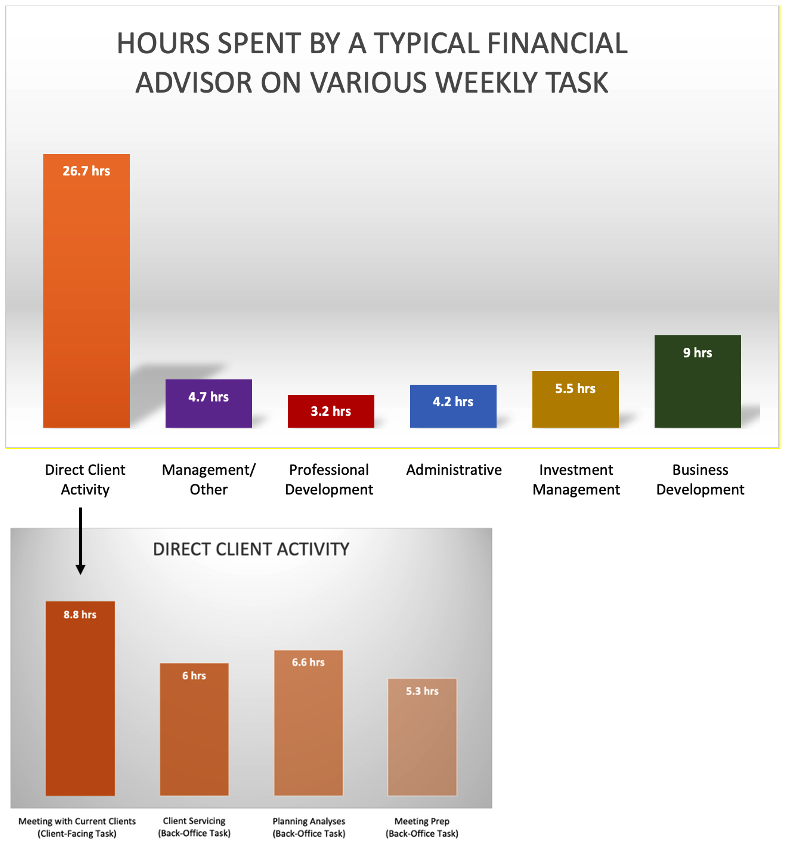
A research study completed by Dr. Derek Tharp in 2018 explored, “How Financial Planners Actually Do Financial Planning” (Tharp, 2018). He was able to determine what an advisor/planner does throughout the week in order to be successful. Figure 3.1 shows how lead advisors indicated they spend their time on a weekly basis. Some interested takeaways from this study follow.
  • Advisors/planners spend 43 hours per week working as a financial advisor; of those 43 hours, 26.7 are spent addressing the following direct client needs…
  • They meet with their current clients, on average, 8.8 hours per week.
  • They spend 5.3 hours per week preparing for meetings.
  • They spend 6.6 hours per week answering client questions.
  • They spend an average of 6 hours per week doing follow-through on client servicing tasks.
  • Advisors indicated that finding and getting new clients took, on average, 9 hours per week. This includes 4 hours meeting with prospective clients and another 5 hours working on marketing and related business development activities.
Screen Shot 2022-06-16 at 12.23.11 PM.png

[Figure 3.1] Time spent by lead advisors on various weekly tasks. (Data from: Tharp, 2018)
Looking at Figure 3.1, you can see that about 50% of their time is spent on client-related activities and less than 20% of their time is spent meeting with their existing clients. It is important to also consider the hours an advisor spends on business development:
  • They spend about 9 hours per week finding and meeting new clients.
  • They spend about 3 hours per week on administrative work and professional development.
  • The spend about 5 hours per week on management tasks (as needed.) 
Investment management work (the work an advisor does when they are researching and performing actual account activities [like trades]) takes about 10% of an advisor’s time. From what you have read, you can conclude that the majority of work an advisor does involves growing and building their book of business. 
In fact, given that the average experienced lead advisor has 96 clients, the average advisor only spends 2.9 hours per year actually “investment managing” the client’s portfolio (Kitces, 2019).
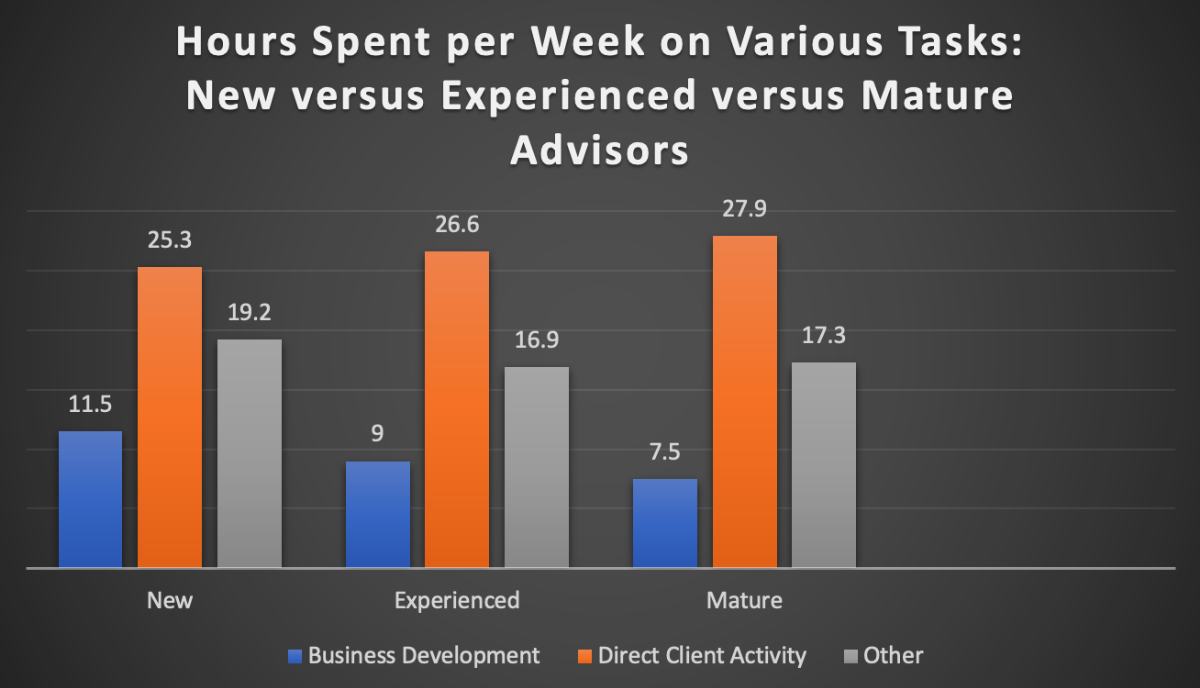
Interestingly, the report determined the following for new financial advisors with less than 5 years of experience:
  • Business development time averages about 21% or about 12 hours per week. 
  • Client meetings with current clients averages about 13% of their time or about 7 hours per week.
Advisors with 5-15 years of experience:
  • Business development time averages about 17% of their time  or about 9 hours per week. 
  • Client meetings with current clients averages about  16% of their time or about 8.3 hours per week.
Mature advisors with 15+ years of experience:
  • Business development time averages about 14% of their time or about 7.5 hours per week. 
  • Client meetings with current clients averages about 19% or their time or about 10.2 hours per week.
Screen Shot 2022-06-16 at 10.55.44 AM.png

[Figure 3.2] New versus experience advisors; how they spend their week. (Data from: Kitces, 2019)

Watch the video below:

Strategies to Build Your Book of Business as a New Advisor

For a new financial advisor, the task of building their client lists can seem quite ominous. This process can take time to build, and it is important to develop a plan and not give up.  Both the plan and the advisor needs to be flexible and adaptable; the advisor needs to be willing to adjust their plan if necessary. Assuming the advisor has completed the licensing required to be advising clients, they can consider moving forward with their plan. 
New advisors and finance professionals will need to expand their reach; they need to look outside their usual working circles to gain access to different networks. In this text, we will discuss the importance of relationship building. This knowledge is a transferable skill that can be applied to working with clients and colleagues who can provide new advisors/professionals with referrals. While social media is a good tool, the personal contact of a relationship can go much further. 

Centres of Influence

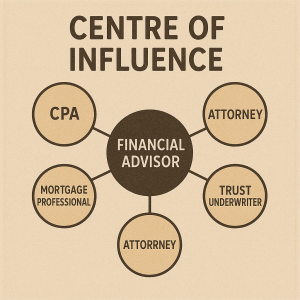
Image generated using the prompt “Create an image of a Centre of Influence,” sourced from OpenAI, 2025.


Developing Centres of Influence is the key to success many new financial advisors. According to FMG, a Centre of Influence is defined as marketing to key people you can rely upon to help grow your business. As a financial advisor, your Centres of Influence (COIs) may include CPAs, attorneys, trust underwriters, mortgage professionals, and more (FMG, 2021).
A Centre of Influence adds value to financial advisors for the following reasons.
  • They give you access to a number of potential clients that you can service.
  • They are willing to recommend you and your services to potential clients.
  • They are respected in their industry.
  • A mutual relationship can develop, where you also becomes a Centre of Influence for them. 
Your relationship with your COI takes time develop and cultivating these relationships is valuable and worth the time invested. Make a point of connecting (you can meet for coffee or lunch) to see how you can help them grow their business. 

Networking for Client Acquisition and career sustainability

In addition to building your skills and industry knowledge, one of the most critical activities for any advisor is building and maintaining a strong professional network. Networking is not simply about job hunting; it is an essential part of building your client base and sustaining long-term success in financial services.

Image generated using the prompt “Create an image depicting Networking,” sourced from OpenAI, 2025.

According to the University of Manchester (2023), networking is an essential ability encompassing interpersonal communication, rapport management, and professionalism. These competencies are fundamental to establishing strong client relationships and business growth.

Effective networking allows you to:

  • Expand your circle of influence
  • Build meaningful relationships with clients, professionals, and community contacts
  • Gain referrals and build trust and credibility
  • Establish a recognizable personal brand in the industry

Strategic Networking Tips for Financial Professionals

  1. Look for the Right People
    Reach out to former colleagues, community leaders, and industry professionals such as CPAs, lawyers, and mortgage specialists. Attend local business networking events or webinars to connect with new contacts.
  2. Be Proactive
    Stay in regular contact with your network through brief updates or messages. Don’t wait until you need something—relationships grow from consistent, genuine engagement.
  3. Offer Assistance
    Helping others in your network builds goodwill and positions you as a knowledgeable and dependable resource. If you can’t help directly, connect them with someone who can.
  4. Cultivate Online Connections
    Use platforms like LinkedIn to maintain visibility, share insights, and engage with others. Join online groups relevant to financial professionals or your niche market.
  5. Follow Up After Events
    Whether in-person or virtual, following up with a new contact after a networking event demonstrates professionalism and interest. A well-timed follow-up can lead to opportunities, introductions, or even new clients.
  6. Develop an Elevator Pitch
    Be ready to explain who you are, what you do, and how you help clients—in 30 seconds or less. Practice this so it feels natural when opportunities arise unexpectedly.

Remember, effective networking is not transactional—it is relational. Your goal is to build long-term trust with people who may become clients, refer clients, or support your practice in other ways.

Carve Out a Niche of the Market

One thing new advisors can do is seek out clients that are underserved. Many established advisors work with retirees (Bloomenthal, 2019). A new advisor has the opportunity to build their client list by approaching  and working with the younger generations.
It is also important for the new advisor to determine what their brand is and how they are going to serve their clients. Establishing a personal brand, one that sets the advisor apart from their competitors, is key, What is the personal added value that you bring to your client experience?
A survey was completed for this text, and when successful advisors were asked what they believe their personal added value for the client experience is, the overwhelmingly theme that evolved from their answers was being personal, honest and empathetic. 
Image generated using the prompt “Create an image of a Niche Market for a Financial professional,” sourced from OpenAI, 2025.

Community Engagement

It is likely that new financial advisors who are getting established have minimal funds for advertising and marketing. It is vital for a new advisor to seek out low-cost options to connect with others (Bloomenthal, 2019).
Image generated using the prompt “Create an image of a what Community Engagement looks like for a Financial professional,” sourced from OpenAI, 2025.
Increasing your circle of influence, and becoming well-known in the community, can lead to success and sustainability in your career. 

Ways for a New Advisor to Find Clients

Growing your network is essential, but that means reaching beyond your inner circle to develop personal relationships with a variety of people.

Look beyond soon-to-be-retirees as clients and find relatively underserved markets, so as to be competitive.

Get involved with your community through volunteering and other programs as a way to feel connected and to find potential client

[Table 3.1] Key takeaways from the article, “Advisors: Top Ways to Find Your First Clients”. (Source: Bloomenthal, 2019)

Strategies to Grow Your Book of Business

Once an advisor is somewhat established with their book of business, sustainability is the key to their continued success. While it is important to continue with the strategies described to build your book of business, the text that follows describes some strategies to help grow and maintain your book of business. Growing and maintaining your book of business is equally as important as building it.

Word of Mouth

Your existing clients are your best resource for advertising your services as a financial advisor. Often, advisors are humble and don’t want to be seen as pushy with their clients, but surprisingly, many times they find out that their clients understand and are willing to help out when asked. Clients who run their own business know the values of referrals and word of mouth advertising. You can say to your client, “If you have enjoyed the customer service I have provided to you, and think that I could do the same for a friend or family member, I would appreciate if you could give them my business card or contact information.”  Always have business cards ready to give out, not having them on you at all times can lead to missed opportunities. 

Social Media Presence/Website

Being established on social media or having a website is a requirement for today’s businesses. However, having a social media account/website is only beneficial if it’s being actively maintained and updated.

Your website should appear as a living brochure so clients can learn what you are about. You should post client testimonials on your site. You can make posts on topics like financial literacy and fraud prevention and include a page addressing any market news updates. 
Your social media platform should remain professional and not include any personal posts. One way you can maximize your social media presence is to post daily on the the popular social media platforms. Consider paying for the business options. While it comes at a cost, these options allow for your posts to be seen by more people. Use visuals in your posts, if you are reposting a meme, check that your grammar and spelling are correct. Engage where possible and use hashtags to help increase your presence. Note Credentialling bodies can have guidelines on social media presence, this will be covered in greater detail in the next chapter. Note is important to refer to credentialling bodies to determine what use of Social Media is acceptable, this will be discussed further in future chapters. 

Guest Speaker Opportunities 

Expanding on your connection within the community, seek out opportunities where you can speak on financial planning topics. Retirement facilities are excellent places to connect with seniors who may be looking for a new advisor. Fraud prevention, especially when related to new technologies, is often a concern for seniors wanting to protect their assets. You can host information events where you can speak on any number of financial literacy topics, offering beverages and snacks is a great way to bring in  potential clients. Connecting with non-profit organizations that support newcomers to Canada is another great way to increase your connection to the community. 

Pipeline

Pipeline is a term used in finance that refers to upcoming business activity. A successful advisor always has something in their pipeline helping with sustainability of the business. Seeking out business that matures or comes due sometime in the future, and ensuring that the necessary steps relating to theis business/asset have been taken, comes under the management of the financial advisor.  Some advisors use Excel or other software to manage their pipeline (knowing where things are at is critical). If something is missed, not handled properly or not on time, the result could be a very poor customer experience; you could end up losing the client. 

Traits of Successful Financial Advisors

Successful financial advisors know not only how to manage their clients’ money, but how to ensure their clients feel safe and financially cared for (Anthony, 2022).
Everyone wants to be good at their chosen career, and knowledge and dedication are key. The article, “5 Traits of Successful Advisors” looks at the five traits most successful financial advisors have (Anthony, 2022).  We summarize those traits below.
1. Passion for Financial Planning and Wealth Management. If you are passionate about what you do as a financial advisor, it will be obvious to your clients. That passion will make them want to work with you and refer you to others. Given that the world of finance is constantly changing, especially in terms of regulations, products/services and technology, having a passion for finance will help you better navigate these changes. 
2. Deep Analytical Ability. Advisors who have a good understanding of the risk and return relationship, and how it impacts every client portfolio, will help the advisor be successful. When you listen to your client’s wants and goals, and balance those against their risk tolerance, you can successfully create a portfolio that meets their needs. This will enhance your relationship with that client. You need monitor client portfolios using a variety of metrics, such as standard deviation, beta, strategic asset allocation, tactical asset allocation, and drawdown. Analytical ability also provides you with the ability to help set the right expectations with your clients, especially when it comes to goals and objectives. You should be the expert in the conversation and be able to communicate well with the client.
3. Professionalism. Building the your book of business is critical to your success. Given all the elements of a financial plan, a good advisor is one that recommends products/services that meet the client’s needs. When you are having a good conversation with a client, you are able to identify gaps a client may not be aware of, and a successful advisor positions these gaps so the client sees them as needs. Clients are looking for someone who is an expert and can clearly communicate gaps and opportunities. Ultimately, to be successful, financial advisors must gather their courage to ask clients for their business. 
4. Putting a Client’s Interests First.  Advisors must put their client’s needs ahead of their own; one only needs to seek out the FP Canada Standard Council Code of Ethics, reiterating this for all Financial Planners. Unfortunately, too many cases have been seen in the news where advisors have acted to fulfill their needs ahead of the client. These situations have caused a negative perception of the finance industry. There is a shift in the industry to be more ethical and transparent in dealings with clients. Successful advisors must believe that the financial interests of both parties are aligned – for if not, a damaging outcome may occur. 
5. Curiosity. A good advisor is curious and willing to dive deep into a client’s details to find the best solution (and exceed the client’s expectations.) Often, challenges are presented where there seems to be no good solution for the given situation. A successful advisor takes the time to investigate all possible solutions. Of course, this does not mean taking unnecessary risks with a client’s situation, but, instead, seeing if there are any possible strategies to help the client. Finding a solution when others have failed can solidify your relationship with the client and produce referrals.

Traits of Successful Advisors 

Successful financial advisors have a large book of client business and a track record of performance and service.

Getting clients and having them stick with you—and recommend you—means being professional and putting your clients first.

At the same time, you need to have a deep understanding of the markets, analytical skills and training, and a passion for finance.

Soft skills can be equally as important as hard skills such as investing acumen and market timing.

[Table 3.2] Key takeaways from the article, “5 Traits of Successful Financial Advisors”. (Source: Anthony, 2022)

Business Plan for your Book of Business/Practice

As a new financial advisor/professional, having a business plan can help you determine how you plan to conduct your business. It may seem like this is common sense, but the truth of the matter is, if an advisor/professional does not have a strategy in place they can quickly become overwhelmed by the needs of all their clients and making very little compensation from those clients. In this section, we will discuss: 1) what is needed in a business plan, and 2) how to establish a business plan. Similar to a career plan, a business plan is not a static document, and it is only valuable if continually updated.
Your business plan as a financial advisor exists to help you keep focus and avoid distraction (Kitces, 2015).
In researching business plans for financial advisors/professionals, this author found extensive evidence that a plan should be a one-page document that is continually reviewed and adjusted over the career span of the financial advisor/professional. Having a one-page plan allows the advisor/professional, to capture the essential elements of the business and provides direction and focus (Kitces, 2015). The plan will provide the advisor/professional with the direction and focus that is needed to reach the business goals of the practice (Career Employer, 2021). Another reason for having a business plan is that a client may ask to see your plan. A client would ask to see your plan so they can determine: 1) how vested you are in your business, and 2) your level of commitment to their overall financial success (Boswell & Nichols, 2018).  You always a want leave clients with the impression that you are prepared.
Business plans for financial advisors/professionals exist throughout the industry, and there are variations among them, but they generally contain similar content. For the purpose of this book, we have adapted the six required elements of a one page business plan for financial advisors/professionals from Kitces (2015).

1. WHO will you serve? Who is your TARGET MARKET?

How do you plan on differentiating yourself as a finance professional? One way to be successful in this role involves becoming a specialist in particular area; this can help differentiate you from your competitors. Inevitably, you have formulated an idea of the type of clients with whom you will work best. It is a good idea to list out the criteria you are looking for in a client. It will make it easier for you to identify the types of clients you are hoping to serve. Identify the niche of clientele that you plan to target, and determine why you want to serve this particular clientele. Research this niche clientele. What factors do you think you can leverage and make your own?
2. What will you DO for them?
How can you help these clients solve their problems? Determining your niche market will dictate what services you specialize in. Specializing in your practice will set you apart from competitors and provide security to your clients. Clients like to know they are working with an expert.
For example, you decide to focus on retired clients and focus specifically on their needs. You could specialize in long-term health care needs, and the funding required for such care. Another possibility involves working with doctors. You could concentrate on doctors who are beginning their practice and help them target the large student debt they accumulated during their studies. However you choose to specialize your practice, it is vital to do your research on how you will be compensated. This information may change your mind on what type of niche of clientele you choose to service.

3. How will you REACH them?

Once you have decided what clientele you want to work with and what you will do for them, it is time to figure out how to reach them. What will be your process for finding prospective clients? You will need to strategically plan how you are going to connect with your niche clientele. Making use of social media platforms is a good place to start. Establishing your online presence, which represents you and your brand, is critical to your success.
In 2018, Stephen Boswell and Kevin Nichols conducted a survey of 524 finance professionals. The following were found to be the most effective strategies (Boswell & Nichols, 2018):
  • unsolicited referrals
  • proactive introductions
  • professional alliances
  • social prospecting
  • intimate social events
  • educational events
  • social media, website and content marketing.
Ultimately, you need a plan what will work best for you, then get out and get started.

4. How will you know if it’s WORKING?

In the first year of your practice, building your client list will seem daunting. If you are doing the right things, you will begin to see progress. The way you can measure your progress is to set up goals. The goals you want to achieve will help you determine if what you are doing is working.
An example of a goal could be: “Meet with 10 Centres of Influence to get introductions to 30 potential clients, leading to 3 new clients in the first three months of my practice.” Goals could also include the number of calls you make, emails you send, articles you write and publish and client meetings you have. When you are first building your practice, these goals help you stay focused on the tasks that build clientele. Eventually, the goals you create will be more results-orientated.

5. Where will you focus YOUR TIME in the business?

When you are beginning your practice, you will often have to do everything, and it may stay this way until you are established. Once you have attained stability in your practice, it is critical that you identify where you want to focus your time. According to Kitces, “The reality is that the quickest way to failure in an advisory firm is to get so caught up on doing “everything” that you fail to focus on the essential activities necessary to really move the business forward.” He says it is essential that you be proactive about: 1) how you choose to spend your time, 2) how you determine what activities you can stop doing, and 3) how you decide if additional resources may be required to help you (Kitces, 2015).

6. How will you STRENGTHEN the foundation?

This point in the business plan is not about what you must do to achieve the goals you have set, but, instead, what needs to be done in order to maximize the practice’s success. You need to know what technological tools may be needed (e.g., a CRM system) to launch your practice and what licensing requirements are necessary. Will the structure of your practice exist in a traditional office space or will it be an entirely virtual workspace? Or will you consider a blended workspace? These are important questions to consider, as they can have financial implications. Having an effective and realistic budget will help with the sustainability of the practice, especially in the early days of business. As the practice becomes more established, and you gain experience, you may start to feel like you are stuck and are no longer progressing. Reviewing your entire business plan, and modifying it where appropriate, is a great way to rejuvenate the practice. An experienced advisor should look at the foundation of their practice to see what needs to be adjusted.
The goal here is to do what is necessary to move forward, not everything; as with so much in the business, waiting until perfection may mean nothing gets done at all (Kitces, 2015).

Summary

To summarize, establishing a career and business plan will help ensure you will achieve your career goals as a new financial advisor. Being honest with oneself and having self-awareness will benefit you in the long run.

References

Anthony, C. (2022, April 2022).5 Traits of Successful Financial Advisors. Investopedia.
Bollomenthal, A. (2019, June 25). Advisors: Top Ways to Find Your First Clients. Investopedia.
FMG Suite. (2021, March 4). Marketing to Centers of Influence for Financial Advisors. FMG Suite, LLC.
Kolakowski, M. (2020, September 17). What Is a Book of Business? Definition & Examples of a Book of Business. The Balance Careers. 
Tharp, D. (2018). How Financial Planners Actually Do Financial Planning. The Kitces Report, Vol. 2.

Media Attributions

  • 50f1da1b-0dce-4ba1-bb47-80e0a422074e
  • 8a1de285-e22d-483e-913b-fec2e814c3f9
  • bf56c963-596e-4dbd-8c0d-336b61cde4f1
  • a961b643-5417-45e1-a435-218dfac79ff3

License

Icon for the Creative Commons Attribution 4.0 International License

Advising for Finance Professionals Copyright © 2025 by Carla Van Horne is licensed under a Creative Commons Attribution 4.0 International License, except where otherwise noted.