1 Chapter 1: Exploring Careers in Finance
-
Describe the diverse career paths within the Canadian financial services industry, including traditional and emerging roles.
-
Compare the responsibilities and required skills across key finance sectors (retail, transactional, middle office, back office, institutional).
- Identify common credentials and licensing requirements for roles such as CFP, CFA, mortgage broker, LIT, and insurance advisor.
- Recognize the importance of continuous learning, personal branding, and relationship-building in career development.
- Begin to reflect on which finance roles best align with your strengths, interests, and career goals.
Exploring Careers in Finance
This course has will teach you how to be a successful advisor and or finance professional by building relationships and connecting with clients and colleagues. These skills can be applied to many careers across finance industry. This chapter will look at just some of the many career paths you can take. The field of finance is vast; someone in this industry can, and likely will, have many different roles throughout their career. Rarely, will you find someone who is retiring from the same position they started in. The field of finance allows for you to grow and build on your existing skills and then transfer those skills to other roles.
Financial Services Career Map
When people think of a career in finance, they typically think of the traditional roles in the banking sector. However, when looking at the Financial Services Career Map and Job Finder Tool provided by the Canadian Securities Institute (A Moody’s Analytics Company, you can clearly see that the options are numerous and varied. This interactive tool allows the user to learn more about a role and what education/licensing is required for the role. The tool is helpful to those looking to plan out their career as they work on developing their career path.
In the rest of this chapter, we will begin breaking down the different areas of financial service careers, and then we will look at careers in finance that are a bit different from the traditional service careers.
Financial Service Careers
Transactional Sector
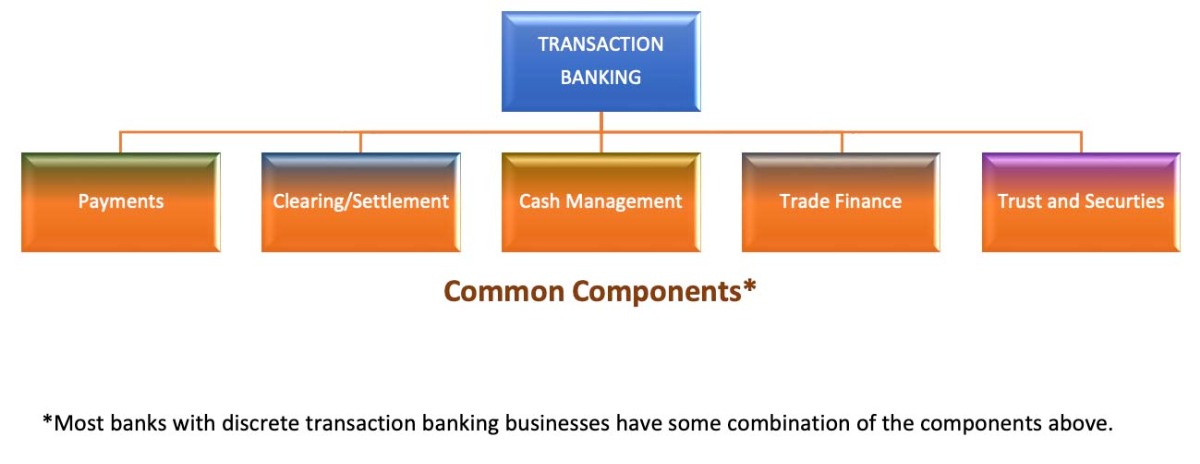
The transactional sector includes those that are largely concerned with carrying out the day-to-day requests of clients and not providing advice. Transaction banking can be defined as the set of instruments and services that a bank offers to trading partners to financially support their reciprocal exchanges of goods (e.g., trade), monetary flows (e.g., cash, or commercial papers (e.g., exchanges) (Dabo, 2021).
Services provided to businesses (e.g., corporate and institutional clients) can include cash management services to assist in a company’s liquidity needs and other services designed for the incoming and outgoing cash flows, international commerce and asset management (Dabo, 2021).
Common Components of banking picture. )
[Figure 1.1] Components of transaction banking. (Data from Dabo, 2021
Retail Sector
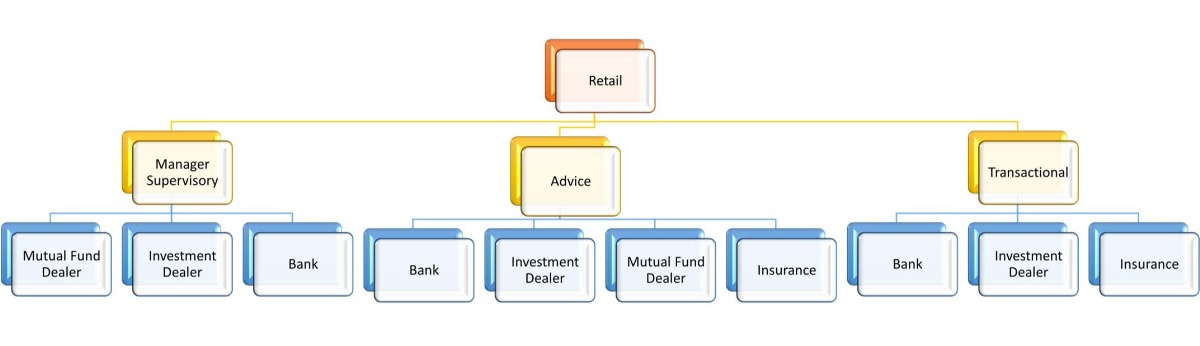
The retail sector includes banking services offered to retail customers (the general public) or small business owners. The roles in this sector attend to the needs of clients in the areas of sales, marketing, advisory or in a servicing capacity. This sector offers various employment opportunities; its distribution network is large and includes Canada’s banks, credit unions, securities dealers, mutual fund dealers and insurance companies. Some individuals choose to be independent agents, brokers, financial advisors or planners.
Career Guide in Banking CVH [Figure 1.2] Career guide for retail banking. (Source: Carla Van Horne, NAIT)
The retail sector is where most individuals start their careers in finance. The key skills required for this sector are :
-
problem solving
-
analytical skills
-
interpersonal skills
-
effective communication.
With an industry that is diverse and, at the same time challenging (in the sense of how quickly it evolves and changes), this is a field for those who are dedicated and ambitious in achieving and exceeding their career goals. According to Veronica Yao, the Top 4 entry-level roles were the following (Yao, 2015):
-
Account Manager; skills needed in this role include sales, relationship management and organization.
-
Client Service Representative; skills needed in this role include sales, problem-solving and communication.
-
Sales Representative; skills needed in this role include meeting deadlines, rapport-building and working under pressure.
-
IT Analyst; skills needed in this role include communication, collaboration and problem-solving.
“Your personal and professional growth is unique to you. Be mindful that it can take many forms including on the job learning that includes coaching and feedback and more formal approaches like instructor-led programs and professional designations”. (Rehana Ciriani, Director, RBC Career Launch Program)
The retail sector clearly has many opportunities worth exploring. Click the following link to review the average starting salary rangesfor various roles in the retail sector across Canada:
Middle Office Sector
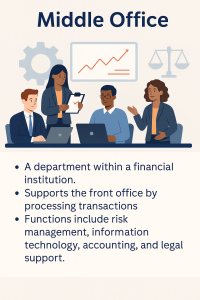
The middle office sector is a department within a financial institution. It supports the front office (which is client-facing) by providing risk management, information technology and legal services. The middle office ensures the due diligence of any deals and agreements made in the front office; they confirm they meet legal requirements. The middle office monitors and computes the profits and losses that the front office generates. The middle office can also include other operational processes that support the front office (e.g., marketing and human resources).
Compliance and risk mitigation are significant responsibilities for someone working in this area. Typically, an employee in this area would possess a bachelor’s degree, MBA and other postgraduate courses (Corporate Finance Institute, 2022).
Image generated using the prompt “Create an image that outlines what Middle Office Sector does in the Finance industry ” sourced from OpenAI, 2025.
A quick summary for middle office sector follows (Corporate Finance Institute, 2022):
-
A middle office is a department within a financial services institution.
-
The middle office supports the front office by processing transactions negotiated by the front office personnel to ensure that transactions are booked and fulfilled appropriately.
-
Other functions performed by the middle office include risk management, information technology, accounting, and legal support.
Back Office Sector
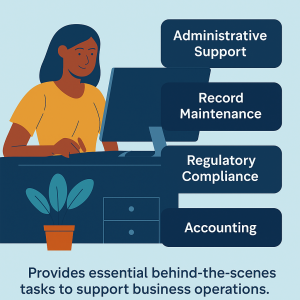
The back office sector provides administrative support to the organization and is not client facing. Functions completed in this area can include settlements, clearances, record maintenance, regulatory compliance, accounting and IT services.
Image generated using the prompt “Create an image that outlines what Back Office Sector does in the Finance industry ” sourced from OpenAI, 2025.
While the back office area may seem to be invisible when compared to other areas within the finance industry, they are vital to providing all business functions related to operations. While the employees in this area do not interact with clients, they do interact with the employees who do. Therefore, someone who is servicing a branch has the employees of that branch as their clients.(Investopedia, 2022)
It is important to note, in recent years back offices have been outsourced or relocated offshore in an effort to reduce costs. There are fewer local back office positions across Canada.
Institutional/Corporate Sector
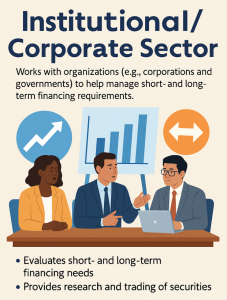
The institutional/corporate sector works with organizations (e.g., corporations and governments) to help manage short- and long-term financing requirements.
An organization’s financing requirements, whether they be short- or long-term financing, need to be evaluated. Short-term financing seeks to find the liquidity challenges and provide options in terms of short-term borrowing. Long-term financing requires proper evaluation and the appropriate choice of financial instruments to meet the needs for capital projects or expansions.
Image generated using the prompt “Create an image that outlines what institutional/corporate sector does in the Finance industry ” sourced from OpenAI, 2025.
The securities dealer in this area serves the needs of mutual fund, hedge and pension fund managers. They provide the needed research for equity, fixed income and derivatives trading to assist in the investment mandates being sought. In addition to providing research and trading the securities to external clients, the securities dealer will trade on their own(firm’s) account. This is known as proprietary trading. (Canadian Securities Institute, 2022).
Additional Finance Career Paths
Certified Financial Planner
The role of a financial planner is to work with Canadians to successfully navigate their finances, based on the client’s goals. A financial planner often works with a client over the span of the client’s life. Whether the client’s goals are ensuring a comfortable retirement, financing their child’s post-secondary education or establishing an estate plan, the financial planner’s job is to help the client achieve their goals while mitigating any risks that come along the way.
NAIT JRSSB Finance students who have taken the following courses: FNCE1125, 2280, 3320, 3314, 4550, and TAXX3312 are courses whose content is approved by FP Canada as Core and the Advanced curriculum towards the CFP designation.
Image generated using the prompt “Create an image that shows a Financial Planner with their client ” sourced from OpenAI, 2025.
“CFP professionals have demonstrated the knowledge, skills, experience and ethics to examine their clients’ entire financial picture, at the highest level of complexity required of the profession, and work with their clients to build a financial plan so that they can Live Life Confidently” (FP Canada™, 2022).
Chartered Financial Analyst
A chartered financial analyst (CFA) is a professional who holds a charter designation from the CFA Institute. These analysts have their abilities and expertise tested in portfolio management, investment analysis, financial reporting and other specific business concentrations. The CFA designation is widely considered to be a “gold standard” for financial analysis (Hayes, 2022). The role of a CFA professional includes relationship and wealth management, credit analysis, trading, accounting, auditing and financial planning. They help their clients make data- or research-based decisions on their finance requirements.
Image generated using the prompt “Create an image shows a Financial Analyst in action” sourced from OpenAI, 2025.
NAIT JR Shaw School of Business Finance BBA program has been accepted into the CFA Institute University Affiliation Program. This means that NAIT’s finance degree program incorporates 70% of the CFA Program Candidate Body of Knowledge (CBOK), which provides students with a solid foundation to complete the CFA exams. The links below provide additional information on becoming a CFA.
Mortgage Broker
A mortgage broker is someone who works with clients to help them find a mortgage or residential lending product that best meets their needs. Mortgage brokers negotiate with mortgage lenders to find the best rate for their clients; they are experts on mortgage financing and can often find solutions for clients that other advisors would not find. Individuals in this role must be well versed in finance and credit analysis. They must be good at networking and building relationships to ensure a sustainable business.
Mortgage brokers often set their own business hours; they usually they work when their clients need them. Clients appreciate the flexibility of dealing with a mortgage broker over dealing with a financial advisor from a bank. Mortgage brokers make the process of buying a home more convenient by being available 24/7. Mortgage brokers are compensated through commissions paid by the lender as a “finder’s fee”. Commissions can vary, but they typically range between 0.5% and 1.20% of the full mortgage amount (Nesto, 2022).
Image generated using the prompt “Create an image shows a Mortgage Broker in action” sourced from OpenAI, 2025.
Licensing is required to become a mortgage broker. To be eligible for licensing, individuals must meet the following eligibility requirements according to the Alberta Mortgage Brokers Association (AMBA):
-
be at least 18 years of age
-
be able to lawfully study and work in Canada
-
be able to provide specific government-issued identification (ID)
-
have a minimum of Canadian high school education or equivalent
-
be proficient in the English language.
Once the minimum requirements are met, there are two courses that individuals must complete: 1) the Fundamentals of Mortgage Brokerage, and 2) the Practice of Mortgage Brokerage. A final exam is then required. It is normal to complete the program within one year.
Licensed Insolvency Trustee (LIT)
A licensed insolvency trustee (LIT) is licensed by the Superintendent of Bankruptcy (Office of the Superintendent of Bankruptcy of Canada, 2021). They help people who are having trouble managing and paying their debts. A LIT can provide advice on anything debt-related, such as debt consolidation and budgeting (BDO, 2022). A LIT assist people seeking debt relief by contacting their creditors and negotiating agreements that lead to either consumer proposals or the client filing for bankruptcy. A LIT provides those seeking service an impartial view, and they act in the best interest of all parties.
Image generated using the prompt “Create an image shows a Licensed Insolvency Trustee in action” sourced from OpenAI, 2025.
The path to becoming a LIT can be quite long, but for those passionate about this career path it can be quite rewarding. According to the Government of Canada, before licensing is granted, certain requirements are needed (Office of the Superintendent of Bankruptcy of Canada, 2021):
-
be of good character and reputation
-
be solvent
-
successfully complete the Chartered Insolvency and Restructuring Professional (CIRP) Qualification Program (CQP), the CIRP National Insolvency Exam and the Insolvency Counsellor’s Qualification Course or the Practical Course on Insolvency Counselling
-
pass an Oral Board of Examination
Most often, a LIT has a bachelor’s degree and CPA. However, individuals with CFA designations can navigate this career path as well.
When beginning this career, it is necessary t find a position at a Trustee’s office. A requirement for someone entering this field is that they be supervised by a LIT throughout the programming process.
Insurance Sales Agent
 Image generated using the prompt “Create an image shows a Insurance Agent in action” sourced fromOpenAI, 2025.
An insurance sales agent sells insurance policies to their clients to help their clients mitigate the financial risks that can occur throughout a person’s life. Being knowledgeable about different insurance plans and policies available help the agent be successful in their role. An insurance agent should possess the following skills and qualifications according to Indeed for Employers:
-
strong business and sales skills
-
analytical skills
-
a positive, ambitious attitude
-
the ability to use computer software programs designed for insurance companies
-
excellent knowledge of all insurance policies
-
excellent customer service skills
-
strong negotiation skills.
There are licensing requirements to become an insurance sales agent. In Canada, a person is required to complete the Life License Qualification Program (American Income, 2020). Click on the following link to review information on how to begin a career as an insurance agent.
Realtor
A realtor or real estate agent helps clients buy and sell land and other properties. Successful realtors have established networks amoung many Centre of Influence’s or COIs that help support their business. A typical day for a realtor may involve time spent in the office time contacting clients, time spent with a client viewing properties and staging properties. Other tasks that a realtor may need to complete are generating leads, researching, marketing, accompanying clients to property closings and communicating with mortgage brokers or their client’s bank.
Image generated using the prompt “Create an image shows a Realtor in action” sourced from OpenAI, 2025.)
An realtor should possess the following skills and qualifications according to Skills You Need (Elena, 2022):
Summary
The careers listed and discussed in this chapter are not an exhaustive list of the many opportunities that exist in the finance industry. As one grows their network of connections with colleagues and COIs, new opportunities will present themselves. A career in the finance industry relies on lifelong learning, and continuing to be current and relevant in your practice is required. Clients will challenge you with their knowledge. Be strategic and stay ahead of what trends are occurring in the industry.
“By failing to prepare, you are preparing to fail”. – Benjamin Franklin
REFERENCES
Barone, A. (2022, March 21). Back Office. Investopedia.
Canadian Securities Institute. (n.d.). Institutional/Corporate. Moody’s Analytics Global Education (Canada), Inc. Retrieved May 24, 2022.
Corporate Finance Institute. (n.d.). Middle Office. CFI Education Inc. Retrieved May 24, 2022.