
5 Chapter 5: Customer Service
Learning Objectives
LEARNING GOALS
Upon completion of this chapter, you should understand:
- Describe how customer service has evolved and how it influences financial services today.
- Identify the steps involved in delivering excellent customer service.
- Explain how nonverbal communication and body language affect client interactions.
- Apply techniques for effective verbal and nonverbal communication in client meetings.
- Discuss the impact of attitude and emotional intelligence on service delivery.
- Recognize the ethical considerations involved in customer service within financial settings.
Evolution of Customer Service
The evolution of customer service can be directly correlated to the evolution of communication. Gone are the days when a utility bill payment was mailed through Canada post. Mail delivery services is commonly known as “snail mail” for a reason.
Customer service has changed dramatically from years past, when the telephone was the main source of communication. Due to the evolution of technology, clients now have significantly more choices in how they receive customer service. It is critical that financial institutions evolve along with technology and the ever-changing needs of their clients. Please review the below Padlet highlighting the evolution of telephone to Mobile Banking and how the RBC adapted its services to meet customer needs.
Societal Factors
Societal factors have had an impact on customer service. We have seen shifting demographic changes over time. Aging populations have led to a variety of needs, including budgeting for medical needs and seeking funds to travel in their retirement years. The younger demographics, the ones who grew up with technology, are constantly seeking out the latest technological advancements, hoping to make their lives easier and more convenient. Challenges exist globally, and the ongoing recovery from the recent pandemic has highlighted the need for customer service, as clients seek out connections once again.
As customer service has evolved, so have client expectations. Managing client expectations is one of the most critical skills a finance professional can have. If client expectations are not well managed, there is a good chance the client will seek out solutions to their needs elsewhere. Companies are now faced with highly competitive situations and delivering exceptional customer service is no longer a bonus… it is a must!
Consumer Behaviour Shifts
According to Statistics Canada, Canadian debt to income ratio for Q3 in 2020 was at 173.47 (Statistics Canada, 2022). Meaning that for every dollar Canadians bring in, they are paying out $1.73. Today’s clients are more cautious with their money, and they are becoming more cognizant of the challenges a heavy debt load can place on their financial situation. Clients are also more educated about their financial situation and will come to see a finance professional prepared with questions. Younger clients are often seeking out fewer financial obligations, and they will likely make more socially-based decisions.
A finance professional must always stay abreast of what is occurring in the economy, not only at the macro level, but they should also know what is happening within the local communities. Challenges that clients present will be similar, but also unique just to them. The best approach to “meet your client where they are at” is to build a relationship based on trust (relationship building will be covered in more detail in future chapters).
“The purpose of business is to create and keep a customer.”
— Peter F. Drucker
Peter Drucker encapsulated the essence of customer-first business philosophy when he stated, “The purpose of business is to create and keep a customer.” This insight highlights the transition from purely transactional sales to the relationship-driven advising model central to modern finance education. (Drucker, 1954)
Four Steps to Provide Excellent Customer Service
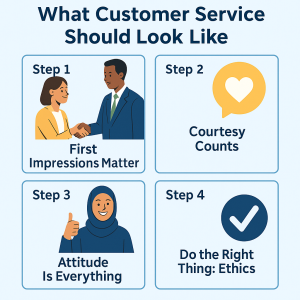
Step 1: First Impressions Matter
Step 2: Courtesy Counts
Step 3: Attitude is Everything
Step 4: Do the Right Thing: Ethics
Step 1: First Impressions Matter
Being prepared to meet a client is a critical first step for the finance professional. According to Kelly Services Inc., a popular Canadian recruitment firm, the following tips will help you make a great first impression (Kelly Services, 2022):
- Make sure your attire is consistent with company culture. A financial institution or insurance company one can expect that formal attire such as a business suit, shirt and tie would be appropriate.
- Make sure you are well groomed. Clothes should be clean and free of wrinkles, no holes or missing buttons. For shoes be sure any scuffs are shined and that shoes are clean. Hair should be tidy and brushed and styled as per one’s preference.
Step 2: Courtesy Counts
It may seem simple at first, but a smile can go a long way when connecting with a client. Smiling when speaking shows that you are approachable. Saying “please” and “thank you” shows courtesy and respect towards another individual. It is important to not interrupt the client when they are speaking, but find a moment and say “excuse me”. This phrase indicates respect and can help to drive the conversation in a different direction. When discussions take a negative or emotional turn, stating “I am sorry” may be needed. Showing empathy to a client at the appropriate time is considerate.
When considering courtesy, it is important to take into consideration verbal cues. The speed at which you speak to a client can impact the client’s impression of you. If you speak too fast, the client may feel like they are being rushed, or they may think they are missing critical information. If you speak too slow, the client may become bored and distracted from the conversation. Tone of voice also matters. Having a friendly and welcoming tone helps set the stage for the relationship. In a financial services environment, the ability to articulate, enunciate and pronounce words correctly is key to establishing your credibility with a client. If there are words or phrases that are challenging, it is advisable to seek out the correct manner to articulate these words and phrases. Steps that can be taken to help improve articulation follow.
1. Listen to Yourself
Record yourself in different situations to hear how your voice sounds. While this can be uncomfortable at times, an activity like this can assist you in uncovering things you didn’t know. Consider whether it is easy to understand what you are saying in your recordings. Are you mumbling? To prevent trailing off, try to pronounce each syllable. This will also you to slow down and give the audience more time to understand your thoughts. (Economy, 2019).
2. Minimize Filler Words
It can be challenging to do, but it is important to reduce the use of filler words (for example, “um” or “uh” or “like”.) These words indicate to the audience that you are unsure of your direction (Economy, 2019). Some options to replace filler words are:
- “moving on”
- “another thing to consider is”
- “let’s discuss the following”
3. Know Your Audience
Audience plays an important and consistent role in how you speak. Keep listeners interested in what you are saying by studying their attention levels and body language (Economy, 2019). You could speed up your speech rate if your audience seems to understand what you’re saying. If it appears they do not understand the message, you may need to slow down your approach and ask more questions to ensure you do not lose the interest of the audience.
Step 3: Attitude is Everything
Are you good at reading facial expressions? Click on the link to take the quiz: The Facial Expressions Test [Facial Expressions]/Science of People) and see how you do!
A person’s stance or the position of their body is known as posture. In western-oriented cultures, your posture (e.g., standing or sitting erect) and position (e.g., leaning forward or away as you speak) can convey different meanings, depending on who you are talking to.
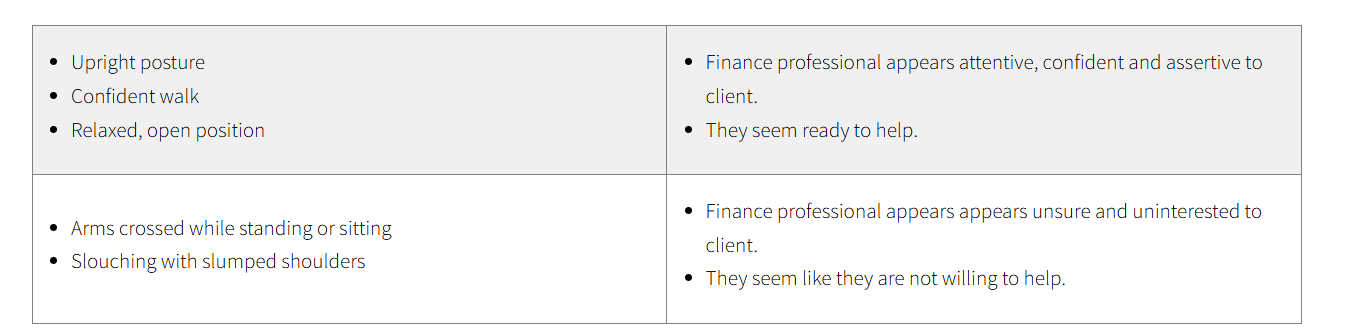
To show a client you are engaged in what they are saying, it is best to lean in and focus your attention on them. This makes them feel like they are being heard. Nodding your head as a client share their concerns is another way to show an increased level of engagement. To supplement nodding of the head, verbalize your understanding with “I see” or “uh-huh.” Other body parts (hands, arms, head and shoulders) can also be used to show that you are listening and indicate enthusiasm. It is important to keep your body language open. This means NOT crossing your arms across your chest. As was mentioned above, physically leaning into the discussion encourages engagement.
It is critical to make a client feel like they are being heard, and that your attention is focused on them. Body language can help you remain focused on your client, as well as, keep the client focused on you so they do not get distracted and miss key information. Asking a client for permission to take notes during the conversation is beneficial. Notes can assist you later as you reflect on the meeting and explore any missed gaps that evolved during the conversation.
Watch the following video and answer the questions below:
What type of body language are you observing here? Positive/Negative
Identify the negative body language cues that occurred in this video, and put them in the order in which they occur.
Tossed key cards at client, Ignoring client by texting on his phone , Sighed heavily, Tense smile, Turned his back to the client, Finger pointing, Interrupted her by raising his hand, Crossed arms, Moved his body physically in her space, Rolled his eyes.
Excellence is not a skill, it’s an attitude. – Ralph Marston
Ralph Marston’s quote clearly indicates that an individual can be excellent with the right attitude. The course, Attitudes for Service (Dale Carnegie), clearly outlines how having the right attitude is critical in customer service.

A good attitude starts with self-reflection; it involves the good each person possesses and the good that others have. Having the confidence to deliver exceptional customer service sets you up for a positive attitude. A finance professional who is empowered to make decisions finds ways to make things right for a client. They go above and beyond to achieve the goal of the meeting and exceed the client’s expectations. Being open-minded allows you to be receptive to various ideas and possibilities. Thinking critically and rationally in any situation, and avoiding stereotyping individuals, drives you towards a positive outlook and a positive attitude.
Step 4: Do the Right Thing: Ethics
Ethics is knowing the difference between what you have the right to do and is right to do. – Potter Stewart
In the finance industry, clients expect that ethics factor into every recommendation/solution that they receive. In ethical service delivery, finance professionals must:
-
Be transparent – Clearly explain product details, fees, and limitations.
-
Respect client autonomy – Avoid pressure tactics; support informed decisions.
-
Act with empathy – Consider the client’s full context before recommending solutions.
-
Follow through on commitments – Deliver on promises made during interactions.
-
Own mistakes – Acknowledge and rectify service errors promptly and professionally.
Watch the following video on the topic of Ethics and sales:
[Video 5.2] Ethical Sales Cultures: Why They Matter. (Source: The Integrity Solutions/YouTube)
Ethical service delivery is foundational in the financial industry. It ensures that clients not only receive accurate advice but are treated fairly and respectfully at every touchpoint. When ethics guide customer interactions — from the first impression to follow-up — trust grows, relationships strengthen, and long-term client satisfaction is achieved.
Body Language/Nonverbal Communication
[Video 5.3] Customer Service: Body Language. (Source: Owen Fitzpatrick/YouTube)
Body language/nonverbal communication is also very important. How a person carries themselves indicates whether they are approachable to someone seeking a conversation. Eye contact is traditionally found in western cultures (i.e., Canada, United States, United Kingdom), and it is normally expected in these cultures. Eye contact can help indicate if someone is listening to the speaker. It helps to gauge if the listener is interested in and understanding the conversation. That being said, Canada has a diverse and growing society, comprised of many different cultures. It is important to know that eye contact is not acceptable in certain cultures, even though that might seem disrespectful to people from a western culture. It is also essential to know that culture is not the only driver for avoiding eye contact. Some individuals may have social anxiety and that may lead them to not make eye contact. Getting to know your client, and recognizing what they value, is critical in any interaction.
Another form of body language is facial expressions. A face can convey many emotions: excitement, happiness, sadness, boredom and much more. A UC Berkeley study from January 2021 found that there are sixteen facial expressions the occur in similar contexts worldwide (Cowen, et al, 2021). It is very important to know that facial expression can cross language barriers. To a stranger, a smiling face could provide an instant feeling of connection. Paying attention to a client’s facial expressions can be quite helpful in determining if the client is understanding and agreeing with the subject of the conversation.
Communicating Effectively
Communicating effectively with clients and co-workers can help you achieve success in your role. There are five steps to ensuring effective communication occurs:
- Step 1: Intentional Communication
- Step 2: What You Don’t Say: Nonverbal Communication
- Step 3: Questions
- Step 4: Listening Actively
- Step 5: When the Client Says No
Step 1: Intentional Communication
In order to be intentional in your communication, you need to know what outcome you hope to achieve through the conversation. Choosing the appropriate words is critical, and it is essential to not use acronyms or jargon commonly used between professionals in the field. A client may be confused by this and not want to proceed with the conversation. Previously, we discussed the importance of tone of voice; it is crucial that your tone of voice match what you intend to communicate.
There are specific phrases you can incorporated into your conversations that show you are welcoming a client into a conversation:
- “The pleasure is all mine.”
- “Certainly” or “Of course”
- “I am glad that I could be of assistance.”
These phrases can help to elevate a conversation from casual to professional. You should be comfortable using the appropriate words and phrases, as you want your conversations to be natural and not forced or awkward.
Step 2: What You Don’t Say: Nonverbal Communication
Nonverbal communication was introduced previously, and we touched on its importance in customer service. This step revisits nonverbal communication and details what you can do to improve your nonverbal communication when having conversations with clients.
- Consider how clients perceive you.
- Smile often throughout your interaction with the client. Smiling, along with word choice, indicates friendliness.
- When appropriate, make eye contact.
- Be conscientious of the distance you stand or sit from your client.
- Ensure that your client is comfortable; that will make them more willing to engage with you.
- Keep your energy level steady and consistent; this will help to ensure your client is keen to hear what you are sharing with them.
Step 3: Questions
(Note that questioning strategies will be covered in future chapters from a different perspective)
Knowing what type of questions to ask during a conversation – and at what point to ask them – will result in better and more successful client interactions. Questions are critical to a finance professional. They will help identify the client’s needs and potentially uncover additional issues that the client was unaware of, allowing for more opportunities. Types of questions that can be used in conversations are open-ended and closed-ended questions.
An open-ended question prompts answers that require more thought and consideration. Open-ended questions help you gather critical information from the client. Examples of information that can be identified by asking open-ended questions follow:
- Customer needs. “Tell me, Mr. Singh, what brings you in today?”
- Historical context to a given situation.“Mr. Chan, can you please tell me about what happened with your mortgage application that caused the delay of a draw of the mortgage for your home being built?”
- Objections that a client may have. “Ms. Crawley, from what you have said, you do not think that a home equity line of credit is the best solution for your needs. Can you please tell me more about your concerns?”
- Client perspectives. “I am sorry to hear that you had a poor experience dealing with our financial advisor, could you please tell me more of what happened?”
Closed-ended questions require a response to be either yes or a no. Closed-ended questions typically start with verbs (e.g., do, did, are and will) and elicit short answers, gaining little to no new information. You would ask closed questions for the following purposes:
- Verifying Information. “Does that sound right to you?”
- Gaining agreement or confirmation.“Mr. Smith, did you say your date of birth was Jan 15th, 1967?” or “To confirm, Ms. Cartwright, you would like to invest $10,000 into your Mutual Fund RRSP account today?”
- Understanding. “Your main concern today is that your account is overdrawn?”
Paraphrasing is critical when having conversations with clients. It helps to ensure that the client and the finance professional understand each other. Paraphrasing occurs when one person repeats back to the other what they have interpreted from the answers to the questions asked. It is a powerful method that, when used correctly, can promote a greater understanding of your client. It also reinforces to the client that you have heard and understood them. Another reason that it is helpful to take notes during conversations is that notes make paraphrasing easier. Here are examples of how to begin to paraphrase:
“If I am hearing you right, you are looking for a way to ensure that you do not have your insurance payment process as insufficient funds and lead to NSF charges.”
or
“So you are saying that you would like to retire by age 55 and want to receive an income after retirement of $120,000 annually?”
Step 4: Listening Actively
(Note Listening Actively will be covered in future chapters from a different perspective)
Listening actively, also referred to as active listening, occurs when a person listens intentionally to hear what another person is saying. It is critical if you want to achieve successful client interactions and build relationships with clients and others.
- Focus your attention entirely on your client. Undoubtedly, there will be distractions surrounding you when you meet with a client. The focus and commitment for that time, though, should be on what the client is saying. Before meeting with your client, put your phone on silent and close out email accounts on your computer. Try to limit disruptions as much as possible.
- Handle interruptions. Even though you do your best to minimize disruptions, there may be times when interruptions occur. The best approach is to handle these interruptions professionally. Apologize to the client for the interruption, assure them that you will be brief and then do what is needed. Return to your client as quickly as possible.
- Keep an open mind and do not judge what the client tells you. The client may share private information about their life, and as a finance professional, it is critical to not judge your client too quickly and make your client feel uncomfortable. You should not interrupt or cut the client off as they answer questions. Moreover, do not interrupt with counter arguments.
- Listen thoroughly and listen for what the client DOES NOT say. It is essential to look directly at the client and observe their body language. Moreover, do not forget to paraphrase and restate what the client has shared in the interaction. Ask questions to assist with clarification, and then summarize their answers.
Step 5. When the Client Says No
If a client says no during a conversation, it is important to listen to their reason for saying no. You should acknowledge their objection, and ask further questions to help determine the underlying reason for them saying no. Handling objections will be covered in more detail in later chapters.
Summary
In summary, the evolution of customer service, from traditional in-person interactions to digital and omnichannel engagements, has significantly transformed business operations, pushing companies to adapt and innovate. Excellence in customer service is now achieved through active listening, empathy, timely response, and personalized solutions. Furthermore, nonverbal cues and body language have a significant influence on client interaction, reinforcing or contradicting verbal messages. Successful communication, characterized by clarity, consistency, and openness, is a key driver of business success. Lastly, understanding personality types and their influence on interactions and decision-making processes can enhance customer service, allowing for more tailored and effective communication strategies.
REFERENCES
Carnegie, D. (n.d.). Attitudes for Service. Dale Carnegie & Associates, Inc. Retrieved April 14, 2022.
Cowen, A.S., et al. (2021). Sixteen facial expressions occur in similar contexts worldwide. Nature, (589), 251–257.
Economy, P. (2019, March 26). 5 Remarkably Powerful Hacks to Become More Articulate (You Don’t Have to Give a TED Talk to Do It). Inc.com.
Jadhav, P. (2019, June 30). What is your sales approach to different types of Customer personalities? Linkedin.com.
Kelly Services Inc. (n.d.). Tips for Presenting Yourself in a Professional Manner. Kelly Services Inc. Retrieved April 14, 2022.
Oxford University Press. (n.d.). Definition of snail mail. Lexico.com. Retrieved April 14, 2022.
Statistic Canada. (n.d.). Household Sector Credit Market Summary Table, Seasonally Adjusted Estimates. Statistics Canada. Retrieved April 14, 2022.
Media Attributions
- Customer_Service_Clean_Infographic