
"

7 Chapter 7: Navigating Client Resistance: A Toolkit for Handling Objections

Learning Objectives

Upon completion of this chapter, you should understand:

  • Define client objections and identify when they typically arise during the advising process.
  • Recognize how low financial literacy and common financial stressors contribute to client objections.
  • Apply a structured process to effectively handle objections with professionalism and empathy.
  • Anticipate and respond to common client objections using practical, client-centered strategies.
  • Demonstrate techniques for maintaining trust and guiding clients toward informed financial decisions.

45% of middle-aged Americans would rather see the dentist than meet with a financial advisor (Perron, 2017).

What are Objections?

Client concerns, resistance, or outright disagreement—these are all types of objections. Anything a client says or does that slows or stops the advising process can be considered an objection. It may sound like “I don’t have the money,” “Let me think about it,” or simply, “No.”.

Image generated using the prompt “Show an Advisor with a client who has an objection,” sourced from OpenAI, 2025.

When Do Clients Object?

Objections can happen at any stage of the client relationship: when trying to book a meeting, during your introduction, or—most often—after presenting a recommendation. Clients may object because they don’t understand, feel overwhelmed, or aren’t ready to make a decision. These are normal moments in the advising process, not signs of failure.

Financial literacy is a key factor. Many clients are unfamiliar with financial terminology or decision-making, and this knowledge gap can trigger resistance.

Why Financial Literacy Matters

The Financial Consumer Agency of Canada (FCAC) completed a survey in 2019, “Canadian Financial Capability Survey (CFCS).”  The findings from this survey can help you better interpret the underlying concerns clients may have and will help you develop a solid understanding of challenges facing the majority of Canadians. Understanding what your clients are facing can help you work through any objections that may occur.

Debt Pressures Canadians are Facing

Image generated using the prompt “Show aa couple struggling with mounting debts,” sourced from OpenAI, 2025.

  • Canadian household debt represented 179% of disposable income in 2024(Statistics Canada, 2024).
  • As of 2024, about 69.8% of Canadians have some form of outstanding debt, including mortgages, student loans, and credit card debt (Made in CA, 2024).
  • According to recent data from Statistics Canada in 2023, 35% of Canadians reported finding it difficult to meet their financial needs, which indicates a significant level of financial stress​. (Statistics Canada, 2023).

Statistics like these can be overwhelming. If we restate the statistics regarding disposable income it would read as such, “For every $1 a Canadian brings into the home, $1.79 is leaving to be paid towards debt and other necessities.”

How does the high level of household debt among Canadians, as indicated in the 2019 Canadian Financial Capability Survey canadian-financial-capability-survey-2019 , impact your approach as a financial advisor when addressing client objections? How can understanding these statistics help you to better assist your clients in managing their financial situation and concerns?

Impact on Advisor Approach:

  1. Empathy-First Communication
    Understanding that financial stress is common allows you to approach objections with greater empathy. Clients may resist advice not out of disagreement but due to fear, embarrassment, or financial strain. Acknowledge their concerns sincerely and without judgment.

  2. Reframing Objections as Opportunities
    A client who says “I can’t afford that right now” may be signaling broader cash flow issues. This is a cue to revisit their budget or debt load, rather than push forward with the original recommendation.

  3. Tailoring Recommendations
    Knowing household debt is a common challenge, tailor solutions to be realistic and manageable—for example, starting with debt consolidation or emergency savings before introducing more complex investment strategies.

  4. Building Trust Through Education
    Use the data to educate clients: “You’re not alone. Many Canadians face similar challenges, but there are steps we can take together.” This helps normalize their experience and reinforces that you’re on their side

How Statistics Help You Serve Better:

  • Contextual Awareness: Understanding the national landscape keeps you grounded in what’s realistic for clients and helps avoid recommending overly aggressive financial plans.

  • Informed Planning: You can better prioritize strategies that address the root causes of financial stress—like reducing high-interest debt or building financial literacy.

  • Anticipating Resistance: With many Canadians facing similar challenges, you can proactively address common objections before they arise, improving client engagement and decision-making.

These statistics allow you to become a more compassionate, realistic, and effective advisor—one who doesn’t just sell products but builds sustainable, trust-based client relationships.

Maintaining a Budget

Image generated using the prompt “Show a client who feels overwhelmed with managing their money,” sourced from OpenAI, 2025.

Students taking this course understand the importance of having a budget. According to Investopedia, a budget helps create financial stability. Plus, following a budget ensures that bills are paid on time, an emergency fund can be established and clients can account for their other savings needs (Bell, 2022).

Nonetheless, 51% of Canadians do not have a budget. When asked why, Canadians cited a wide range of reasons for not having a budget including:

  • not having enough time for it or find budgeting boring (9%)
  • feeling overwhelmed at the idea of managing money (6%)
  • not being responsible for financial matters in their household or preferring not to know about their finances (4%)
  • preferred not to say (5%) (Financial Consumer Agency of Canada, 2019).

Recognizing that your clients may fall into one of these categories can be concerning. However, it does present as an opportunity for you to educate your clients, and help them overcome the challenges they face when managing their money.

Retirement Savings

According to the FCAC survey, 69% of Canadians who have not yet retired are preparing for retirement. Canadians are either doing this independently or with a pension through their employer. This statistic is an improvement, as the percentage of people preparing for retirement has increased from 66% in 2014 (Financial Consumer Agency of Canada, 2015). This is good news! Awareness surrounding saving for retirement is improving, and Canadians see that planning for their retirement is necessary. You should recognize, though, that roughly 31% of Canadians do not have a retirement plan, and these individuals are likely feeling uncertain and overwhelmed regarding their retirement (Financial Consumer Agency of Canada, 2019). If your client has no plan for retirement, you should approach this topic carefully and determine the level of knowledge they have on the subject. You should work with the client; educate them on the importance of saving for retirement and help them see it as a goal they can achieve.

Emergency Fund

Image generated using the prompt “Create an image that represents an emergency fund,” sourced from OpenAI, 2025.

According to an article on Wealthsimple, the standard amount of funds that a client should have in an emergency savings fund should be 3 to 6 months worth of your household income. However, new economic pressures now have advisors saying 8 to 12 months (Goldman, 2021). The FCAC study results indicated that 64% of Canadians have emergency funds for three months worth of expenses, and 65% of Canadians are confident that they could come up with an additional $2,000 if needed.

This statement needs to be considered on a case-by-case basis. If you have a client who has paid off their mortgage and has minimal bills, they are more likely to come up with that additional $2,000. A client who is a retired senior and on a fixed income is much less likely to be able to find the additional funds needed. Having an emergency fund is correlated to those Canadians that have a budget; 65% of budgets have an emergency account (Financial Consumer Agency of Canada, 2019).

Where Do Clients Get Their Advice? 

Eventually, as we seek to understand our clients, we begin to see why financial advisors are needed, and why clients are often hesitant to commit and may object when a proposed solution is presented to them. The FCAC survey provides some food for thought for advisors — where are Canadians going to get their financial advice?

  • 49% of Canadians seek financial advice from a financial advisor/planner
  • 41% seek advice from their bank
  • 39% seek advice from family and friends
  • 33% do internet research
  • 15% get information from print media
  • 10% get information from radio or television programs (Financial Consumer Agency of Canada, 2019).

The above information is valuable. Advisors need to know where their clients are gathering information from as this allows them to correct any incorrect or misinformation that the client may have come to learn.

The Process for Handling Objections

Having an approach to objections can assist the advisor in ensuring that you are addressing the correct issue that the client is concerned with. This objection handling process will take you through the steps to overcome and resolve the client underlying concerns.
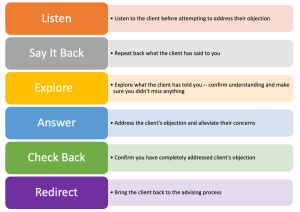
[Figure 7.1] Objection-handling process. (Created by: Professor Carla Van Horne, NAIT)

Listen

Image generated using the prompt “Create an image that shows someone listening to their client,” sourced from OpenAI, 2025.


Listen to the objection before handling it. An immediate response may be to ask the client, “But what about …?” Give your client the time to think through their objection and to explain what is bothering them. It will be challenging to do, but listening here is critical. You can pick up valuable clues from the client from the way they phrase their objection. It may be that they misunderstood something that you stated in their recommendation, and the client is unsure. Rather than admitting they don’t understand, they object as if they are feeling uncomfortable at the moment.

Say It Back to the Client

When you are sure the client is done talking, look thoughtful for a moment and then repeat back what he has said. Saying something like, “I see you’re concerned about tying up the equity in your home,” is fine. This both shows that you were listening and allows the client a chance to clarify. The key here is to wait and allow the client time to share the concerns they are bringing to your attention. Maybe you missed something in explaining how the product or service will work or even how the process will work.

Image generated using the prompt “Create an image that shows an advisor saying it back to the client,” sourced from OpenAI, 2025.

Explore for Reasoning

Sometimes the client’s first objection isn’t their real concern. For example, many clients will use the objection that the cost is too high, but perhaps the client doesn’t understand what the product and/or service is and how it truly can benefit them. It is possible they object because you missed some vital information. Clarification is important for you to ensure you are listening to what your client is saying.

Image generated using the prompt “Create an image that shows an advisor exploring for reasoning,” sourced from OpenAI, 2025.

Answer the Objection

Fully understanding a client’s objection allows you the opportunity to answer it. When a client objects, they are expressing fear or confusion. Your goal at this point is to relieve their concerns. If you have specific examples, such as a story from an existing client or a statistics, by all means, present them. Facts can help support your recommendation.

Image generated using the prompt “Create an image that shows an advisor answering the objection,” sourced from OpenAI, 2025.

Check Back with the Client

Take a moment to confirm that you have answered the client’s objection fully. Usually, this step is as simple as saying, “Does that make sense?” or “Have I answered your concern?” If the client answers affirmatively, you can move on. If they seem to hesitate or act uncertain, though, you may not have fully addressed their concerns. You will have to go back to an earlier step and try again.

Redirect the Conversation

Bring the client back into the flow of the advising process. If you are in the middle of your presenting the product/service when the client raises their objection, then once you have answered it, quickly summarize what you had been talking about before you move on.
If you have finished your recommendation, check if the client has any other objections, and then start completing the requirements to set up the product or service the client is to receive.

The Next Steps (Closing)

The point of an advising conversation is to determine whether a need exists for the advisor’s product, and, assuming the client recognizes that need, what the next steps in the process would be. This process is referred to as closing. Based on your identifying the decision process earlier in the conversation, at the end of an advising conversation you need to confidently request or suggest moving to the next step. Ultimately, the final step would be actually agreeing to purchase the product, do business, sign a contract, or begin the relationship. However, in many cases, the “close” for that meeting is to agree to another meeting, or to move to the next step in the process.

Asking to Proceed to the Next Step (Close)

When the time outlined for a particular conversation is coming to an end, you need to initiate the close for that meeting. Generally speaking, you can begin this process by confidently stating, that based on the discussion, there is a need for the client to continue in the process or when in the final meetings, to adopt what you are offering. This is when you refer back to the needs discovered and the agreed upon connection between those needs and the benefits of your offering. Here is an example of how to initiate asking for the next step:
After asserting and confirming the connection between the client’s needs and the benefits of your offerings, the next step is suggesting a plan of action to move forward. In this way, there will be less ambiguity and a clear decision to move forward (or not). This plan of action should include what you will do and what the client should do.

Common Client Objections and How to Overcome Them

Information provided below was adapted from the ThinkAdvisor article, “How to Respond to 12 Common Client Objections” written by Bryce Sanders (October 2020).

1. It is not the right time.

A client could be saying this for a number of reasons; you will need to dig a bit to find out what the real objection is. It could be that they are uneasy about the current economic conditions. 
Try to avoid saying, “What are you waiting for? When will it be the right time? 
Instead, say something like, “Tell me more about what concerns you have surrounding timing? or “What concerns do you have around investing now?” 
You need to link positives to the recommended solution. As their advisor, you are recommending a course of action that, at the moment, the client is hesitant about. You need to work with the client to help them move past their fears.
2. Let me think about it.
This objection is similar to the first objection, but here they are trying to delay making the decision for one or more reasons. Clients who are indecisive will present this objection, wanting more time to find reasons against moving forward. They are afraid of making the commitment, and then it fails. 
Try to avoid saying, “I understand. I will leave the room for you to think about it.” Later, when you return to the room,  do not say, “Now that you had time to think about it, let us move on.” 
From a client’s perspective, you have not identified their true concern and leaving the room likely solves nothing. There are questions you need to ask for better understanding.
Instead, say something like, “Based on what we have discussed today, this does seem like the best course of action to help you achieve your retirement goals. It sounds like I may have missed something. Can you tell me more about your concerns?”
3. I don’t have any money. 
This objection can be somewhat uncomfortable. The client came to your for financial advice but cannot commit. It is embarrassing for the client; you need to present with care, as there is still an opportunity with this client.
Try to avoid saying, “Why didn’t you say something sooner? Now my time and yours have been wasted.”
Instead, say something like, “It is all right that you do not have the funds to start this type of investment today. How about we look at some budgeting options to see what we can do to get you to the point where investing in this investment portfolio is possible. How does that sound?”

4. I need to speak to my spouse. 

This objection should really be identified earlier on in the conversation by asking the client, “Are you the decision-making authority for your household, or should we have your spouse/partner here?” However, if this was missed, or the client initially indicated they were the decision-maker, they could be looking for more time to think. The client may also be concerned with trying to explain your proposed solution to their spouse/partner. 
Try to avoid saying, “Not an issue, let’s call them now. What is their number?” A client hearing this will feel even more cornered, and in all likelihood, the client will end the meeting and leave. 
Instead, say something like, “Of course, including your spouse/partner in this decision is important, and I want to be sure I am able to answer any questions that they may have. When can we meet? I can come to your home if that is more convenient for you?”

5. I already have an advisor. 

Often, clients are not able to differentiate between advisors and see them as all the same. To be fair, they may have a long-standing relationship with an advisor, and clients will often feel like they are “cheating” on their advisor by conversations with another advisor. 
Try to avoid saying, “Obviously, they are not as good as I am. I was able to find this gap in your financial portfolio that they should have found years ago.”
Instead, say something like, “Clients who are successful with their financial situation have multiple relationships and advisors who help consult on their needs. How many advisors do you have? What do they specialize in?”

6. I’m waiting until after the election.

Clients are often concerned with any type of uncertainty. It is helpful to educate your clients on what has historically has happened during election periods. Using an Andex chart is often helpful for the subject of this conversation. 
Click the following link to see an example of an Andex Chart from RBC Global Asset Management. 
Try to avoid saying, “Don’t tell me you want ______ party to win.” It is important to avoid any political discussions during a conversation. A comment like that could end the conversation quickly.
Instead, say something like, “Elections can provide uncertainty, and it is important to remember, no matter which party wins the election, the economy moves on. You will still have your goal of retirement. We need to work with what we currently know and review the economic trends to help guide our decision. I would like to show you this Andex chart that tracks valuable information, including the different Prime Ministers in office over a 70-year period. While we cannot predict the future, looking at historical data can help us understand how similar situations have occurred and what the outcomes of those were.”

7. Call me in a year.

A client stating an objection like this could be an indication that they do not have the time to focus on this conversation at the moment, or there is something financially significant happening in a year’s time that will impact them, like a bonus. Information that is critical to know, from an advisor’s perspective.
Try to avoid saying, “We don’t need a year, we can wrap this up today.” This comes off as a high-pressure sales tactic, and will likely turn your client off to the presented solution. 
Instead, say something like, “Tell me more about why waiting a year would be a better option than investing these funds today? My concern for you is, we know what the current market conditions are today. A year from now is so uncertain.”

8. You are new at this, or you are too young. 

Every new advisor hears this objection when they first begin practicing. The client assumes your lack of experience will hurt their financial situation. You need to overcome this concern by sharing your credibility statement (addressed in an earlier in the text). If, after sharing your credibility statement, the client is still uncomfortable, ask if they would like to be referred to another advisor; one with more experience. 
Try to avoid saying, “We both are new and can learn together!” This is a poor statement; the client has more to lose than you do.
Instead, say something like, “I understand that you are concerned that I am new to my role. I can assure you that I have completed all the required educational and licensing requirements to be your financial advisor. Plus, I am part of a larger team who oversees my work to ensure accuracy and that best practices are being followed. How about we continue this conversation? If you still have concerns about my ability by the end of our conversation you can let me know. Does that sound all right with you?” 

9. The stock market is too high.

Here, it is important to remember exactly where clients are getting their information (as indicated earlier  in the 2019 FCAC report) and approach the conversation from that perspective. The client could be concerned with what they heard on the news, such the market may be dropping off soon.
Try to avoid saying, “Too high? This market is set to continue to boom!” A statement like this does nothing to alleviate a client’s concerns or fears. In fact, it will only heighten them. 
Instead, say something like, “Market fluctuations can be concerning; I want to show you the Andex chart that shows the cyclical history of the economy over a 70-year period. It is important to not “time the market.”  We want a long-term strategy for you that allows for growth and sustainability. Let’s look at an investment strategy called dollar-cost averaging.” 

10. The stock market is too low. 

A client providing this objection is in the same position as the client in topic number 9, only from a different perspective 
Try to avoid saying, “Sure, the market is down, but it’s on sale! Now is the time to buy!” While this may be true, stating this as a fact, without education, can make your client feel alienated, as they may not understand your point of the market being on sale. 
Instead, say something like, “Market fluctuations can be concerning. I want to show you the Andex chart that shows the cyclical history of the economy over a 70-year period. It is important to not “time the market.” We want a long term strategy for you that allows for growth and sustainability. Let’s look at an investment strategy called dollar-cost averaging.” It is the same statement as above, and provides an opportunity for you to educate the client on market movements and put the client at ease.

11. I am waiting for interest rates to go up. 

A client making this statement could be assuming that interest rates will return to the level of what was seen in the 1970s and 1980s. The opportunity here is to show the client the Andex chart that illustrate interest rates over time. It could help them understand the likelihood of a rate increase, and how long it could potentially take to see such an increase.
Try to avoid saying, “That may take a very long time. How old are you again?” Your client will likely be offended and end the conversation.
Instead, say something like, “Interest rates move in cycles. Currently, we are in a low-interest-rate environment and have been for some time. What are the funds in your savings earning now? It is very likely they are earning less than 1%, and with inflation where it is, you are earning a negative return. My question to you would be, how long do you plan to wait for interest rates to increase? I would be concerned that if you wait too long, you will miss out on opportunity for you to find a way to have your funds grow. Here is what I was thinking when I came up with this solution.” 

12. You are too expensive.

Clients making this statement are likely to be influenced by friends, what they see on social media or advertisements for low-fee investing. The client does not see the value-add that a financial advisor has to offer them. 
Try to avoid saying, “What are you comparing that to? You obviously haven’t done well on your own, as you wouldn’t be here to see me today.” Stating this to your client will likely end the conversation, as you have embarrassed them. 
Instead, say something like, “The services I will provide to you, over the course of our relationship, will help you achieve your financial goals. I am an advisor that will work for you and your specific needs. A robo-advisor cannot handle the emotional complexities that come with your life experiences. It will not now how to handle challenges that will arise. Together we can work to build a secure financial future. How does that sound?”

Summary

Client objections are natural, and often signal uncertainty or a need for clarification—not rejection. The most successful advisors don’t avoid objections; they prepare for them. By combining empathy, financial insight, and strategic communication, you can turn client hesitation into meaningful dialogue and lasting trust.

REFERENCES

Bell, A. (2202, February 24). 6 Reason Why You Need a Budget. Investopedia.
Financial Consumer Agency of Canada. (2015, November 24). Managing Money and Planning for the Future: Key Findings from the 2014 Canadian Financial Capability Survey. Government of Canada.
Financial Consumer Agency of Canada. (2019, November). Canadians and Their Money: Key Findings from the 2049 Canadian Financial Capability Survey. Government of Canada. 
Goldman, A. (2021, March 15). Emergency Funds: What, Why & How Much. Wealthsimple.
Hayes, A. (2022, March 13). Dollar-Cost Averaging (DCA). Investopedia.
Made in CA. (2024). Household debt in Canada statistics for 2024. Retrieved from https://madeinca.ca
Perron, R. (2017, July). AARP and Ad Council Saving for Retirement Campaign Survey. AARP Research.
Peters, K. (2021, July 2021). Market Timing. Investopedia.
Sanders, B. (2020, October 19). How to Respond to 12 Common Client Objections. ThinkAdvisor.
Statistics Canada. (2019, June 13). National Balance Sheet and Financial Flow Accounts, First Quarter 2019. Government of Canada. 
Statistics Canada. (2023). The traditional credit card debt hangover following the holidays, or something more ominous?. Retrieved from https://www.statcan.gc.ca
Statistics Canada. (2017, December 7). Survey of Financial Security, 2016. Government of Canada. 

Media Attributions

  • c7f3fc2b-f16c-47bc-be6a-04abfe70ceea
  • 3fa30309-f83c-459b-94a5-d93544308bcf
  • 6200c10d-47ff-4b7a-a67e-6df6bb88266b
  • 63634b2f-9291-4a78-bf6e-36dd93ef0880
  • OBJECTIONS2
  • 7ccfce46-7ac7-4dff-a73e-d6f817c3db67
  • 71ba64b5-ce43-4bfd-a078-bea61c3b8b47
  • 58674bb5-a7d2-41d5-8c81-a54f323141a6
  • Screenshot 2025-06-23 135013

License

Icon for the Creative Commons Attribution 4.0 International License

Advising for Finance Professionals Copyright © 2025 by Carla Van Horne is licensed under a Creative Commons Attribution 4.0 International License, except where otherwise noted.