
Cladonia
Cladonia P. Browne, 1756
Cladonia is often the first genus of lichen people learn. Like Cher, Cladonia need no secondary, common name. And like Cher, they are hard to ignore. Some species form crimson red apothecia, and many form extensive, mixed colonies in dry forests or on decomposing logs.
Cladonia are difficult to make generalities about because of their diversity. A few commonalities:
- They do not limit themselves to one growth form. How boring – how cliche. No, most Cladonia are dimorphic: each colony starts as a primary thallus, which may be crustose or squamulose.
- Given the right circumstances, most species produce secondary, fruticose, sky-seeking stalks called podetia.
- Podetia are almost always hollow. Typically they are composed of an outer cortex (missing in the Reindeer lichens), a layer of alga, medulla, and a stiff, inner, cartilaginous layer called a stereome. The stereome provide structural strength, and may be translucent or blackened (e.g., Cladonia stygia).
- Podetia may be shrub-like, club-like, wand-like or cupped, unbranched or highly branched.
- The podetial cortex may be smooth and intact, or it may break down into soredia, granules or host abundant secondary squamules.
- Cladonia are chlorolichens, associating strictly with green, trebouxioid algae.
- Cladonia are chemically diverse, and we are still untangling whether some species traditionally separated by chemistry are distinct species, or whether they are more accurately classified as chemotypes of a single species.
TIP: Brodo et al. (2001) tells us the the best place to perform spot tests is on the lower surface of squamules, sorediate patches, and podetial tips (e.g., cup margins). Avoid the base of the podetia, it may be senescent and/or have additional secondary metabolites.
TIP: It is easy to get overwhelmed with Cladonia. Species almost always grow intermixed. Be very careful in picking out one morphogroup of Cladonia in a mixed colony to key out. Use your evolved pattern-finding brain, and trust it when it tells you that two things are different; key out one at a time; build experience from there.
-
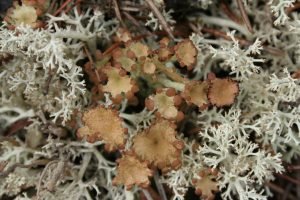
- Cladonia gracilis subsp. turbinata with Cladonia arbuscula subsp. mitis, Lesser Slave Lake region, AB
-
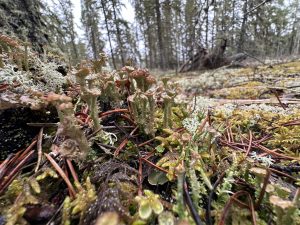
- Cladonia gracilis subsp. turbinata, Lac la Biche region, AB
-
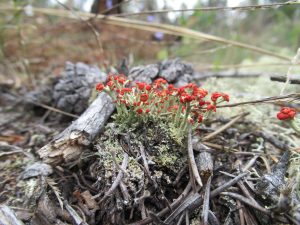
- Cladonia cristatella, Lac la Biche region, AB
-
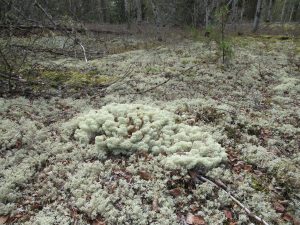
- Cladonia stellaris surrounded by Cladonia mitis in jackpine stand, Old Conklin Hwy, Lac la Biche region, AB
Explore the thallus of Cladonia magyarica to reinforce the terms introduced above.
Click to download a PDF of Cladonia Keys v.2025
Cladonia Part 1: The Reindeer Lichen
Reindeer lichens are heavily branched, have hollow podetia, lack an outer cortex, and are typically terricolous (grows on the ground). Their primary thalli are crustose and rarely observed. Many species are adapted to relatively dry areas where dew is abundant, but some can stand having their feet wet in bogs. Others form diverse colonies on logs. Reindeer lichen used to be classified in their own genus, Cladina. Phylogenetic data did not support that division and the species were reclassified.
Number of species known or with high potential to be found in Alberta: 6
RENR Students: Cladonia to know – be able to key them out or recognize them (all are covered in Brodo et al. 2001 and Goward 1999)
-
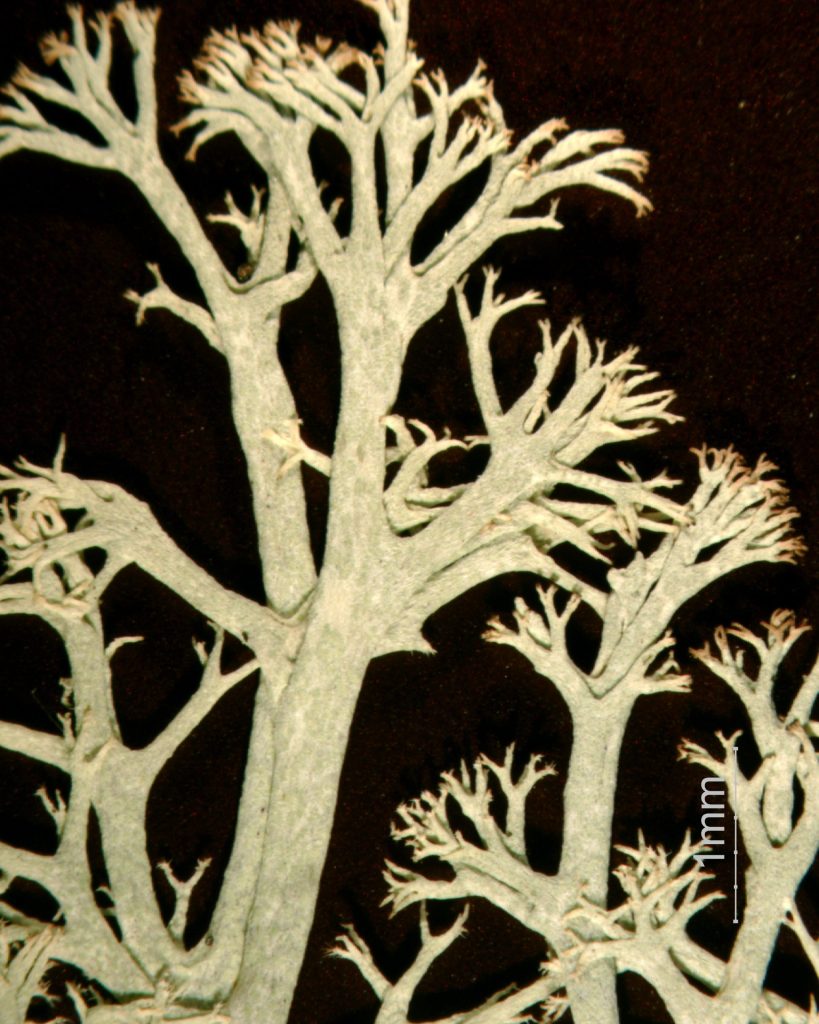
- Cladonia arbuscula close-up showing woolly surface due to lack of a cortex
-
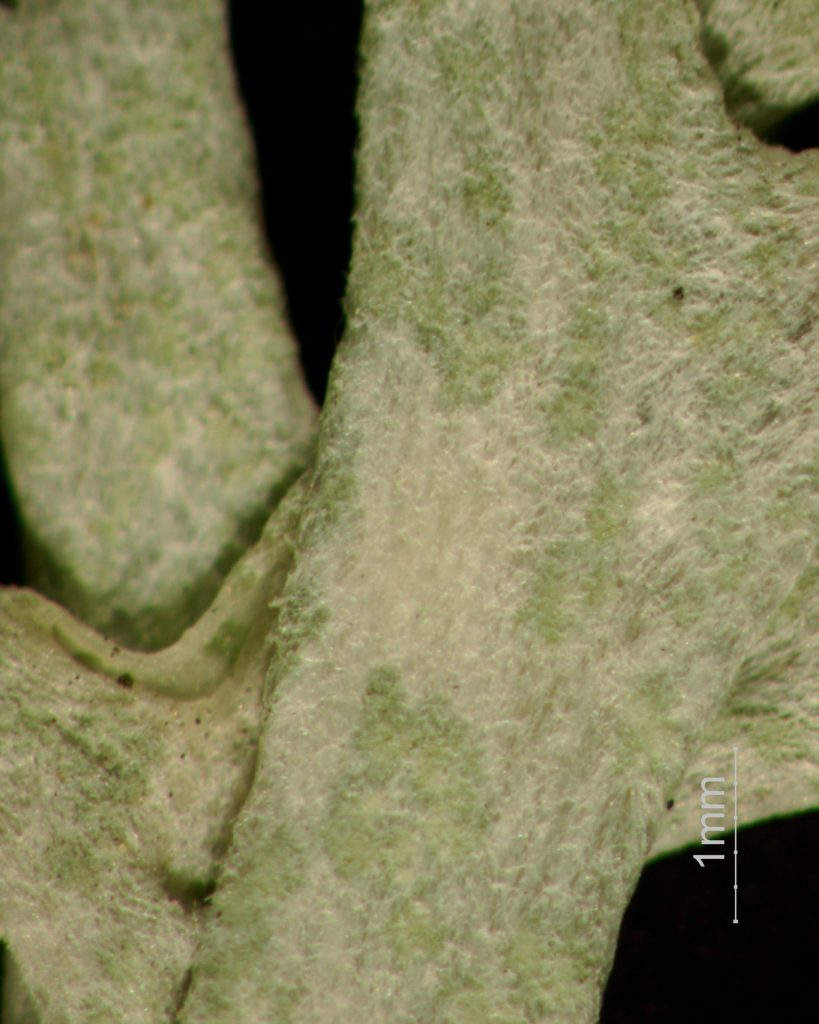
- Cladonia arbuscula close-up showing woolly surface due to lack of a cortex
Cladonia Part 2: The rest of them
The cupped, club-like and wand-like Cladonia are some of Alberta’s most diverse, widespread and phenotypically-plastic lichens. In other words, a ton of fun!
Number of species known or with high potential to be found in Alberta: 94
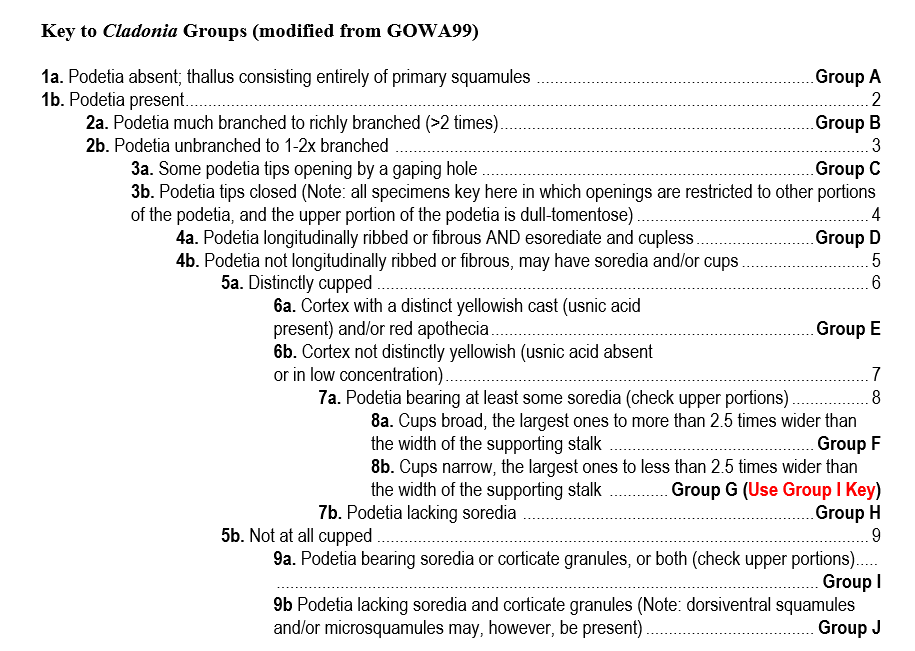
Because of their diversity, it is helpful to separate them down into smaller groups united by a some easily observed traits. Goward (1999) broke Cladonia into 9 groups. Below are three versions of that grouping key. Start with the one that feels most intuitive to you, and then work through the detailed keys to species linked below.
Click to download a PDF of Cladonia Keys v.2025
Morphogroup Key Version #1: Traditional text
Morphogroup Key #2: Pictorial summary with line drawings from Goward 1999
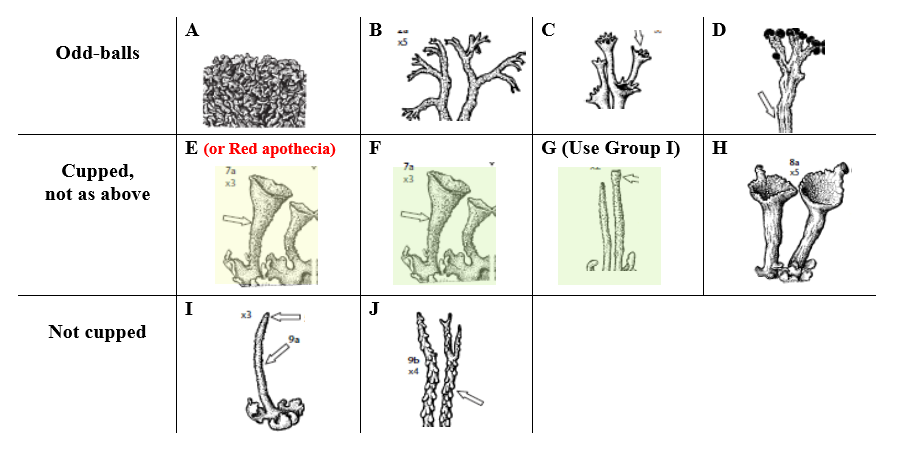
Morphogroup Key Version #3: Photo summary with Alberta Examples
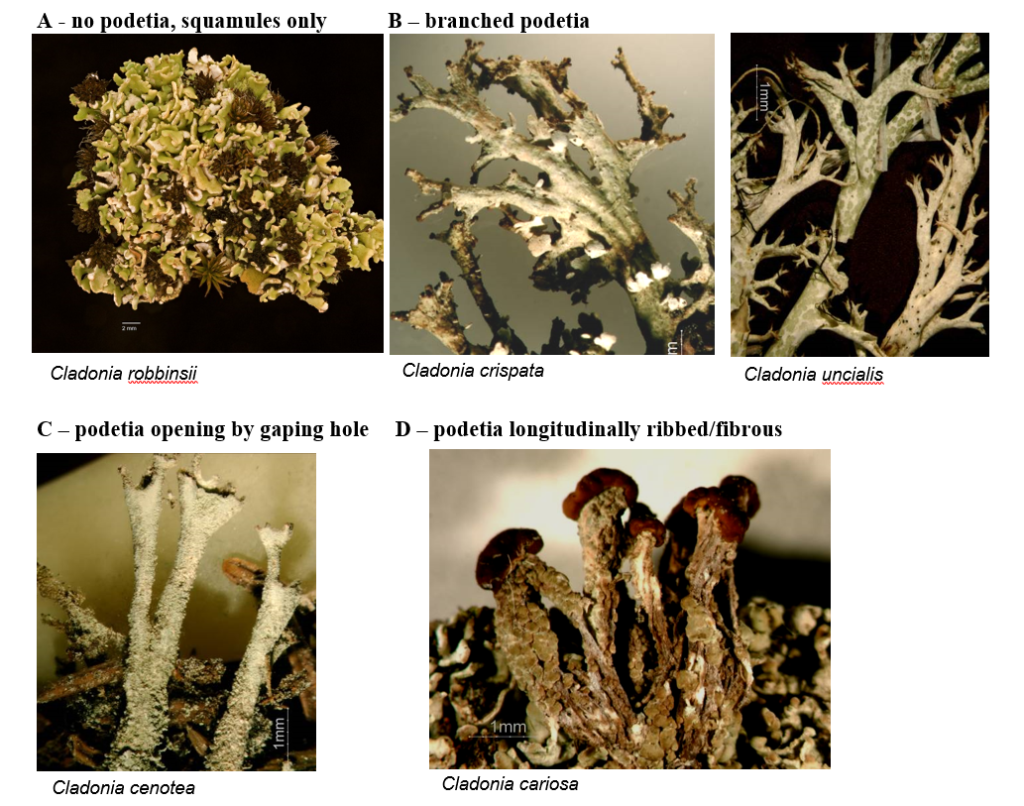
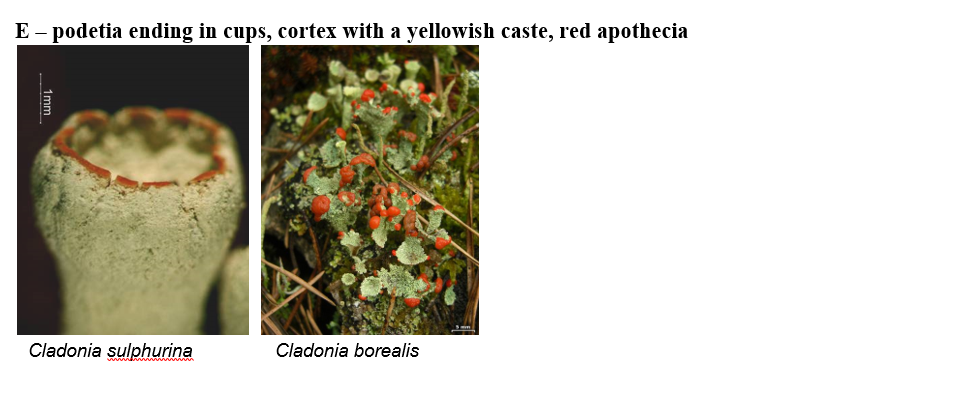
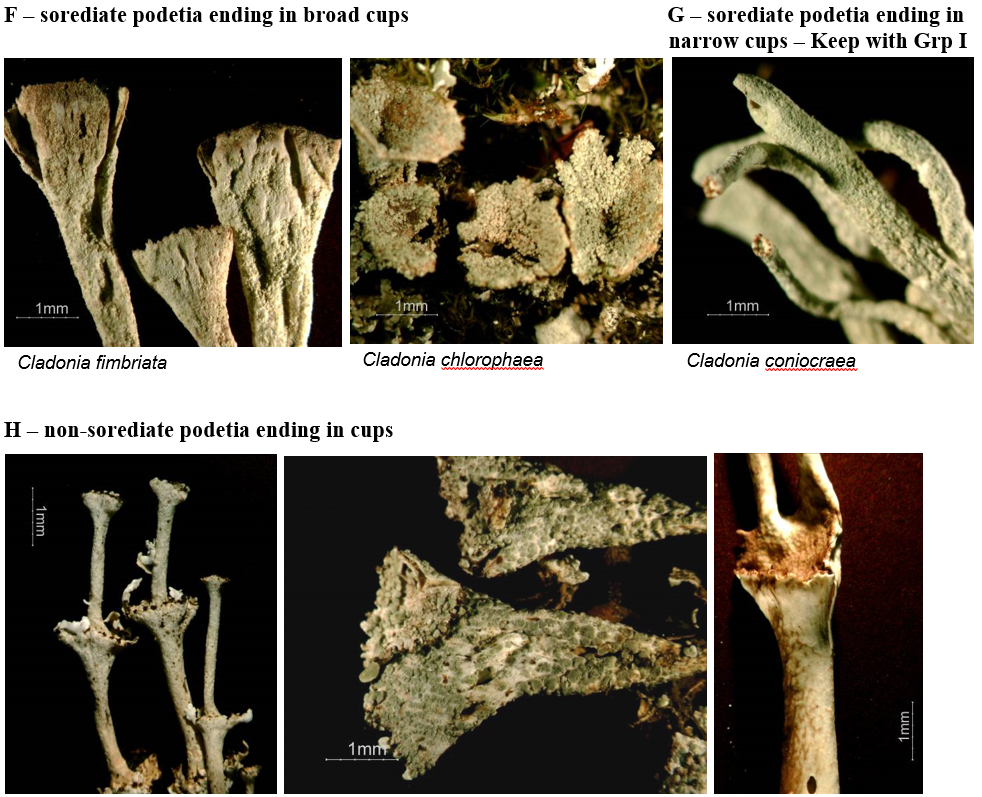
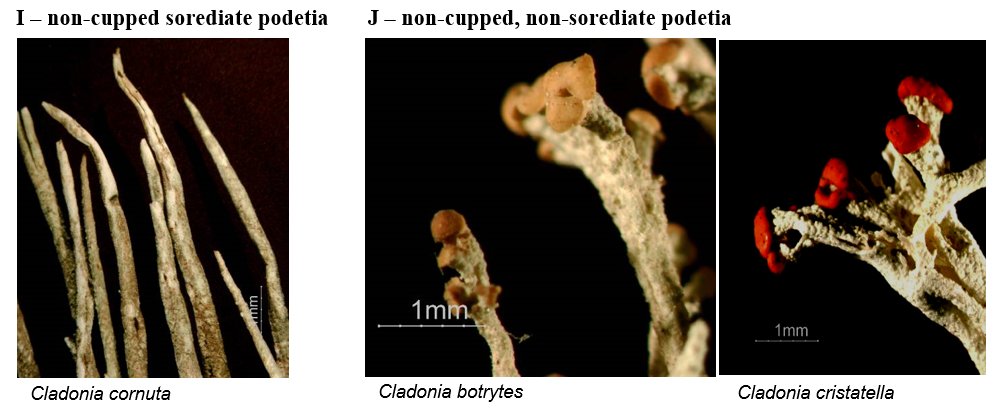
RENR Students: Cladonia to know – be able to key them out (most are covered in Brodo et al. 2001 and Goward 1999)
Crustose: flat, growing in 2-dimensions, lacking lower cortex and not detachable from substrate intact (either intimately attached or actually growing into the upper layers of the substrate, with hyphae penetrating the intercellular space of the substrate; often paint-like or leprose (=dust-like)
Squamulose: like small foliose lichens but always lacking a lower cortex; may be imbricate (=shingled) or peltate (=attached centrally).
Squamule (plural: squamules): small, flat, leaf-like lobes. In general, squamules are attached at one edge and have a white lower surface, without any attachment structures. Refer to entry for podetia. Squamules may also be peltate (=attached centrally).
Foliose: mostly growing in 2-dimensions, typically flat and leaf-life, usually has a distinct and separate upper and lower cortex (but some genera lack a lower cortex); typically with multiple attachments points but can be detached from the substrate intact and may even sparsely attached or unattached
Podetium (plural: podetia): erect, stalk-like structures, often bearing cups and/or apothecia, as seen in the genus Cladonia. Typically, podetia arise secondarily from a primary thallus such as squamules or a crust. The primary thallus may persist or disappear after podetia form. Line drawing reproduced courtesy of BC Ministry of Forests and T. Goward, from Goward 1999, fig. 8f.
Cortex (plural: cortices): outer protective layer of a lichen thallus, composed of fungal cells embedded in a matrix. Many foliose lichens have differentiated upper and lower cortices, while some lichens have only an upper cortex (e.g., Peltigera), and fruticose lichens typically have one homogenous cortex. Line drawing reproduced courtesy of BC Ministry of Forests and T. Goward, from Goward et al. 1994, fig. 4.
Soredium (plural: soredia) small, rounded, asexual reproductive structures made of hyphae and a few photobiont cells. Soredia originate from the algal layer and become exposed through a crack or hole in the cortex. Refer to farinose and soralia. Soredia detach and leave powdery residue on your finger when rubbed. Compare to isidia. Line drawing reproduced courtesy of BC Ministry of Forests and T. Goward, from Goward et al. 1994, fig. 9f.
Chlorolichen (plural: chlorolichens): lichens where the dominant photosynthetic partner is a green alga like Trebouxia.