
Self and Selves
Kasia Runté
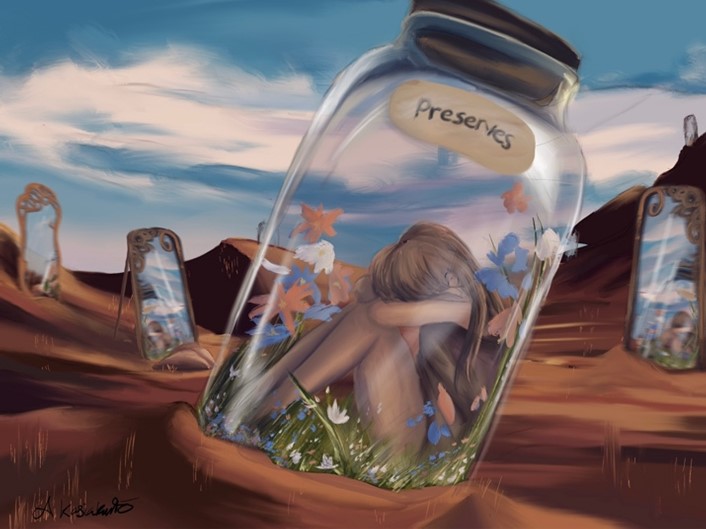
The girl in the jar represents the attempt to preserve one’s continuity of self (Henriques, 2014). The surrounding mirrors reflect how others perceive different aspects of that self but can never capture its entirety. Our self is not unitary but necessarily fragmented as we present in different roles and interactions (Henriques, 2014). Different observers therefore perceive and reflect back to us different fragments. The mirrors at different distances represent how some social relationships are closer than others and therefore reflect a more complete image.
The figure is self-hugging because others may try to define us negatively. W.E. B. DuBois (1903/2016) describes how identity is shaped by one’s own experience of self and socially imposed expectations. Du Bois (1903/2016) discusses this double consciousness in the context of race, but it applies to other marginalized groups, such as disabled people. The glass represents DuBois’s veil, keeping others from acknowledging one’s personhood. The distortions in the glass (here, the ability/disability binary) reflect back upon oneself in the mirrors.
The purple haze in the glass/sky suggests no matter how deep we delve, we cannot know ourselves because part of our identity is the reflection of ourselves in the mirror of others’ perceptions. The flowers/grass within the jar represent a rich internal life in which the self is constantly changing (Henriques, 2014) and therefore has the potential for resilience and growth. The jar is stuck in sand, because we can feel stuck and isolated. Many people feel alienated from their labour, from purpose, and meaning (Marx, 1844).
References
Du Bois, W.E.B. (1903/2016). Double consciousness and the veil. In C. Lemert (Ed.), Social theory: The multicultural and classical Readings (pp. 126-130). Westview Press.
Henriques, G. (2014, April 25). One self or many selves? Understanding why we have a multiplicity of self-states. Psychology Today. https://www.psychologytoday.com/ca/blog/theory-knowledge/201404/one-self-or-many-selves
Marx, K. (1844). Estranged Labour. Marxist.Org. https://www.marxists.org/archive/marx/works/1844/manuscripts/labour.htm