
Trends in Organizational Behaviour
Organizations operate in what we refer to as an open system. This means organizations are influenced by various forces both internal and external in their operations. As a result, organizations are required to look at aspects of their organization that can change like; structure, design, and culture of the organization (internal forces), and aspects that they cannot like; population demographics, technology, attitudes towards diversity, etc. These forces continue to influence decisions that organizations make on an ongoing basis to maintain their efficiency and effectiveness. This section will outline some of the current trends in organizational behaviour.
Lack of Employee Engagement
Studies suggest that fostering engagement, a concept related to passion, in employees has a significant impact on the corporate bottom line. Gallup, for instance, has been at the forefront of measuring the impact of employee engagement. Employee engagement is a concept that is generally viewed as managing discretionary effort, that is, when employees have choices, they will act in a way that furthers their organization’s interests. An engaged employee is a person who is fully involved in and enthusiastic about their work.[1] The consulting firm BlessingWhite offers this description of engagement and its value: “Engaged employees are not just committed. They are not just passionate or proud. They have a line of sight on their own future and on the organization’s mission and goals. They are ‘enthused’ and ‘in gear’ using their talents and discretionary effort to make a difference in their employer’s quest for sustainable business success”.[2]
Engaged employees are those who are performing at the top of their abilities and are happy about it. According to statistics that Gallup has drawn from 300,000 companies in its database, 75%–80% of employees are either “disengaged” or “actively disengaged”.[3]
That’s an enormous waste of potential. Consider Gallup’s estimation of the impact if 100% of an organization’s employees were fully engaged:
· Customers would be 70% more loyal.
· Turnover would drop by 70%.
· Profits would jump by 40%.
Job satisfaction studies in the United States routinely show job satisfaction ratings of 50%–60%. But one recent study by Harris Interactive of nearly 8,000 American workers went a step further.[5] What did the researchers find?
· Only 20% feel very passionate about their jobs.
· Less than 15% agree that they feel strongly energized by their work.
· Only 31% (strongly or moderately) believe that their employer inspires the best in them.
It is clear that engagement is both a challenge and an opportunity for OB.
.
Technology
Technology has transformed the way work gets done and has created many great opportunities. The intersection of increasing personal computing power, the Internet, as well as nanotechnology are allowing things to be created that were not even imaginable 50 years ago. And the rate of technological change is not expected to slow down anytime soon. Gordon Moore, a co-founder of Intel Corp., shocked the world in 1975 with what is now termed Moore’s Law, which states that computing power doubles every 2 years. This explains why a 4-year-old computer can barely keep up with the latest video game you have purchased. As computers get faster, new software is written to capitalize on the increased computing power.
We are also more connected by technology than ever before. It is now possible to send and receive e-mails or text messages with your coworkers and customers regardless of where in the world you are. Over 100 million adults in the United States use e-mail regularly (at least once a day)[5] and Internet users around the world send an estimated 60 billion e-mails every day[6], making e-mail the second most popular medium of communication worldwide, second only to voice. Technology has also brought plenty of challenges to individuals and organizations alike. To combat the overuse of e-mail, companies such as Intel have instituted “no e-mail Fridays,” in which all communication is done via other communication channels. The technology trend contains challenges for organizational behavior.
Employment Changes: Aging Workforce and the Millennial Generation
You have probably heard that the workforce is aging. Over the next 30 years, 76 million baby boomers will retire, but there will only be 46 million new workers from Generation X and Y entering the labor force. This demographic trend creates both challenges and opportunities for organizations. The aging trend has been predicted for decades. “The number of U.S. workers over the age of 40 has increased significantly over the past 30 years. By 2010, more than 51% of the workforce will be 40 or older, up almost 20% over 30 years. At the same time, the portion of the workforce aged 25 to 39 will decline by nearly 3%. The number of workers aged 55 and older will grow from 13% of the labor force in 2000 to 20% in 2020”.[7] There will be a record number of retirements. Aging workforces can create great opportunities for industries such as health care, but it can also mean great challenges lie ahead as entire industries related to basic infrastructure face massive retirement projections. For example, everything from air traffic controllers to truck drivers are predicted to be in huge demand as thousands of retiring workers leave these industries at roughly the same time.[8]
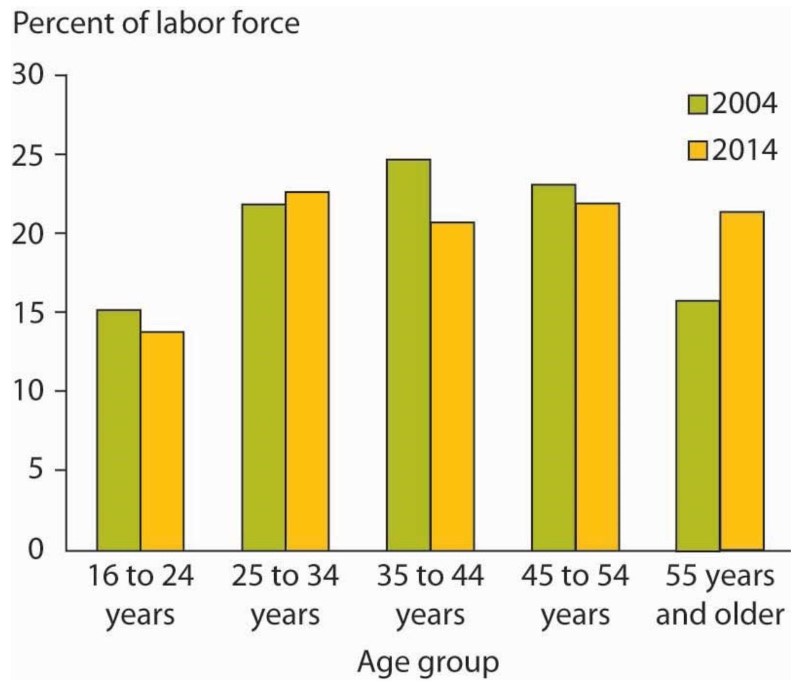
Source: U.S. Department of Labor, Bureau of Labor Statistics Occupational Outlook Handbook 2006–2007 edition. Retrieved October 15, 2007, from http://www.bls.gov/oco/images/ocotjc03.gif.
The Millennial Generation (which includes those born between 1980 and 2000) differs from previous generations in terms of technology and multitasking as a way of life. Having never known anything different, this population has technology embedded in their lives. In addition, they value teamwork, feedback, and challenging work that allows them to develop new skills. If you are in this generation or know those who are, you know there is an expectation of immediate interaction.[9] The challenge for organizational behavior is to keep individuals from different generations communicating effectively and managing people across generational lines despite different values placed on teamwork, organizational rewards, work–life balance, and desired levels of instruction.
Diversity, Equity, and Inclusion
Diversity refers to identity-based differences among and between two or more people that affect their lives as applicants, employees, and customers. These identity-based differences include such things as race and ethnicity, gender, sexual orientation, and age. Groups in society based on these individual differences are referred to as identity groups. These differences are related to discrimination and disparities between groups in areas such as education, housing, healthcare, and employment. The term managing diversity is commonly used to refer to ways in which organizations seek to ensure that members of diverse groups are valued and treated fairly within organizations in all areas including hiring, compensation, performance evaluation, and customer service activities. The term valuing diversity is often used to reflect ways in which organizations show appreciation for diversity among job applicants, employees, and customers.[10] Inclusion, which represents the degree to which employees are accepted and treated fairly by their organization[11], is one way in which companies demonstrate how they value diversity. In the context of today’s rapidly changing organizational environment, it is more important than ever to understand diversity in organizational contexts and make progressive strides toward a more inclusive, equitable, and representative workforce.
The Challenge of Ethical Behaviour
Finally, the future will bring a renewed concern with maintaining high standards of ethical behavior in business transactions and in the workplace. Many executives and social scientists see unethical behavior as a cancer working on the fabric of society both in business and beyond. Many are concerned that we face a crisis of ethics in the West that is undermining our competitive strength. This crisis involves business, governments, customers, and employees. Especially worrisome is unethical behavior among employees at all levels of the organization. For example, recent reports found that employees and vendors accounted for a higher percentage of thefts than did retail customers.[12]
In addition, we hear about illegal and unethical behavior on Wall Street—pension scandals in which disreputable executives gamble on risky business ventures with employee retirement funds, companies that expose their workers to hazardous working conditions, and blatant favoritism in hiring and promotion practices. Although such practices occur throughout the world, their presence nonetheless serves to remind us of the challenges we face.
This challenge is especially difficult because standards for what constitutes ethical behavior lie in a “gray zone” where clear-cut right-or-wrong answers may not always exist. For example, if you were a sales representative for an American company abroad and your foreign competitors used bribes to get business, what would you do? In the United States and Canada, such behavior is illegal, yet it is perfectly acceptable in other countries. What is ethical here? Similarly, in many countries women are systematically discriminated against in the workplace; it is felt that their place is in the home. In the United States and Canada, again, this practice is illegal. If you run an American company in one of these countries, would you hire women in important positions? If you did, your company might be isolated in the larger business community, and you might lose business. If you did not, you might be violating what most North Americans believe to be fair business practices.
Sustainability and Green Business Practices
Social responsibility is not just something organizations do at the price of profits. It can also lead to superior results. Environmentally Neutral Design (END) has designed a shoe that reduces the amount of material needed so it costs less to produce and is the lightest performance shoe on the market.
The primary role of for-profit companies is to generate shareholder wealth. More recently, the concept of the triple bottom line has been gaining popularity. Those subscribing to the triple bottom line believe that beyond economic viability, businesses need to perform well socially and environmentally. While some organizations have embraced the concepts underlying the triple bottom line, businesses are also undergoing a great deal of “greenwashing,” which refers to the marketing of products or processes as green to gain customers without truly engaging in sustainable business practices. Sustainable business practices are those that meet the present needs without compromising the needs of future generations. The challenge is to reconcile the accountability that publicly owned firms have in generating wealth for their shareholders while attending to the triple bottom line. On the other hand, organizations also have an opportunity to leverage a proactive stance toward innovative processes that can result in even greater profits for their products. For example, sales of the Toyota Prius, which combines combustion engine efficiency with hybrid electric technology, have been dramatic and have helped propel Toyota to record market share and profits. An unlikely leader in the sustainability movement is Wal-Mart. Wal-Mart hired Adam Werbach, the former president of the Sierra Club, to help train 1.3 million North American Wal-Mart employees about sustainability. Wal-Mart has also been pressuring suppliers to produce compact fluorescent lightbulbs with less mercury and has slashed the resources needed in packaging by requiring all suppliers to make packages smaller.[13] In the future, increasing interdependence between businesses, governmental agencies, and NGOs is bound to effect change throughout the economy.[15]