
Process-based Theories

Process-Based Theories
A separate stream of research views motivation as something more than action aimed at satisfying a need. Instead, process-based theories view motivation as a rational process. Individuals analyze their environment, develop thoughts and feelings, and react in certain ways. Process theories attempt to explain the thought processes of individuals who demonstrate motivated behaviour. Under this category, we will review equity theory and expectancy theory.
Equity Theory
Imagine that you are paid $10 an hour working as an office assistant. You have held this job for 6 months. You are very good at what you do, you come up with creative ways to make things easier around you, and you are a good colleague who is willing to help others. You stay late when necessary and are flexible if requested to change hours. Now imagine that you found out they are hiring another employee who is going to work with you, who will hold the same job title, and who will perform the same type of tasks. This particular person has more advanced computer skills, but it is unclear whether these will be used on the job. The starting pay for this person will be $14 an hour. How would you feel? Would you be as motivated as before, going above and beyond your duties? How would you describe what you would be feeling?

If your reaction to this scenario is along the lines of “this would be unfair,” your behaviour may be explained using equity theory[15]. According to this theory, individuals are motivated by a sense of fairness in their interactions. Moreover, our sense of fairness is a result of the social comparisons we make. Specifically, we compare our inputs and outcomes with other people’s inputs and outcomes. We perceive fairness if we believe that the input-to-outcome ratio we are bringing into the situation is similar to the input-to-outcome ratio of a comparison person, or a referent. Perceptions of inequity create tension within us and drive us to action that will reduce perceived inequity.
What are Inputs and Outputs?
Inputs are the contributions people feel they are making to the environment. In the previous example, the person’s hard work; loyalty to the organization; the amount of time with the organization; and level of education, training, and skills may have been relevant inputs. Outcomes are the perceived rewards someone can receive from the situation. For the hourly wage employee in our example, the $10 an hour pay rate was a core outcome. There may also be other, more peripheral outcomes, such as acknowledgment or preferential treatment from a manager. In the prior example, however, the person may reason as follows: I have been working here for 6 months. I am loyal, and I perform well (inputs). I am paid $10 an hour for this (outcomes). The new person has no experience here (referent’s inputs) but will be paid $14 an hour. This situation is unfair.
We should emphasize that equity perceptions develop as a result of a subjective process. Different people may look at the same situation and perceive different levels of equity. For example, another person may look at the same scenario and decide that the situation is fair because the newcomer has computer skills and the company is paying extra for those skills.
Who Is the Referent?
The referent other may be a specific person as well as a category of people. Referents should be comparable to us—otherwise, the comparison is not meaningful. It would be pointless for a student worker to compare himself to the CEO of the company, given the differences in the nature of inputs and outcomes. Instead, individuals may compare themselves to someone performing similar tasks within the same organization or, in the case of a CEO, a different organization.
Reactions to Unfairness
The theory outlines several potential reactions to perceived inequity. Oftentimes, the situation may be dealt with perceptually by altering our perceptions of our own or the referent’s inputs and outcomes. For example, we may justify the situation by downplaying our own inputs (I don’t really work very hard on this job), valuing our outcomes more highly (I am gaining valuable work experience, so the situation is not that bad), distorting the other person’s inputs (the new hire really is more competent than I am and deserves to be paid more), or distorting the other person’s outcomes (she gets $14 an hour but will have to work with a lousy manager, so the situation is not unfair). Another option would be to have the referent increase inputs. If the other person brings more to the situation, getting more out of the situation would be fair. If that person can be made to work harder or work on more complicated tasks, equity would be achieved. The person experiencing a perceived inequity may also reduce inputs or attempt to increase outcomes. If the lower-paid person puts forth less effort, the perceived inequity would be reduced. Research shows that people who perceive inequity reduce their work performance or reduce the quality of their inputs[16]. Increasing one’s outcomes can be achieved through legitimate means such as negotiating a pay raise. At the same time, research shows that those feeling inequity sometimes resort to stealing to balance the scales[17]. Other options include changing the comparison person (e.g., others doing similar work in different organizations are paid only minimum wage) and leaving the situation by quitting [18]. Sometimes it may be necessary to consider taking legal action as a potential outcome of perceived inequity. For example, if an employee finds out the main reason behind a pay gap is gender-related, the person may react to the situation by taking legal action because sex discrimination in pay is illegal in Canada.
Potential Responses to Inequity
| Reactions to inequity | Example |
|---|---|
| Distort perceptions | Changing one’s thinking to believe that the referent actually is more skilled than previously thought |
| Increase referent’s inputs | Encouraging the referent to work harder |
| Reduce own input | Deliberately putting forth less effort at work. Reducing the quality of one’s work |
| Increase own outcomes | Negotiating a raise for oneself or using unethical ways of increasing rewards such as stealing from the company |
| Change referent | Comparing oneself to someone who is worse off |
| Leave the situation | Quitting one’s job |
| Seek legal action | Suing the company or filing a complaint if the unfairness in question is under legal protection |
Figure 3.6: Potential Responses to Inequity
Source: Based on research findings reported in Carrell, M. R., & Dittrich, J. E. (1978). Equity theory: The recent literature, methodological considerations, and new directions. Academy of Management Review, 3, 202–210; Goodman, P. S., & Friedman, A. (1971). An examination of Adams’s theory of inequity. Administrative Science Quarterly, 16, 271–288; Greenberg, J. (1993). Stealing in the name of justice: Informational and interpersonal moderators of theft reactions to underpayment inequity. Organizational Behavior and Human Decision Processes, 54, 81–103; Schmidt, D. R., & Marwell, G. (1972). Withdrawal and reward reallocation as responses to inequity. Journal of Experimental Social Psychology, 8, 207–211.
Overpayment Inequity
What would you do if you felt you were over-rewarded? In other words, how would you feel if you were the new employee in our student-worker scenario? Originally, equity theory proposed that over-rewarded individuals would experience guilt and would increase their effort to restore perceptions of equity. However, research does not provide support for this argument. Instead, it seems that individuals experience less distress as a result of being over-rewarded[19]. It is not hard to imagine that individuals find perceptual ways to deal with a situation like this, such as believing they have more skills and bring more to the situation compared to the referent person. Therefore, research does not support equity theory’s predictions with respect to people who are overpaid[20].
Individual Differences in Reactions to Inequity
So far, we have assumed that once people feel a situation is inequitable, they will be motivated to react. However, does inequity disturb everyone equally? Researchers have identified a personality trait that explains different reactions to inequity and named this trait as equity sensitivity[21]. Equity-sensitive individuals expect to maintain equitable relationships, and they experience distress when they feel they are over-rewarded or under-rewarded. At the same time, there are some individuals who are benevolent, those who give without waiting to receive much in return, and entitled, who expect to receive substantial compensation for relatively little input. Therefore, the theory is more useful in explaining the behaviour of equity-sensitive individuals, and organizations will need to pay particular attention to how these individuals view their relationships.
.
Fairness Beyond Equity: Procedural and Interactional Justice
Equity theory looks at perceived fairness as a motivator. However, the way equity theory defines fairness is limited to the fairness of rewards. Starting in the 1970s, research on workplace fairness began taking a broader view of justice. Equity theory deals with outcome fairness, and therefore it is considered to be a distributive justice theory. Distributive justice refers to the degree to which the outcomes received from the organization are perceived to be fair. Two other types of fairness have been identified: procedural justice and interactional justice.
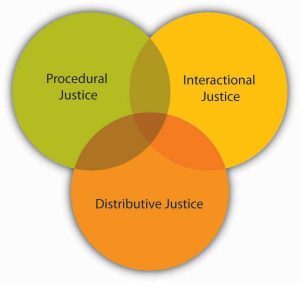
Let’s assume that you just found out you are getting a promotion. Clearly, this is an exciting outcome and comes with a pay raise, increased responsibilities, and prestige. If you feel you deserve to be promoted, you would perceive high distributive justice (you getting the promotion is fair). However, you later found out upper management picked your name out of a hat! What would you feel? You might still like the outcome but feel that the decision-making process was unfair. If so, you are describing feelings of procedural justice. Procedural justice refers to the degree to which fair decision-making procedures are used to arrive at a decision. People do not care only about reward fairness. They also expect decision-making processes to be fair. In fact, research shows that employees care about the procedural justice of many organizational decisions, including layoffs, employee selection, surveillance of employees, performance appraisals, and pay decisions[22]. People also tend to care more about procedural justice in situations in which they do not get the outcome they feel they deserve>[23]. If you did not get the promotion and later discovered that management chose the candidate by picking names out of a hat, how would you feel? This may be viewed as adding insult to injury. When people do not get the rewards they want, they tend to hold management responsible if procedures are not fair[24].
Why do employees care about procedural justice? There are three potential reasons>[25]. First, people tend to believe that fairness is an end in itself and it is the right thing to do. Second, fair processes guarantee future rewards. If your name was picked out of a hat, you have no control over the process, and there is no guarantee that you will get future promotions. If the procedures are fair, you are more likely to believe that things will work out in the future. Third, fairness communicates that the organization values its employees and cares about their well-being.
Research has identified many ways of achieving procedural justice. For example, giving employees advance notice before laying them off, firing them, or disciplining them is perceived as fair. Advance notice helps employees prepare for the changes facing them or allows them to change their behaviour before it is too late. Allowing employees’ voices in decision-making is also important[26]. When designing a performance-appraisal system or implementing a reorganization, it may be a good idea to ask people for their input because it increases perceptions of fairness. Even when it is not possible to have employees participate, providing explanations to employees helps foster procedural justice[27]. Finally, people expect consistency in treatment[28]. If one person is given extra time when taking a test while another is not, individuals would perceive decision-making as unfair.
Now let’s imagine the moment your boss told you that you are getting a promotion. Your manager’s exact words were, “Yes, we are giving you the promotion. The job is so simple that we thought even you can handle it.” Now, what is your reaction? The feeling of unfairness you may now feel is explained by interactional justice. Interactional justice refers to the degree to which people are treated with respect, kindness, and dignity in interpersonal interactions. We expect to be treated with dignity by our peers, supervisors, and customers. When the opposite happens, we feel angry. Even when faced with negative outcomes such as a pay cut, being treated with dignity and respect serves as a buffer and alleviates our stress[29].
OB Toolbox: Be a Fair Person!
- When distributing rewards, make sure you pay attention to the different contribution levels of employees. Treating everyone equally could be unfair if they participated and contributed at different levels. People who are more qualified, and skilled, or those who did more than others expect to receive a greater share of rewards.
- Sometimes you may have to disregard people’s contributions to distribute certain rewards. Some rewards or privileges may be better distributed equally (e.g., health insurance) or based on the particular employee’s needs (such as unpaid leave for health reasons).
- Pay attention to how you make decisions. Before making a decision, ask people to give you their opinions if possible. Explain your decisions to the people who are affected by it. Before implementing a change, give people advance notice. Enforce rules consistently among employees.
- Pay attention to how you talk to people. Treat others the way you want to be treated. Be kind, courteous, and considerate of their feelings.
- Remember that justice is in the eye of the beholder. Even when you feel you are being fair, others may not feel the same way, and it is their perception that counts. Therefore, pay attention to being perceived as fair.
- People do not care only about their own justice level. They also pay attention to how others are treated as well. Therefore, in addition to paying attention to how specific employees feel, creating a sense of justice in the entire organization is important.
Sources: Adapted from ideas in Colquitt, J. A. (2004). Does the justice of the one interact with the justice of the many? Reactions to procedural justice in teams. Journal of Applied Psychology, 89, 633–646; Cropanzano, R., Bowen, D. E., & Gilliland, S. W. (2007). The management of organizational justice. Academy of Management Perspectives, 21, 34–48.
Employers would benefit from paying attention to all three types of justice perceptions. In addition to being the right thing to do, paying attention to justice perceptions leads to outcomes companies care about. Injustice is directly harmful to employees’ psychological health and well-being and contributes to stress>[30]. High levels of justice create higher levels of employee commitment to organizations, and they are related to higher job performance, and higher levels of organizational citizenship (behaviours that are not part of one’s job description but help the organization in other ways, such as speaking positively about the company and helping others), and higher levels of customer satisfaction. Conversely, low levels of justice lead to retaliation and support of unionization[31].
Expectancy Theory
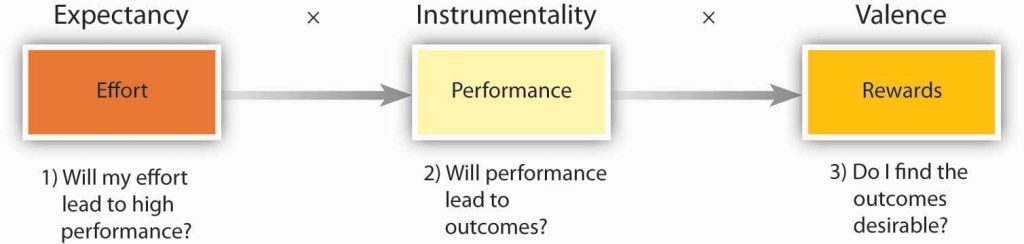
According to expectancy theory, individual motivation to put forth more or less effort is determined by a rational calculation in which individuals evaluate their situation[32]. According to this theory, individuals ask themselves three questions.
Sources: Based on Porter, L. W., & Lawler, E. E. (1968). Managerial attitudes and performance. Homewood, IL: Irwin; Vroom, V. H. (1964). Work and motivation. New York: Wiley.
.
The first question is whether the person believes that high levels of effort will lead to outcomes of interest, such as performance or success. This perception is labeled expectancy. For example, do you believe that the effort you put forth in a class is related to performing well in that class? If you do, you are more likely to put forth the effort.
The second question is the degree to which the person believes that performance is related to subsequent outcomes, such as rewards. This perception is labeled instrumentality. For example, do you believe that getting a good grade in the class is related to rewards such as getting a better job, or gaining approval from your instructor, or your friends or parents? If you do, you are more likely to put forth the effort.
Finally, individuals are also concerned about the value of the rewards awaiting them as a result of their performance. The anticipated satisfaction that will result from an outcome is labeled valence. For example, do you value getting a better job, or gaining approval from your instructor, friends, or parents? If these outcomes are desirable to you, your expectancy and instrumentality are high, and you are more likely to put forth the effort.
Expectancy theory is a well-accepted theory that has received a lot of research attention[33]. It is simple and intuitive. Consider the following example. Let’s assume that you are working in the concession stand of a movie theater. You have been selling an average of 100 combos of popcorn and soft drinks a day. Now your manager asks you to increase this number to 300 combos a day. Would you be motivated to try to increase your numbers? Here is what you may be thinking:
- Expectancy: Can I do it? If I try harder, can I really achieve this number? Is there a link between how hard I try and whether I reach this goal or not? If you feel that you can achieve this number if you try, you have high expectancy.
- Instrumentality: What is in it for me? What is going to happen if I reach 300? What are the outcomes that will follow? Are they going to give me a 2% pay raise? Am I going to be named the salesperson of the month? Am I going to receive verbal praise from my manager? If you believe that performing well is related to certain outcomes, instrumentality is high.
- Valence: How do I feel about the outcomes in question? Do I feel that a 2% pay raise is desirable? Do I find being named the salesperson of the month attractive? Do I think that being praised by my manager is desirable? If your answers are yes, valence is positive. In contrast, if you find the outcomes undesirable (you definitely do not want to be named the salesperson of the month because your friends would make fun of you), valence is negative.
If your answers to all three questions are affirmative—you feel that you can do it, you will get an outcome if you do it, and you value the reward—you are more likely to be motivated to put forth more effort toward selling more combos.
As a manager, how can you motivate employees? In fact, managers can influence all three perceptions[34].
Influencing Expectancy Perceptions
Employees may not believe that their effort leads to high performance for a multitude of reasons. First, they may not have the skills, knowledge, or abilities to successfully perform their jobs. The answer to this problem may be training employees or hiring people who are qualified for the jobs in question. Second, low levels of expectancy may be because employees may feel that something other than effort predicts performance, such as political behaviours on the part of employees. If employees believe that the work environment is not conducive to performing well (resources are lacking or roles are unclear), expectancy will also suffer. Therefore, clearing the path to performance and creating an environment in which employees do not feel restricted will be helpful. Finally, some employees may perceive little connection between their effort and performance level because they have an external locus of control, low self-esteem, or other personality traits that condition them to believe that their effort will not make a difference. In such cases, providing positive feedback and encouragement may help motivate employees.
Influencing Instrumentality Perceptions
Showing employees that their performance is rewarded is going to increase instrumentality perceptions. Therefore, the first step in influencing instrumentality is to connect pay and other rewards to performance using bonuses, award systems, and merit pay. However, this is not always sufficient, because people may not be aware of some of the rewards awaiting high performers. Publicizing any contests or award programs is needed to bring rewards to the awareness of employees. It is also important to highlight that performance, not something else, is being rewarded. For example, if a company has an employee of the month award that is rotated among employees, employees are unlikely to believe that performance is being rewarded. This type of meritless reward system may actually hamper the motivation of the highest-performing employees by eroding instrumentality.
Influencing Valence
Employees are more likely to be motivated if they find the reward to be attractive. This process involves managers finding what their employees value. Desirable rewards tend to be fair and satisfy different employees’ diverging needs. Ensuring high valence involves getting to know a company’s employees. Talking to employees and surveying them about what rewards they find valuable are some methods to gain understanding. Finally, giving employees a choice between multiple rewards may be a good idea to increase valence.
| Expectancy | Instrumentality | Valence |
|---|---|---|
| • Make sure employees have proper skills, abilities, and knowledge • Ensure that the environment facilitates performance • Provide encouragement to make people believe that their effort makes a difference |
• Reward employee performance • Inform people in advance about the rewards • Try to eliminate non-performance influence over rewards |
• Find rewards that are desirable to employees • Make sure that the rewards are viewed as fair • Give employees choice over rewards |
Figure 3.9: Ways in Which Manager Can Influence Expectancy, Instrumentality, and Valence