
Creating and Sustaining Organizational Culture

Creating and Sustaining Organizational Culture
How Are Cultures Created?
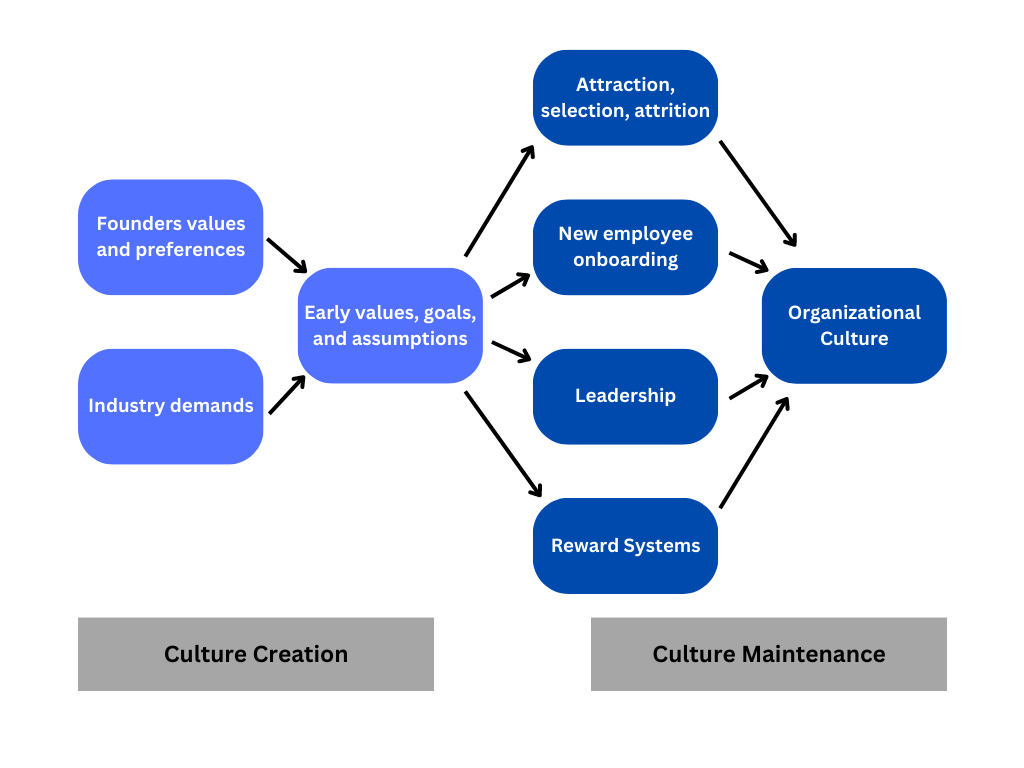
Where do cultures come from? Understanding this question is important so that you know how they can be changed. An organization’s culture is shaped as the organization faces external and internal challenges and learns how to deal with them. When the organization’s way of doing business provides a successful adaptation to environmental challenges and ensures success, those values are retained. These values and ways of doing business are taught to new members as the way to do business[8]. The factors that are most important in the creation of an organization’s culture include the founders’ values, preferences, and industry demands.
Founder’s Values
A company’s culture, particularly during its early years, is inevitably tied to the personality, background, and values of its founder or founders, as well as their vision for the future of the organization. This explains one reason why culture is so hard to change: It is shaped in the early days of a company’s history. When entrepreneurs establish their own businesses, the way they want to do business determines the organization’s rules, the structure set up in the company, and the people they hire to work with them.

As a case in point, some of the existing corporate values of the ice cream company Ben & Jerry’s Homemade Holdings Inc. can easily be traced to the personalities of its founders Ben Cohen and Jerry Greenfield. In 1978, the two ex-hippie high school friends opened up their first ice cream shop in a renovated gas station in Burlington, Vermont. Their strong social convictions led them to buy only from the local farmers and devote a certain percentage of their profits to charities. The core values they instilled in their business can still be observed in the current company’s devotion to social activism and sustainability, its continuous contributions to charities, its use of environmentally friendly materials, and its dedication to creating jobs in low-income areas.
Even though the company was acquired by Unilever PLC in 2000, the social activism component remains unchanged and Unilever has expressed its commitment to maintaining it[9]. There are many other examples of founders instilling their own strongly held beliefs or personalities in the businesses they found. For example, as mentioned earlier, Microsoft’s aggressive nature is often traced back to Bill Gates and his competitiveness. According to one anecdote, his competitive nature even extends to his personal life such that one of his pastimes is to compete with his wife in solving identical jigsaw puzzles to see who can finish faster[10]. Similarly, Joseph Pratt, a history and management professor, notes, “There definitely is an Exxon way. This is John D. Rockefeller’s company, this is Standard Oil of New Jersey, which is the one that is most closely shaped by Rockefeller’s traditions. Their values are very clear. They are deeply embedded. They have roots in 100 years of corporate history”[11].
Founder values become part of the corporate culture to the degree they help the company be successful. For example, the social activism of Ben & Jerry’s was instilled in the company because the founders strongly believed in these issues. However, these values probably would not be surviving 3 decades later if they had not helped the company in its initial stages. In the case of Ben & Jerry’s, these charitable values helped distinguish their brand from larger corporate brands and attracted a loyal customer base. Thus, by providing a competitive advantage, these values were retained as part of the corporate culture and were taught to new members as the right way to do business. Similarly, the early success of Microsoft may be attributed to its relatively aggressive corporate culture, which provided a source of competitive advantage.
Industry Demands
While founders undoubtedly exert a powerful influence over corporate cultures, industry characteristics also play a role. Industry characteristics and demands act as a force to create similarities among organizational cultures. For example, despite some differences, many companies in the insurance and banking industries are stable and rule-oriented, many companies in the high-tech industry have innovative cultures, and companies in the nonprofit industry tend to be people-oriented. If the industry is one with a large number of regulatory requirements—for example, banking, health care, and nuclear power plant industries—then we might expect the presence of a large number of rules and regulations, a bureaucratic company structure, and a stable culture. Similarly, the high-tech industry requires agility, taking quick action, and low concern for rules and authority, which may create a relatively more innovative culture [12]. The industry’s influence over culture is also important to know because this shows that it may not be possible to imitate the culture of a company in a different industry, even though it may seem admirable to outsiders.
How Are Cultures Maintained?
As a company matures, its cultural values are refined and strengthened. The early values of a company’s culture exert influence over its future values. It is possible to think of organizational culture as an organism that protects itself from external forces. Organizational culture determines what types of people are hired by an organization and what types are left out. Moreover, once new employees are hired, the company assimilates new employees and teaches them the way things are done in the organization. We call these processes attraction-selection-attrition and onboarding processes. We will also examine the role of leaders and reward systems in shaping and maintaining an organization’s culture. It is important to remember two points: The process of culture creation is in fact more complex and less clean than the name implies. Additionally, the influence of each factor on culture creation is reciprocal. For example, just as leaders may influence what type of values the company has, the culture may also determine what types of behaviours leaders demonstrate.
Attraction-Selection-Attrition (ASA)
Organizational culture is maintained through a process known as attraction-selection-attrition. First, employees are attracted to organizations where they will fit in. In other words, different job applicants will find different cultures to be attractive. Someone who has a competitive nature may feel comfortable and prefer to work in a company where interpersonal competition is the norm. Others may prefer to work in a team-oriented workplace. Research shows that employees with different personality traits find different cultures attractive. For example, out of the Big Five personality traits, employees who demonstrate neurotic personalities were less likely to be attracted to innovative cultures, whereas those who had an openness to experience were more likely to be attracted to innovative cultures[13]. As a result, individuals will self-select the companies they work for and may stay away from companies that have core values that are radically different from their own.
 Of course, this process is imperfect, and value similarity is only one reason a candidate might be attracted to a company. There may be other, more powerful attractions such as good benefits. For example, candidates who are potential misfits may still be attracted to Google because of the cool perks associated with being a Google employee. At this point in the process, the second component of the ASA framework prevents them from getting in: Selection. Just as candidates are looking for places where they will fit in, companies are also looking for people who will fit into their current corporate culture. Many companies are hiring people to fit with their culture, as opposed to fit with a certain job. For example, Southwest Airlines prides itself on hiring employees based on personality and attitude rather than specific job-related skills, which are learned after being hired. This is important for job applicants to know because, in addition to highlighting your job-relevant skills, you will need to discuss why your personality and values match those of the company.
Companies use different techniques to weed out candidates who do not fit with corporate values. For example, Google relies on multiple interviews with future peers. By introducing the candidate to several future coworkers and learning what these coworkers think of the candidate, it becomes easier to assess the level of fit. The Container Store Inc. ensures cultural fit by hiring among its customers[14]. This way, they can make sure that job candidates are already interested in organizing their lives and understand the company’s commitment to helping customers organize theirs. Companies may also use employee referrals in their recruitment process. By using their current employees as a source of future employees, companies may make sure that the newly hired employees go through a screening process to avoid potential person-culture mismatch.
Even after a company selects people for person-organization fit, there may be new employees who do not fit in. Some candidates may be skillful in impressing recruiters and signal high levels of cultural fit even though they do not necessarily share the company’s values. Moreover, recruiters may suffer from perceptual biases and hire some candidates thinking that they fit with the culture even though the actual fit is low. In any event, the organization is going to eventually eliminate candidates who do not fit in through attrition. Attrition refers to the natural process in which the candidates who do not fit in will leave the company. Research indicates that person-organization misfit is one of the important reasons for employee turnover[15].
As a result of the ASA process, the company attracts, selects, and retains people who share its core values. On the other hand, those people who are different in core values will be excluded from the organization either during the hiring process or later on through naturally occurring turnover. Thus, organizational culture will act as a self-defending organism where intrusive elements are kept out. Supporting the existence of such self-protective mechanisms, research shows that organizations demonstrate a certain level of homogeneity regarding the personalities and values of organizational members[16].
New Employee Onboarding
Another way in which an organization’s values, norms, and behavioural patterns are transmitted to employees is through onboarding (also referred to as the organizational socialization process). Onboarding refers to the process through which new employees learn the attitudes, knowledge, skills, and behaviours required to function effectively within an organization. If an organization can successfully socialize new employees into becoming organizational insiders, new employees feel confident regarding their ability to perform, sense that they will feel accepted by their peers, and understand and share the assumptions, norms, and values that are part of the organization’s culture. This understanding and confidence in turn translate into more effective new employees who perform better and have higher job satisfaction, stronger organizational commitment, and longer tenure within the company[17].
There are many factors that play a role in the successful adjustment of new employees. New employees can engage in several activities to help increase their own chances of success at a new organization. Organizations also engage in different activities, such as implementing orientation programs or matching new employees with mentors, which may facilitate onboarding.
What Can New Employees Do During Orientation?
New employees who are proactive, seek feedback, and build strong relationships tend to be more successful than those who do not[18]. for example, feedback-seeking helps new employees. Especially on a first job, a new employee can make mistakes or gaffes and may find it hard to understand and interpret the ambiguous reactions of coworkers. New hires may not know whether they are performing up to standards, whether it was a good idea to mention a company mistake in front of a client, or why other employees are asking if they were sick over the weekend because of not responding to work-related e-mails. By actively seeking feedback, new employees may find out sooner rather than later any behaviours that need to be changed and gain a better understanding of whether their behaviour fits with the company culture and expectations. Several studies show the benefits of feedback-seeking for new employee adjustment.
Relationship building, or networking, is another important behaviour new employees may demonstrate. Particularly when a company does not have a systematic approach to onboarding, it becomes more important for new employees to facilitate their own onboarding by actively building relationships. According to one estimate, 35% of managers who start a new job fail in the new job and either voluntarily leave or are fired within 1.5 years. Of these, over 60% report not being able to form effective relationships with colleagues as the primary reason for their failure[19]. New employees may take an active role in building relations by seeking opportunities to have a conversation with their new colleagues, arranging lunches or coffee with them, participating in company functions, and making the effort to build a relationship with their new supervisor[20].
| You’ve Got a New Job! Now How Do You Get On Board? |
|---|
|
Sources: Adapted from ideas in Couzins, M., & Beagrie, S. (2005, March 1). How to…survive the first six months of a new job. Personnel Today, 27; Wahlgreen, E. (2002, December 5). Getting up to speed at a new job. Business Week Online. Retrieved January 29, 2009, from http://www.businessweek.com/careers/content/dec2002/ca2002123_2774.htm.
What Can Organizations Do During Onboarding?
Many organizations, including Microsoft, Kellogg Company, and Bank of America, take a more structured and systematic approach to new employee onboarding, while others follow a “sink or swim” approach in which new employees struggle to figure out what is expected of them and what the norms are.
A formal orientation program indoctrinates new employees to the company culture, as well as introduces them to their new jobs and colleagues. An orientation program is important because it has a role in making new employees feel welcome in addition to imparting information that may help new employees be successful in their new jobs. Many large organizations have formal orientation programs consisting of lectures, videotapes, and written material, while some may follow more unusual approaches. According to one estimate, most orientations last anywhere from one to five days, and some companies are currently switching to a computer-based orientation. Ritz-Carlton, the company ranked number 1 in Training magazine’s 2007 top 125 lists, uses a very systematic approach to employee orientation and views orientation as the key to retention. In the two-day classroom orientation, employees spend time with management, dine in the hotel’s finest restaurant, and witness the attention to customer service detail firsthand. For example, they receive hand-written welcome notes and their favorite snacks during the break. During these two days, they are introduced to the company’s intensive service standards, team orientation, and its own language. Later, on their 21st day, they are tested on the company’s service standards and are certified[21]. Research shows that formal orientation programs are helpful in teaching employees about the goals and history of the company, as well as communicating the power structure. Moreover, these programs may also help with a new employee’s integration into the team. However, these benefits may not be realized to the same extent in computer-based orientations. In fact, compared to those taking part in a regular, face-to-face orientation, individuals undergoing a computer-based orientation were shown to have a lower understanding of their job and the company, indicating that different formats of orientations may not substitute for each other[22].
What Can Organizational Insiders Do During Onboarding?
One of the most important ways in which organizations can help new employees adjust to a company and a new job is through organizational insiders—namely supervisors, coworkers, and mentors. Research shows that leaders have a key influence over onboarding, and the information and support leaders provide determine how quickly employees learn about the company’s politics and culture. Coworker influence determines the degree to which employees adjust to their teams. Mentors can be crucial to helping new employees adjust by teaching them the ins and outs of their jobs and how the company really operates. A mentor is a trusted person who provides an employee with advice and support regarding career-related matters. Although a mentor can be any employee or manager who has insights that are valuable to the new employee, mentors tend to be relatively more experienced than their protégés. Mentoring can occur naturally between two interested individuals, or organizations can facilitate this process by having formal mentoring programs. These programs may successfully bring together mentors and protégés who would not come together otherwise. Research indicates that the existence of these programs does not guarantee their success, and there are certain program characteristics that may make these programs more effective. For example, when mentors and protégés feel that they had input in the mentor-protégé matching process, they tend to be more satisfied with the arrangement. Moreover, when mentors receive training beforehand, the outcomes of the program tend to be more positive[23]. Because mentors may help new employees interpret and understand the company’s culture, organizations may benefit from selecting mentors who personify the company’s values. Thus, organizations may need to design these programs carefully to increase their chance of success.
| How to Maximize Onboarding Success |
|---|
Onboarding plans should have the following characteristics:
|
Source: Adapted from Bauer, T. N., & Elder, E. (2006). Onboarding newcomers into an organization. 58th Annual Society for Human Resource Management (SHRM) Conference & Exposition. Washington, DC.
Leadership
 Leaders are instrumental in creating and changing an organization’s culture. There is a direct correspondence between a leader’s style and an organization’s culture. For example, when leaders motivate employees through inspiration, corporate culture tends to be more supportive and people-oriented. When leaders motivate by making rewards contingent on performance, the corporate culture tends to be more performance-oriented and competitive[24]. In these and many other ways, what leaders do directly influence the cultures their organizations have.
Part of the leader’s influence over culture is through role modeling. Many studies have suggested that leader behaviour, the consistency between organizational policy and leader actions, and leader role modeling determine the degree to which the organization’s culture emphasizes ethics[25]. The leader’s own behaviours will signal to employees what is acceptable behaviour and what is unacceptable. In an organization in which high-level managers make the effort to involve others in decision-making and seek the opinions of others, a team-oriented culture is more likely to evolve. By acting as role models, leaders send signals to the organization about the norms and values that are expected to guide the actions of organizational members.
Leaders also shape culture by their reactions to the actions of others around them. For example, do they praise a job well done, or do they praise a favored employee regardless of what was accomplished? How do they react when someone admits to making an honest mistake? What are their priorities? In meetings, what types of questions do they ask? Do they want to know what caused accidents so that they can be prevented, or do they seem more concerned about how much money was lost as a result of an accident? Do they seem outraged when an employee is disrespectful to a coworker, or does their reaction depend on whether they like the harasser? Through their day-to-day actions, leaders shape and maintain an organization’s culture.
Rewards Systems
Finally, the company culture is shaped by the type of reward systems used in the organization, and the kinds of behaviours and outcomes it chooses to reward and punish. One relevant element of the reward system is whether the organization rewards behaviours or results. Some companies have reward systems that emphasize intangible elements of performance as well as more easily observable metrics. In these companies, supervisors and peers may evaluate an employee’s performance by assessing the person’s behaviours as well as the results. In such companies, we may expect a culture that is relatively people or team-oriented, and employees act as part of a family[26]. On the other hand, in companies that purely reward goal achievement, there is a focus on measuring only the results without much regard for the process. In these companies, we might observe outcome-oriented and competitive cultures. Another categorization of reward systems might be whether the organization uses rankings or ratings. In a company where the reward system pits members against one another, where employees are ranked against each other and the lower performers receive long-term or short-term punishments, it would be hard to develop a culture of people-orientation which may lead to a competitive culture. On the other hand, evaluation systems that reward employee behaviour by comparing them to absolute standards as opposed to comparing employees to each other may pave the way to a team-oriented culture. Whether the organization rewards performance or seniority would also make a difference in culture. When promotions are based on seniority, it would be difficult to establish a culture of outcome orientation. Finally, the types of behaviours that are rewarded or ignored set the tone for the culture. Service-oriented cultures reward, recognize and publicize exceptional service on the part of their employees. In safety cultures, safety metrics are emphasized and the organization is proud of its low accident ratings. What behaviours are rewarded, which ones are punished, and which are ignored will determine how a company’s culture evolves.