
Resistance to Change

Resistance to Change
Changing an organization is often essential for a company to remain competitive. Failure to change may influence the ability of a company to survive. Yet, employees do not always welcome changes in methods. According to a 2007 survey conducted by the Society for Human Resource Management (SHRM), resistance to change is one of the top two reasons why change efforts fail. In fact, reactions to organizational change may range from resistance to compliance to being an enthusiastic supporter of the change, with the latter being the exception rather than the norm[8].
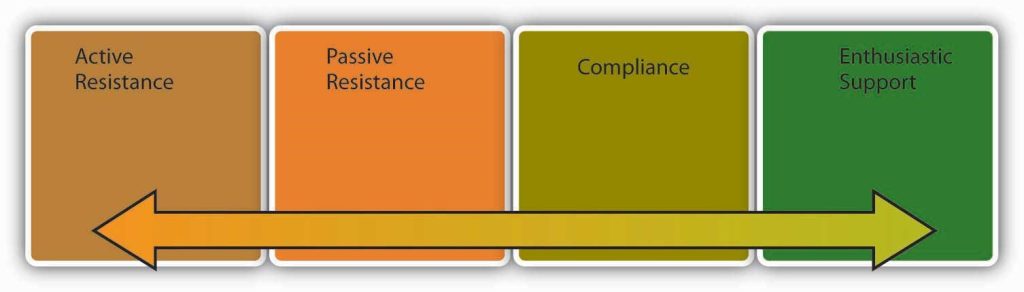
Active resistance is the most negative reaction to a proposed change attempt. Those who engage in active resistance may sabotage the change effort and be outspoken objectors to the new procedures. In contrast, passive resistance involves being disturbed by changes without necessarily voicing these opinions. Instead, passive resisters may quietly dislike the change, feel stressed and unhappy, and even look for an alternative job without necessarily bringing their point to the attention of decision-makers. Compliance, on the other hand, involves going along with proposed changes with little enthusiasm. Finally, those who show enthusiastic support are defenders of the new way and actually encourage others around them to give support to the change effort as well.
Any change attempt will have to overcome the resistance on the part of people to be successful. Otherwise, the result will be a loss of time and energy as well as an inability on the part of the organization to adapt to the changes in the environment and make its operations more efficient. Resistance to change also has negative consequences for the people in question. Research shows that when people negatively react to organizational change, they experience negative emotions, use sick time more often, and are more likely to voluntarily leave the company[9].
The following is a dramatic example of how resistance to change may prevent improving the status quo. Have you ever wondered why the letters on keyboards are laid out the way they are? The QWERTY keyboard, named after the first six letters in the top row, was actually engineered to slow us down. The first prototypes of the typewriter keyboard would jam if the keys right next to each other were hit at the same time. Therefore, it was important for manufacturers to slow typers down. They achieved this by putting the most commonly used letters to the left-hand side and scattering the most frequently used letters all over the keyboard. Later, the issue of letters being stuck was resolved. In fact, an alternative to the QWERTY named the Dvorak keyboard provides a much more efficient design and allows individuals to double traditional typing speeds. Yet the shift never occurred. The reasons? Large numbers of people resisted the change. Teachers and typists resisted because they would lose their specialized knowledge. Manufacturers resisted because of the costs inherent in making the switch and the initial inefficiencies in the learning curve[10]. In short, the best idea does not necessarily win, and changing people requires understanding why they resist.

Why Do People Resist Change?
Disrupted Habits
People often resist change for the simple reason that change disrupts our habits. Do you think about how you are driving when you drive? Most of the time probably not, because driving generally becomes an automated activity after a while. You may sometimes even realize that you have reached your destination without noticing the roads you used or having consciously thought about any of your body movements. Now imagine you drive for a living, and even though you are used to driving an automatic car, you are now forced to use a stick shift. You can most likely figure out how to drive a stick, but it will take time, and until you figure it out, you cannot drive on autopilot. You will have to reconfigure your body movements and practice shifting until you become good at it. You may find that for this simple reason, people sometimes are surprisingly outspoken when confronted with simple changes such as updating to a newer version of a particular software or a change in their voice mail system.
Personality
Some people are more resistant to change than others. Research shows that people who have a positive self-concept are better at coping with change, probably because those who have high self-esteem may feel that whatever the changes are, they are likely to adjust to it well and be successful in the new system. People with a more positive self-concept and those who are more optimistic may also view change as an opportunity to shine as opposed to a threat that is overwhelming. Finally, risk tolerance is another predictor of how resistant someone will be to stress. For people who are risk-avoidant, the possibility of a change in technology or structure may be more threatening[11].
Feelings of Uncertainty
Change inevitably brings feelings of uncertainty. You have just heard that your company is merging with another. What would be your reaction? Such change is often turbulent, and it is often unclear what is going to happen to each individual. Some positions may be eliminated. Some people may see a change in their job duties. Things can get better—or they may get worse. The feeling that the future is unclear is enough to create stress for people because it leads to a sense of lost control[12].
Fear of Failure
 People also resist change when they feel that their performance may be affected by the new system. People who are experts in their jobs may be less than welcoming of the changes, because they may be unsure whether their success would last under the new system. Studies show that people who feel that they can perform well under the new system are more likely to be committed to the proposed change, while those who have lower confidence in their ability to perform after changes are less committed[13].
Personal Impact of Change
It would be too simplistic to argue that people resist all change, regardless of its form. In fact, people tend to be more welcoming of change that is favorable to them on a personal level (such as giving them more power over others, or change that improves the quality of life such as bigger and nicer offices). Research also shows that commitment to change is highest when proposed changes affect the work unit with a low impact on how individual jobs are performed[14].
Prevalence of Change
Any change effort should be considered within the context of all the other changes that are introduced in a company. Does the company have a history of making short-lived changes? If the company structure went from functional to product-based to geographic to matrix within the past 5 years, and the top management is in the process of going back to a functional structure again, a certain level of resistance is to be expected because people are likely to be fatigued as a result of the constant changes. Moreover, the lack of a history of successful changes may cause people to feel skeptical toward the newly planned changes. Therefore, considering the history of changes in the company is important to understand why people resist. Also, how big is the planned change? If the company is considering a simple switch to a new computer program, such as introducing Microsoft Access for database management, the change may not be as extensive or stressful compared to a switch to an enterprise resource planning (ERP) system such as SAP or PeopleSoft, which require a significant time commitment and can fundamentally affect how business is conducted[15].
Perceived Loss of Power
One other reason why people may resist change is that change may affect their power and influence in the organization. Imagine that your company moved to a more team-based structure, turning supervisors into team leaders. In the old structure, supervisors were in charge of hiring and firing all those reporting to them. Under the new system, this power is given to the team itself. Instead of monitoring the progress the team is making toward goals, the job of a team leader is to provide support and mentoring to the team in general and ensure that the team has access to all resources to be effective. Given the loss in prestige and status in the new structure, some supervisors may resist the proposed changes even if it is better for the organization to operate around teams.
Is All Resistance Bad?
Resistance to change may be a positive force in some instances. In fact, resistance to change is a valuable feedback tool that should not be ignored. Why are people resisting the proposed changes? Do they feel that the new system will not work? If so, why not? By listening to people and incorporating their suggestions into the change effort, it is possible to make a more effective change. Some of a company’s most committed employees may be the most vocal opponents of a change effort. They may fear that the organization they feel such a strong attachment to is being threatened by the planned change effort and the change will ultimately hurt the company. In contrast, people who have less loyalty to the organization may comply with the proposed changes simply because they do not care enough about the fate of the company to oppose the changes. As a result, when dealing with those who resist change, it is important to avoid blaming them for a lack of loyalty[16].