Communication Channels and Channel Richness

Communication Channels and Channel Richness
Next, we are going to discuss four types/channels of communication: verbal communication involving listening to a person to understand the meaning of a message, written communication in which a message is read, nonverbal communication involving observing a person and inferring meaning, and digital communication.
Verbal Communication
The primary means of communication is verbal, and in most cases, it’s the most effective. Examples of verbal communication can be a speech, a one-on-one meeting, or a group discussion.
A major advantage of verbal communication is speed, as the sender of the message encodes it into words, and a receiver immediately decodes it and offers feedback. Any errors can be corrected early before mistakes are made and productivity is hindered.
A primary disadvantage of verbal communication comes into play whenever the message has to be passed through many people. Did you ever play the game “telephone” with your friends as a child? If you did, you’ll remember that one player starts a message as a whisper at one end, and by the time it reached the other it was often changed, sometimes in a funny way. All laughs aside, that’s a real phenomenon and a real issue in organizations. When messages are verbally passed from person to person, there’s a potential for that message to become distorted.
Written Communication
Written communication includes newsletters, memos, emails, instant messaging, and anything that you type or write. They’re verifiable forms of communication, existing beyond the moment of transmission and something receivers can refer back to for clarification.
The primary advantage of written communications is exactly that—they are written. They exist beyond the moment of transmission and can be used as a reference later. Due to their ability to easily be referenced, written communications are particularly good for lengthy, complex communications. Additionally, the process of creating a written communication often requires that the sender be more thorough in his or her communication because there is often enough time to revise and review what’s been written and to be more careful about the information being transmitted.
A disadvantage of written communication is the lack of feedback. Oral communication allows a receiver to respond instantly to the sender with feedback. Written communication doesn’t have a built-in feedback mechanism, and because of that feedback can arrive too late for appropriate action. Another disadvantage of written communication is that it’s time-consuming. Due to the lack of immediate feedback, it’s often a good idea to be more thorough in your written communications, which inevitably takes more time to consider how your words might be unclear and preemptively write in additional context. If a message needs to be communicated quickly, written communication isn’t always the best solution.
Nonverbal Communication
It’s not just what you say, it’s how you say it! There’s a myth that says communication is 35% verbal and 65% nonverbal. If that were true, people speaking a foreign language would be much easier to understand. However, it’s very true that nonverbal communication adds additional meaning to in-person conversations. Nonverbal communication includes all of those things that aren’t spoken but definitely transmit part of the message, including the following:
- facial expressions
- gestures
- proximity to receiver
- touch
- eye contact
- appearance
For instance, your friend may be telling you that she’s really excited about a party she’s planning to attend. But if she appears apathetic and listless, the communication doesn’t come across quite the same. Senders who stand too close to a receiver send a different message than those who keep a socially acceptable distance. Senders who make eye contact appear to be more confident than those who avoid it. And finally, a sender’s general appearance—choice of dress, hygiene, choice of delivery method, etc.—can also send a message that either supports or detracts from the verbal message.
Digital Communication
Digital communication is the exchange of information and meaning using an election, digital medium. While understanding how to best use digital communication is important, as one would be hard-pressed to find an organization that does not use some sort of digital communication – it is also important to recognize that digital communication brings with it some challenges.
Instant messaging has become a standard means of communication in many businesses. While it provides users with an immediate communication method, the casual nature of instant messaging can lead to a lack of professionalism in communication.
Video meetings, facilitated by software such as Zoom, Microsoft Teams, and Google Meet, have become a primary method of communication in businesses, especially in the context of remote work. This form of communication provides geographical flexibility and collaboration, enabling individuals to connect virtually around the world. It can also lead to Zoom Fatigue, a term coined to describe the tiredness or burnout associated with the overuse of virtual communication tools. Continuous virtual meetings can be mentally exhausting.
In the current digital age, social media has become an important channel for businesses to communicate, both internally and externally. Social media provides businesses with a platform to reach a vast, global audience – allowing for direct communication with customers and potential clients. It can, however, also require a high level of monitoring and response, especially since negative comments or reviews can quickly spread on social media and potentially damage a brand’s reputation. Watch this video, Former FBI Agent Explains How to Read Body Language, for an interesting discussion on this topic.
Channel Richness
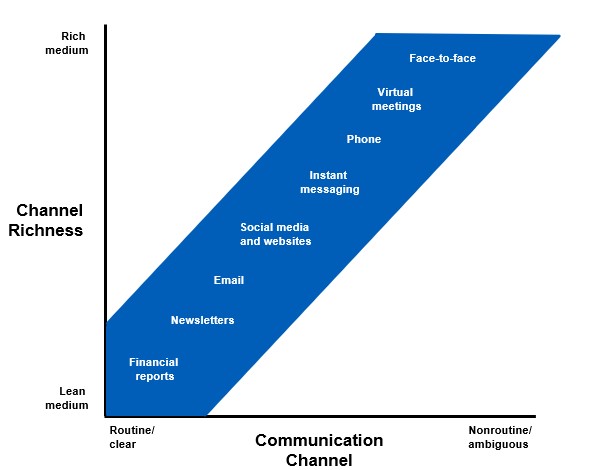
Employees have more communication channels to choose from than ever before, ranging from physical and digital forms of face-to-face interaction to a multitude of ways to transmit written messages. So, which communication channel is most appropriate in a particular situation? The channel used to communicate a message can affect how accurately the message will be received. Consider the chart below:
.
.
The key to effective communication is to match the communication channel with the goal of the message. For example, written media may be a better choice when the sender wants a record of the content, has less urgency for a response, is physically separated from the receiver, and doesn’t require a lot of feedback from the receiver, or when the message is complicated and may take some time to understand.
Face-to-face communication, on the other hand, makes more sense when the sender is conveying a sensitive or emotional message, needs feedback immediately, and does not need a permanent record of the conversation.
Like face-to-face and phone conversations, videoconferencing has high information richness, because receivers and senders can see or hear beyond just the words that are used—they can see the sender’s body language or hear the tone of their voice. Instant messaging, social media, websites, and company newsletters offer medium-rich channels because they convey words and pictures or photos. Formal written documents, such as legal documents and financial statements, convey the least richness because the format is often rigid and standardized. As a result, the tone of the message is often lost.
Consider the following…
Communication can occur without you even realizing it. Consider the following:
Is your e-mail name professional? The typical convention for business e-mail contains some form of your name. While an e-mail name like “LazyGirl” or “DeathMonkey” may be fine for chatting online with your friends, they may send the wrong signal to individuals you e-mail such as professors and prospective employers.
Is your outgoing voicemail greeting professional? If not, change it. Faculty and prospective recruiters will draw certain conclusions if, upon calling you, they get a message that screams, “Party, party, party!”
Have you set your social media accounts to private? Consider what posts might be public and could be seen by potential employers.
Googled yourself lately? If not, you probably should. Potential employers have begun searching the Web as part of background checking, and you should be aware of what’s out there about you.