1 OER Activities at SAIT
History of OER at SAIT
SAIT has made great strides in incorporating OER into courses since the work first began in 2016.
From 2016-2018, OER activities at SAIT were focused on AlbertaOER (ABOER ) grants. These grants supported SAIT faculty in developing OER materials in math and science courses. These successful projects showed the value of OER in student learning. As mentioned in the Introductory module, research at SAIT also highlighted student struggles with textbook costs.
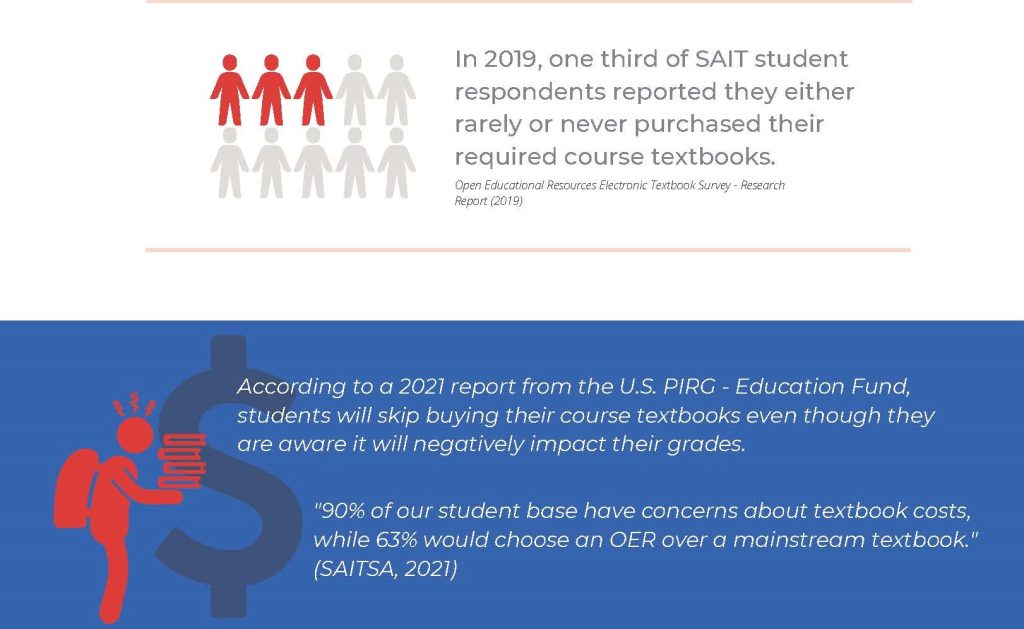
In May 2018, Southern Alberta Institute of Technology (SAIT) announced that it had officially adopted one of the first institutional Open Educational Resources (OER) policies in Canada. This policy was part of SAIT’s initiative, outlined in the 2017-2020 Applied Education Plan, to “support faculty in adopting, adapting and creating open education resources that increase access to relevant, flexible learning content.”
The impact of the new policy, procedures, and activities could be seen in the dramatic rise in OER use at SAIT. In the 2018-19 academic year, five Communications courses (90+ sections) began using OER for the first time. These new projects joined ongoing OER use in math and statistics courses. A long-term vision for OER activities at SAIT was also introduced in 2019 in the form of a 5 year strategic plan.
In February 2020, the Reg Erhardt Library joined with University of Alberta, University of Lethbridge, University of Calgary, and MacEwan University to form the Open Education Alberta working group, resulting in the launch of a free-access provincial OER publishing platform that greatly improves faculty access to OER technology and increases distribution of SAIT’s OER material to the public. The launch of this service led to the development of the SAIT OER publishing program.
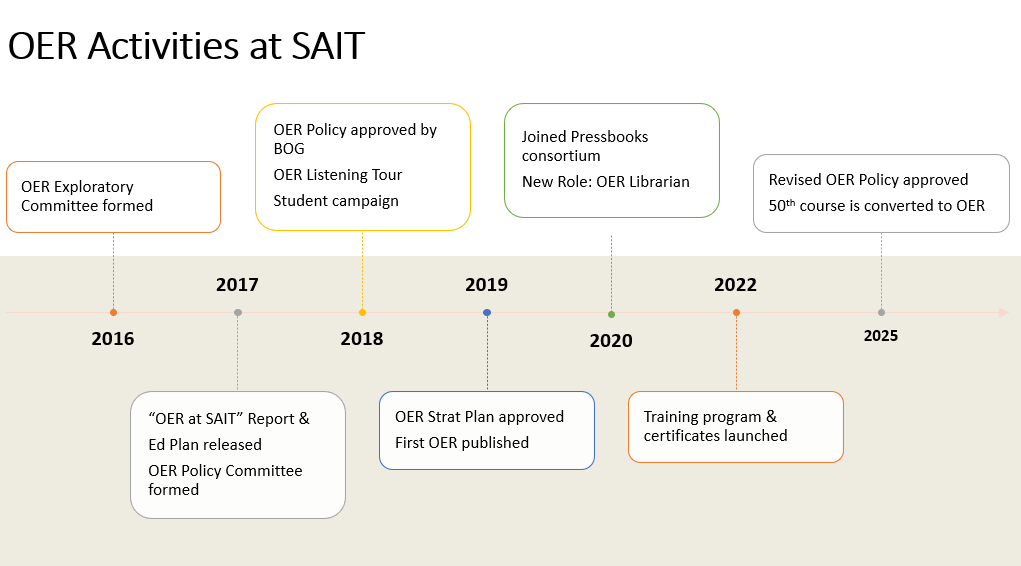
In the 2021-22 Academic Year, the Reg Erhardt Library supported SAIT faculty to complete six OER projects in the areas of business, liberal arts, and mathematics. Outside of publishing, the SAIT OER program activities include educational workshops to support staff and faculty implementation of OER in curriculum as well as consulting on open licensing projects across the institution.
In the last nine years, SAIT faculty’s adoption of OER textbooks has impacted more than 55,000 students in 50 courses, saving them over 5.8 million dollars while improving their access to learning materials.