
What is HRM and Why Does it Matter?

.
It’s the early 1900s and you are twelve years old, living in a North American city where industrialization has begun to boom. On Monday at 5 a.m., you line up with the rest of your family to begin your long workday at a textile factory. If it isn’t busy you will end your day around 8:00 p.m. You visit with your parents and siblings during your fifteen-minute lunch break.
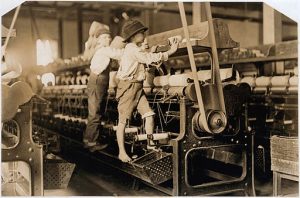 The factory where you work is not heated, has no ventilation system, and the windows can’t be opened to let out the exhaust fumes from the machinery. Since you are small, your responsibility is to climb in between the machinery and dislodge pieces of material that get caught in the gears and belts—while the machines are still running. You have to be especially careful because the only light in the factory is the sunlight that comes through the dirty windows. If you are not killed or maimed by the equipment, chances are good that your life will be cut short by the toxic fumes you inhale while in the factory.
Every member of your family works there, including your four-year-old sister. Your father, the most highly skilled worker in the family, makes about ten cents per hour, your mother makes about half that since she’s a woman, and you, as a child, make even less. Fortunately, you don’t have to worry about doing homework, because you don’t attend school, and you’ll learn to read and write only if your parents teach you on Sunday—the one day of the week when you don’t go to work.
Similar grim working conditions continued for decades in North America until labor unions formed and activists began to lobby for worker protection. It’s hard, today, to imagine what those conditions really must have been like. We have always worked in conditions regulated for health and safety. We aren’t forced to work for pennies per day. Understanding how far we have come in terms of employee rights and protections is an important context for thinking about human resource management.
Let’s Explore Human Resources Management (HRM)
What do all businesses have in common regardless of the product or service? Employees! Unless you are a sole proprietor, you will have to navigate the process of planning for, recruiting, hiring, training, managing, and possibly firing employees. These responsibilities all fall under the heading of human resource management.
Human resource management (HRM or HR) is essentially the management of human resources. It is a function in organizations designed to maximize employee performance in service of an employer’s strategic objectives. HR is primarily concerned with the management of people within organizations, focusing on policies and systems. HR departments in organizations typically undertake several activities, including employee benefits design, employee recruitment, training and development, performance appraisal, and rewarding (e.g., managing pay and benefit systems). HR also concerns itself with organizational change and industrial relations, that is, the balancing of organizational practices with requirements arising from collective bargaining and governmental laws.
HR is a product of the human relations movement of the early twentieth century when researchers began documenting ways of creating business value through the strategic management of the workforce. The function was initially dominated by transactional work, such as payroll and benefits administration, but due to globalization, company consolidation, technological advances, and further research, HR today includes strategic initiatives like talent management, industrial and labor relations, and diversity and inclusion.
Most companies focus on lowering employee turnover and on retaining the talent and knowledge held by their workforce. Hiring a new employee is a costly process and there’s always a risk that the incoming employee won’t match the performance of the person who previously worked in that position. HR departments strive to offer benefits that will appeal to workers, thus reducing the risk of losing corporate knowledge. Businesses are moving globally and forming more diverse teams. It is the role of human resources to make sure that these teams can function and that people can communicate cross-culturally and across borders. Due to business changes, current topics in human resources are diversity and inclusion as well as using technology to advance employee engagement.
In short, HR involves maximizing employee productivity. HR managers may also focus on a particular aspect of HRM, such as recruiting, training, employee relations, or benefits. Recruiting specialists are in charge of finding and hiring top talent. Training and development professionals ensure that employees are trained and receive ongoing professional development. This takes place through training programs, performance evaluations, and reward programs. Employee relations deals with employee concerns and incidents such as policy violations, sexual harassment, and discrimination. Benefit managers develop compensation structures, family-leave programs, discounts, and other benefits available to employees. At the other end of the spectrum are HR generalists who work in all areas or as labor relations representatives for unionized employees.
The Core Functions of HR
Human resources (HR) professionals conduct a wide variety of tasks within an organizational structure. A brief rundown on the core functions of human resource departments will be useful in framing the more common activities a human resource professional will conduct. The core functions can be summarized as follows:
Staffing
This includes the activities of hiring new full-time or part-time employees, hiring contractors, and terminating employee contracts.
Staffing activities include:
- Identifying and fulfilling talent needs (through recruitment, primarily)
- Utilizing various recruitment technologies to acquire a high volume and diverse pool of candidates (and to filter them based on position requirements)
- Protecting the company from lawsuits by satisfying legal requirements and maintaining ethical hiring practices
- Writing employee contracts and negotiating salary and benefits
- Terminating employee contracts when necessary
Training and Development
Onboarding new employees and providing professional development opportunities is a key investment for organizations, and HR is charged with seeing that those efforts and resources are well spent and utilized.
Development activities include:
- Training and preparing new employees for their roles
- Providing training opportunities (internal training, educational programs, conferences, etc.) to keep employees up to date in their respective fields
- Preparing management prospects and providing feedback to employees and managers
Compensation
Salary and benefits are also within the scope of human resource management. This includes identifying appropriate compensation based on role, performance, and legal requirements.
Compensation activities include:
- Setting compensation levels to be competitive and appropriate within the market, using benchmarks such as industry standards for a given job function
- Negotiating group health insurance rates, retirement plans, and other benefits with third-party providers
- Discussing raises and other compensation increases and/or decreases with employees in the organization
- Ensuring compliance with legal and cultural expectations when it comes to employee compensation
Health and Safety
HR managers are also responsible for understanding and implementing the best safety and health practices in their industry and addressing any relevant employee concerns.
Safety and health activities include the following:
- Ensuring compliance with legal requirements based on job function for safety measures (i.e., hard hats in construction, available counseling for law enforcement, appropriate safety equipment for chemists, etc.). Many of these requirements are specified by the Occupational Health and Safety (OSH).
- Implementing new safety measures when laws change in a given industry
- Discussing safety and compliance with relevant government departments
- Discussing safety and compliance with unions
Employee and Labour Relations
Defending employee rights, coordinating with unions, and mediating disagreements between the organization and its human resources are also core HR functions.
Employee and labour relations activities include:
- Mediating disagreements between employees and employers
- Mediating disagreements between employees and other employees
- Investigating claims of harassment and other workplace abuses
- Discussing employee rights with unions, management, and stakeholders
- Acting as the voice of the organization and/or the voice of the employees during any broader organizational issues about employee welfare
The management of human resources. It is a function in organizations designed to maximize employee performance in service of an employer's strategic objectives.