
The Nature of Goals of Business

Getting Down to Business
A business is any activity that provides goods or services to consumers for the purpose of making a profit. Be careful not to confuse the terms revenue and profit. Revenue represents the funds an enterprise receives in exchange for its goods or services. Profit is what’s left (hopefully) after all the bills are paid.
A company like Apple produces and sells goods (Mac, iPhone, iPad, Apple Watch) – tangible products, while many businesses, provide services. Your bank is a service company, as is your Internet provider. Hotels, airlines, law firms, movie theaters, and hospitals are also service companies. Many companies provide both goods and services. For example, your local car dealership sells goods (cars) and also provides services (automobile repairs).
It’s also important to recognize that some organizations are not set up to make profits for individual stakeholders. Many are established to provide social or educational services for the entire public. Such not-for-profit (or nonprofit), organizations include the United Way, Habitat for Humanity, the Boys and Girls Clubs, the Red Cross, and many colleges and universities. Most of these organizations, however, function in much the same way as a business. They establish goals and work to meet them in an effective, efficient manner. Thus, most of the business principles introduced in this text also apply to nonprofits.
Business Participants and Activities
Participants
Every business must have one or more owners whose primary role is to invest money in the business. When a business is being started, it’s generally the owners who polish the business idea and bring together the resources (money and people) needed to turn the idea into a business. The owners also hire employees to work for the company and help it reach its goals. Owners and employees depend on a third group of participants— customers. Ultimately, the goal of any business is to satisfy the needs of its customers in order to generate a profit for the owners.
Stakeholders
Consider your favorite restaurant. It may be an outlet or franchise of a national chain (more on franchises in a later chapter) or a local “mom-and-pop shop” without affiliation to a larger entity. Whether national or local, every business has stakeholders – those with a legitimate interest in the success or failure of the business and the policies it adopts. Stakeholders include customers, vendors, employees, landlords, bankers, and others (see Figure 1.1). Other stakeholders include the general public, the environment, and all the various government departments which impact the business. All have a keen interest in how the business operates, in most cases for obvious reasons. If the business fails, employees will need new jobs, vendors will need new customers, and banks may have to write off loans they made to the business. Stakeholders do not always see things the same way – their interests sometimes conflict with each other. For example, lenders are more likely to appreciate high-profit margins that ensure the loans they made will be repaid, while customers would probably appreciate the lowest possible prices. Pleasing stakeholders can be a real balancing act for any company.
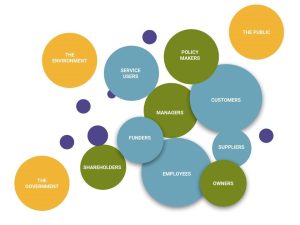
Figure 1.1: Stakeholders
Functional Areas of Business
Human Resources
HR managers are responsible for ensuring that the organization has all of the skills and capabilities necessary to run the business. HR managers develop staffing plans, recruit and select new employees, monitor the performance management process, and develop succession plans for advancement and replacement. They develop standards for compensation and benefits and assist managers with staff issues.
Supply Chain/Operations
All companies must convert resources (labour, materials, money, information, and so forth) into goods or services. Some companies, such as Apple, convert resources into tangible products—Macs, iPhones, etc. Others, such as hospitals, convert resources into intangible products — e.g., health care. The person who designs and oversees the transformation of resources into goods or services is called an operations manager. This individual is also responsible for ensuring that products are of high quality. In many organizations, operations management includes managing the supply chain which controls the delivery of raw materials and the distribution of finished goods.
Marketing
Marketing consists of everything that a company does to identify customers’ needs (i.e., market research) and design products to meet those needs. Marketers develop the benefits and features of products, including price and quality. They also decide on the best method of delivering products and the best means of promoting them to attract and keep customers. They manage relationships with customers and make them aware of the organization’s desire and ability to satisfy their needs.
Accounting/Finance
Managers need accurate, relevant, and timely financial information, which is provided by accountants. Accountants measure, summarize, and communicate financial and managerial information and advise other managers on financial matters. There are two fields of accounting. Financial accountants prepare financial statements to help users, both inside and outside the organization, assess the financial strength of the company. Managerial accountants prepare information, such as reports on the cost of materials used in the production process, for internal use only.
Information Technology
Information is one of the critical assets of most businesses. Businesses such as Meta are entirely information-based businesses. Information technology (IT) managers are concerned with building computer and network infrastructure, implementing security protocols, and developing user interfaces and apps for customers. Usually, there is a high level of integration between the business’s website or application and other departments within the business, such as finance, marketing, and operations. Often, businesses must develop interfaces to send and receive information from other companies, including suppliers, logistics, and shipping suppliers.
External Forces that Influence Business Activities
Businesses don’t operate in a vacuum: they’re influenced by a number of external factors. These include the economy, government, consumer trends, technological developments, public pressure to act as good corporate citizens and other factors. Collectively, these forces constitute what is known as the “macro environment” – essentially the big picture world outside over which the business exerts very little if any control.
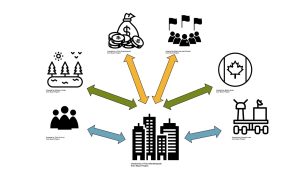
Figure 1.2: The Business and Its Environment
“Business and Its Environment” sums up the relationship between a business and the external forces that influence its activities. One industry that’s clearly affected by all these factors is the fast-food industry. Companies such as Taco Bell, McDonald’s, Tim Hortons, and others all compete in this industry. Here are a few statements to show the way external factors impact business. For instance, a strong economy means people have more money to eat out. Food standards are monitored by a government agency, the Canadian Food and Drug Inspection Agency at the federal level with entities at both the provincial and municipal levels following through with adherence. Preferences for certain types of foods are influenced by consumer trends (fast food companies are being pressured to make their menus healthier).
Of course, all industries are impacted by external factors, not just the food industry. As people have become more conscious of the environment, they have begun to choose new technologies, like all-electric cars to replace those that burn fossil fuels. Both established companies, like Nissan with its Nissan Leaf, and brand-new companies like Tesla have entered the market for all-electric vehicles. While the market is still small, it is expected to grow at a compound annual growth rate of 19.2% between 2013 and 2019 [1].
Exploring Contemporary Business Trends
Utilizing Canadian business news sources, research and analyze a contemporary trend in Canadian business.
Possible News Sources:
– CBC News – https://www.cbc.ca/news
– The Globe and Mail – https://www.theglobeandmail.com/
– The National Post – https://nationalpost.com/
– Bloomberg Canada – https://www.bloomberg.com/canada
– The Canadian Press – https://www.thecanadianpressnews.ca/
Your research and analysis should address the following questions:
- What are the factors driving the trend you chose?
- How are Canadian businesses adapting to this trend?
- What are the potential implications of this trend for Canadian businesses and the economy as a whole?
Consider working with 2 to 3 other classmates to complete this activity.
- Transparency Market Research. (2014, July). Electric Vehicles Market (on-road) (hybrid, plug-in, and battery) – Global Industry Analysis, Size, Share, Growth, Trends and Forecast, 2013 – 2019. Retrieved from: http://www.transparencymarketresearch.com/electric-vehicles-market.html ↵
Any activity that provides goods or services to consumers for the purpose of making a profit.
Rather than making a profit, these businesses operate to provide social or educational services to the public.
Those individuals or parties with a legitimate interest in the success or failure of the business and the policies it adopts.