
The Skills Needed by Managers

To be a successful manager, you’ll have to master several skills. To get an entry-level position, you’ll have to be technically competent at the tasks you’re asked to perform. To advance, you’ll need to develop strong interpersonal and conceptual skills. The relative importance of different skills varies from job to job and organization to organization, but to some extent, you’ll need them all to forge a managerial career.
You’ll also be expected to communicate ideas clearly, use your time efficiently, and reach sound decisions throughout your career.
Technical Skills
Technical skills refer to the specific knowledge and abilities required to perform particular tasks related to a specific field or profession. These skills are often associated with the competencies needed to use complex tools, machinery, software, or methodologies specific to a particular job or industry. Technical skills are usually acquired through formal education, training programs, certifications, and hands-on experience.
In the context of the workforce, technical skills can vary widely across different sectors. For example:
- In marketing and digital marketing, technical skills might include using digital marketing tools and platforms, such as Google Analytics, AdWords, or social media management tools like Hootsuite.
- In operations and supply change management, they could involve skills in supply chain management software, like SAP SCM, Oracle SCM Cloud, or Microsoft Dynamics 365.
- In finance and accounting, technical skills might include the ability to use accounting software, such as QuickBooks, Xero, or SAP.
Technical skills are crucial for performing the specialized functions of a job efficiently and effectively, and they are often key factors in hiring decisions, performance evaluations, and career advancement. As technology and industries evolve, the demand for certain technical skills may change, highlighting the importance of continuous learning and skill development.
Interpersonal Skills
Interpersonal skills, also known as people skills or soft skills, refer to the abilities that enable an individual to interact effectively and harmoniously with other people. These skills encompass a wide range of competencies that facilitate communication and interaction in a positive, productive manner. Interpersonal skills are crucial in both personal and professional contexts, as they contribute to building strong relationships, fostering teamwork, and facilitating conflict resolution.
Key aspects of interpersonal skills could include:
- Communication Skills: The ability to convey information clearly and listen actively. This includes both verbal and non-verbal communication, such as body language, tone of voice, and facial expressions.
. - Empathy: The capacity to understand and share the feelings of another, which is vital for building rapport and trust.
. - Adaptability: Being flexible and open to change, and able to adjust one’s approach to meet the needs of different situations and individuals.
. - Cultural Awareness: Understanding and respecting cultural differences and being able to interact effectively with people from diverse backgrounds.
Interpersonal skills are highly valued in the workplace because they enhance collaboration, customer service, and overall organizational performance. Unlike technical skills, which are often job-specific and learned through education or training, interpersonal skills are more about character traits and behaviors that are developed over time and through various life experiences.
What is Emotional Intelligence? [1]
Conceptual Skills
Conceptual skills refer to the ability to understand complex ideas and the interrelationships between them, enabling effective problem-solving and decision-making in complex and abstract contexts. These skills involve thinking creatively and envisioning the “big picture” of an organization or project, including its strategic direction, long-term planning, and systemic thinking. Conceptual skills are crucial for senior-level managers and leaders, as they must oversee and integrate various parts of an organization, anticipate future trends, and devise strategic plans that align with the organization’s goals.
Conceptual skills in a business context involve the application of high-level thinking and abstract reasoning to solve complex problems, make strategic decisions, and innovate. Consider the following examples of how one might utilize conceptual skills:
- Innovating new products or services: An entrepreneur identifies a gap in the market and conceptualizes a new product or service to fill that gap. This process involves creative problem-solving, envisioning future market needs, and understanding how different technologies and consumer behaviors can come together to create a successful offering.
. - Leading organizational change: A manager tasked with leading a digital transformation initiative within their company uses conceptual skills to understand how changes in technology impact different parts of the organization. They must envision the future state of the organization post-transformation, anticipate potential challenges, and develop a comprehensive plan to guide the organization through the change.
. - Optimizing operations for sustainability: An operations manager applies conceptual skills to redesign manufacturing processes, reducing waste and minimizing environmental impact. This requires understanding the complex interplay between production methods, materials sourcing, environmental regulations, and sustainability goals to develop an integrated, systemic solution.
Analytical Skills
Analytical skills refer to the ability to collect and analyze information, problem-solve, and make decisions based on available data. These skills encompass a wide range of activities including, but not limited to, identifying patterns, brainstorming, observing, interpreting data, integrating new information, theorizing, and making decisions based on multiple factors and options available. Analytical skills enable individuals to break down complex information into manageable parts, understand the underlying causes of problems, and develop effective solutions.
In a business context, analytical skills are crucial across various roles and levels, from entry-level positions to senior management. They are particularly important in fields such as finance, where analysts might forecast future revenues; in marketing, where professionals might analyze consumer behavior to create targeted advertising campaigns; in operations, where teams might optimize supply chain logistics; and in strategic planning, where leaders use analytical skills to set the future direction of the company based on market trends and competitive analysis.
Sharpen Your Critical Thinking [2]
Decision-Making Skills
In every function performed, a role taken on, and a set of skills applied, a manager is a decision-maker. Decision-making means choosing among alternatives. Decision-making occurs in response to the identification of a problem or an opportunity. The decisions managers make fall into two basic categories: programmed and non-programmed. Programmed decisions are made in response to routine situations that occur frequently in a variety of settings throughout an organization. For example, the need to hire new personnel is a common situation for most organizations. Therefore, standard procedures for recruitment and selection are developed and followed in most companies.
Infrequent, unforeseen, or very unusual problems and opportunities require non-programmed decisions by managers. Because these situations are unique and complex, the manager rarely has a precedent to follow.
Whether a decision is programmed or non-programmed, managers typically follow five steps in the decision-making process, as illustrated in Figure 5.5:
- Recognize or define the problem or opportunity. Although it is more common to focus on problems because of their obvious negative effects, managers who do not take advantage of new opportunities may lose a competitive advantage over other firms.
. - Gather information to identify alternative solutions or actions.
. - Select one or more alternatives after evaluating the strengths and weaknesses of each possibility.
. - Put the chosen alternative into action.
. - Gather information to obtain feedback on the effectiveness of the chosen plan.
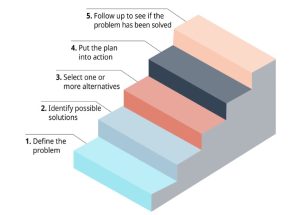
Figure 5.5: The Decision-Making Process
Decision-making comes with its challenges. Consider a restaurant manager facing declining customer satisfaction due to slow service times. To address this, the manager is considering introducing a new, faster point-of-sale (POS) system. The challenges include the cost of the new system, training staff to use it effectively, and ensuring the technology integrates smoothly with the kitchen’s order management system. After weighing these factors against the potential to improve service speed and customer satisfaction, the manager decides to proceed with the implementation, planning for a careful transition to minimize disruptions. This required the manager to conduct research and utilize critical thinking, data analysis, and logical reasoning to make a decision.
- Harvard Business School Online. (2022, September 15). What is Emotional Intelligence | Business: Explained [Video]. YouTube. https://www.youtube.com/watch?v=tbKr0EuiVjc ↵
- BBC Ideas. (2021, January 21). Five simple strategies to sharpen your critical thinking | BBC Ideas [Video]. YouTube. https://www.youtube.com/watch?v=NHjgKe7JMNE ↵
Refer to the specific knowledge and abilities required to perform particular tasks related to a specific field or profession.
Also known as people skills or soft skills, refer to the abilities that enable an individual to interact effectively and harmoniously with other people.
Refer to the ability to understand complex ideas and the interrelationships between them, enabling effective problem-solving and decision-making in complex and abstract contexts.
Refer to the ability to collect and analyze information, problem-solve, and make decisions based on available data. These skills encompass a wide range of activities including, but not limited to, identifying patterns, brainstorming, observing, interpreting data, integrating new information, theorizing, and making decisions based on multiple factors and options available.
Occurs in response to the identification of a problem or an opportunity which requires a manager to choose among alternative solutions/options.