
The Planning Process

Planning begins by anticipating potential problems or opportunities the organization may encounter. Managers then design strategies to solve current problems, prevent future problems, or take advantage of opportunities. These strategies serve as the foundation for goals, objectives, policies, and procedures. Put simply, planning is deciding what needs to be done to achieve organizational objectives, identifying when and how it will be done, and determining who should do it. Effective planning requires extensive information about the external business environment in which the firm competes and its internal environment.
There are four basic types of planning: strategic, tactical, operational, and contingency. Most of us use these different types of planning in our own lives. Some plans are broad and long-term (more strategic), such as attending graduate school after earning a bachelor’s degree. Some plans are much more specific and short-term (more operational), such as planning to spend a few hours in the library this weekend. Your short-term plans support your long-term plans. If you study now, you have a better chance of achieving some future goals, such as getting a job interview or attending graduate school. Like you, organizations tailor their plans to meet the requirements of future situations or events.
Types of Planning
| Types of Planning | Time Frame | Level of Management | Extent of Coverage | Purpose and Goal | Breadth of Content | Accuracy and Predictability |
| Strategic | 1-5 years | Top management (CEO, Vice Presidents, Directors, Division Heads) | External environment and the entire organization | Establish mission and long-term goals | Broad and general | A high degree of uncertainty |
| Tactical | Less than 1 year | Middle management | Strategic business units | Establish mid-range goals for implementation | More specific | Moderate degree of uncertainty |
| Operational | Current | Supervisory management | Geographic and functional divisions | Implement and activate specific objectives | Specific and concrete | Reasonable degree of certainty |
| Contingency | When an event occurs or a situation demands | Top and middle management | External environment and the entire organization | Meet unforeseen challenges and opportunities | Both broad and detailed | A reasonable degree of certainty once an event or situation occurs |
Strategic Planning
Strategic planning involves creating long-range (one to five years), broad goals for the organization and determining what resources will be needed to accomplish those goals. Evaluating external environmental factors such as economic, technological, and social issues is critical to successful strategic planning. Strategic plans, such as the organization’s long-term mission, are formulated by top-level managers and put into action at lower levels in the organization.
An organization’s mission is formalized in its mission statement, a document that states the purpose of the organization and its reason for existing. Let’s take a look at Shopify’s Mission:
Shopify’s Mission, Vision and Strategy
Mission: Shopify’s mission is succinctly stated as “to make commerce better for everyone.” This mission reflects the company’s dedication to simplifying and democratizing commerce, enabling people worldwide to start, run, and grow their businesses with ease. By reducing barriers to business ownership, Shopify aims to empower entrepreneurs of all sizes and backgrounds to succeed in the competitive world of e-commerce.
Vision: Shopify’s vision statement is closely aligned with its mission: “to make commerce better for everyone, so businesses can focus on what they do best – building and selling their products.” This vision emphasizes creating a seamless and supportive environment where merchants can concentrate on their core business activities while Shopify handles the complexities of commerce and technology.
Strategy: Shopify’s strategy revolves around continuous innovation, scalability, and enhancing the overall retail experience.
- Innovation – Shopify continually develops tools to blend in-store vibrancy with online convenience, such as the Retail Plan and POS Go checkout scanner, aimed at providing a seamless retail experience.
- Client-Centric Approach – Shopify focuses on making its platform accessible and beneficial for all business owners, from established enterprises to novice entrepreneurs. This approach includes offering extensive resources and support to ensure merchants can thrive.
- Core Values – Shopify’s core values include motivating employees and clients, encouraging creative thinking, promoting autonomous management, and providing boundless opportunities. These values are integral to fostering a supportive and innovative company culture.
- Long-Term Vision – Shopify aims for long-term sustainability and growth, striving to remain a pivotal player in the e-commerce field for over a century. This ambition drives the company to continually improve its services and expand its ecosystem of partners. [1]
SWOT Analysis
An important step in the strategic planning process is to assess your company’s fit with its environment. A common approach to environmental analysis is matching the strengths of your business with the opportunities available to it. It’s called SWOT analysis because it calls for analyzing an organization’s Strengths, Weaknesses, Opportunities, and Threats. Watch the video below to learn more about the SWOT analysis. [2]
It begins with an examination of external factors that could influence the company in either a positive or a negative way. These could include economic conditions, competition, emerging technologies, laws and regulations, and customers’ expectations.
One purpose of assessing the external environment is to identify both opportunities that could benefit the company and threats to its success. For example, a company that manufactures children’s bicycle helmets would view a change in federal law requiring all children to wear helmets as an opportunity. The news that two large sports equipment companies were coming out with bicycle helmets would be a threat.
The next step is to evaluate the company’s strengths and weaknesses – the internal factors that could influence company performance in either a positive or negative way. Strengths might include a motivated workforce, state-of-the-art technology, impressive managerial talent, or a desirable location. The opposite of any of these strengths could signal a potential weakness (poor workforce, obsolete technology, incompetent management, or poor location). Armed with a good idea of internal strengths and weaknesses, as well as external opportunities and threats, managers will be better positioned to capitalize on opportunities and strengths. Likewise, they want to improve on any weak areas and protect the organization from external threats.
Setting Goals
Assessing your company’s fit with its environment is an important step in the strategic planning process. And, while your mission statement affirms what your organization is generally committed to doing, it doesn’t tell you how to do it. So the next step in the strategic planning process is establishing goals and objectives. Goals are major accomplishments that the company wants to achieve over a long period. To challenge and yet manage, SMART is an often-applied acronym that guides the development of goals. A SMART goal is:
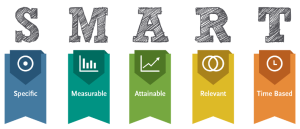
Figure 5.4: Setting SMART Goals
Specific: The who, what, where, when, why, and the which involved with the goal. Define the goal as much as possible with no ambiguous language.
.
Measurable: Can you track the progress and measure the outcome? How much, how many, and how will I know when my goal is accomplished?
.
Attainable: Is the goal reasonable enough to be accomplished? Make sure the goal is not out of reach or below standard performance.
.
Relevant: Is the goal worthwhile and will it meet your and your organization’s needs? Is each goal consistent with other established goals, plans, and timelines?
.
Timely: Your goal should include a time limit. It will establish a sense of urgency and prompt better time management.
.
Setting Objectives
Objectives are shorter-term performance targets that direct the activities of the organization toward the attainment of a goal. They should be clearly stated, achievable, and measurable: they should give target dates for the completion of tasks and stipulate who’s responsible for taking necessary actions. [3]
An organization will have several goals and related objectives. Some will focus on financial measures, such as profit maximization and sales growth. Others will target operational efficiency or quality control. Still, others will govern the company’s relationships with its employees, its community, its environment, or all three.
Finally, goals and objectives change over time. As a firm reassesses its place in its business environment, it rethinks not only its mission but also its approach to fulfilling it.
Tactical Planning
The overall plan is broken down into more manageable, shorter-term components called tactical plans. These plans specify the activities and allocation of resources (people, equipment, money) needed to implement the strategic plan over a given period. Tactical plans have a shorter (less than one year) time frame than strategic plans and more specific objectives designed to support the broader strategic goals. Tactical plans begin to address issues of coordinating and allocating resources to different parts of the organization.
Operational Planning
The tactical plan is then broken down into various operational components that provide detailed action steps to be taken by individuals or groups to implement the tactical and strategic plans. Operational plans cover only a brief period—say, a month or two.
Operational planning creates specific standards, methods, policies, and procedures that are used in specific functional areas of the organization. Operational objectives are current, narrow, and resource-focused. They are designed to help guide and control the implementation of tactical plans.
Planning for Contingencies and Crises
The key to effective planning is anticipating future situations and events. Yet even the best-prepared organization must sometimes cope with unforeseen circumstances, such as a natural disaster, an act of terrorism, or a radical new technology. Therefore, many companies have developed contingency plans that identify alternative courses of action for very unusual or crises. The contingency plan typically stipulates the chain of command, standard operating procedures, and communication channels the organization will use during an emergency.
An effective contingency plan can make or break a company. Consider the example of Marriott Hotels in Puerto Rico. Anticipating Hurricane Maria in 2017, workers at the San Juan Marriott had to shift from their regular duties to handling the needs of not only customers but everyone who needed assistance in the wake of the hurricane that devastated the island. A contingency plan and training for events such as this were a key part of managing this crisis. [4] The company achieved its goal of being able to cater to guests and general needs due to planning and training while having a contingency plan in place. One guest commented on TripAdvisor, “Could not believe how friendly, helpful & responsive staff were even during the height of the hurricane. Special thanks to Eydie, Juan, Jock, Ashley, and security Luis. They kept us safe & were exemplary. Will always stay at Marriott from now on.” [5] Within one month after Hurricane Maria hit, operations were back to normal at the San Juan Marriott. [6]
Managing Change – Boeing Takes Off in New Direction
Boeing and Airbus have been locked in fierce competition for the world’s airplane business for decades. What characterized most of that period was a focus on designing larger and larger airplanes. Since its development in the 1970s, Boeing revamped its pioneering B747 numerous times and at one time boasted over 1,300 jumbo jets in operation around the world. As part of this head-to-head competition for bragging rights to the largest jet in the air, Boeing was working on a 747X, a super-jumbo jet designed to hold 525 passengers. In what seemed to be an abrupt change of strategy, Boeing conceded the super-jumbo segment of the market to its rival and killed plans for the 747X. Instead of trying to create a plane with more seats, Boeing engineers began developing planes to fly fewer people at higher speeds. Then, as the rising price of jet fuel surpassed the airlines’ ability to easily absorb its increasing cost, Boeing again changed its strategy, this time focusing on developing jets that use less fuel. In the end, Boeing’s strategy changed from plane capacity to jet efficiency.
The new strategy required new plans. Boeing managers identified gaps in Airbus’s product line and immediately set out to develop planes to fill them. Boeing announced a new 787 “Dreamliner,” which boasted better fuel efficiency thanks to lightweight composite materials and next-generation engine design. Even though the 787 has less than half the seating of the Airbus A380, Boeing’s Dreamliner is a hit in the market. Orders for the new plane have been stronger than anticipated, forcing Boeing to change its production plans to meet demand. The company decided to accelerate its planned 787 production rate buildup, rolling out a new jet every two days or so.
Airbus was not so lucky. The company spent so much time and energy on its super-jumbo that its A350 (the plane designed to compete with Boeing’s 787) suffered. The 787 uses 15 percent less fuel than the A350, can fly nonstop from Beijing to New York, and is one of the fastest-selling commercial planes ever.
The battle for airline supremacy continues to switch between the two global giants. In 2017, Boeing beat Airbus on commercial jet orders at the Paris Air Show and continues to push forward. A spokesperson has hinted at a hybrid fuselage for midrange planes, which could carry passengers farther at lower costs. If successful, Boeing will regain the market share lost to the Airbus A321. [7] [8] [9] [10] [11] [12] [13]
- What seems to be the difference in how Boeing and Airbus have approached planning?
- Do you think Airbus should change its strategic plans to meet Boeing’s or stick with its current plans? Explain.
Crisis Management
Organizations also face the risk of encountering crises that require immediate attention. Rather than waiting until such a crisis occurs and then scrambling to figure out what to do, many firms practice crisis management. Some, for instance, set up teams trained to deal with emergencies. Members gather information quickly and respond to the crisis while everyone else carries out his or her normal duties. The team also keeps the public, the employees, the press, and government officials informed about the situation and the company’s response to it.
An example of how to handle crisis management involves Wendy’s. After learning that a woman claimed she found a fingertip in a bowl of chili she bought at a Wendy’s restaurant in San Jose, California, the company’s public relations team responded quickly. Within a few days, the company announced that the finger didn’t come from an employee or a supplier. Soon after, the police arrested the woman and charged her with attempted grand larceny for lying about how the finger got in her bowl of chili and trying to extort $2.5 million from the company. But the crisis wasn’t over for Wendy’s. The incident was plastered all over the news as a grossed-out public sought an answer to the question, “Whose finger is (or was) it?” A $100,000 reward was offered by Wendy’s to anyone with information that would help the police answer this question. The challenge Wendy’s faced was how to entice customers to return to its fifty San Francisco–area restaurants (where sales had plummeted) while keeping a low profile nationally. Wendy’s accomplished this objective by giving out free milkshakes and discount coupons to customers in the affected regions and, to avoid calling attention to the missing finger, by making no changes in its national advertising. The crisis-management strategy worked and the story died down (though it flared up temporarily when the police arrested the woman’s husband, who allegedly bought the finger from a coworker who had severed it in an accident months earlier). [14]
Even with crisis-management plans in place, however, it’s unlikely that most companies will emerge from a potentially damaging episode as unscathed as Wendy’s did. For one thing, the culprits in the Wendy’s case were caught, and the public was willing to forgive an organization it viewed as a victim. Given the current public distrust of corporate behaviour, however, companies whose reputations have suffered due to questionable corporate judgment usually don’t fare as well.
- Shopify. (2023, December 5). Investor Day. https://investors.shopify.com/Home/default.aspx ↵
- Parr and Associates. (2014, January 4). How to SWOT Analysis [Video]. YouTube. https://www.youtube.com/watch?v=NVwQNOIu808 ↵
- Safranski, S. and Kwon, I. (1991). Strategic Planning for the Growing Business. U.S. Small Business Administration. Retrieved from: http://webharvest.gov/peth04/20041105092332/http://sba.gov/library/pubs/eb-6.pdf ↵
- Richard Levick, “Crisis Contingency Planning, Risk Assessment Vitally Important in Today’s Climate,” Forbes, https://www.forbes.com, November 16, 2017. ↵
- Trip Advisor website, https://www.tripadvisor.com/ShowUserReviews-g147320-d149920-r526998919-San_Juan_Marriott_Resort_Stellaris_Casino-San_Juan_Puerto_Rico.html, accessed November 15, 2017. ↵
- San Juan Marriott website, http://www.marriott.com/hotels/travel/sjupr-san-juan-marriott-resort-and-stellaris-casino/, accessed November 15, 2017. ↵
- Gillian Rich, “Why Boeing's Paris Air Show Orders Are ‘Staggering’,” http://www.investors.com, June 22, 2017 ↵
- Jon Ostrower, “Boeing vs. Airbus: A New Winner Emerges at the Paris Air Show,” CNN, http://money.cnn.com, June 22, 2017 ↵
- Gillian Rich, “’Hybrid’ Design for New Boeing Midrange Jet Could Hit This Sweet Spot,” http://www.investors.com, June 20, 2017 ↵
- Alex Taylor, III, “Boeing Finally Has a Flight Plan,” Fortune, June 13, 2005, pp. 27–28; J. Lynn Lunsford and Rod Stone, “Boeing Net Falls, but Outlook Is Rosy,” The Wall Street Journal, July 28, 2005, p. A3 ↵
- Carol Matlack and Stanley Holmes, “Why Airbus Is Losing Altitude,” Business Week, June 20, 2005, p. 20 ↵
- J. Lynn Lunsford, “UPS to Buy 8 Boeing 747s, Lifting Jet’s Prospects,” The Wall Street Journal, September 18, 2005, p. A2 ↵
- “Airbus to Launch A350 Jet in October,” Xinhua News Agency, September 14, 2005, online; “Boeing Plans Major Change,” Performance Materials, April 30, 2001, p. 5. ↵
- Richtel, M. (2005, April 29). Wendy’s Gets a Break, But Still Has Work Ahead of it. The New York Times. Retrieved from: http://www.nytimes.com/2005/04/29/business/media/wendys-gets-a-break-but-still-has-work-ahead-of-it.html?_r=0 ↵
The process of determining the organization's goals and strategies for achieving them. This includes developing long-term plans, as well as short-term operational plans.
Involves creating long-range (one to five years), broad goals for the organization and determining what resources will be needed to accomplish those goals. Evaluating external environmental factors such as economic, technological, and social issues is critical to successful strategic planning.
Assessing a company's fit with its environment by analyzing an organization's strengths, weaknesses, opportunities, and threats.
Major accomplishments that the company wants to achieve over a long period.
Shorter-term performance targets that direct the activities of the organization toward the attainment of a goal.
These plans specify the activities and allocation of resources (people, equipment, money) needed to implement the strategic plan over a given period. Tactical plans have a shorter (less than one year) time frame than strategic plans and more specific objectives designed to support the broader strategic goals.
The plan is then broken down into various operational components that provide detailed action steps to be taken by individuals or groups to implement the tactical and strategic plans. Entails creating specific standards, methods, policies, and procedures that are used in specific functional areas of the organization.
An established plan that enabled the organization to prepare for unforeseen circumstances, such as a natural disaster, an act of terrorism, or a radical new technology.