
The Functions of Management

The functions of management are a set of interrelated activities fundamental to any organization’s success. The four main functions of management are planning, organizing, leading, and controlling. These functions are integral to the process of achieving organizational goals and objectives and ensuring that resources are used efficiently and effectively.
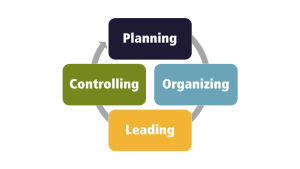
Figure 5.1: The Functions of Management
The Planning Function
Planning is the process of determining the organization’s goals and strategies for achieving them. This includes developing long-term plans, as well as short-term operational plans.
Without a plan, it’s hard to succeed at anything. The reason is simple: if you don’t know where you’re going, you can’t move forward. Successful managers decide where they want to be and then figure out how to get there; they set goals and determine the best way to achieve them. As a result of the planning process, everyone in the organization knows what should be done, who should do it, and how to do it.
Developing a Strategic Plan
Coming up with an idea—say, starting a note-taking business—is a good start, but it’s only a start. Planning for it is a step forward. Planning begins at the highest level and works its way down through the organization. Step one is usually called strategic planning: the process of establishing an overall course of action. To begin this process, you should ask yourself a couple of very basic questions: why, for example, does the organization exist? What value does it create? Sam Walton posed these questions in the process of founding Walmart: his new chain of stores would exist to offer customers the lowest prices with the best possible service. [1]
Once you’ve identified the purpose of your company, you’re ready to take the remaining steps in the strategic planning process:
- Write a mission statement that tells customers, employees, and others why your organization exists.
. - Identify core values or beliefs that will guide the behavior of members of the organization.
. - Assess the company’s strengths, weaknesses, opportunities, and threats.
. - Establish goals and objectives, or performance targets, to direct all the activities that you’ll perform to achieve your mission.
. - Develop and implement tactical and operational plans to achieve goals and objectives.
The Organizing Function
A second key function of managers is organizing, which is the process of coordinating and allocating a firm’s resources to carry out its plans. Organizing includes developing a structure for the people, positions, departments, and activities within the firm. Managers can arrange the structural elements of the firm to maximize the flow of information and the efficiency of work processes. They accomplish this by doing the following:
- Dividing up tasks (a division of labor)
. - Grouping jobs and employees (departmentalization)
. - Assigning authority and responsibilities (delegation)
The Leading Function
Leading, the third key management function, is the process of guiding and motivating others toward the achievement of organizational goals. A leader can be anyone in an organization, regardless of position, able to influence others to act or follow, often by their own choice. Managers are designated leaders according to the organizational structure but may need to use negative consequences or coercion to achieve change. In the organization structure, top managers use leadership skills to set, share, and gain support for the company’s direction and strategy—mission, vision, and values, as Jeff Bezos does at Amazon. Middle and supervisory management use leadership skills in the process of directing employees daily as the employees carry out the plans and work within the structure created by management. Top-level leadership demonstrated by Bezos was also exhibited by Jack Welch while leading General Electric and led to many studies of his approach to leadership. Organizations, however, need strong effective leadership at all levels to meet goals and remain competitive.
The Controlling Function
The fourth key function that managers perform is controlling. Controlling is the process of assessing the organization’s progress toward accomplishing its goals. It includes monitoring the implementation of a plan and correcting deviations from that plan. As shown below, controlling can be visualized as a cyclical process made up of five stages:
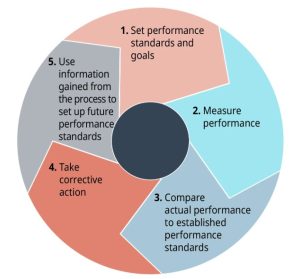
Figure 5.2: The Control Process
Performance standards are the levels of performance the company wants to attain. These goals are based on strategic, tactical, and operational plans. The most effective performance standards state a measurable behavioral objective that can be achieved in a specified time frame. For example, the performance objective for the sales division of a company could be stated as “$200,000 in gross sales for January.” Each employee in that division would also have a specified performance goal. Actual firm, division, or individual performance can be measured against desired performance standards to see if a gap exists between the desired level of performance and the actual level of performance. If a performance gap does exist, the reason for it must be determined and corrective action taken.
Feedback is essential to the process of control. Most companies have a reporting system that identifies areas where performance standards are not being met. A feedback system helps managers detect problems before they get out of hand. If a problem exists, the managers take corrective action. Toyota uses a simple but effective control system on its automobile assembly lines. Each worker serves as the customer for the process just before his or hers. Each worker is empowered to act as a quality control inspector. If a part is defective or not installed properly, the next worker won’t accept it. Any worker can alert the supervisor to a problem by tugging on a rope that turns on a warning light (i.e., feedback). If the problem isn’t corrected, the worker can stop the entire assembly line.
Why is controlling such an important part of a manager’s job? First, it helps managers to determine the success of the other three functions: planning, organizing, and leading. Second, control systems direct employee behavior toward achieving organizational goals. Third, control systems provide a means of coordinating employee activities and integrating resources throughout the organization.
- Walmart. (2016). Our Story. Walmart.com. Retrieved from: http://corporate.walmart.com/our-story/our-history ↵
The process of determining the organization's goals and strategies for achieving them. This includes developing long-term plans, as well as short-term operational plans.
The process of coordinating and allocating a firm's resources in order to carry out its plans. Organizing includes developing a structure for the people, positions, departments, and activities within the firm.
The process of guiding and motivating others toward the achievement of organizational goals.
The process of assessing the organization's progress toward accomplishing its goals.