Personal and Business Ethics
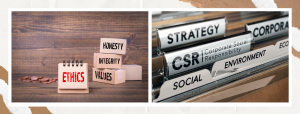
What are Ethics?
Personal ethics refers to the principles and values that an individual considers important and uses as a guide for their behaviour and decision-making in daily life. These ethical principles are shaped by a combination of personal beliefs, cultural influences, upbringing, experiences, and moral philosophies. Personal ethics determine how an individual distinguishes right from wrong, guide their interactions with others, and influences their choices and actions.
Personal ethics can encompass a wide range of moral principles, such as honesty, integrity, responsibility, fairness, respect for others, and compassion. While these principles can be universally recognized, the priority and interpretation of these values can vary greatly from one individual to another.
Personal ethics play a crucial role in shaping an individual’s character and how they engage with the world around them. They provide a moral framework for making decisions, influencing behaviour in both personal and professional contexts, and contributing to an individual’s sense of identity and purpose.
Consider Your Own Ethics
What factors have influenced your individual value system or personal code of ethics?
What moral guide your behaviour and decisions?
How do you stay true to your own values and personal code of ethics?
As a business student and professional, one of your key tasks is learning how to recognize and deal with the ethical challenges that will confront you. When asked what he looked for in a new hire, Warren Buffet, the world’s most successful investor, replied:
“I look for three things. The first is personal integrity, the second is intelligence, and the third is a high energy level.” He paused and then added: “But if you don’t have the first, the second two don’t matter“. [1]
Business Ethics
It is in the best interest of the company to operate ethically. Trustworthy companies are better at attracting and keeping customers, talented employees, and capital. Those tainted by questionable ethics suffer from dwindling customer bases, employee turnover, and investor mistrust.
Business ethics refers to the principles and standards that guide behaviour in business. It involves applying ethical considerations to business operations and decision-making processes, encompassing a wide range of issues such as corporate governance, insider trading, bribery, discrimination, corporate social responsibility, and fiduciary responsibilities. Business ethics ensures that a certain required level of trust exists between consumers and businesses in the market.
The goal of business ethics is to ensure that organizations operate in a manner that is fair, ethical, and beneficial to all stakeholders, including employees, customers, suppliers, and the wider community. It encourages businesses to balance profit-making activities with activities that benefit society; it also involves developing principles and practices that reflect a business’s commitment to ethical behaviour and compliance with legal standards.
Acting ethically in business means more than simply obeying applicable laws and regulations. It also means being honest, doing no harm to others, competing fairly, and declining to put your own interests above those of your company, its owners, and its workers. If you’re in business, you obviously need a strong sense of what’s right and wrong. You need the personal conviction to do what’s right, even if it means doing something that’s difficult or personally disadvantageous.
People choose between right and wrong based on their personal code of ethics. They are also influenced by the ethical environment created by their employers. Consider the following headlines [2] [3] [4]:
- Investment advisor Bernie Madoff was sentenced to 150 years in prison for defrauding clients out of more than $65 billion.
- Former United Airlines CEO Jeff Smisek leaves the company after a federal investigation into whether United tried to influence officials at the Port Authority of New York.
- Renaud Laplanche, the founder of Lending Club, loses his job because of faulty practices and conflicts of interest at the online peer-to-peer lender.
- Wells Fargo CEO John Stumpf was fired after company employees opened more than 2 million fake accounts to meet aggressive sales targets.
As these actual stories illustrate, poor business ethics can create a very negative image for a company, can be expensive for the firm and/or the executives involved, and can result in bankruptcy and jail time for the offenders. Organizations can reduce the potential for these types of liability claims by educating their employees about ethical standards, by leading through example, and through various formal and informal programs.
Tips to Maintain Honesty and Integrity
- Follow your code of personal conduct; act according to your convictions rather than doing what’s convenient (or profitable) at the time.
- While at work, focus on your job, not on nonwork-related activities, such as browsing social media or taking personal phone calls.
- Don’t take office supplies or products or other company resources for your use.
- Be honest with customers, management, coworkers, competitors, and the public.
- Remember that it’s the small, seemingly trivial, day-to-day activities and gestures that build your character.
The Volkswagen Emissions Scandal [5]
The Volkswagen emissions scandal, also known as “Dieselgate,” is a high-profile case of corporate fraud that emerged in September 2015. The scandal involves Volkswagen Group, one of the largest car manufacturers in the world, deliberately installing software in its diesel-powered cars to cheat on emissions tests. The software enabled the cars to emit up to 40 times more pollutants than allowed by law, including nitrogen oxide (NOx), which is a major contributor to air pollution and has been linked to serious health problems. The scandal caused a significant public outcry and resulted in lawsuits, fines, and a major hit to Volkswagen’s reputation and financial performance. [6] [7]
- Gostick, A., & Telford D. (2003). The Integrity Advantage. Salt Lake City: Gibbs Smith. ↵
- “Top 10 Crooked CEOs,” TIME, http://content.time.com, accessed June 23, 2017 ↵
- Jena McGregor, “More CEOs Are Getting Forced Out for Ethics Violations,” Washington Post, https://www.washingtonpost.com, May 15, 2017 ↵
- Adam Hartung, “Wells Fargo CEO Stumpf Is Gone: Is This the Beginning of Wholesale Leadership Change?” Forbes, http://www.forbes.com, October 13, 2016. ↵
- CNN Business. (2016, June 28). Volkswagen emissions scandal: A timeline [Video]. YouTube. https://www.youtube.com/watch?v=Y5TvFY7xRDM ↵
- EPA. (2015, September 18). EPA, California Notify Volkswagen of Clean Air Act Violations / Carmaker allegedly used software that circumvents emissions testing for certain air pollutants. https://www.epa.gov/newsreleases/epa-california-notify-volkswagen-clean-air-act-violations ↵
- The Guardian. (2015, September 22). Volkswagen scandal: what you need to know. https://www.theguardian.com/business/2015/sep/22/volkswagen-scandal-what-you-need-to-know ↵
The principles and values that an individual considers important and uses as a guide for their behaviour and decision-making in daily life.
The principles and standards that guide behaviour in business.