
5.2 Safety Measures and Standards
As you’ve learned, medical device reprocessing is the process of cleaning, disinfecting, and sterilizing medical devices to ensure their safe reuse. Within the reprocessing area, there are several risks including environmental, chemical, physical, and biological risks. In this chapter, you will learn about the role of safety protocols and safe work practices within reprocessing areas.
Safety Standards, Policies and Procedures in Reprocessing
In the medical device reprocessing area, policies and procedures serve as essential tools to guide MDRTs in performing their duties safely, consistently, and in compliance with regulatory standards, such as Canadian Standards Association (CSA) medical device reprocessing standards for all healthcare settings (2023). In addition, documents such Standard Operating Procedures (SOPs) outline step-by-step instructions for handling, cleaning, disinfecting, and sterilizing reusable medical instruments, helping to prevent infection and ensure patient safety. They also provide clear direction on the correct use of personal protective equipment (PPE), safe chemical handling, equipment maintenance, and what to do in the event of a spill or exposure incident. All staff are expected to follow these procedures closely to maintain a high standard of care, reduce risk, and support a safe working environment. Regular review and training ensures MDRTs remain up to date with the latest practices and safety expectations.
Manufacturer’s Instructions for Use (MIFUs) are essential documents that outline the specific steps required to safely and effectively clean, disinfect, and sterilize a medical device. These instructions are validated by the manufacturer and take into account the device’s design, materials, and intended use.
MIFUs ensure that MDRTs follow procedures that have been tested and approved by the device manufacturer, including required cleaning agents, temperature limits, sterilization methods (e.g., steam, ethylene oxide), and cycle durations. Ignoring or misinterpreting MIFUs can compromise patient safety, result in regulatory non-compliance, and may even void the device’s warranty. Adhering to MIFUs is a key to reducing infection risk and ensuring devices perform as intended with every use.
Routine Practices
Certain routine practices are required every day or throughout the day to ensure the safety of those working in the Medical Device Reprocessing Area (MDRA). Some of these practices will be discussed in more detail later in the chapter; however, these routine practices often include the following:
- Hand hygiene
- Aseptic techniques
- Use and selection of proper personal protective equipment (PPE)
- Disinfection and cleaning of the work environment
- Disinfection and cleaning of equipment
- Handling of waste, linens, and sharps
- Prevention of blood-borne pathogen transmission
- Routine education and training related to workplace safety
- Infection prevention and control practices
(Canadian Standards Association, 2023)
This is not an exhaustive list, but it does provide examples of routine practices that are conducted one or more times every day in the MDRA.
Environmental Risks in Reprocessing Area
Environmental risks in a medical device reprocessing area refer to hazards in the physical workspace that can impact the safety of both staff and reprocessed instruments and medical devises. Common environmental risks include inadequate ventilation, improper zoning (mixing clean and dirty areas), and improper waste disposal. For instance, insufficient airflow can lead to the accumulation of harmful vapors from disinfectants, posing respiratory hazards to staff. Additionally, inadequate separation between clean and dirty zones can result in cross-contamination of sterilized instruments and medical devices.
Maintaining a controlled environment is crucial to mitigate these risks. Implementing measures such as positive-pressure ventilation in clean areas and negative-pressure in dirty zones helps prevent the transfer of contaminants. Regular monitoring of air quality, proper waste segregation, and adherence to established protocols for chemical handling further contribute to a safe and effective reprocessing environment. By addressing these environmental factors, healthcare facilities can enhance the safety of both staff and patients.
Chemical Risks in the Reprocessing Area
Chemical risks in a medical device reprocessing area stem from the use of various cleaning agents, disinfectants, and sterilants that are essential for ensuring the safety and cleanliness of reusable medical devices. These chemicals, while effective in eliminating pathogens, can pose significant risks to the health and safety of MDRTs if not handled properly. Exposure to hazardous chemicals may occur through skin contact, inhalation of fumes or vapors, or accidental ingestion. Common chemicals used in reprocessing, such as glutaraldehyde, hydrogen peroxide, and chlorine-based disinfectants, can be toxic, corrosive, or irritating to the eyes, skin, and respiratory system. Understanding the risks associated with these chemicals and adhering to safety guidelines is critical to maintaining a safe work environment.
To reduce these chemical risks, proper safety protocols must be followed at all times. Personal protective equipment (PPE) such as gloves, masks, goggles, and gowns should be worn when handling chemicals, and adequate ventilation systems must be in place to reduce exposure to harmful vapors. Additionally, MDRTs should be familiar with the Workplace Hazardous Materials Information System (WHMIS) and safety data sheets (SDS) for each chemical in use. Clear labeling, correct storage, and proper disposal of chemicals further minimizes the potential for accidents and spills. Healthcare facilities provide training to ensure MDRTs can safely identify and handle hazardous chemicals. By adhering to these procedures and maintaining strong awareness of chemical safety, the risks of exposure in reprocessing areas can be effectively controlled.
Physical Hazards in Reprocessing
The most common physical safety hazard in a medical device reprocessing area is the risk of sharp objects and needles. Medical devices like surgical instruments, syringes, and scalpels can be contaminated with pathogens after use, posing a risk of cuts or punctures to reprocessing professionals during the cleaning, disinfection, or sterilization process. Accidental injuries from sharp objects can lead to bloodborne pathogen exposure, such as HIV, Hepatitis B, and Hepatitis C, making it a serious safety concern.
There are two types of sharps: reusable sharps and single-use sharps. Reusable medical devices that are sharp, such as scissors and skin hooks, or devices that have sharp components are segregated in the MDRA to protect staff. Specific procedures are followed to reprocess and handle reusable sharps and are discussed elsewhere.
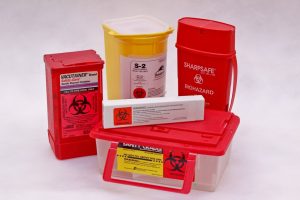
Single-use sharps are intended to be disposed of safely at the location where they are used. Sometimes single-use sharps such as syringes, suture needles, and scalpel blades are not disposed of where they are used and end up in the MDRA. If single-use sharps are found in the MDRA, they need to be handled and disposed of safely in a puncture-resistant sharps contain as shown in Figure 5.1, reported to a supervisor, and an incident report completed. Sharps are hazardous, and any incident of them arriving in the MDRA must be reported to prevent the incident from occurring in the future (Canadian Standards Association, 2023).
Biological Hazards in a Reprocessing Area
The most common biological safety hazard in a medical device reprocessing area is exposure to infectious microorganisms, such as bloodborne pathogens (HIV, Hepatitis B, and Hepatitis C), bacteria, viruses, fungi, and prions. These pathogens are often present on used medical instruments and medical devices that have come into contact with blood, bodily fluids, or tissues.
A blood or body fluid (BBF) exposure is defined as an exposure to potentially infectious body fluids or blood through the following methods:
- Percutaneous exposure: A puncture wound by a sharp object or needle
- Permucosal exposure: Body fluids or blood that splashes onto your mucous membranes
- Non-intact skin exposure: Exposure through eczema, an open wound, lesion, or scratch (BC Centre for Disease Control, 2021).
Prior to reprocessing, you need to perform a risk assessment. If you know you will potentially be exposed to body fluids or blood, such as when you work in the decontamination area, you must determine what PPE you will need to ensure your safety and decrease the risk of transmission. For example, using clean gloves when handling all blood and body fluids, wearing a gown if blood or body fluids may touch your uniform or exposed skin, wearing a face shield if body fluids may splash, and following additional precautions as required by policies and procedures at the facility.
If exposure does occur, you need to adhere to the healthcare facility’s policies and report the incident to your supervisor or manager, occupational health, and the Infection Prevention and Control (IPAC) team. A thorough assessment is required to determine immediate actions, prophylaxis care, and follow-up, including prevention education.
The above content includes some, but not all, safety considerations when working in the MDRA. Be sure to refer to your facility’s policies and procedures and ensure that safety standards are upheld. Your own safety and that of other healthcare providers and patients relies on adhering to the facility’s standards. The next few sections of this chapter will focus on infection prevention and control because it is an integral aspect of safety in the MDRA.
Attribution
Unless otherwise indicated, material on this page has been adapted from the following resource:
Hughes, M., Kenmir, A., St-Amant, O., Cosgrove, C., & Sharpe, G. (2021). Introduction to infection prevention and control practices for the interprofessional learner. eCampusOntario. https://ecampusontario.pressbooks.pub/introductiontoipcp/, licensed under CC BY-NC 4.0
References
BC Centre for Disease Control (BCCDC). (2021). Communicable disease control: Blood and body fluid exposure management. http://www.bccdc.ca/resource-gallery/Documents/Guidelines%20and%20Forms/Guidelines%20and%20Manuals/Epid/CD%20Manual/Chapter%201%20-%20CDC/BBFE%20Guidelines%20FINAL%20April_2021.pdf.
Canadian Standards Association (CSA). (2023). CSA Z314:23 – Canadian medical device reprocessing in all health care settings. CSA Group. https://www.csagroup.org/store/product/CSA%20Z314:23/
Image Credits
(Images are listed in order of appearance)
Improperly Discarded ‘Sharps’ Can Be Dangerous (6322401410) by U.S. Food and Drug Administration, Public domain

.jpg)