
5.3 Infection Prevention and Control (IPC) Basics
(Alberta Health Services, 2017)
How Infections Spread
The World Health Organization’s (WHO) International Classification of Diseases (ICD) is used in clinical fields to classify diseases and monitor morbidity and mortality (Parker et al., 2016). In this section, we will discuss some of the terminology used by the ICD and in healthcare professions in general to describe and categorize various types of disease.
An infectious disease is any disease caused by the direct effect of a pathogen (Parker et al., 2016). A pathogen may be cellular, such as bacteria, parasites, and fungi, or acellular, such as viruses, viroids, and prions. Some infectious diseases are also communicable, meaning that they are capable of being spread from person to person through direct or indirect mechanisms. Some infectious communicable diseases are also considered contagious, meaning that they are easily spread from person to person (Parker et al., 2016). Not all contagious diseases are equally so; the degree to which a disease is contagious usually depends on how the pathogen is transmitted. For example, measles is a highly contagious viral disease that can be transmitted when an infected person coughs or sneezes and an uninfected person breathes in droplets containing the virus. Gonorrhea is not as contagious as measles because transmission of the pathogen, Neisseria gonorrhoeae, requires close, intimate contact between an infected person and an uninfected person (Parker et al., 2016).
The ability of a microbial agent to cause disease is called pathogenicity, and the degree to which an organism is pathogenic is called virulence (Parker et al., 2016). Virulence is a continuum. On one end of the spectrum are organisms that are avirulent, meaning “not harmful,” and on the other are organisms that are highly virulent. Highly virulent pathogens will almost always lead to a disease state when introduced to the body, and some may even cause multi-organ and body system failure in healthy individuals. Less virulent pathogens may cause an initial infection but may not always cause severe illness. Pathogens with low virulence would more likely result in mild signs and symptoms of disease, such as low-grade fever, headache, or muscle aches. Some individuals might even be asymptomatic (Parker et al., 2016).
An example of a highly virulent microorganism is Bacillus anthracis, the pathogen responsible for anthrax. B. anthracis can produce different forms of disease depending on the route of transmission, such as cutaneous injection, inhalation, or ingestion (Parker et al., 2016). The most serious form of anthrax is inhalation anthrax. After B. anthracis spores are inhaled, they germinate. An active infection develops, and the bacteria release potent toxins that cause edema, hypoxia, and necrosis. Signs and symptoms of inhalation anthrax include high fever, difficulty breathing, vomiting and coughing up blood, and severe chest pains suggestive of a heart attack. With inhalation anthrax, the toxins and bacteria enter the bloodstream, which can lead to multi-organ failure and the death of the patient. If a gene or genes involved in pathogenesis is inactivated, the bacteria become less virulent or nonpathogenic (Parker et al., 2016).
Healthcare-Associated Infections
Infections acquired in healthcare facilities, including hospitals, are called nosocomial infections or healthcare-associated infections (HAIs). When infection prevention and control practices are used consistently, the transfer of healthcare-associated infections can be prevented. HAIs are often related to surgery or other invasive procedures that provide the pathogen with access to a portal of entry. For an infection to be classified as an HAI, the client must have been admitted to the healthcare facility for a reason other than the infection (Hannon & Porth, 2016). In these settings, clients suffering from a primary disease are often afflicted with compromised immunity and are more susceptible to secondary infection and opportunistic pathogens. HAIs often occur when pathogens are introduced to clients’ bodies through contaminated surgical or medical equipment, such as catheters and respiratory ventilators.
Several factors contribute to the prevalence and severity of nosocomial diseases. Firstly, sick patients bring numerous pathogens into hospitals, and some of these pathogens can be transmitted easily via improperly sterilized medical equipment, bedsheets, call buttons, door handles, or by clinicians, nurses, or therapists who do not wash their hands before touching a patient. Secondly, many hospital patients have weakened immune systems, making them more susceptible to infections. Compounding this, the prevalence of antibiotics in hospital settings can select for drug-resistant bacteria that may cause very serious infections that are difficult to treat (Parker et al., 2016).
Estimates suggest that over 220,000 people contract an HAI each year, approximately one in every nine hospitalized clients, with mortality rates fluctuating between 3.2% and 4.3% per 100 cases between 2013 and 2017 (Public Health Agency of Canada, 2019). HAIs can cause symptoms ranging from asymptomatic colonization to septic shock and death. This results in increased suffering for clients and increased healthcare costs for Canadians (Public Health Agency of Canada, 2019).
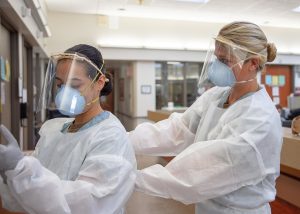
Prior to providing care, healthcare providers must perform a point-of-care risk assessment of the environment before every interaction with clients to ensure safe care and determine the potential risk for exposure to infections. Risks include exposure to blood, body fluids, mucous membranes, non-intact skin, contaminated surfaces or soiled items, and even airborne particles. Once you have completed a risk assessment, you need to assess how to decrease your risk of exposure, determine the infection prevention and control practices required to minimize your risk, such as hand hygiene and required PPE, and identify how to prevent transmission to others (Provincial Infectious Diseases Advisory Committee, 2012). Hand hygiene is considered the most important and effective measure to prevent HAIs. Figures 5.2 and 5.3 show the practice of using PPE and regular handwashing as a way to decrease the risk of exposure.

Diseases that are contracted as the result of a medical procedure are known as iatrogenic diseases (Parker et al., 2016). Iatrogenic diseases can occur after procedures involving wound treatment, catheterization, or surgery if the wound or surgical site becomes contaminated (Parker et al., 2016). For example, an individual treated for a skin wound might acquire necrotizing fasciitis, an aggressive “flesh-eating” disease if bandages or other dressings became contaminated by Clostridium perfringens or one of several other bacteria that can cause this condition (Parker et al., 2016).
Medical and Sterile Asepsis
There are two types of techniques used to prevent the spread of infections: medical asepsis and sterile asepsis. Medical asepsis, or clean technique, reduces and prevents the spread of microorganisms. Examples include hand hygiene, using personal protective equipment (PPE), and following routine practices.
Sterile asepsis, or sterile technique, is a strict technique to eliminate all microorganisms from an area. Examples include using steam, hydrogen peroxide, or other sterilizing agents on surgical tools.
Both of these techniques are integral in health care and are used differently depending on the context, need, and intended use of equipment or an area.
Key Concept
A key concept in reprocessing is the difference between clean, disinfected, and sterile.
In medical reprocessing, clean means that visible soil and biomaterial has been removed from the surfaces. Although a surface may appear clean, it can still have millions of microorganisms. All medical devices must be thoroughly cleaned before they can be disinfected or sterilized.
Disinfected means that microorganisms have been removed to a safe level, though some fungal spores may still be present.
Sterile means that all microorganisms, including spores, have been eliminated. In a later chapter, we will explore whether a device needs to be disinfected or sterilized based on the Spaulding Classification System.
Attribution
Unless otherwise indicated, material on this page has been adapted from the following resource:
Hughes, M., Kenmir, A., St-Amant, O., Cosgrove, C., & Sharpe, G. (2021). Introduction to infection prevention and control practices for the interprofessional learner. eCampusOntario. https://ecampusontario.pressbooks.pub/introductiontoipcp/, licensed under CC BY-NC 4.0
References
Alberta Health Services. (2017, July 11). Transmission of microorganisms in the healthcare Environment [Video]. YouTube. https://youtu.be/BOqtOG_rKgI
Canadian Nosocomial Infection Surveillance Program. (2020). Healthcare-associated infections and antimicrobial resistance in Canadian acute care hospitals, 2014–2018, 46(5), 99–112. https://doi.org/10.14745/ccdr.v46i05a01 , licensed under CC BY 4.0
Hannon, R. A., & Porth, C. M. (2016). Porth pathophysiology: Concepts of altered health states (2nd Canadian ed.). Wolters Kluwer.
Parker, N., Schneegurt, M., Thi Tu, A.-H., & Forster, B. M. (2016). Microbiology. OpenStax. https://openstax.org/details/books/microbiology
Public Health Agency of Canada. (2019). The Canadian Nosocomial Infection Surveillance Program (CNISP): Summary report of healthcare associated infection (HAI), antimicrobial resistance (AMR) and antimicrobial use (AMU) surveillance data from January 1, 2013, to December 31, 2017. Government of Canada. https://www.canada.ca/content/dam/canada/public-health/services/publications/science-research-data/summary-report-healthcare-associated-infection-antimicrobial-resistance-antimicrobial-use-surveillance-data-2013-2017/CNISP-2013-2017-Report-EN-WEB-v2.pdf
Provincial Infectious Diseases Advisory Committee (PIDAC) & Ontario Agency for Health Protection and Promotion. (2012). Routine practices and additional precautions in all health care settings (3rd ed.). Public Health Ontario. https://www.publichealthontario.ca/-/media/documents/B/2012/bp-rpap-healthcare-settings.pdf?la=en
Image Credits
(Images are listed in order of appearance)
Medical personnel don PPE before entering a COVID-19-positive, non-critical patient’s room (50199060167) by Petty Officer 3rd Class Jacob L Greenberg/U.S. Navy, Public domain
Prevention of spreading of covid-19 method by Davyimage, CC BY-SA 4.0
The number of cases of a disease
The number of deaths caused by a disease
A type of microorganism that is not composed of cells
Without symptoms
Fluid buildup in tissues
A condition that prevents oxygen from reaching tissues
Cell death and inflammation

.jpg)
