
4.2 Basic Microbiology Concepts
From boiling thermal hot springs to deep beneath the Antarctic ice, microorganisms can be found almost everywhere on Earth in great quantities. Microorganisms (or microbes, as they are also called) are small organisms. Most are so small that they cannot be seen without a microscope. Microbiology is the study of these microscopic organisms.
Most microorganisms are harmless to humans and, in fact, many are helpful. They play fundamental roles in ecosystems everywhere on the planet, forming the backbone of many food webs. People use them to make biofuels, medicines, and even foods. Without microbes, there would be no bread, cheese, or beer. Our bodies are filled with microbes, and our skin alone is home to trillions of them. Some of them we can’t live without, whereas others cause diseases that can make us sick or even kill us.
Although much more is known today about microbial life than ever before, the vast majority of this invisible world remains unexplored. Microbiologists continue to identify new ways that microbes benefit and threaten humans.
Classification of Microorganisms
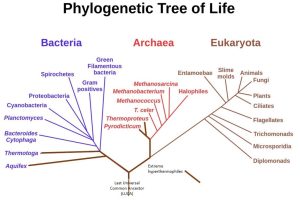
Classification of microorganisms and organisms, or the determination of how to group them, continually changes as we acquire new information and new tools for assessing their characteristics (Bruslind, 2019). Currently, all organisms are grouped into one of three categories or domains: Bacteria, Archaea, and Eukarya. The three-domain classification system, first proposed by Carl Woese in the 1970s, is based on ribosomal RNA (rRNA) sequences and is widely accepted by scientists today as the most accurate current portrayal of organism relatedness (Bruslind, 2019). Figure 4.1 provides an image of the phylogenetic tree of life that divides all organisms among the three domains.
Bacteria
The Bacteria domain contains some of the best known microbial examples, such as Escherichia coli (Bruslind, 2019). Most of the members are unicellular, lack a nucleus or any other organelles, have a cell wall with a particular substance known as peptidoglycan (which is not found anywhere else but in bacteria), and are common in soil, water, our foods, and our own bodies (Bruslind, 2019).
Archaea
Archaea is a relatively new domain—these organisms used to be grouped in the Bacteria domain. There are some obvious similarities because member of Archaea are mostly unicellular, the cells lack a nucleus or any other organelles, they have 70S ribosomes, and all are microbes (Bruslind, 2019). However, they have completely different cell walls that can vary markedly in composition but lack the peptidoglycan found in members of the Bacteria domain. In addition, their rRNA sequences have shown that they are not closely related to Bacteria at all (Bruslind, 2019).
Eukarya
The Eukarya domain includes many non-microbes, such as animals and plants, but there are numerous microbial examples as well, including as fungi, protists, slime moulds, and water moulds (Bruslind, 2019). The eukaryotic cell type has a nucleus, as well as many organelles, such as mitochondria or an endoplasmic reticulum. They are commonly found as unicellular or multicellular organisms (Bruslind, 2019).
Viruses
Viruses are not part of the three-domain classification system because they lack ribosomes, and therefore lack rRNA sequences for comparison (Bruslind, 2019). They are classified separately, using characteristics specific to viruses. Viruses are typically described as obligate intracellular parasites, a reference to their strict requirement for a host cell in order to replicate or increase in number. These acellular entities are often agents of disease, a result of their cell invasion (Bruslind, 2019).
Characteristics of Microorganisms
Once microorganisms became visible to humans with the help of microscopes, scientists began to realize their enormous diversity. Microorganisms vary in all sorts of ways, including their size, appearance, and rates of reproduction. Most microorganisms are unicellular and small enough that they require artificial magnification to be seen. However, some unicellular microorganisms are visible to the naked eye, and some multicellular organisms are microscopic.
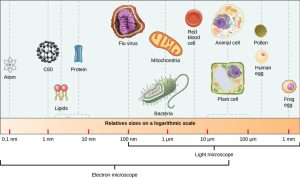
An object must measure about 100 micrometres (µm) to be visible without a microscope, but most microorganisms are many times smaller than that. For some perspective, consider that a typical animal cell measures roughly 10 µm across but is still microscopic. Bacterial cells are typically about 1 µm, and viruses can be 10 times smaller than bacteria. Figure 4.2 below provides an illustration of the differing sizes of some of these microorganisms.
Specialties within Microbiology
Microbiology is a broad term that encompasses the study of all types of microorganisms. But in practice, microbiologists tend to specialize in one of several subfields. For example, bacteriology is the study of bacteria, mycology is the study of fungi, protozoology is the study of protozoa, parasitology is the study of helminths (worms) and other parasites, and virology is the study of viruses. Immunology, the study of the immune system, is often included in the study of microbiology because host–pathogen interactions are central to our understanding of infectious disease processes. Microbiologists can also specialize in certain areas of microbiology, such as clinical microbiology, environmental microbiology, applied microbiology, or food microbiology.
Attribution
Unless otherwise indicated, material on this page has been adapted from the following resource:
Parker, N., Schneegurt, M., Tu, A.-H. T., Lister, P., & Forster, B. M. (2016). Microbiology. OpenStax. https://openstax.org/details/books/microbiology licensed under CC BY 4.0
References
Bruslind, L. (2019). General microbiology. https://open.oregonstate.education/generalmicrobiology/, licensed under CC BY-NC 4.0
Kaiser, G. (2025). Microbiology. LibreTexts. https://bio.libretexts.org/Bookshelves/Microbiology/Microbiology_(Kaiser), licensed under CC BY 4.0
Image Credits
(Images are listed in order of appearance)
Phylogenic tree by John D. Croft, CC BY-SA 3.0
Relative size of microscopic entities by Charles Molnar and Jane Gair, OpenStax, CC BY-SA 4.0
Composed of only one cell
Composed of more than one cell
A type of microorganism that is not composed of cells