
3.7 Digestive and Endocrine Systems
Digestive System Overview and Functions
The function of the digestive system (Figure 3.26) is to break down food, release its nutrients, and absorb those nutrients into the body. The small intestine is the pillar of the system. It is where the majority of digestion occurs and where most of the released nutrients are absorbed into the blood. However, each of the digestive system organs makes a vital and necessary contribution to this process.
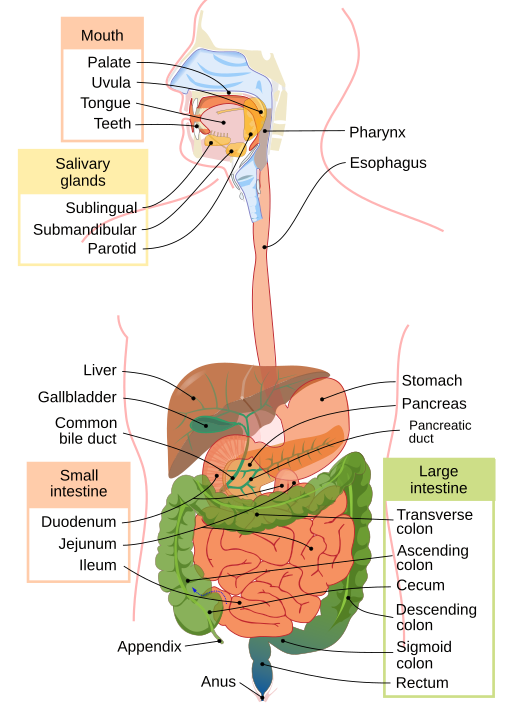
As is the case with all body systems, the digestive system does not work in isolation; it functions cooperatively with the other systems of the body (Betts et al., 2013). Consider for example, the interrelationship between the digestive and cardiovascular systems. Arteries supply the digestive organs with oxygen and processed nutrients, and veins drain the digestive tract. These intestinal veins, constituting the hepatic portal system, are unique—they do not return blood directly to the heart; rather, the blood is diverted to the liver where its nutrients are off-loaded for processing before blood completes its circuit back to the heart (Betts et al., 2013). At the same time, the digestive system provides nutrients to the heart muscle and vascular tissue to support their functioning.
The interrelationship of the digestive and endocrine systems is also critical. Hormones secreted by several endocrine glands, as well as endocrine cells of the pancreas, stomach, and small intestine, contribute to the control of digestion and nutrient metabolism. In turn, the digestive system provides the nutrients to fuel endocrine function (Betts et al., 2013).
Components of the Digestive System
Mouth: The mouth begins the digestive process by ingesting food and chewing it, starting the chemical breakdown of carbohydrates, then moving the food into the pharynx.
Salivary glands: These small exocrine glands are located in the mouth and tongue. They constantly produce saliva, and on average, secrete about 1 to 1.5 litres of saliva each day.
Teeth: Made of similar material to bones, the teeth are used to tear, grind, and otherwise mechanically break down food.
Pharynx: Also known as the throat, this organ is involved in both digestion and respiration. When food enters the pharynx, involuntary muscle contractions close off the airways to prevent food from entering. When a person is not eating, the airways are open for air to enter from the mouth and nasal cavities.
Esophagus: This muscular tube connects the pharynx to the stomach. It is approximately 25 centimetres long and is collapsed when not engaged in swallowing.
Stomach: The stomach participates in almost all the digestive activities except for ingestion and defecation. The stomach has four main regions: cardia, fundus, body, and pylorus.
Small intestine: Almost all digestion occurs in the small intestine, and practically all absorption takes place there as well. The small intestine has three parts: duodenum, jejunum, and ileum.
Key Concept
The small intestine is about 3 metres long in a living person, but about twice as long in a cadaver as a result of the loss of muscle tone. This also makes it about five times longer than the large intestine.
Large intestine: The primary function of the large intestine is to complete the absorption of nutrients and water, synthesize vitamins, form feces, and eliminate feces from the body. The large intestine has four main regions: cecum, colon, rectum, and anus.
Liver: The largest gland in the body, the liver weighs approximately 1.4 kilograms in an adult. It is also one of the most important organs because of its role as an accessory digestive organ and in metabolism and regulation.
Pancreas: The pancreas is involved in a mix of exocrine functions, such as secreting digestive enzymes, and endocrine functions, such as releasing hormones into the blood.
Gallbladder: This organ is approximately 8 to 10 centimetres long. It stores, concentrates, and then sends bile into the duodenum (part of the small intestine).
Common Digestive System Surgeries
- Appendectomy: Removal of the appendix.
- Cholecystectomy: Removal of the gallbladder.
- Colostomy: The surgical creation of an opening into the colon, which is often done when there is an obstruction, cancer, or another pathology present in the colon. A colostomy bag is attached to the opening to collect feces.
- Colonoscopy: The visual examination of the colon with an endoscope.
Endocrine System Overview and Functions
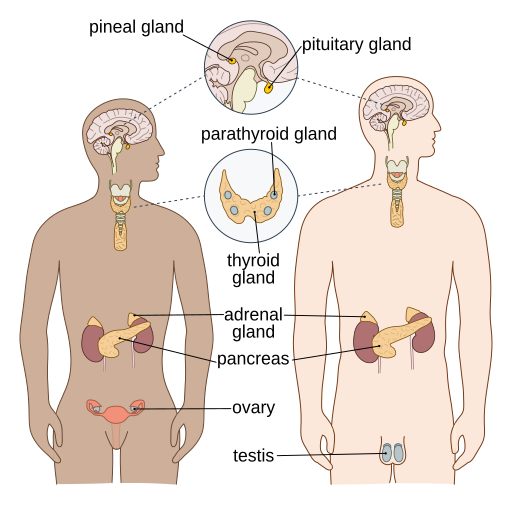
The purpose of the endocrine system (Figure 3.27) is to regulate various organs by releasing hormones. It is a key player in maintaining homeostasis in the body, which it does by sending chemical signals to one or more glands to control and coordinate hormones. Sometimes these chemical signals have an immediate effect, whereas others take time for changes to occur. For example, target cells may take up to 48 hours to respond to reproductive hormones, but adrenal hormones, such as epinephrine and norepinephrine, are released within seconds when you are confronted with a dangerous or frightening situation.
In addition, endocrine signalling is typically less specific than neural signalling (Betts et al., 2013). The same hormone may play a role in a variety of different physiological processes depending on the target cells involved. For example, the hormone oxytocin promotes uterine contractions in people in labour. It is also important in breastfeeding and may be involved in the sexual response and in feelings of emotional attachment in humans (Betts et al., 2013).
Components of the Endocrine System
Hypothalamus: A structure in the brain, the hypothalamus is located in front of and below the thalamus and both produces and secretes many hormones.
Pineal gland: This gland is positioned below and slightly behind the thalamus. It is a very small gland whose functions are not entirely understood. Some of the specialized cells in the pineal gland are known to produce and secrete the hormone melatonin.
Pituitary gland: This small, bean-sized organ is divided into two parts: the posterior pituitary, which does not produce hormones but stores and secretes hormones produced by the hypothalamus, and the anterior pituitary, which does produce hormones.
Thyroid gland: This butterfly-shaped organ is located in front of the trachea, just below the larynx. It produces the hormones tri-iodothyronine (T3), thyroxine (T4), and calcitonin, which regulate the body’s metabolic rate and control digestive, muscle, and heart functions, as well as brain development and bone maintenance.
Parathyroid glands: These glands are tiny, round structures found on the rear surface of the thyroid gland. They produce and secrete parathyroid hormone, the major hormone involved in the regulation of blood calcium levels.
Adrenal glands: The triangular adrenal glands are found on top of the kidneys. They have a rich blood supply and actually possess one of the highest rates of blood flow in the whole body. These glands produce hormones that help regulate metabolism, the immune system, blood pressure, the body’s response to stress, and other essential functions. The hormones they secrete include adrenaline, cortisol, aldosterone, dehydroepiandrosterone (DHEA), and testosterone (in small amounts) (Betts et al., 2013).
Pancreas: This long, slender organ is located posterior to the bottom half of the stomach. It is primarily an exocrine gland, secreting a variety of digestive enzymes, but it also has an endocrine function. Its pancreatic islets secrete the hormones glucagon, insulin, somatostatin, and pancreatic polypeptide.
Ovaries: The ovaries are female reproductive organs. The primary hormones produced by the ovaries are estrogens, which include estradiol, estriol, and estrone. Estrogens play an important role in many physiological processes, including the development of the regulation of the menstrual cycle, the development of female secondary sexual characteristics, the development of breast tissue, and the maintenance of pregnancy. Another important ovarian hormone is progesterone, which helps regulate the menstrual cycle and is necessary to prepare the body for pregnancy and maintain pregnancy.
Testes: The testes are male reproductive organs. The primary hormone produced by the testes is testosterone, a steroid hormone important in the development of the male reproductive system, the maturation of sperm cells, and the development of male secondary sex characteristics, which include a deepened voice, body hair, and increased muscle mass.
Attribution
Unless otherwise indicated, material on this page has been adapted from the following resource:
Sturdy, L., & Erickson, S. (2022). The language of medical terminology. Open Education Alberta. https://pressbooks.openeducationalberta.ca/medicalterminology/, licensed under CC BY-NC-SA 4.0
References
Betts, J. G., Young, K. A., Wise, J. A., Johnson, E., Poe, B., Kruse, D. H., Korol, O., Johnson, J. E., Womble, M., & DeSaix, P. (2013). Anatomy and physiology. OpenStax. https://openstax.org/details/books/anatomy-and-physiology, licensed under CC BY 4.0
Image Credits
(Images are listed in order of appearance)
Digestive system diagram en by LadyofHats and Jmarchn, Public domain
Endocrine English by OpenStax and Tomáš Kebert and umimeto.org, CC BY-SA 4.0