
3.2 Cells, Tissues, Organs, and Systems
This chapter will allow you to apply some of the knowledge you gained from the last chapter to basic concepts about anatomy, physiology, and other aspects of the human body. Anatomy focuses on structure, whereas physiology focuses on function (Sturdy & Erickson, 2022). The video below will give you an overview of what anatomy and physiology encompass, then the remaining part of this section will discuss them in more detail.
Understanding cells, tissues, and organs is essential to medical device reprocessing because it helps prevent patient harm. Proper cleaning and sterilization eliminate pathogens that could infect cells, while thorough rinsing and residue removal protect tissues from irritation or damage. For example, residual disinfectants can inflame soft tissues like the cornea, and contaminated instruments can cause infections such as endocarditis in the heart. This understanding of biology provides a strong foundation for mastering more advanced reprocessing procedures.
(CrashCourse, 2015)
The Levels of Organization
As shown in Figure 3.1, it is best to consider the structures of the body in terms of levels of organization that increase in complexity: atoms, molecules, cells, tissues, organs, organ systems (body systems), and organisms (Sturdy & Erickson, 2022).
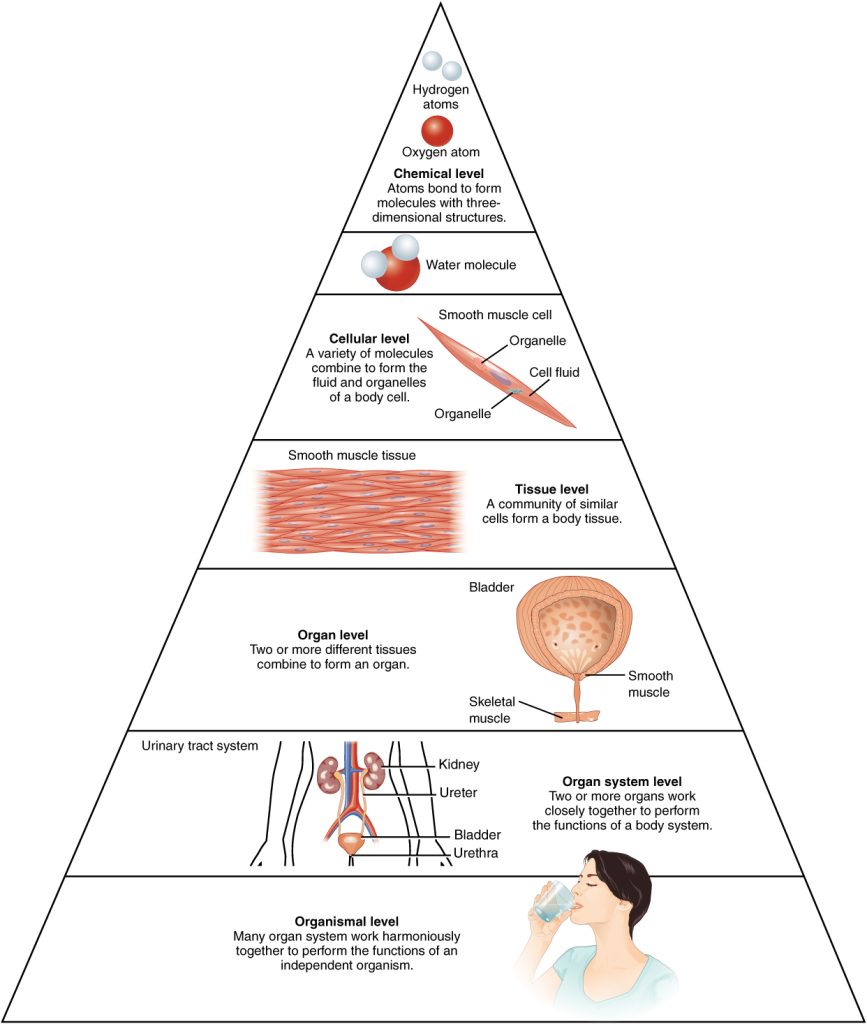
All matter in the universe is composed of one or more unique pure substances called elements. Some examples are hydrogen, oxygen, carbon, nitrogen, calcium, and iron. The smallest unit of any of these elements is the atom, and two or more atoms combine to form a molecule. Examples of molecules include water, proteins, and sugars. Molecules are found in all living things and are essentially the building blocks of all body structures.
The Cell
A cell is the smallest independently functioning unit of a living organism. All living structures of human anatomy contain cells, and almost all functions of human physiology are performed in cells or are initiated by cells. Despite differences in structure and function, all living cells in multicellular organisms have a surrounding cell membrane. Just as the outer layer of your skin separates your body from its environment, the cell membrane (also known as the plasma membrane) separates the inner contents of a cell from its exterior environment. The cell membrane provides a protective barrier around the cell and regulates which materials can pass in or out. It is an extremely pliable structure composed primarily of back-to-back phospholipids (a bilayer). Figure 3.2 provides a detailed diagram of a cell found in the human body.
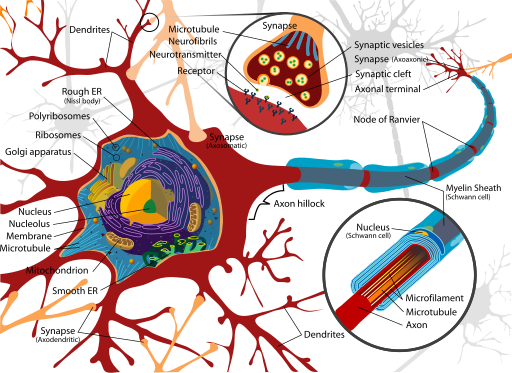
Now that you have learned that the cell membrane surrounds all cells, you can dive inside a prototypical human cell to learn about its internal components and their functions. All living cells in multicellular organisms contain an internal cytoplasmic compartment and a nucleus within the cytoplasm. An organelle (“little organ”) is one of several different types of membrane-enclosed bodies in the cell, each performing a unique function. Just as the various bodily organs work together in harmony to perform all of the body’s functions, the many different cellular organelles work together to keep the cell healthy and performing all its important functions. The organelles and the fluid cytosol, taken together, compose the cell’s cytoplasm. A mitochondrion (plural: mitochondria) is a membranous, bean-shaped organelle that is the “energy transformer” of the cell. The nucleus is a cell’s central organelle, which contains the cell’s deoxyribonucleic acid (DNA). Inside the nucleus lies the blueprint that dictates everything a cell will do and all the products it will make. This information is stored in the DNA. The nucleus sends “commands” to the cell via molecular messengers that translate the information from the DNA. Each cell in your body (with the exception of germ cells) contains a complete set of your DNA. When a cell divides, the DNA must be replicated so that each new cell receives a full complement of DNA.
Tissue
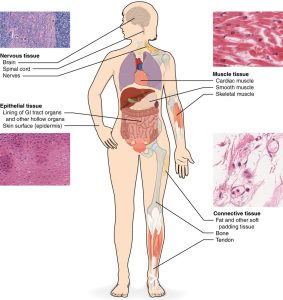
A tissue is a group of many similar cells that work together to perform a specific function. There are four types of tissue in the human body:
- Epithelial tissue, also referred to as epithelium, refers to the sheets of cells that cover exterior surfaces of the body, line internal cavities and passageways, and form certain glands.
- Connective tissue, as its name implies, binds the cells and organs of the body together and functions in the protection, support, and integration of all the parts of the body.
- Muscle tissue is excitable, responding to stimulation and contracting to provide movement. It occurs as three major types: skeletal (voluntary) muscle, smooth muscle, and cardiac muscle in the heart.
- Nervous tissue is also excitable, allowing the propagation of electrochemical signals in the form of nerve impulses that communicate between different regions of the body. Figure 3.3 shows the four types of tissue and some of the locations where they can be found in the human body.
Organs
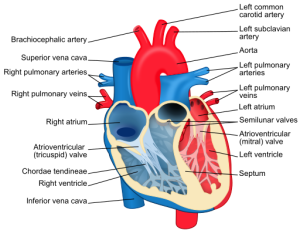
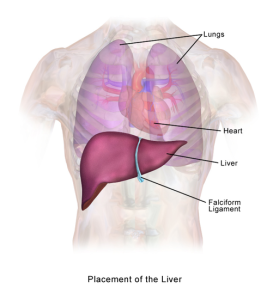
Organs are a distinct structure of the body composed of two or more tissue types. Each organ performs one or more specific physiological functions within the body. You are likely already familiar with many of the organs in the human body, such as the heart (Figure 3.4), liver (Figure 3.5), lungs, and pancreas. A number of other organs will be discussed in the following pages of this chapter.
Body Systems
A body system, also known as an organ system, is a group of organs that work together to perform major functions and meet the physiological needs of the body. It is important to note that many organs actually work in more than one body system. The human body has 11 body systems, and you will learn about them throughout this chapter:
- Cardiovascular system
- Respiratory system
- Endocrine system
- Reproductive system (male and female)
- Lymphatic system
- Urinary system
- Nervous system
- Integumentary system
- Digestive system
- Muscular system
- Skeletal system
(Carter & Rutherford, 2020)
Medical device reprocessing is directly related to body systems because the devices used in healthcare procedures interact with various parts of the body, and proper reprocessing is crucial for preventing infections and ensuring patient safety. The level of reprocessing required (cleaning, disinfection, or sterilization) depends on the body system the device interacts with and the level of risk of infection. Inadequate reprocessing can lead to the spread of bacteria and viruses through reusable equipment, resulting in patient harm.
Understanding body systems helps to understand this risk. The Spaulding Classification system (along with manufacturer’s instructions for use (MIFU) and the healthcare facilities policies and procedures) informs the reprocessing criticality.
| Device Type | Device comes in contact with… |
| Non-critical | intact skin (not mucous membranes) |
| Semi-critical | mucous membranes or non-intact skin |
| Critical | sterile tissue or the vascular system |
Key Concept
In the human body, the organs work collaboratively with multiple body systems. For example, the heart (cardiovascular system) and lungs (respiratory system) work together to deliver oxygen throughout the body and remove carbon dioxide (Sturdy & Erickson, 2022).
The organism level is the highest level of organization, and an organism can independently perform all the physiological functions necessary for life. In a multicellular organism such as a human, all the cells, tissues, organs, and organ systems work together to maintain life.
Attribution
Unless otherwise indicated, material on this page has been adapted from the following resource:
Betts, J. G., Young, K. A., Wise, J. A., Johnson, E., Poe, B., Kruse, D. H., Korol, O., Johnson, J. E., Womble, M., & DeSaix, P. (2013). Anatomy and physiology. OpenStax. https://openstax.org/details/books/anatomy-and-physiology, licensed under CC BY 4.0
References
Carter, K., & Rutherford, M. (2020). Building a medical terminology foundation. eCampusOntario. https://ecampusontario.pressbooks.pub/medicalterminology/, licensed under CC BY 4.0
CrashCourse. (2015, January 6). Introduction to anatomy & physiology: Crash Course anatomy & physiology #1 [Video]. YouTube. https://www.youtube.com/watch?v=uBGl2BujkPQ&t=11s
Sturdy, L., & Erickson, S. (2022). The language of medical terminology. Open Education Alberta. https://pressbooks.openeducationalberta.ca/medicalterminology/, licensed under CC BY-NC-SA 4.0
Image Credits
(Images are listed in order of appearance)
Figure 1.3 Levels of Organization of the Human Body. From Betts, J. G., Young, K. A., Wise, J. A., Johnson, E., Poe, B., Kruse, D. H., Korol, O., Johnson, J. E., Womble, M., & DeSaix, P. (2013). 1.2 Structural organization of the human body. In Anatomy and physiology. OpenStax. https://openstax.org/details/books/anatomy-and-physiology, licensed under CC BY 4.0
Complete neuron cell diagram en by LadyofHats, Public domain
Figure 4.2 Four Types of Tissue: Body. From Betts, J. G., Young, K. A., Wise, J. A., Johnson, E., Poe, B., Kruse, D. H., Korol, O., Johnson, J. E., Womble, M., & DeSaix, P. (2013). 4.1 Types of tissues. In Anatomy and physiology. OpenStax. https://openstax.org/details/books/anatomy-and-physiology, licensed under CC BY 4.0
Heart diagram-en by ZooFari, CC BY-SA 3.0
Blausen 0616 Liver Location by BruceBlaus, CC BY 3.0