
2.5 Prefixes
A prefix is located at the beginning of a medical term and alters the meaning of the term. It is important to spell and pronounce prefixes correctly. When writing a prefix, if it is not in a medical term, you must place a “-” after the prefix. Not all medical terms have a prefix, but many do.
The following is a good technique to help you memorize prefixes:
- Start by reviewing the most common prefixes that are listed below.
- Compare the prefixes to the examples of use in medical terms in the tables below.
- Try to relate the prefixes to common terms you hear in everyday life.
| Prefixes | MEANING | EXAMPLE OF USE IN MEDICAL TERMS |
|---|---|---|
| a- , an- | no, not | asepsis |
| ab- | away from | abduction |
| ad- | toward | adduction |
| ante- | before | antepartum |
| anti- | against | antigen |
| bi- | both sides | bilateral hip reconstruction |
| cata- | down, complete | cataplasia |
| circum- | around | circumcision |
| dia- | through, complete | diarrhea |
| dis- | apart, away | dislocation |
| dys- | painful | dysentery |
| ec- | out, outside of | ectopic pregnancy |
| endo- , en- | within | endoscope |
| exo- | outside | exocrine |
Key Concept
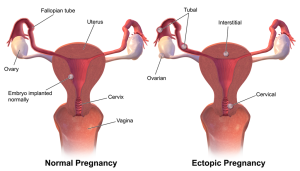
An ectopic pregnancy is medical emergency and must be treated as soon as possible because of the potential medical consequences if it is not. Figure 2.7 illustrates the location of the embryo in a normal pregnancy and in an ectopic one; an ectopic pregnancy can occur in the ovaries, fallopian tubes, cervix, or abdomen. The term ectopic has the prefix ec-, meaning “outside of,” top meaning “place,” and -ic, meaning “pertaining to.”
| Prefixes | MEANING | EXAMPLE OF USE IN MEDICAL TERMS |
|---|---|---|
| hemi- | half | hemigastrectomy |
| hyper- | too much, excessive | hypertension |
| hypo- | too little, less than normal | hypotension |
| inter- | between | intercostal |
| intra- | within | intravenous |
| meta- | change, beyond | metacarpal |
| neo- | new | neonatal |
| para- | beside, near | parathyroidectomy |
| peri- | around | pericardial |
| post- | after | postpartum |
| pre- | before | preoperative |
| sub- | under, beneath | subcutaneous |
| supra- | above | suprapubic |
| trans- | across, through | transurethral |
Key Concept
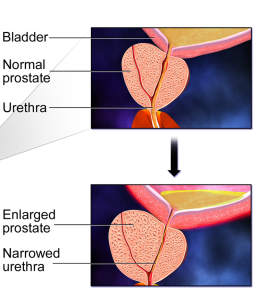
Figure 2.8 illustrates the difference between a normal prostate and an enlarged one caused by benign prostatic hyperplasia. This term includes the prefix hyper-, meaning “excessive,” which relates to the increase in the size of the prostate.
This condition is often treated with medication or through a procedure called a transurethral resection of the prostate. Transurethral has the prefix trans-, meaning “across or through,” urethro, meaning “urethra,” and -al meaning “pertaining to.” As the meaning of this medical term indicates, it is a procedure where part of the prostate is removed with a surgical instrument that goes through the urethra.
Attribution
Unless otherwise indicated, material on this page has been adapted from the following resource:
Sturdy, L., & Erickson, S. (2022). The language of medical terminology. Open Education Alberta. https://pressbooks.openeducationalberta.ca/medicalterminology/, licensed under CC BY-NC-SA 4.0
Image Credits
(Images are listed in order of appearance)
Ectopic Pregnancy by BruceBlaus, CC BY-SA 4.0
Benign Prostatic Hyperplasia (BPH) by BruceBlaus, CC BY-SA 4.0
Not septic; free from bacteria and viruses
Movement away from something (the body)
Movement towards something (the body)
Before birth
Producing against; a substance that triggers an immune response in the body
Pertaining to both sides
Forming down (in terms of cells or tissues); the degeneration of cells or tissues
Cutting around
Loose, watery bowel movements
Movement away from a location; in this case, the bones of a join pushed out of their normal position
A condition of painful intestines; a gastrointestinal disease characterized by bloody diarrhea
Pertaining to outside its place; in this case, a pregnancy that occurs outside a viable location
An instrument to visually examine within the body; a medical device with an attached light that is used to look inside a body cavity or organ
Secretion outside, often in reference to endocrine glands that secrete outside the body
Removal of half the stomach
High blood pressure
Low blood pressure
Within (between) the ribs
Pertaining to within the vein
Pertaining to beyond the wrist
Pertaining to new birth
Removal beside the thyroid; removal of one or more of the parathyroid glands
Pertaining to around the heart
Birth after or after birth
Before an operation
Pertaining to under the skin
Pertaining to above the pelvis
Pertaining to through the urethra


.png)