
2.4 Suffixes
A suffix is a word part that is located at the end of a word. It can alter the meaning of a medical term, and it is important to spell and pronounce suffixes correctly. When writing a suffix, if it is not in a medical term, you must place a “-” before the suffix.
Suffixes are not always explicitly stated in the definition of a word, and it is common that suffixes are not explicitly stated when defining a medical term in all medical settings. However, when reading a medical report, the suffix is always clearly written. In order to properly spell and pronounce medical terms, it is helpful to learn the suffixes.
| SUFFIXES | MEANING | EXAMPLE OF USE IN MEDICAL TERMS |
|---|---|---|
| -ac, -al, -ary, -eal, -ic, -ous | pertaining to | cardiac, renal, esophageal, pulmonary, cancerous |
| -algia | condition of pain | arthralgia |
| -cide | kill | germicide |
| -cise | cut | excise |
| -cision | process of cutting | incision |
| -ectasis | dilation | bronchiectasis |
| -ectomy | removal, excision, cutting out | appendectomy |
| -emia | blood | hyperglycemia |
| -genic | origin | osteogenic |
| -gen | producing | antigen |
| -ia | condition | pneumonia |
| -iasis | disease | nephrolithiasis |
| -itis | inflammation | appendicitis |
| -iod | growth | fibroid |
Key Concept
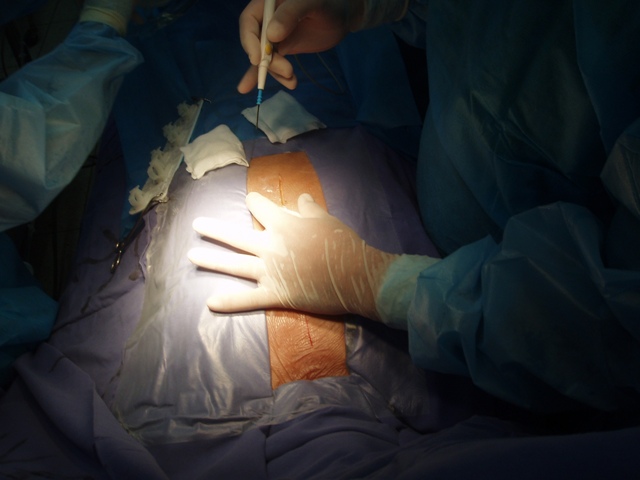
Incisions are done for many reasons, and Figure 2.4 shows a surgeon making an abdominal incision. The surgeon could possibly be doing an exploratory laparotomy or some form of resection. Incision has the suffix -cision, which means “process of cutting.”
| SUFFIXES | MEANING | EXAMPLE OF USE IN MEDICAL TERMS |
|---|---|---|
| -megaly | enlargement | cardiomegaly |
| -necrosis | death of tissue | arterionecrosis |
| -ology | study of | bacteriology |
| -oscopy | visual examination | laparoscopy |
| -ostomy | surgically create an opening | colostomy |
| -otomy | incision into an organ | gastrotomy |
| -oma | tumour | carcinoma |
| -pathy | disease | cardiomyopathy |
| -penia | decrease | cytopenia |
| -pexy | surgical fixation | orchiopexy |
| -plasty | surgical repair | rhinoplasty |
| -rrhea | flow, discharge | rhinorrhea |
| -rrhage | excessive discharge | hemorrhage |
| -rrhaphy | to suture | myorrhaphy |
| -sclerosis | hardening | arteriosclerosis |
| -stomy | opening | colostomy |
| -tome | cutting instrument | Osteotome |
| -tripsy | surgical crushing | extracorporeal shockwave lithotripsy |
Key Concepts
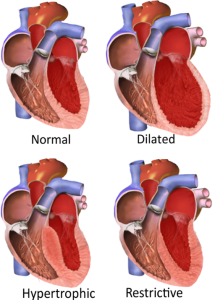
Figure 2.5 different forms of cardiomyopathy. This condition can be caused by a number of factors, and the term includes the word parts cardio, meaning “heart,” myo, meaning “muscle,” and the suffix -pathy, meaning “disease.”
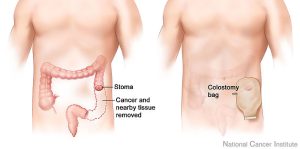
A colostomy (Figure 2.6) is a common medical procedure done in a hospital and can be performed for a number of reasons, including cancer, obstructions, and trauma. The operation involves creating a stoma, which is an opening, on the abdomen where a colostomy bag can be attached. The term includes the word parts colo, meaning “colon,” and -ostomy, meaning “surgically create an opening.”
Attribution
Unless otherwise indicated, material on this page has been adapted from the following resource:
Sturdy, L., & Erickson, S. (2022). The language of medical terminology. Open Education Alberta. https://pressbooks.openeducationalberta.ca/medicalterminology/, licensed under CC BY-NC-SA 4.0
Image Credits
(Images are listed in order of appearance)
Incisión de Piel by Alexperf, CC BY 3.0
Major categories of cardiomyopathy by Npatchett, CC BY-SA 4.0
Colostomy by National Cancer Institute Visuals Online, Public domain
Pertaining to the heart
Pertaining to the kidney(s)
Pertaining to the esophagus
Pertaining to the lungs
Pertaining to cancer
Pain in a joint or joints
A substance that kills germs
To cut out
A cut or wound; typically a cut made into the body to perform surgery
Dilation of the bronchial tubes
Removal of the appendix
Condition of high sugar; typically high blood sugar or blood glucose
Origin of bone; relating to bone formation
Producing against; a substance that triggers an immune response in the body
A condition of the lung(s)
Kidney stones
Inflammation of the appendix
A growth composed of smooth muscle cells and fibrous connective tissue
Enlargement of the heart
Death of tissue in an artery
The study of bacteria
A visual internal examination of the abdomen
An opening into the colon
An incision into the stomach
A cancerous tumour or mass
A disease condition of the heart muscle
A decrease in the number of cells
Surgical fixation of the testes
Surgical repair of the nose
Flow from the nose
Excessive discharge of blood
A procedure involving the suturing of a muscle
Hardening of the arteries
An instrument for cutting bone
A procedure that uses shock waves to break up kidney stones