
5.4 Routine Practices for IPC
In a medical device reprocessing area, following dress code rules, using personal protective equipment (PPE), and practicing good hand hygiene are key to keeping the environment safe and preventing the spread of infection. These practices are not just about following rules—they protect MDRTs from harmful germs and chemicals and help keep reprocessed medical devices clean and safe for patient use.
Dress Code Requirements
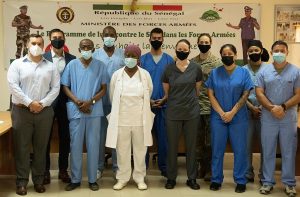
Although not always thought of as related to safety, healthcare facilities have a dress code policy in effect for safety considerations. All personnel must adhere to the dress code and policy, which needs to be posted at each entrance to the MDRA (Canadian Standards Association, 2023). Personal protective equipment (PPE) will be supplied, and training in its use, such as donning and doffing, will be provided by the healthcare facility. All MDRA professionals will wear PPE based on a risk assessment and need throughout the day. Reusable PPE will be laundered by the facility. Scrub attire must also be donned once personnel enter the MDRA area. This attire needs to be changed daily, or more often if it becomes soiled. Figures 5.4 and 5.5 provide examples of healthcare professionals in scrubs and a room filled with hospital-issued scrubs. Some other dress code requirements that are often found within the MDRA include the following:
- All jewelry must be removed and exposed piercings that cannot be removed must be covered.
- All nails must be natural, trimmed, and clean.
- False eyelashes or extensions are not permitted.
- Footwear must be enclosed in the front and back, and should be dedicated to work use only. Footwear must also be durable.
- Hair needs to be tied back and covered with a clean hood or hair covering. Beard coverings should be used, if applicable.
- Personnel must not wear their MDRA uniform or PPE outside the healthcare setting. If it is necessary to wear the uniform outside, for example, during a fire drill or emergency, then a new one needs to be put on before returning to the MDRA.
(Canadian Standards Association, 2023)

Personal Protective Equipment (PPE)
In health care, personal protective equipment (PPE) refers to specialized clothing or equipment, including gloves, gowns, facial protection such as masks and eye protection, and respirators. PPE acts as a barrier to protect the healthcare provider from exposure to microorganisms and can also be used to prevent the transmission of microorganisms from clients to staff, staff to clients, and staff to staff (PIDAC, 2012).
Certain pathogens and communicable diseases are easily transmitted and require additional precautions to interrupt the spread of suspected or identified agents to healthcare providers, other clients, and visitors (PIDAC, 2012). Additional precautions are used along with routine practices and are defined by how a microorganism is transmitted (Potter et al., 2019).
Routine practices and additional precautions involve wearing PPE. Pieces of PPE can be worn individually on their own or in combination. Deciding what PPE is appropriate for a given situation depends on the known infectious agent, the mode of transmission, and a point-of-care risk assessment. PPE should be put on just prior to potential exposure to an infectious agent or bodily fluid, and then discarded appropriately according to your facility’s guidelines.
Gloves
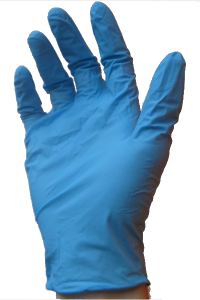
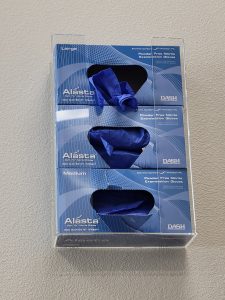
Gloves are disposable, one-time-use coverings to protect the hands of healthcare providers. Gloves, shown in Figures 5.6 and 5.7, protect the hands of the healthcare provider from coming into contact with body fluids such as blood, urine, feces, mucous membranes, and non-intact skin, or equipment and other surfaces that may have been contaminated with body fluids.
Gloves are to be task-specific and should not be worn for more than one task or procedure because some tasks may have a greater concentration of microorganisms than other tasks. Gloves should never be reused or washed to be used again. Reusing gloves has been linked with the transmission of organisms such as methicillin-resistant Staphylococcus aureus (MRSA) and gram-negative bacilli (PIDAC, 2012).
Gloves should always be used in combination with hand hygiene. They should never replace the need for hand hygiene, which should always be performed prior to applying gloves and again after gloves are removed for several reasons, including the following:
- Gloves may have imperfections such as holes or cracks that are not visible.
- Hands may have become contaminated while removing the gloves.
- Gloves may have become damaged while in use.
(PIDAC, 2012)
Ensure that your nails are short prior to applying gloves so that your nails do not puncture them. Don gloves after hand hygiene, ensuring that your hands are completely dry, and choose the appropriate gloves for the activity. There is no specific method for putting on gloves. The healthcare provider should be careful when donning gloves to avoid tearing, and donned gloves should completely cover the wrists. When removing gloves, the healthcare provider should use glove-to-glove and skin-to-skin technique so that they do not contaminate themselves.
Gowns
In health care, there are two types of medical gowns: isolation gowns and surgical gowns. Gowns may also be called procedural gowns, non-surgical gowns, or operating-room gowns. Surgical gowns are worn by healthcare providers while performing care in a sterile area. Gowns used for additional precautions are usually called isolation gowns. Isolation gowns are garments worn to protect clothing from the splashing or spraying of body fluids and to reduce the transmission of microorganisms.
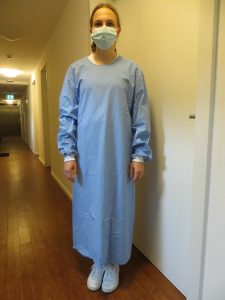
Isolation gowns can be disposable or reusable. The gowns should have long sleeves with a snug fit at the wrist, cover both the front and the back of the body from the neck to the thighs, and overlap at the back. A gown, as shown in Figure 5.8, should fasten at the neck and waist using ties, snaps, or Velcro. A variety of gown sizes should be made available to ensure appropriate coverage for healthcare providers (PIDAC, 2012).
Disposable gowns are made from materials that make them resistant to fluids. Reusable gowns are made of tightly woven cotton or polyester and are chemically finished to improve their fluid resistance.
If gloves are being worn with a gown, the gloves should fit over the cuffs of the gown. Gowns are considered task-specific. They should be changed if heavily soiled or damaged and should not be reused. Special care should be taken when removing the gown to prevent the contamination of clothing and skin (PIDAC, 2012). The front of the gown is always considered to be contaminated, as are ties at the front. Ties at the side and the back are considered to be uncontaminated (Kozier et al., 2018).
After use, gowns should be discarded into an appropriate receptacle for laundering or disposal, depending on if the gown is reusable or not.
Masks
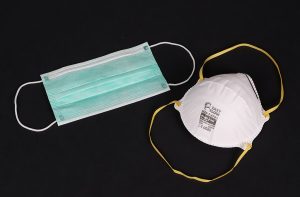
Masks, as shown in Figure 5.9, are protective coverings worn by healthcare providers to protect the mucous membranes of the nose and mouth. In health care, masks are often referred to as medical masks, procedural masks, or surgical masks. Medical masks are secured to the head by strings that are tied around the top and back of the head or by elastic loops around the ears. The top edge of the mask has a bendable strip to better secure the seal of the mask over the bridge of the nose. Some masks are combined with a shield or visor that covers the eyes and can be worn when both a mask and eye covering are required.
Eye Protection
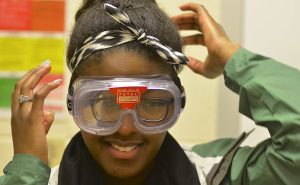
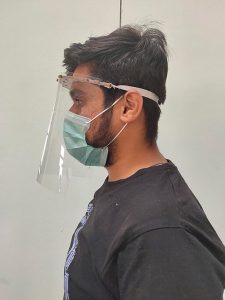
Eye protection includes face shields (Figure 5.10), visors attached to masks, and goggles (Figure 5.11) that are used to protect the eyes of healthcare providers and may be disposable or reusable. Eye protection should be worn by healthcare providers when procedures or care activities are likely to cause splashing or spraying of body fluids, or when the provider is within 2 metres of a coughing client. Eyeglasses can be worn under face shields and goggles. If eye protection is reusable, it should be cleaned before reuse. Face shields and visors attached to masks offer better visibility than goggles. Eye protection should allow for visual acuity while fitting comfortably and securely (PIDAC, 2012).
Bouffants and Booties
Bouffants are caps, also known as head covers, that are strong and lightweight, and are made of breathable polypropylene fabric (Figure 5.12). They are designed to protect against dirt, grime, and certain dry particulates in controlled environments. Importantly within the MDRA, bouffants and other protective clothing such as beard covers and undershirts, are worn to ensure that hair does not contaminate any medical device surfaces. Booties may also be worn as PPE; booties are covers worn over shoes to keep them clean and protected when there is a risk of contamination. Booties are also worn to ensure that contaminants within the MDRA are not transported to other areas.

Hand Hygiene
Hand hygiene is the single most effective technique to reduce the transmission of infections, including antibiotic-resistant organisms (ARO) and healthcare-associated infections (HAI) (Provincial Infectious Diseases Advisory Committee [PIDAC], 2014). Hand hygiene is the process of removing, killing, or destroying transient microorganisms or visible soiling from hands (PIDAC, 2012). There are two hand-hygiene techniques: handwashing with soap and water and the use of alcohol-based hand rub (ABHR), also referred to as hand hygiene gel or hand sanitizer. Another form of hand hygiene is surgical-hand antisepsis; however, this method is typically reserved for specific medical procedures such as surgery.
Healthcare providers’ hands are the most common mode of transmission of microorganisms (PIDAC, 2014). As such, microorganisms can easily transfer from your hands to objects in the healthcare setting when proper hand hygiene practices are not followed. When you touch a client, their personal items, medical equipment, or the surrounding environment, you can indirectly transmit microorganisms to the client, another client, yourself, and equipment, or transfer them to a new environment. Consistent and effective hand hygiene is required in any healthcare setting.
Handwashing with Soap and Water
Handwashing involves the use of soap and water to physically remove microorganisms from your hands. Certain occasions will require handwashing instead of relying on ABHR. You must wash your hands with soap and water if your hands are visibly soiled, have been exposed to any blood or body fluids, or have been exposed to or suspected to have norovirus, C. difficile, or Bacillus anthracis (PIDAC, 2012; PIDAC, 2014). The mechanical action of lathering and scrubbing with soap for a minimum of 20 seconds while washing your hands is important to remove transient flora and bacteria.
Hand hygiene with water requires soap to dissolve fatty materials and facilitate their subsequent flushing by rinsing with water. Soap must be rubbed on all surfaces of both hands, followed by thorough rinsing and drying. Water alone is not suitable for cleaning soiled hands (PIDAC, 2014). The entire procedure should last 40 to 60 seconds and use a soap approved by the healthcare agency.
Safety Considerations
- Always wash hands with soap and water if hands are visibly soiled.
- When working with clients where C. difficile, norovirus, or Bacillus anthracis is suspected or confirmed, soap and water must be used because it is more effective at physically removing C. difficile spores than ABHR, which is not as effective at penetrating the spores (PIDAC, 2014).
- Friction and rubbing are required to remove transient bacteria, oil, and debris from hands.
- Always use soap and water if hands are exposed to blood, body fluids, or other body substances.
- Multi-step rubbing techniques using soap and water are required to promote coverage of all surfaces of hands.
Common Errors When Washing Hands with Soap and Water
- Not using enough soap to cover all the surfaces of the hands and wrists
- Not using friction when washing hands
- Not washing hands for long enough; washing should be done for a minimum of 20 seconds (PIDAC, 2012)
- Skipping areas such as fingernails, wrists, backs of hands, and thumbs
- Not removing all the soap from hands and wrists
- Shaking water off your hands
- Not thoroughly drying your hands
- Drying your hands from wrists to fingers or in both directions
The video below by Alberta Health Services (2017a) provides an overview of the best practice for handwashing with soap and water.
(Alberta Health Services, 2017a)
Alcohol-Based Hand Rub (ABHR)
When performing hand hygiene using the alcohol-based hand rub (ABHR) technique, a liquid, gel, or foam alcohol-based solution such as ethanol, isopropanol, or combination is used. ABHR is the preferred method to use when your hands are not visibly soiled and to reduce the number of transient microorganisms on your hands; it is more effective than washing hands with soap and water (PIDAC, 2014).
The Benefits of ABHR
- Kills the majority of microorganisms, including viruses, from hands
- Requires less time to use than soap and water—only about 20 to 30 seconds
- Is easy to use and has a high level of availability at the point of care where three elements—the client, the healthcare provider, and care involving the client—occur together
- Provides better skin tolerability and reduces skin irritation because it contains emollients
(PIDAC, 2012)
Safety Considerations
- Do not use ABHR in combination with soap and water because this may increase skin irritation.
- Use ABHR that contains emollients (oils) to help reduce skin irritation and over-drying.
- Allow hands to dry completely before initiating tasks such as touching a client or the environment, or applying clean or sterile gloves.
- ABHR may be used for all four moments of hand hygiene, as long as the hands are not contaminated or visibly soiled.
- Do not use ABHR if there is suspected or confirmed contamination with C. difficile, norovirus, or Bacillus anthracis. ABHR will not kill spore-forming pathogens.
Common Errors When Performing ABHR Techniques
- Not letting your hands air dry, such as rubbing your hands on your pants to dry them off
- Shaking out your hands to dry
- Applying too much alcohol-based solution
- Not applying enough alcohol-based solution
- Not rubbing hands long enough—for a minimum of 20 seconds and until hands are dry
- Skipping areas such as fingernails, wrists, back of the hands, and thumbs
The video below by Alberta Health Services (2017b) provides an overview of the best practice for hand hygiene with alcohol based hand rub.
(Alberta Health Services, 2017b)
Attribution
Unless otherwise indicated, material on this page has been adapted from the following resource:
Hughes, M., Kenmir, A., St-Amant, O., Cosgrove, C., & Sharpe, G. (2021). Introduction to infection prevention and control practices for the interprofessional learner. eCampusOntario. https://ecampusontario.pressbooks.pub/introductiontoipcp/, licensed under CC BY-NC 4.0
References
Alberta Health Services. (2017a, July 11). How to hand wash [Video]. YouTube. https://youtu.be/vLm4reF_djQ
Alberta Health Services. (2017b, July 11). How to use alcohol based hand rub [Video]. YouTube. https://youtu.be/JWdytA-jLt8
Kozier, B., Erb, G., Berman, A., Snyder, S., Frandsen, G., Buck, M., Ferguson, L., Yiu, L. & Leeseberg Stamler, L. (2018). Fundamentals of Canadian nursing: Concepts, process, and practice. (4th Canadian ed.). Pearson Canada.
Provincial Infectious Diseases Advisory Committee (PIDAC) & Ontario Agency for Health Provincial Infectious Disease Advisory Committee. (2012). Routine practices and additional precautions in all health care settings (3rd ed.). Public Health Ontario. https://www.publichealthontario.ca/-/media/Documents/B/2012/bp-rpap-healthcare-settings.pdf?rev=97a9a0d61f7848e3bc721a119a0f8f63&sc_lang=en&hash=4787BA86E5938928772DB8A8D3E0D2E7
Provincial Infectious Diseases Advisory Committee & Ontario Agency for Health Protection and Promotion. (2014). Best practices for hand hygiene in all health care settings (4th ed.). Public Health Ontario. https://www.publichealthontario.ca/-/media/documents/B/2014/bp-hand-hygiene.pdf?la=en
Image Credits
(Images are listed in order of appearance)
Corpsman Folds Scrubs (49757617343) by Navy Medicine, U.S. Navy, Public domain
Ouakam Military Hospital, Senegal – MEDREX 21-4 (51357165209) by U.S. Army Southern European Task Force, Africa, CC BY 2.0
Disposable nitrile glove by Tjwood, CC0 1.0
Nitrile Gloves holder 20230316 110111 by Kiran891, CC BY-SA 4.0
Schutzkittel Langarm by BlankeVla, CC BY-SA 4.0
FFP and Surgical Face masks used during Coronavirus pandemic COVID-19 by NurseTogether, CC BY 4.0
Face shield 4 by Pooja Jadhav, CC BY-SA 4.0
201550311 GCC Student Success Day (16609001648) by Germanna CC, CC BY 2.0
Medical Bouffant Cap by MidniteMoonlite, CC BY 3.0

.jpg)
.jpg)


.jpg)
