
Section 5: Important Moves in Academic Writing
Starting and Planning a Research Paper
Key Steps to Start a Research Paper
A university-level research paper is likely more complex than what you wrote in high school; therefore, starting your research paper well before the deadline and giving yourself enough time to complete each step is important.
Here are some of the key steps for starting your paper:
Step 1: Understand the assignment
Understanding your purpose and audience is the first step in any writing project. You should also know the required or expected text genre (i.e., lab report, position paper, analytical essay). Here are some tips to help you understand your writing assignment.
Read the assignment carefully
- Look for action verbs like “analyze,” “explain,” “discuss,” and “argue,” as these words will tell you the purpose of the writing.
- Connect the assignment to the course learning outcomes. Understanding how the assignment connects to the course learning outcomes can help you to focus your writing on issues relevant to the audience.
- Look for words like “essay,” “report,” “summary,” “reflection,” etc. These words tell you what genre your audience is expecting you to write. Knowing the genre will also help you locate examples or similar texts that you can use to try to understand the common features of the required genre.
- Treat the assignment description like any course reading: Highlight and annotate it. Note any areas of confusion, and follow up with your instructor to clarify these questions.
Note style and formatting requirements
- Make a note of any file name, file type, word count, font, font size, line spacing, title page, heading, and citation style requirements.
Read the grading rubric
- Understand how your instructor will assess your writing. What elements of the assignment will be weighed the most heavily? Which elements are less important?
Analyze examples
- Analyze examples of successful student writing provided by your instructor. If your instructor has given you successful examples of writing, ask yourself what features made these examples successful. Use the grading rubric or criteria to help guide your assessment. You can look for similar texts online if your instructor does not provide examples. Be careful, however, as your instructor may have different assessment criteria, and the example you find online might not be a good example.
Review the assignment description periodically
- It is easy to forget key details about the assignment requirements as you work through the research and writing process. Review the assignment description occasionally to ensure you are on the right track.
Step 2: Choose a topic
All research and research papers start with an idea. Sometimes, your instructor gives you a list of possible topics, or you can immediately think of an appropriate one. However, coming up with a topic for a research paper can also be daunting. Here are some strategies to help you generate ideas for your research paper if you aren’t sure what you want to write about.
Lean into your interests
You likely have interests outside of university that could be used as topics for a research paper. What do you do in your spare time? Do you play a sport? Do you have a particular hobby? Do you play video games? Do you volunteer? Do you follow a certain social media influencer? Do you like a specific TV show, movie, or book genre?
Students sometimes feel their interests may not be serious enough for an academic paper. Good news! Academics study every aspect of our world, including your interests. For instance, if you like hockey, you may be pleasantly surprised that academics share your interest. You can find academic research on the physiology of hockey, the physics of hockey, player efficacy in hockey, the impact of birthdates on the success of hockey players, and much, much more (Google Scholar search results for hockey). You can find out what academics say about your favourite interests by searching for related terms in Google Scholar, a search engine for academic research.
Follow your curiosity
One of the best parts about being at university is that you can follow your curiosity. Ask yourself: What has been drawing your attention lately? What questions have you been asking yourself about the world? These could be questions that have bothered you for a long time or random questions that pop into your head. For instance, you may have wondered why you procrastinate when you have a writing project. You may have wondered if the fact that your cat ignores its image in the mirror makes them intelligent. You may have noticed stands of dead trees in the Edmonton River Valley as you ride the LRT to the university. You have asked yourself: Why is that? Is that normal? These types of questions often make good starting points for a research paper.
Help people
Improving the lives of others is a common motivation for research studies and papers. Perhaps you work with children who are having trouble learning math concepts. For your research paper, you could investigate what academic research says about children with numeracy difficulties. Look around you: Learn more about what academics have found to help the people in your community.
Bust a myth
Another good approach to finding good ideas for a paper is reconsidering what you know about the world. Do you or the people around you hold any misconceptions about the world? Have your professors mentioned common misconceptions in their fields? Some common myths that you could bust in a research paper include the idea that we have different learning styles (visual, auditory, kinesthetic), the idea that teaching grammar will help improve students’ writing or the idea that we need to drink 8 cups of water daily.
Solve a problem
As we move through the world, we encounter ways in which the systems around us are unhelpful. For instance, in the early days of the Internet, we didn’t know how to design websites well. Academic research on how users interacted with websites helped us to improve how we organized information so that users could find it more quickly. Are there other small irritations or problems you have encountered that you would like to solve? Have you ever wondered what the most effective way is to learn a language? Have you wondered how you can convince your older family members that their ideas about climate change are incorrect? Have you wondered about the best way to improve your performance in a sport? These questions are good places to start a research paper.
Advance your learning journey
You can also take a very pragmatic approach to choosing a topic for your research paper. For instance, say you are studying neuroscience, and you know that you will be taking a course on drugs and the nervous system next semester. You could help your future self by doing some research on this topic.
A note of caution here: You cannot submit a paper written for this class in another class in the future. Similarly, you cannot submit a paper you wrote for your current course in another class. This is against academic integrity rules. However, you can always expand and deepen your knowledge in your subject area.
Activities to help you find a topic
As you work through finding a topic, some of the following activities might help.
- Skim read a few articles. You can always poke around the academic research to assess the viability of your topic. Say that you want to explore the impact of video gaming on the development of social skills. Type a few keywords into Google Scholar to see what is out there. Do any of the articles catch your fancy? Quickly read the abstract and introduction to see if this might be a good topic for your paper.
- Create a list. As you start a paper, building lists of possible topics is a well-known strategy. It’s a standard for a reason. It helps you to build a breadth of ideas through brainstorming.
- Discuss your ideas. Often, one of the best things you can do is discuss your potential ideas with others. Ask a friend or family member. You can also discuss your ideas with fellow students or the teaching team.
- Try an invention activity. Try one of the invention activities listed in the chapter on Invention.
Step 3: Refine your topic
Most writers start with a topic that is too broad, requiring some work to narrow it down into a manageable size. As you become more familiar with university writing, you will learn to judge better what you can adequately cover in the amount of words you are allowed.
Think of this process of refining your topic as moving closer to a bulls-eye, as Figure 1 shows. Throughout the research and writing process, you will likely have to adjust and readjust the focus of your paper as you get to know your topic better.
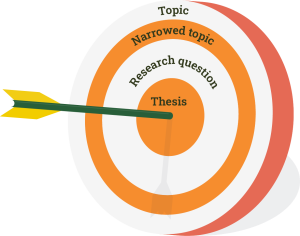
Here are some tips to help you narrow down your topic.
Narrow down specific aspects
You can narrow down a research topic by focusing on particular aspects. For example, you could focus on setting, geographic location, timeframe, or demographic characteristics like age group, gender, or other determining characteristics.
If we start with the topic “cat intelligence,” we could use some of the following filters to narrow down this topic:
- Intelligence of cats in shelters, in the wild, or in human homes
- Intelligence of cats in cold climates, cats in cities, cats in rural areas
- Intelligence development during the first six months of life
- Intelligence of female or male cats
- Intelligence of Maine Coon cats (this is a particular breed of cat)
- Intelligence of cats from large litters
Ask yourself questions about your topic
Ask yourself journalistic questions (who, what, where, when, why, and how) about your topic.
If you are interested in writing a paper about the intelligence of cats, here are some questions you could ask to refine your research.
Who
- Who benefits from understanding cat intelligence?
- Who influences cat intelligence (the cat’s parents, the mother, and humans)?
What
- What are the key components of cat intelligence (i.e., short-term memory, problem-solving, etc.)?
- What are the differences in brain structure between cats and other animals?
- What types of tasks can cats perform that demonstrate their intelligence?
Where
- Where do cats typically exhibit intelligent behaviours (domestic environments with humans, in the wild)?
When
- When do cats develop certain cognitive abilities?
- When are cats most likely to exhibit intelligent behaviours?
Why
- Why is it important to study cat intelligence?
- Why do cats seem less cooperative in intelligence studies compared to dogs?
How
- How can we determine the intelligence of a cat?
- How do cats learn and remember new information?
- How do cats communicate their needs and emotions to humans?
- How does nutrition impact cat cognition?
How much/How many
- How long can cats remember specific events or locations?
Develop a research question
It can be helpful to frame your topic as a research question. In doing so, you set a clear goal for your paper: Answer your research question! You will likely develop a clear answer to your research question as you learn more about your topic. This will be the foundation for your thesis statement, which will be the main assertion of your research paper. We will discuss thesis statements later in the course.
Table 1 lists some example patterns for research questions. Note. Adapted from Writing Strong Research Questions, by S. McCombes, 2023.
| General Questions | Specific Questions (Cats) | |
|---|---|---|
| Describing and defining |
|
|
| Exploring change and connection |
|
|
| Explaining and testing |
|
|
| Evaluating and acting |
|
|
Step 4: Make a plan
One of the most challenging aspects of university writing is planning your time well. As you become more experienced writers, you will have a better sense of how long a research paper takes you to write, but at the beginning of your university career, it is probably fair to say that it will take you longer than you think.
Writing a research paper takes longer than writing papers without research, such as reflections or argument papers without research. To write a research paper properly, you need to read and summarize your sources, synthesize the source (identify common similarities and differences across multiple sources), and develop a clear thesis statement that reflects your thinking or contribution to the topic. The work of writing a research paper requires high-order thinking in addition to the hard work of writing. One study found that students spent about 9 to 15 hours writing a 1500-word research paper (Torrance, Thomas & Robinson, 2000). In this study, Torrance and his co-authors (2000) surveyed 493 students and found that the students who spent the most time planning, outlining, and revising were likely to receive higher grades than those who spent less time on these stages. This study gives us some sense of how long it might take you to write a short research paper. Remember, however, that each writer is different, and you should monitor your own pace to understand better how much time you will require for your writing assignments.
Here are some tips for planning your time.
Mark key deadlines in your calendar
In this course, you will submit intermediate stages and drafts of your writing project. By asking you to submit these intermediary pieces of your writing, we are helping you learn the research and writing process. Be sure to mark all of these dates in your calendar. Work backwards from each deadline and schedule time to work on your assignments.
Set realistic deadlines
In general, human beings are not good at setting realistic deadlines. As you complete each stage of writing your research papers, note how long these activities took. This will help you better understand the time you need for the research and writing process.
Add buffer time
You may encounter some setbacks as you research and write. Be sure to give yourself some buffer time to make sure you can recover from these surprises. Remember that it is normal to revisit earlier stages of the research and writing process as you progress. Most researchers and writers have to do this. We learn as we research and write; our new knowledge may mean we must change direction or refine our ideas more.
Prioritize tasks
Make sure to allocate enough time for research, drafting, and revision, as these tasks will lay the groundwork for a successful paper.
Freewrite if you get stuck
Staring at a blank page is frustrating, and you can get easily overwhelmed. Often, we get stuck because we cannot sort out our thoughts. Set a timer and freewrite about your topic. Remember that time spent freewriting is better than time spent feeling frustrated.
Using Generative AI to Start a Research Paper
Consider academic integrity
- Please refer to your course syllabus and university policies on using Generative AI.
Use it effectively
Here are some sample prompts you can ask Generative AI to help you start a research paper:
- My professor has given me the following assignment. Please help me analyze this assignment by listing the purpose, audience, and genre. Make a bulleted list of all style and formatting requirements.
- Act as a professor in [name a field]. Provide suggestions to help an undergraduate student narrow their topic for a 1200-word paper on [name your topic].
- I am an undergraduate student in [name your field]. I have been asked to write a 1200-word research paper in [name your course]. Given the following course learning outcomes, could you suggest potential topics for my research paper? [Add the course learning outcomes].
- Provide me with a list of journalistic questions that explore the topic of [name your topic].
- I have a 1200-word research paper due in one week. Please provide me with a list of tasks to complete the research project. Provide the estimated amount of time for each task.
Beware of the limitations
- Generative AI cannot offer new ideas, as it is simply remixing and repurposing existing data and patterns.
- These tools can only offer ideas from their limited set of training materials. This means that the list of ideas the tools produce may not reflect unique human perspectives.
- Generative AI may hallucinate. For example, it might not give you adequate time estimates if you ask how long a research task will take.
Consider your learning journey
- You may fail to consider your creative and interesting ideas if you use Generative AI to help generate and refine your research paper topics.
- You may lose confidence in your ability to connect and find relationships between ideas if you rely too extensively on Generative AI in the early stages of your research and writing process.
Consider ethics
- Make sure that you understand the ethical implications of using these tools.
References
Torrance, M., Thomas, G.V., & Robinson, E.J. (2000). Individual differences in undergraduate essay-writing strategies: A longitudinal study. Higher Education, 39, 181-200. https://doi.org/10.1023/A:1003990432398
Attributions
“Starting and Planning a Research Paper” by Nancy Bray, Introduction to Academic Writing, University of Alberta, is licensed under CC BY-NC 4.0