
Section 2: The Writing Process
The Writing Process
When we talk about writing, it may seem that we are talking about only one activity: the act of putting words together in a meaningful way. However, writing involves many different types of activities, and understanding and mastering the different activities in various stages of the writing process can help you improve the efficiency and quality of your writing.
The writing process involves several stages, which will be explained in more detail in subsequent chapters. These stages are:
- Invention. Explore and research your topic.
- Drafting. Put together your ideas into a text.
- Revision. Re-see your draft and add, delete, rewrite, and move parts of it to improve the overall effectiveness of the text.
- Feedback. Ask yourself and others if your text achieves its purpose.
- Editing. Improve the style of your writing. Improve cohesion and conciseness.
- Proofreading. Correct grammar, spelling and punctuation. Check formatting.
- Publishing or sharing. Disseminate your text to readers.
The writing process is iterative, meaning your writing will ideally go through several feedback and improvement cycles. For instance, after you receive feedback on your draft, you may find yourself returning to the invention stage to generate new ideas to add to your draft. The iterative nature of writing means that you should plan your time generously for writing projects: you will encounter unforeseen issues that you will need to address to make your writing as effective as possible.
Figure 1 illustrates the iterative stages of the writing process.
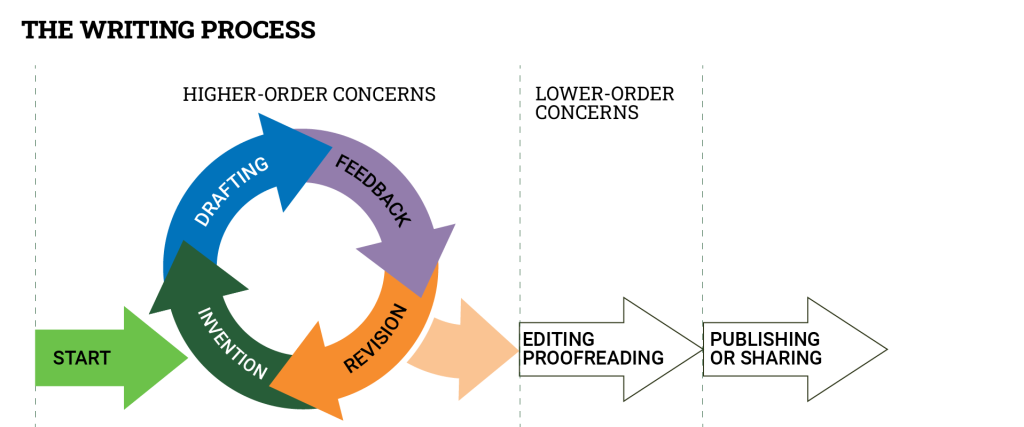
Your writing process may also depend on the context in which you are writing. If you have a timed writing task on an exam, you must adapt your process to fit the time constraints. If you are writing an article or book for publication, you will go through several rounds of revision and editing.
It is also helpful to distinguish between low-stakes writing, for which there are few consequences for unpolished writing, and high-stakes writing, where every aspect of the writing process will impact the effectiveness of your text. Low-stakes writing will not require a fulsome writing process, whereas high-stakes writing will.
Moving From Higher-Order to Lower Concerns
The stages of the writing process move from higher-order concerns to lower-order concerns. Higher-order concerns include the quality of your analysis and argumentation, the appropriateness of your content, the organization of writing, including your introduction and conclusion, and the effectiveness of your text for your audience and purpose. Higher-order concerns should be the primary focus of your writing process because they are the most important factor in communicating successfully. High-quality writing often goes through several drafting, revision, and feedback stages.
Lower-order concerns include stylistic issues like conciseness and coherence, correctness and consistency issues in grammar, punctuation and spelling, and the formatting of your document. Save work on lower-order concerns until you are satisfied with your content and organization. You don’t want to spend too much time perfecting the style or grammar of your writing when these corrections might get deleted in the revision process.
The advice to leave lower-order concerns until the end of a writing project may differ from what you have learned about writing in the past. However, consider this: you could write a grammatically and stylistically perfect text full of meaningless sentences that are ineffective at achieving your purpose. Much of the writing generated by Generative AI falls into this category. It looks great on the surface, but if you read it carefully, it does not communicate meaningfully or effectively. Writing that is superficially perfect but does not effectively convey meaning is not good writing.
Attributions
“The Writing Process?” by Nancy Bray, Introduction to Academic Writing, University of Alberta, is licensed under CC BY-NC 4.0