
Fern gametophytes in varying densities
4. Lab Procedure – Session 2
4.1 Quantifying the Effect of Density on Sex Expression
A few weeks ago, you sowed fern spores on 6 different plates – each plate should have a different density of spores where the density was reduced by approximately half at every dilution. After approximately 4 days, the spores would begin germinating and after 7 days the gametophyte sex would be distinguishable. The gametophytes that you are observing in this lab should have reached sexual maturity!
For this part, you will be counting the number of gametophytes that are male and hermaphroditic at each density. I recommend using the counting grid and observing the ferns through the agar (inverted). Work in pairs to collect the data.
1. Set up one dissecting microscope per person.
2. Work together to ensure that you are both counting accurately and can differentiate between the 2 sexual types. Do this by working on plate ‘F’ together (you will both need to look at it but use only one microscope for this part).
a. When you examine your plate under the dissecting microscope you should notice that you have two types of gametophytes growing. You will have very small, tongue-shaped male gametophytes and large, heart-shaped hermaphroditic gametophytes (Figure 2 in the introduction).
b. Describe the distribution of gametophytes in your data collection table. Are they evenly distributed or arranged in clumps? [Why do you think noting the distribution is important?]
c. Use a counting grid to systematically count the number of each sexual type on the plate. Record all the data in your first data collection table.
3. Once you are confident in your counting, divide the plates between the two of you and count the number of each sexual type on all plates (I recommend that one student counts E, D, B and the other C, A). Be sure to keep track of the gametophyte distribution for each plate.
4. Calculate the percent of gametophytes that are of each sexual type. Record in your data collection table.
5. Calculate the number of gametophytes per cm2 on each plate and record the values in your data collection table. This value represents the density of gametophytes on each plate. The formula is as follows (total plate area = 22.5 cm2): Density = (total number of gametophytes)/(total area on the plate (cm2))
6. Record data into the class spreadsheet. In the spreadsheet, you will notice a column regarding distribution. You can select clumped, even, and mix of clump and even.
4.2 Quantifying the Effect of Density on Gametophyte Size
In this part of the lab, you will be measuring the width of hermaphroditic gametophytes from different densities. We will compile the class data again to allow for a larger sample size for our data analysis.
1. Look at the calculated densities from 4.1 and identify the highest and lowest density plates. Then look for the middle 2 plates – select the plate with the higher of the 2 densities (e.g., if plate C = 24 gametophytes/cm2 and D = 20 gametophytes/cm2, select C).
2. For each of the 3 plates identified above:
a. Make a wet mount slide with 4 randomly selected hermaphroditic gametophytes from your plate, trying not to get them from all the same area. You are provided with cotton swabs and dissection needles to help lift the gametophytes from the plate. Be sure to not get any agar as this will make the specimen too thick. Do your best to have the thallus flat when you put the coverslip on.
b. On the 10x lens, measure the width at the widest part of each gametophyte (Figure 3). Record the data for each individual in your second data collection table. Note: if you increase the contrast by closing the iris diaphragm, you may be able to see the corkscrew-shaped sperm swimming around the gametophytes!
c. When you are done collecting the data on 4 gametophytes for all 3 plates (12 gametophytes measured per pair!), enter the data into the class data sheet.
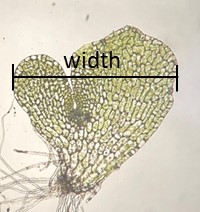
Figure 3. Measuring the widest part of a hermaphroditic gametophyte. Photo taken under 100x total magnification through a Kyowa microscope.