
Exploring Biological Diversity
Exploring Biological Diversity
Learning Objectives
Upon completion of this lab, students will be able to:
- Systematically survey living organisms in an outdoor space (macroscopic organisms)
- Use field guide, taxonomic identification keys, and/or identification applications to identify organisms
- Write scientific questions that can be asked in evolutionary biology based on your observations
1. Lab Overview and Background
Throughout AUBIO 112 lecture, you have been learning about the mechanisms and patterns of evolution. The last few lecture topics of the course have focused on the major groupings of life. You are going to use what you have been learning in the lecture, and your own person experience, to classify the different living organisms that you observe outdoors.
1.1 Identifying Organisms
There are a variety of tools that can be used for identifying organisms, but the tools used can depend on the type of organism, level of identification desired, and the context. For example, DNA barcoding is a molecular method used to accurately identify species that requires time, money, and specific equipment. This tool is used frequently in laboratory situations where immediate identification is not necessary, but it is not practical for many situations.
In this lab, and in most situations you will face, you will be using different identification tools that allow you to identify morphologically discrete species, or give you guidelines on higher-level identification (e.g., coniferous tree): Field guides, taxonomic identification keys, and identification applications. See the “Species Identification” resources on the class website and the example below (Figure 1).
- Biologists and naturalists often use field guides to identify the organisms they are observing. Field guides are typically books (and now apps!) that have species’ pictures or drawings, distinguishing characteristics, and geographic ranges.
- Taxonomic identification keys are constructed by a taxonomic specialist and consist of a sequence of identification steps, each with several alternatives. Moving through the key using characteristics will lead to identification of the organism.
- Photo identification technology is becoming quite accurate! There are now a number of online identification applications on phones/computers/tablets. Experts and specialists, with the help of citizen scientists, put together identification criteria for many common organisms. Along with the criteria, the application has numerous photos of positively identified organisms and uses photo recognition software; so when a photo is uploaded, the application can identify the organism (if the photo is clear!). A limitation to using applications to automatically identify organisms is that the naturalist does not learn the key distinguishing features of the organisms and often the inventory of species is not complete/not accurate. Ultimately, a combination of field guides, taxonomic identification keys and applications can help a naturalist learn how to identify organisms around them.
A limitation to field guides, taxonomic identification keys, and identification applications is that some species are not easily distinguishable by morphological characteristics. If species identification is essential, DNA barcoding can be done to verify field identification.
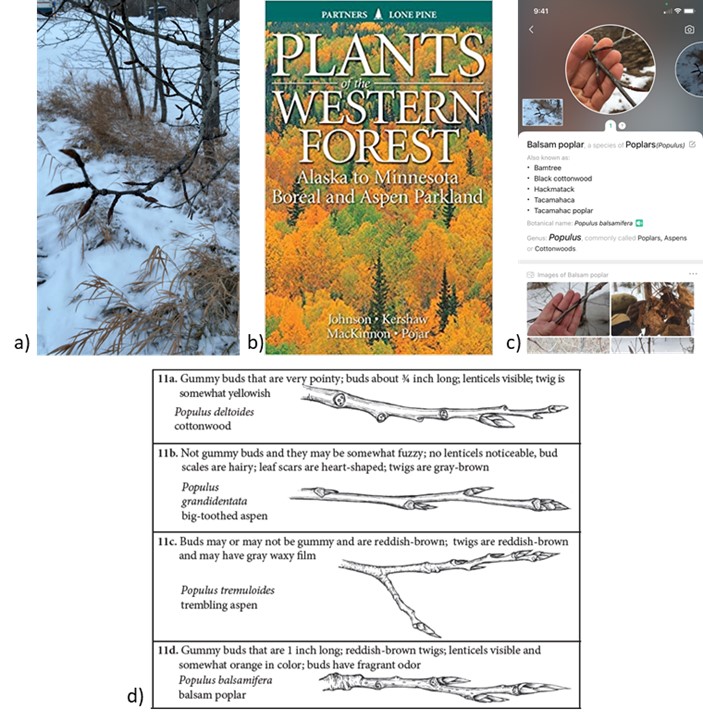
Figure 1. This tree is in Jody’s yard (a) – if we wanted to identify it, we could use this b) field guide, c) identification application (I used “picture this”), or d) taxonomic identification key (I would have gone through numerous steps to get to this point!). Note, I use all 3 guides to confirm my identification because I want to learn more!