
Library Resources
Citing Your Sources
Whenever you use information created by others in your own work, you need to cite it. For a review of how citation works and why it’s important, watch this 2-minute introduction to citation video.
Introduction to CSE Style
CSE, which stands for Council of Science Editors, is a common citation style used in the sciences. As with most citation styles, CSE-style references answer four key questions:
| Question | Description |
| Who wrote the work? | The names of the author(s) or editor(s). |
| When was it published? | Usually the year of publication. For online works like webpages, a specific date is included if available. |
| What is it called? | The title of the work. |
| Where can it be found? | Details about where the work was published (e.g., journal name, edition information, publisher, URL) |
CSE allows three different systems for in text citation style and ordering a reference list:
- Name-year: In-text citations are in name-year format, e.g., (Barrow 2004), and the reference list is ordered alphabetically by author.
- Citation-sequence: In-text citations are numbered, and the reference list numbering is based on order of appearance in the paper.
- Citation-Name: In-text citations are numbered, and reference list numbering is alphabetical by author.
At Augustana, the name-year system is usually used. This means that whenever you refer to a particular work in your text, you should include the last name(s) of the author(s) and the year of publication in parenetheses. This in-text reference will match with a reference list entry at the end of your paper that includes the full citation details for the work.
The next section shows how to create reference list entries for a journal article and a book, two common types of sources you may need to cite.
Journal article
An online journal article reference should be formatted like this:
Author(s). Year. Article title. Abbreviated Journal Title. [accessed date];Volume(issue):page–range. URL (using the DOI if it has one).
Here is an example of a completed journal article reference:
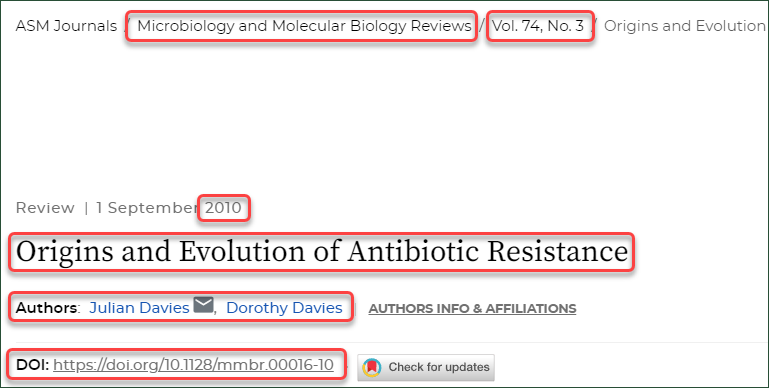
Davies J, Davies D. 2010. Origins and evolution of antibiotic resistance. Microbiol Mol Biol Rev. [accessed 2015 Jan 29];74(3):417–433. https://doi.org/10.1128/MMBR.00016-10.
You can usually find these pieces of information within the article itself, or in an online record that has details about the article. The following image shows a journal article record with the citation details circled. The only piece of information missing from this record is the page range, which can be found within the article.
One thing to note about CSE style is that it uses abbreviated journal titles. You can use a few different databases to search for the name of a journal and find its abbreviation:
- CAS Source Index Search Tool
- Web of Science Journal Title Abbreviations list
- Journals Referenced in NCBI Databases
For example, if you wanted to find the abbreviation for Microbiology and Molecular Biology Reviews, you could start by searching for its title using the CAS Source Index search tool:
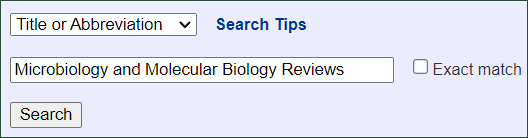
There are two results, and the second one is an exact match.

Clicking on its title opens a record that shows the abbreviated title, which you can then use in your reference.
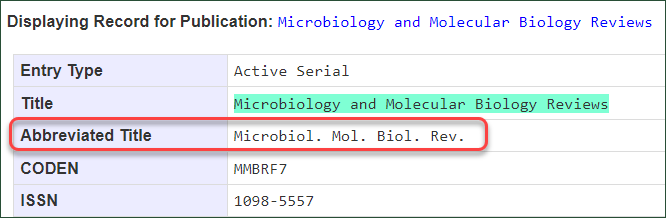
If you search for a journal title and get no results, try using one of the other two databases listed above. If there are no exact matches in any of them, you can search for each word of the journal name in the List of Title Word Abbreviations to find out how it should be abbreviated. Note that articles (e.g., the, an), conjunctions (e.g., and), and prepositions (e.g., on, in, of) are omitted from abbreviated journal titles.
Book
An ebook reference should be formatted like this:
Author(s). Year. Book title. Edition (if relevant). Place of publication: Publisher; [accessed date]. URL (using the DOI if it has one).
If you were citing a print book, you would leave out the access date and the URL, and just end with a period after the publisher.
Here is an example of a completed ebook reference:
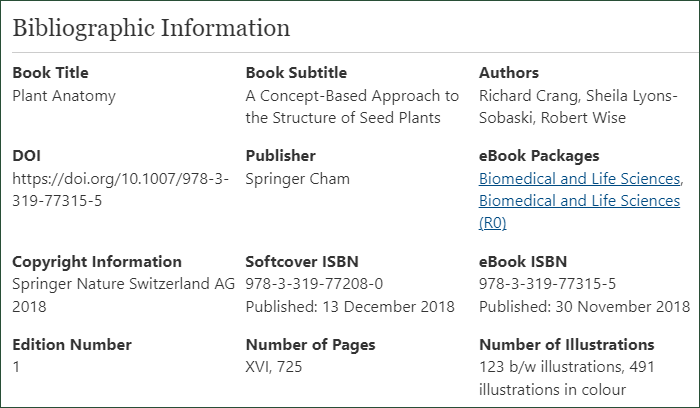
Crang R, Lyons-Sobaski S, Wise R. 2018. Plant anatomy: a concept-based approach to the structure of seed plants. Cham (Switzerland): Springer Nature; [accessed 2023 Dec 12]. https://doi.org/10.1007/978-3-319-77315-5.
You can usually find these pieces of information within the book itself, or in an online record for the book. For example, the following record includes most of the details needed to cite this ebook including the title, authors, year of publication, publisher, and DOI.
CSE-Style Resources
For more examples and instructions, use the CSE resources in the Citation & Reference Management Guide.
- The U of A Library’s CSE QuickGuide includes example citations for common types of sources.
- If you want to see templates showing the pieces of information included in each type of reference, try the guide provided by CSE.
If you have questions, you are welcome to ask us for help. We won’t check your reference list, but we can guide you to relevant examples.
Library Resources Conclusion
You should now have a better understanding of how to find, evaluate, and cite biological information. If you have any questions, don’t hesitate to ask! You can use the library’s chat and email service, visit the Augustana Library, or email me.