11 Technology Integration and the ICT Program of Study
Tracy Boger
Learning Outcomes
After reading this chapter you will be able to:
- Describe the ICT Program of Study (POS), including how it is structured by division
- Differentiate between general and specific learning outcomes
- Describe the 3 categories of the ICT POS
- Explain how teachers use the ICT POS and core subject POS to guide technology integration decisions
Technology Integration Introduction
The road map for technology integration looks different for core subject areas compared to standalone technology courses. The program of study for a standalone technology course, such as computer programming or graphic design, includes learning outcomes that clearly define the technical skills and knowledge that students are expected to learn. Teachers who teach stand-alone technology courses have autonomy over how they teach but are relatively limited in the tools they can select when teaching those learning outcomes. For example, a teacher who is teaching coding would obviously be limited to choosing a programming language. However, there is more flexibility for integrating technology into core subjects. A teacher who is teaching World War II in social studies could integrate technology in several ways, such as exploring a virtual museum, using interactive maps of key battles, watching documentaries, integrating digital formative assessments, or accessing archived online primary sources such as journals, diaries, government documents, photos, or news articles from the period. Alternatively, students could represent what they learned by creating a digital story, podcast, video, digital presentation, interactive timeline, infographic, or a virtual interactive map.
To guide decisions about technology integration, it is recommended that teachers draw on curricular documents and apply the Technological Pedagogical and Content Knowledge (TPACK) framework to inform pedagogical choices. To gain insight into expected technology learning outcomes teachers can turn to curriculum documents such as the Information and Communication Technology (ICT) Program of Studies (2000). However, technology integration involves more than simply identifying technology learning outcomes. Merely using technology in a lesson does not guarantee effective technology integration, because a nuanced understanding of technology, pedagogy, and content knowledge (TPACK) is essential for the alignment of pedagogical approaches with the appropriate tools that support the achievement of learning outcomes. As mentioned in Chapter 7, the Technological Pedagogical Content Knowledge (TPACK) framework can help guide technology integration decisions by facilitating critical reflection on the interplay between technology, pedagogy, and content (Koehler & Mishra, 2008).

Information and Communication Technology (ICT) Program of Studies
In Alberta, the Information and Communication Technology (ICT) Program of Studies (2000) requires teachers to integrate technology when teaching core subjects. This expectation is stated clearly in the ICT Program of Studies: “The ICT curriculum is not intended to stand alone, but rather to be infused within core courses and programs” (ICT POS, p. 1). For this reason, the ICT Program of Studies has been described as a “curriculum within a curriculum using the core subjects of English Language Arts, Math, Science and Social Studies as a base” (Alberta Education, 2025).
Unlike other programs of study that structure learning outcomes by grade and course, the ICT Program of Studies is structured by division, with each division spanning three grades.
Table 11.2 Grade Ranges for the ICT Outcomes in Alberta
| Division | Grades |
|---|---|
| Division 1 | Grades 1, 2, 3 |
| Division 2 | Grades 4, 5, 6 |
| Division 3 | Grades 7, 8, 9 |
| Division 4 | Grades 10, 11, 12 |
________________________________________________________________________
Source: Alberta Education. (2000). Information and communication technology program of studies. https://education.alberta.ca/information-communication-technology/program-of-studies/
The advantage of this format is that it provides teachers with greater flexibility. Rather than teaching a specific learning outcome by the end of grade 2, a teacher can complete that outcome anytime during grades 1 to 3. The drawback is that this approach requires coordination, tracking, and communication within schools to ensure all technology outcomes are met across all grades.
ORGANIZATION OF learning outcomes
The ICT Program of Studies is divided into three interrelated categories:
- Communicating, inquiring, decision making and problem solving
- Foundational operations, knowledge and concepts
- Processes for productivity
The advantage of this format is that it provides teachers with greater flexibility. Rather than teaching a specific learning outcome by the end of grade 2, a teacher can complete that outcome anytime during grades 1 to 3. The drawback is that this approach requires coordination, tracking, and communication within schools to ensure all technology outcomes are met across all grades.
Processes for Productivity
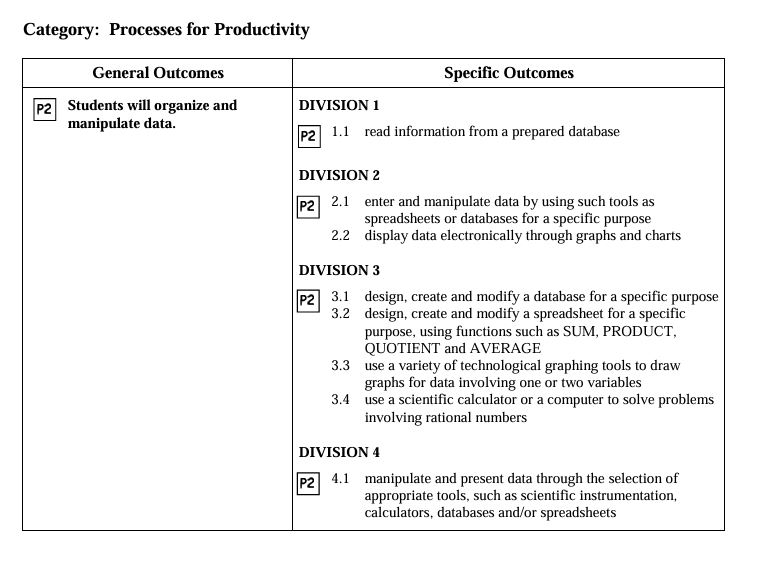
Processes for Productivity outcomes focus on the knowledge and skills required to use word processors, spreadsheets, databases, email, Internet browsers, graphic applications, multimedia and presentation tools. The emphasis of this category is on developing skills such as “text composition; data organization; graphical, audio and multimedia composition and manipulation; media and process integration; and electronic communication, navigation and collaboration through electronic means” (Alberta Education, 2000, p. 2). As students progress to higher levels, their skills build on what they have previously learned and become more in-depth. For example, in division 2, students are expected to enter data into spreadsheets, whereas in division 3, they are expected to perform calculations using functions such as SUM, PRODUCT, QUOTIENT, and AVERAGE.
Foundational Operations, Knowledge and Concepts
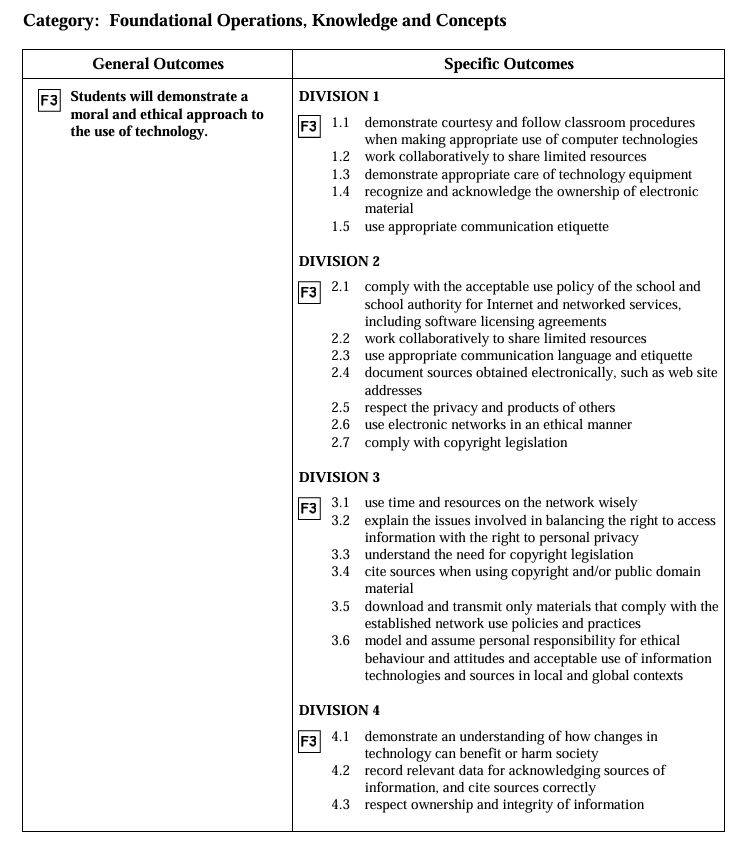
The focus of Foundational Operations is on understanding the nature of technology, the moral and ethical use of technology, mass media, ergonomic and safety issues, and basic computer, telecommunication and multimedia technology operations (Alberta Education, 2000, p. 2). Many of the learning outcomes in the Foundational Operations section of the ICT POS address ethical and responsible online behaviour, which is a key component of digital citizenship. For example, foundational operation outcomes address issues related to privacy, responsible use, e-commerce, legal issues such as copyright, and health and wellness. A comprehensive discussion of digital citizenship will be explored in Chapters 26 and 27.
Communicating, Inquiring, Decision Making and Problem Solving
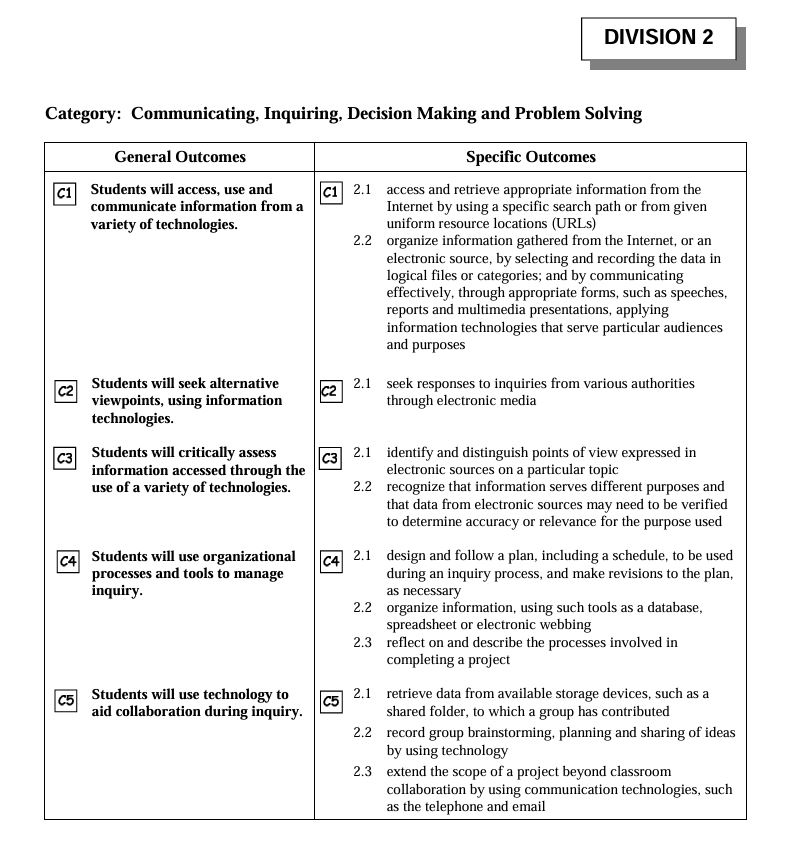
The Communicating and Problem Solving section focuses on real life scenarios that require critical thinking skills. These outcomes require students to demonstrate “the ability to use a variety of processes to critically assess information, manage inquiry, solve problems, do research and communicate with a variety of audiences” (Alberta Education, 2000, p. 2). This category of the ICT Program of Studies builds on the Processes for Productivity and Foundational Operations categories. Some of the expectations listed in this category align with digital literacy education goals. For example, outcome C3.2.1 and C3.2.2 (below) emphasize fact-checking and critically evaluating online content.
TECHNOLOGY INTEGRATION Summary
The expectations for technology integration vary by the instructional context and the subject being taught. Despite these contextual variations, the main goal of technology integration remains the achievement of learning outcomes outlined in the core subject area’s program of study. When integrating technology into a core subject area, like math, it is important that teachers recognize that the role of technology is to support math outcomes. This requires the ability to apply TPACK (Koehler & Mishra, 2008) and think critically about how to use technology appropriately in a specific context. As discussed in Chapter 7, frameworks such as PICRAT (Kimmons et al., 2020) and SAMR (Puentedura, 2003) can also help teachers make decisions regarding technology integration strategies. The PICRAT model encourages educators to critically reflect on the pedagogical role of technology and the level of student engagement that technology facilitates. Whereas the SAMR framework provides a structured lens through which teachers can assess the degree to which technology modifies or redefines the learning experience. Collectively, TPACK, PICRAT, and SAMR promote a more deliberate and reflective approach to technology integration.
From a practical application perspective, it can be tempting for novice teachers to start with a technology tool in mind and then attempt to find a way to integrate it into their course. This approach can be successful if the tool is used to meet learning outcomes and supports learning in a meaningful way; however, teachers should be cautious about using technology for the sake of using technology. If a tool does not fundamentally enhance or contribute to learning, it may be wise for teachers to spend their limited time on other important tasks. Importantly, technology integration is not only about enhancing technical skills; it is about purposefully using technology to meet learning outcomes through exploration, problem solving, communication, collaboration, and the application of critical thinking skills.
Learning Check
References
Alberta Education. (2013). Alberta digital citizenship policy development guide. https://education.alberta.ca/media/3227621/digital-citizenship-policy-development-guide.pdf
Alberta Education. (2000). Information and communication technology program of studies. https://education.alberta.ca/information-communication-technology/program-of-studies/
Alberta Education. (2025, August 25). Information & communication technology program of studies. https://education.alberta.ca/information-communication-technology/program-of-studies/
Kimmons, R., Graham, C. R., & West, R. E. (2020). The PICRAT model for technology integration in teacher preparation. Contemporary Issues in Technology and Teacher Education, 20(1). https://citejournal.org/volume-20/issue-1-20/general/the-picrat-model-for-technology-integration-in-teacher-preparation
Koehler, M. J., & Mishra, P. (2008). Introducing TPACK. In American Association of Colleges for Teacher Education Committee on Innovation and Technology (Ed.), Handbook of technological pedagogical content knowledge (TPACK) for educators (pp. 3–29). Routledge. https://punyamishra.com/wp-content/uploads/2008/05/koehler_mishra_08.pdf
Puentedura, R. R. (2003). A matrix model for designing and assessing network-enhanced courses. Hippasus. Retrieved from http://www.hippasus.com/resources/matrixmodel/
Saskatchewan Ministry of Education. (2015). Digital citizenship education in Saskatchewan schools – K-12. https://publications.saskatchewan.ca/#/products/74037
Technological Pedagogical and Content Knowledge (TPACK) is a theoretical framework that describes the types of knowledge that teachers need to effectively integrate technology in their teaching. It was formally introduced by Punya Mishra and Matthew J. Koehler, and built on the work of Lee S. Schulman, who introduced the concept of Pedagogical Content Knowledge (PCK).
A matrix model that helps educators to evaluate and reflect on technology integration in their classroom. Developed by Royce Kimmons, Charles R. Graham and Richard E. West, it allows teachers to assess how technology is being used both in terms of student activity and the role the technology plays in the lesson. It is an acronym that stands for Passive, Interactive, Creative, Replacement, Amplification, Transformation.
a technology integration model that holds that technology use in the classroom either takes the form of Substitution, Augmentation, Modification, or Redefinition (SAMR)