10 ISTE Technology Standards
Tracy Boger
Learning Outcomes
After reading this chapter you will be able to:
- Describe ISTE’s Technology Standards
- Explain why Canadian teachers should be aware of the ISTE Technology Standards
Technology standards for students differ from curriculum documents in terms of purpose, scope, and implementation. The purpose of a program of study or curriculum document is to define specific learning outcomes that educators are mandated to teach. Alberta’s ICT Program of Studies (2000), mandates what students should know and do with respect to technology, whereas the International Society for Technology in Education (ISTE) Technology Standards (2021), provide general competency based statements that can be adapted by schools, districts, and governments worldwide. For example, ISTE Technology Standards (2021) state that a student should be a Knowledge Constructor who can “critically curate a variety of resources using digital tools” (p. 3). This general statement contrasts with the more specific learning outcome, which requires students to: “design, create and modify a spreadsheet for a specific purpose, using functions such as SUM, PRODUCT, QUOTIENT and AVERAGE” (Alberta Education, 2000, p. 18). Curriculum documents define educational goals, while technology standards (in the context of this discussion) provide a general framework for incorporating technology to meet those goals. Technology standards may serve to guide the integration of technology into the curriculum, but they are not the curriculum itself.
There are many reasons why technology standards are useful for educators. Research has shown that it is helpful to have clearly defined standards to guide and support teachers with technology integration efforts (Dinçer, 2018; Uerz et al., 2018). ISTE Technology Standards provide guidance and support best practices for technology integration in the classroom (Crompton, 2023). In addition, curriculum documents may define technical competencies for students, but they do not explicitly define the necessary technical skills and knowledge that are expected of teachers. Technology standards for teachers are useful because they fill in this gap by clarifying expectations of teachers. Importantly, both teachers and administrators can use ISTE’s standards as guidelines for technology integration, to inform professional practice, and to provide direction for professional development.
ISTE
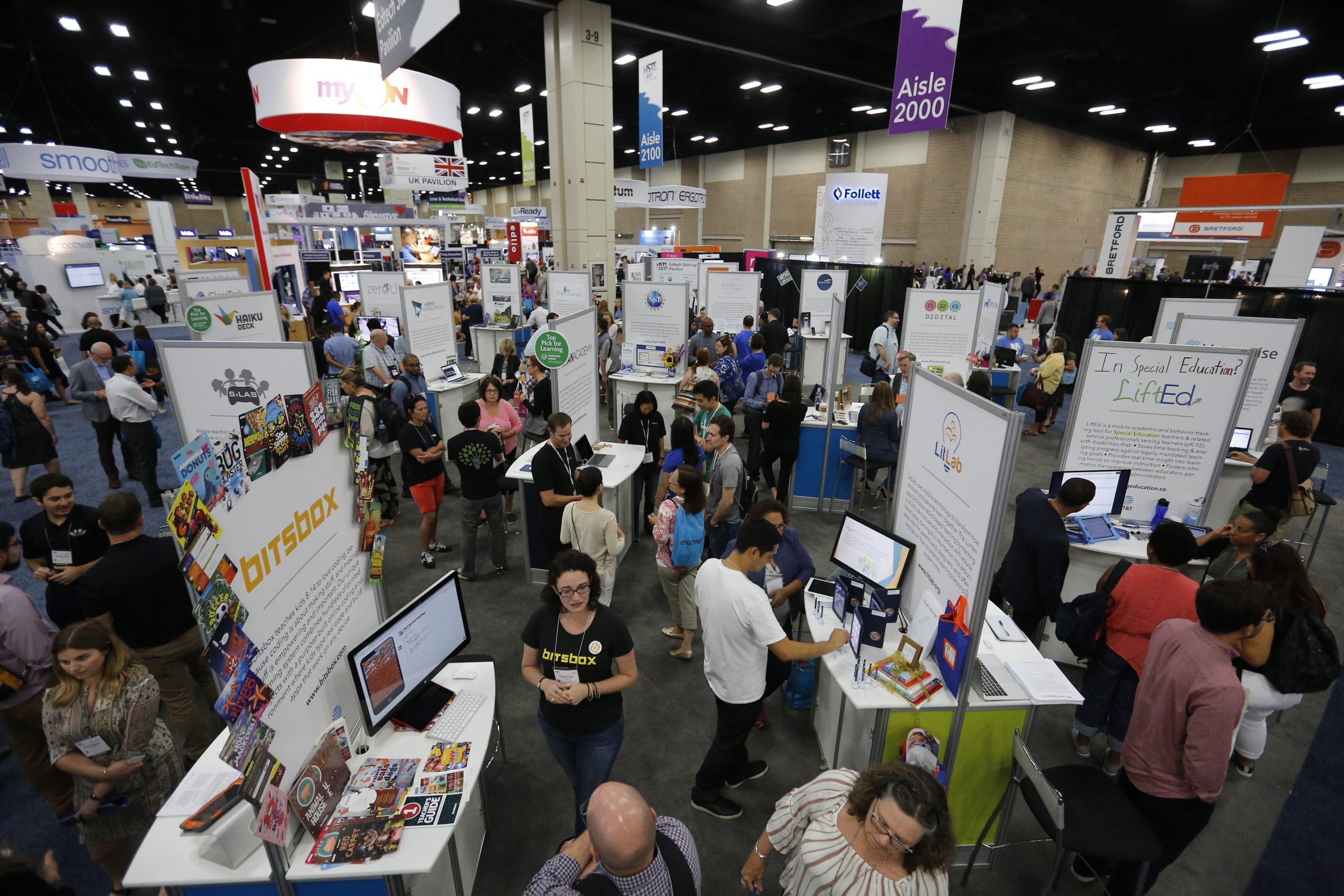
One significant and widely known source of educational technology standards comes from the International Society for Technology in Education (ISTE). ISTE is a professional organization that focuses on supporting technology integration through its technology standards and professional development opportunities, which include ISTE U online courses, ISTE-certified programs, and professional conferences such as ISTELive. As its name suggests, ISTE is truly international in scope (ISTE, 2022). For example, in 2024, the ISTELive conference had 16,500 attendees from 84 countries (ISTE, 2024b). ISTE’s international network includes affiliated organizations and partners from across the globe.
ISTE Educational Technology Standards
The ISTE Standards, which are available in nine languages, serve to guide professional practice and growth. Initially, the ISTE Standards were called the National Educational Technology Standards (NETS), but they were later renamed in 2016 (ISTE-ASCD, 2024). The first student NETS were published in 1998, while the teacher NETS were released much later, in 2000 (ISTE-ASCD, 2024). Since their inception, these standards have been continually revised and upgraded. Over the years, the ISTE Standards have expanded in scope to include technology standards for educational leaders, coaches, and computational thinking competencies for educators (ISTE, 2024a). Together, these standards provide a “comprehensive approach to advancing educator practice and professional growth for using technology in the service of learning, and support planning for digital learning, curriculum mapping and school improvement” (ISTE, 2024a, p. 2).
ISTE Standards for Teachers
ISTE’s technology standards for teachers were developed “through a research process with input from 2,429 participants, including association leaders, technology experts, educational leaders, and educators from 38 countries” (Crompton, 2023, p. 202). The ISTE Standards for Teachers do not identify specific tools for teachers to learn and use; instead, they focus on the teacher’s roles in the classroom. These roles are divided into the categories of empowered professional and learning catalyst. For each of these teacher roles, there are several indicators to help clarify what the standards look like in practice. The ISTE Standards for Teachers, including the roles of the teacher and corresponding indicators, are summarized below.
Summary of ISTE Standards for Teachers
2.1 Learner
2.1.a Set Professional Goals
2.1.b Participate in PLNs
2.1.c Keep Current on Research
2.2 Leader
2.2.a Advance a Shared Vision
2.2.b Advocate for Access
2.2.c Model Digital Tool Use
2.3 Citizen
2.3.a Create Positive Experiences
2.3.b Evaluate Resources for Credibility
2.3.c Model Safe, Legal, Ethical Practices
2.3.d Manage and Protect Data
2.4 Collaborator
2.4.a Collaborate with Colleagues
2.4.b Learn Alongside Students
2.4.c Use Collaborative Tools
2.4.d Empower Community to Support Students
2.5 Designer
2.5.a Accommodate Learner Differences
2.5.b Design Authentic Learning Activities
2.5.c Innovative Learning Environments
2.6 Facilitator
2.6.a Foster Student Ownership of Learning
2.6.b Foster Classroom Management of Tech
2.6.c Teach Computational and Design Thinking
2.6.d Model and Nurture Creativity
2.7 Analyst
2.7.a Offer Alternative Assessments
2.7.b Use Tech to Create Assessments
2.7.c Use Data to Guide Progress
________________________________________________________________
Source: International Society for Technology in Education. (2024a). ISTE standards. https://www.iste.org/standards
ISTE Technology Standards for Students
Much like ISTE’s technology standards for teachers, the technology standards for students are organized by the different roles that students assume when engaging with technology. These roles include those of empowered learner, digital citizen, knowledge constructor, innovative designer, computational thinker, creative communicator, and global collaborator. The technology standards for students are general, open-ended, and are not delineated by grade or subject. The standards provide flexibility in how they can be met by focusing on what students should do rather than prescribing a specific method for meeting them. However, this flexibility also means that teachers are responsible for educating themselves about best practices for technology integration.
Summary of ISTE Standards for Students
1.1 Empowered Learner: Students leverage technology to take an active role in choosing, achieving and demonstrating competency in their learning goals, informed by the learning sciences.
1.2 Digital Citizen: Students recognize the responsibilities and opportunities for positively contributing to their digital communities.
1.3 Knowledge Constructor: Students critically curate a variety of resources using digital tools to construct knowledge, produce creative artifacts and make meaningful learning experiences for themselves and others.
1.4 Innovative Designer: Students use a variety of technologies within a design process to identify and solve problems by creating new, useful or imaginative solutions.
1.5 Computational Thinker: Students develop and employ strategies for understanding and solving problems in ways that leverage the power of technological methods to develop and test solutions.
1.6 Creative Communicator: Students communicate clearly and express themselves creatively for a variety of purposes using the platforms, tools, styles, formats and digital media appropriate to their goals.
1.7 Global Collaborator: Students use digital tools to broaden their perspectives and enrich their learning by collaborating with others and working effectively in teams locally and globally.
_______________________________________________________________
To view ISTE’s complete Technology Standards for Students:
Source: International Society for Technology in Education. (2024a). ISTE standards. https://www.iste.org/standards
Adopting ISTE Standards
Even though ISTE is a reputable professional organization and their standards have been widely adopted, teachers are not required to work towards meeting ISTE Standards unless mandated by local educational authorities. This does not mean that the ISTE Standards are not relevant or useful for teachers who teach in jurisdictions where the standards have not been adopted. Since ISTE Standards are regularly updated, they are particularly useful for teachers who wish to stay on top of the latest developments in educational technology. In addition, teachers can benefit from using the ISTE Standards for Teachers to guide professional development goals. Crompton and Sykora (2021) point out that there are many ways in which school authorities can use the ISTE Standards, including assisting with hiring decisions and guiding professional development initiatives. In jurisdictions where ISTE Standards are used to assist with hiring decisions, it would be very wise for teachers to be familiar with these standards.
Adopting ISTE Standards
Adopting the standards in a school, district, state/province or nation takes different forms. Educational authorities and education leaders may decide to use the standards in a variety of ways, including:
- As part of statewide or district-level expectations.
- To guide systemwide planning, including school improvement, technology or digital learning plans.
- To guide professional development plans and/or individual professional growth goals.
- To map curriculum.
- To ensure that lesson design and plans include the purposeful use of technology.
- As part of a learning management system or web system.
- In teacher preparation across the curriculum.
- To embed in job descriptions and hiring decisions.
___________________________________________________________________
Source: Crompton, H., & Sykora, C. (2021). Developing instructional technology standards for educators: A design-based research study. Computers and Education Open, 2. https://doi.org/10.1016/j.caeo.2021.100044
ISTE and Educational Practices in Canada
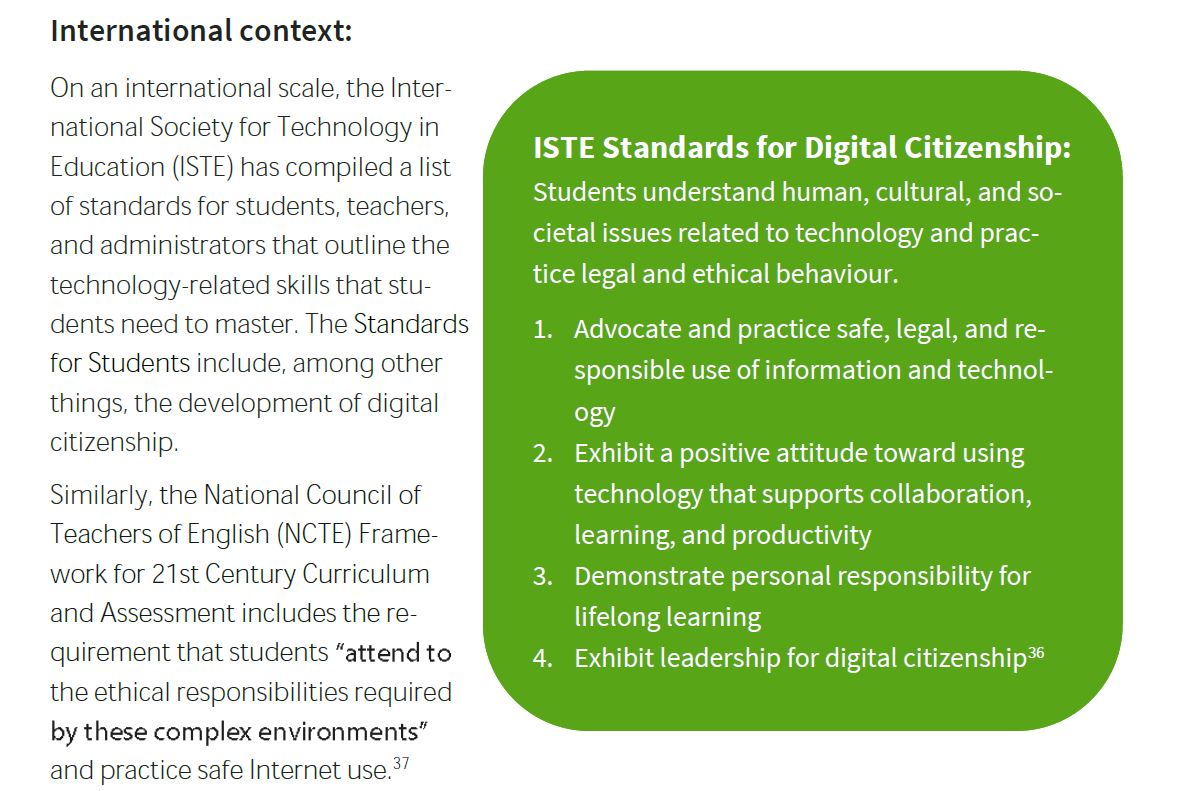
The influence of ISTE in Canada is made evident by the inclusion of ISTE Standards within official documents issued by several provincial Ministries of Education. For example, ISTE’s Digital Citizenship Standard has been integrated into digital citizenship policy guides in Saskatchewan (Saskatchewan Ministry of Education, 2015) and Alberta (Alberta Education, 2012). These guides support school divisions and administrators in the development of policies and procedures pertaining to security, online safety, and the ethical and responsible use of technology. Additionally, the province of Manitoba (Manitoba Ministry of Education, 2024) references ISTE’s digital citizenship standard on the Ministry of Education’s website. It should be noted, however, that the ISTE Standards have been updated since the digital citizenship standard was integrated into these documents. In any case, the fact that provincial Ministries of Education have acknowledged the ISTE Standards within official documents is a clear indicator of the influence of the ISTE Standards in Canada.
Digital Citizenship in Saskatchewan Schools
From Digital Citizenship Education in Saskatchewan Schools, page 11.
_____________________________________________________________
Source: Saskatchewan Ministry of Education. (2015). Digital citizenship education in Saskatchewan schools. https://publications.saskatchewan.ca/#/products/74447
The influence of ISTE standards is also evident in Canada’s digital literacy education frameworks. Canada does not have a national strategy for digital literacy education and there is variation from province to province. British Columbia (British Columbia Ministry of Education, 2015), New Brunswick (New Brunswick Department of Education and Early Childhood Development, 2025), and Ontario (Ontario Ministry of Education, 2020) have each developed separate digital literacy education frameworks (Rong & Estaiteyeh, 2024). Of the three frameworks, the influence of ISTE Standards is most evident in British Columbia’s Digital Literacy Framework (2015), which directly references the standards and performance indicators. Although not all digital literacy frameworks in Canada explicitly reference ISTE Technology Standards, the ISTE competencies that relate to the roles of Digital Citizen, Creative Communicator, and Global Collaborator align with digital literacy education goals. Despite the variation in digital literacy education frameworks across Canada, one commonality is that these programs all have a degree of alignment with ISTE Technology Standards.
Learning Check
References
Alberta Education. (2012). Policy development guide for digital citizenship. https://education.alberta.ca/media/3227621/digital-citizenship-policy-development-guide.pdf
Alberta Education. (2000). Information and communication technology program of studies. https://education.alberta.ca/information-communication-technology/program-of-studies/
British Columbia Ministry of Education and Childcare. (2015). Digital literacy framework (BC). https://www2.gov.bc.ca/gov/content/education-training/k-12/teach/resources-for-teachers/digital-literacy
Crompton, H. (2023). Evidence of the ISTE standards for educators leading to learning gains. Journal of Digital Learning in Teacher Education, 39(4), 201–219. https://doi.org/10.1080/21532974.2023.2244089
Crompton, H., & Sykora, C. (2021). Developing instructional technology standards for educators: A design-based research study. Computers and Education Open, 2. https://doi.org/10.1016/j.caeo.2021.100044
Dinçer, S. (2018). Are preservice teachers really literate enough to integrate technology in their classroom practice? Determining the technology literacy level of preservice teachers. Education and Information Technologies, 23(6), 2699–2718. https://doi.org/10.1007/s10639-018-9737-z
International Society for Technology in Education. (1998). National educational technology standards for students. https://eric.ed.gov/?id=ED421971
International Society for Technology in Education. (2000). National educational technology standards for teachers. http://www.broward.k12.fl.us/it/strategicplan/pdf/nets.pdf
International Society for Technology in Education. (2017). ISTE standards for educators. https://www.iste.org/standards/for-educators
International Society for Technology in Education. (2021). ISTE Standards. https://cms-live-media.iste.org/ISTE-Standards-One-Sheet_Combined_11-22-2021_vF4-1-4.pdf
International Society for Technology in Education. (2022). ISTE 2022 annual report. ISTE. https://cms-live-media.iste.org/www-root/2023-03/ISTE-2022-Annual-Report.pdf
International Society for Technology in Education. (2024a). ISTE standards. https://www.iste.org/standards
International Society for Technology in Education. (2024b, June 26). More than 16,500 attend ISTELive 2024 in Denver, Colorado, and virtually. ISTE News. https://iste.org/news/more-than-16-500-attend-istelive-2024-in-denver-colorado-and-virtually
International Society for Technology in Education and the Association for Supervision and Curriculum Development. (2024, June 26). Our story. https://iste-ascd.org/our-story
Law, N. & Woo, D., de la Torre, J. & Wong, G. (2018). A global framework of reference on digital literacy skills for indicator 4.4.2. UNESCO Institute for Statistics. https://unesdoc.unesco.org/ark:/48223/pf0000265403
New Brunswick Department of Education and Early Childhood Development. (2025). Digital literacies: Playing and learning with young children: Professional support document. https://www2.gnb.ca/content/dam/gnb/Departments/ed/pdf/ELCC/digital-literacies.pdf
Manitoba Education and Early Childhood Learning. (2024, June 26). Digital citizenship. Literacy with ICT Across the Curriculum. A Model for 21st Century Learning from K-12. https://www.edu.gov.mb.ca/k12/tech/lict/what/citizen.html
New Brunswick Ministry of Education. (2025). New Brunswick digital literacy framework. https://www2.gnb.ca/content/dam/gnb/Departments/ed/pdf/ELCC/digital-literacies.pdf
Ontario Ministry of Education. (2020). Transferable skills curriculum. Ministry of Education. https://www.dcp.edu.gov.on.ca/en/program-planning/transferable-skills/digital-literacy
Rong, W. & Estaiteyeh, M. (2024). Digital literacy in Canadian classrooms: A systematic review of teachers’ professional development programs. Canadian Journal for New Scholars in Education / Revue canadienne des jeunes chercheures et chercheurs en éducation, 15(2), 230. https://journalhosting.ucalgary.ca/index.php/cjnse/article/view/79533
Saskatchewan Ministry of Education. (2015). Digital citizenship education in Saskatchewan schools. https://publications.saskatchewan.ca/#/products/74447
Uerz, D., Volman, M., & Kral, M. (2018). Teacher educators’ competencies in fostering student teachers’ proficiency in teaching and learning with technology: An overview of relevant research literature. Teaching and Teacher Education, 70, 12–23. https://doi.org/10.1016/j.tate.2017.11.005
Educational standards related to technology that are focused on pedagogy and learner outcomes when using the technology tool(s), not the specifications of the technology itself.
Clear and measurable statements that specify what a learner will be able to know, do, or value by successfully completing a learning experience. A learning outcome is a student-centered statement of the demonstrable result of learning.
A student who can actively use technology to build new understanding by critically selecting, curating, and making use of digital resources to construct knowledge, create artifacts, and engage in meaningful learning experiences. This term was defined in the ISTE Standards for Students.
A way of thinking that involves using analysis and logic to express problems and their solutions in a way that a computer could understand and execute.
A person who has the knowledge, skills, and awareness to use technology responsibly, respectfully, ethically, and legally.