3 Demonstrating the Resilience of ePortfolios in Times of Disruption: Two International Case Studies
Shari Bowker, The University of Queensland, Australia
Amy Cicchino, University of Central Florida, USA
Kevin Kelly, San Francisco State University, USA
Kristina Hoeppner, Catalyst IT, New Zealand
Christina Mayes, Dominican University of California, USA
Megan Mize, Old Dominion University, USA
Christine Slade, The University of Queensland, Australia
Suzanne Schibeci, University of New South Wales, Australia
Sarah Zurhellen, Appalachian State University, USA
ABSTRACT
This chapter explores ePortfolios as a resilient practice in higher education during periods of disruption. Drawing on the Support principle from the Digital Ethics Principles in ePortfolios, developed by the Association for Authentic, Experiential, and Evidence-Based Learning’s (AEEBL’s) Digital Ethics Task Force, the authors argue that the student resilience fostered by ePortfolio practices can only be achieved successfully if ePortfolio programs are implemented and supported in a way that makes them resilient as well. Two case studies from Old Dominion University (ODU) in the United States and The University of Queensland (UQ) in Australia demonstrate how both institutions embedded ePortfolio pedagogy across curricular and co-curricular contexts through centralized, well-resourced support systems that sustained student engagement and learning continuity during the rapid transition to online and hybrid learning necessitated by the COVID-19 pandemic. Survey data from North America, Australia, and New Zealand complement these case studies, highlighting both the strengths and challenges of resilient ePortfolio implementation. While survey respondents reported diverse support roles and modalities, they also noted a lack of institutional recognition and compensation for ePortfolio professionals, underscoring the need for formal acknowledgment of the labor underpinning the resilience of ePortfolio implementations. The findings affirm that when supported by intentional pedagogical design and institutional investment, ePortfolios foster student agency, reflection, and adaptability, all of which support their resilience as learners and, in the future, as professionals. As higher education continues to face disruptions, from technological shifts to enrollment challenges, sustained support for ePortfolio ecosystems will be essential. Institutions must prioritize not only technological infrastructure but also the professional development and recognition of those who lead and sustain ePortfolio initiatives. In doing so, they cultivate ethical, inclusive, and future-ready learning environments that empower both educators and learners.
Keywords: ePortfolios, resilience, institutional support, reflection, student-centered learning
INTRODUCTION
Since ePortfolios emerged in higher education in the 1990s (Farrell, 2020), research has shown that they support deep learning skills, like reflection (Yancey, 2009), integrative learning (Eynon et al., 2014), digital technological literacy (Brown Wilson et al., 2018), communication (Galeucia et al., 2023), authentic assessment (Cambridge, 2010), and learner agency (Beckers et al., 2016). As the eleventh high-impact practice (Watson et al., 2016), ePortfolio pedagogies have remained constant, even in times of disruption, supporting larger educational goals of retention, persistence, and student success (Finley & McNair, 2013). Zhang and Tur’s (2024) review of pandemic ePortfolio scholarship found that the same practices that encourage engagement and self-directed learning processes generally helped students cope with isolation and remote learning during the COVID-19 pandemic. As generative artificial intelligence (GenAI) challenges higher education now, ePortfolios continue to help students grow critical digital literacies without sacrificing the values of reflection and metacognition (Lee & Long Zhesxing, 2023; Zhang & Tur, 2022; Zhang, 2024).
This chapter employs case study and survey data to show how ePortfolio pedagogies support resilience in crisis learning contexts and to suggest that educational institutions committed to weathering ongoing disruptions should support ePortfolio programs and initiatives robustly. Two cases—one from Old Dominion University (Norfolk, VA, United States) and another from The University of Queensland (Brisbane, Australia)—highlight how resilient ePortfolio pedagogies and support structures served educators during the pandemic and the disarray of early GenAI adoption. Despite these strong cases, however, survey data from North America, Australia, and New Zealand suggest that while ePortfolio pedagogies can impact learning, even in times of disruption, the people who labor to lead ePortfolio programs and initiatives are often under-supported and under-resourced. In presenting these data, we argue that institutions that commit to supporting proven ePortfolio practices can continue to assist students and educators through future disruptions (i.e., changing enrollment dynamics).
The work in this chapter is informed by the Association for Authentic, Experiential, and Evidence-Based Learning’s (AAEEBL) Digital Ethics in ePortfolios Task Force (Task Force) and their Digital Ethics Principles in ePortfolios (AAEEBL Digital Ethics Task Force, 2023a). This chapter focuses on the Support principle, which emphasizes that ePortfolio programs and practices do not just happen but require training, expertise, financial support, policies, and partnerships to be resilient and sustainable (AAEEBL Digital Ethics Task Force, 2023b).
AAEEBL and the Digital Ethics Task Force
Founded in 2009 as an international professional development organization for ePortfolio practitioners and researchers (AAEEBL, 2025), AAEEBL’s main activity is its annual meeting, held at different institutions throughout North America. At times, AAEEBL also partners with other organizations promoting ePortfolios, such as ePortfolios Australia, ePortfolio Ireland, and the Association of American Colleges and Universities (AAC&U). In 2018, community members initiated conversations around digital ethics and ePortfolios, which resulted in conference sessions and online conversations in 2018 and 2019 (Kelly et al., 2021). Ultimately, the Task Force was conceived at the AAEEBL Annual Meeting in 2019, which was held at Bronx Community College in New York City, NY, USA.
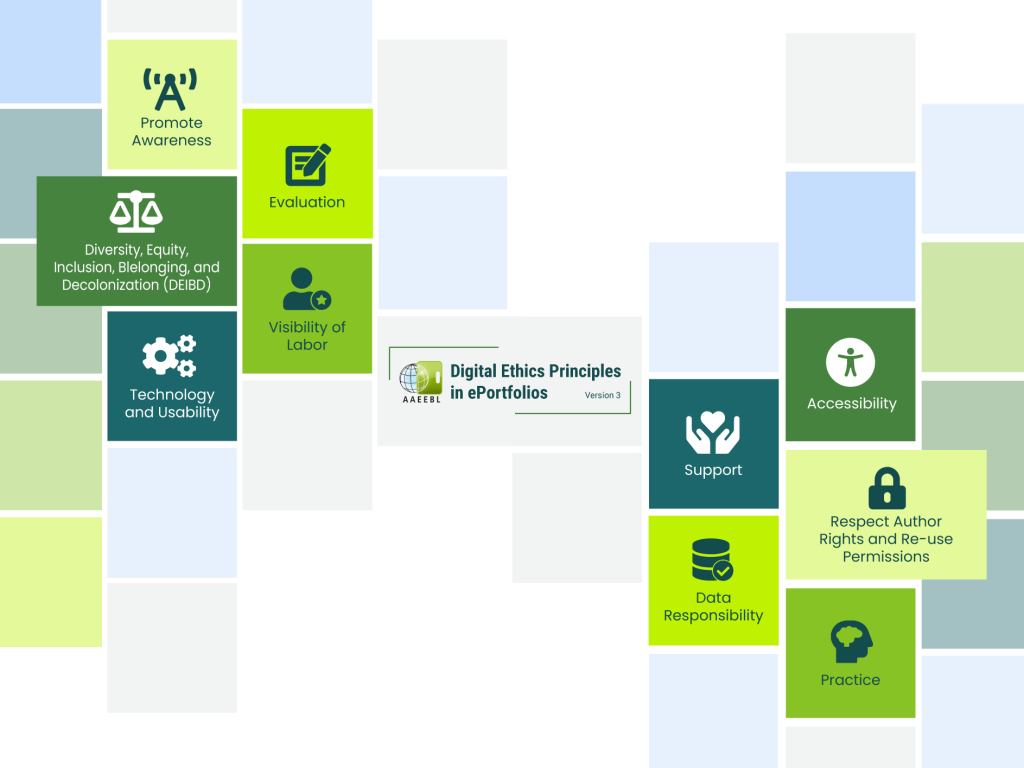
The first three years of the Task Force were dedicated to the development and refinement of digital ethics principles to guide ePortfolio practice. Ten principles (see Figure 1) emerged from that work, covering the range of activities ePortfolio authors, educators, and platform providers are involved in:
- Support
- Promote Awareness
- Practice
- Evaluation
- Diversity, Equity, Inclusion, Belonging, and Decolonization (DEIBD)
- Accessibility
- Technology and Usability
- Data Responsibility
- Respect for Author Rights and Re-Use Permissions
- Visibility of Labor
Figure 1
Visual Representation of the Digital Ethics Principles in ePortfolios
During the development phase, these principles were tested with community members in workshops, conference sessions, and academic articles. Feedback from these activities was incorporated into the revised principles that were published in 2022 that now form the core principles that guide the further work of the Task Force.
Each principle follows a common structure: First, the rationale describes its importance for ePortfolio work. That is followed by a series of strategies for incorporating the principle into ePortfolio practice and encompasses strategies for three audiences: portfolio authors, educators, and platform providers. Scenarios illustrate one or more of these strategies to give readers concrete examples of how the strategies can be applied. At the end, a series of resources encourage readers to explore each principle further.
In the years since 2022, the Task Force’s focus has shifted towards research—in particular around the visibility of labor in ePortfolio work. Two surveys were conducted (one for ePortfolio practitioners in North America and one for ePortfolio practitioners in Australia and New Zealand), and the results are currently in the analysis stage (Bowker et al., 2024; Slade et al., 2024; Gresham et al., 2023). Additionally, the use of GenAI in ePortfolio practice is being explored through the creation of a position paper as well as a series of webinars (AAEEBL Digital Ethics Task Force, 2024) that investigate different applications of GenAI in ePortfolio practice. Task Force members continue to engage the ePortfolio community in conversations around digital ethics, in particular through events and presentations.
The Support Principle
Of the ten original principles, we focus on the Support principle here to emphasize the critical role that every element of this principle plays in designing and maintaining resilient ePortfolio programs and initiatives, which are key to supporting resilience in students. The Support principle states, “Institutions should provide appropriate support for students, educators, administrators, and staff who create ePortfolios” (AAEEBL Digital Ethics Task Force, 2023b). In effect, this principle insists that it is not enough to make ePortfolio tools available. Colleges and universities must also make sure each stakeholder group—students, educators, staff, and campus leaders—has what it needs to be successful. This principle, in particular, is relevant to the cases below, which describe the common role that support played in developing cultures of resilience at two different institutions. Strategies to accomplish robust support include providing training and resources about using ePortfolios in teaching and learning contexts (Case 1) and promoting effective pedagogical and assessment strategies (Case 2). Other strategies address issues like widening access to students from low-income backgrounds and engaging the community proactively in conversations about digital ethics.
LITERATURE REVIEW
ePortfolio Support
ePortfolios offer a space and process for students to record and reflect on their experiential learning, but the implementation of ePortfolios within institutions tends to occur in isolation or ad hoc. Because ePortfolio initiatives are often led by dedicated individual practitioners, achieving scale and sustainability can be difficult. Moreover, overcoming misconceptions about the implementation of ePortfolios (Joyes & Gray, 2010) requires support from key stakeholders: educators, institutional leaders, and students (AAEEBL Digital Ethics Task Force, 2023b).
Among educators, the value of ePortfolio pedagogy is passed from colleague to colleague; therefore, the most important training and support is from those already using ePortfolio pedagogy successfully within an institution (Zhang & Tur, 2024). Experiences successfully using and refining ePortfolios to support reflection, artifact curation, and assessment are paramount for those new to the concept. In this context, support can be provided through simple instruction and mentoring as well as more formally, through organized workshops and showcases (Strampel et al., 2017) and the formation of communities of practice.
While this collegial support often relies on the energetic determination and conviction of individual practitioners, top-down support is also needed. University policy supporting the use of ePortfolios has been found to be important, particularly when it encourages using ePortfolios to holistically assess the development of students’ learning rather than just the result (Beckers et al., 2016). Ideal support at an institutional level includes the availability of consistent and widely available technology and the provision of supportive and professional staff. While ePortfolio implementation does not need to be contingent on a specific platform or disciplinary expertise, support at the executive level for staff training and development is essential for the continuation of the practice (Zhang & Tur, 2022).
Additionally, while buy-in from students can further convince institutional decision-makers to continue or expand support, convincing students of the value of ePortfolios requires providing explicitly targeted reasons for using them (Blom & Hitchcock, 2017). This must include clear instruction on the use of reflective practice as well as the demonstrated effectiveness of ePortfolios in transformative and demonstrative learning (Lewis, 2017). Further, incorporating peer review as support within a cohort (Zhang & Tur, 2022) is central to the wider acceptance of ePortfolios for self-directed learning. Support mechanisms provide the foundation for ePortfolio integration, yet it is through their sustained use that we begin to see how ePortfolios function as instruments of resilience, enabling learners to adapt, reflect, and grow in times of disruption and crisis.
Resilience
A scoping review of the literature found that institutions use ePortfolios to promote student self-awareness and academic resilience and measure the effectiveness of such practices based on how well they “prevent attrition and enable academic success in higher education” (McCarthy et al., 2024, p. 11). Some higher or tertiary educational institutions describe their student resilience goals in the context of increasing student motivation and engagement (Boyd & Fleeting, 2024). In addition, students’ own language and behaviors, as demonstrated through their ePortfolio work, confirm feelings of resilience. Compared to control groups, students who completed reflection-based ePortfolio assignments made increased references to being resilient (Di Silvestro & Nadir, 2021) and/or having “grit,” a form of resilience characterized as the “determination to achieve long-term goals and a willingness to persevere in the face of obstacles” (Singer-Freeman & Bastone, 2017, p. 152).
While institutions use ePortfolio assignments and reflections to cultivate student resilience in academic environments, fostering resilience through ePortfolio practice extends beyond academic work, as students bridge to careers and navigate career journeys. Institutions in Australia, Canada, and the USA reported requiring ePortfolio-based reflections on professional and personal identity specifically to foster graduate students’ resilience and connections within the profession (McAllister & Hauville, 2017; Wald et al., 2015). In addition, Kelly and Le Rossignol (2022) found that students who followed an ePortfolio career approach were “more resilient in their search for employment in a difficult field” (p. 793).
From a workforce perspective, Whitchurch (2015) described resilience in higher education staff employed in “Third Space” roles, or positions that cannot be clearly defined as academic or non-academic. These staff members often manage simultaneous projects for diverse stakeholders across an institution and demonstrate an ability “to cope with ambiguity and to accommodate, and even use productively, the tensions they encountered” (p. 95). Gresham, Mize, and Zurhellen (2023) applied Whitchurch’s third space professionals framework within the contexts of ePortfolio programs, noting how ePortfolios’ unique situatedness within institutions poses particular risks regarding staff and administrative labor that could undermine the resilience of ePortfolio programs if not addressed through top-level administrative planning and support.
All in all, the literature shows that resilience is both a key outcome of successful ePortfolio practice for students and a key requirement for institutions that want to sustain such outcomes for their students, particularly during times of crisis and disruption. Institutions and programs intentionally require ePortfolio artifacts and reflections to promote resilience within both academic and professional contexts. Students, who later become job seekers and then professionals, exhibit that resilience through their personal, academic, and professional reflections and actions. The following case studies build on the literature to highlight the dual roles of support and resilience in ePortfolio practice and illustrate how institutional support has enabled faculty and students to navigate ePortfolio implementation while also revealing how the process itself fosters resilience in learning.
CASE STUDIES IN EPORTFOLIO RESILIENCE
Case 1: Old Dominion University (Norfolk, VA, United States of America)
Old Dominion University (ODU) is a public, research-intensive institution located in Norfolk, Virginia, USA, serving over 20,000 students annually. With a diverse student population, including many first-generation, military-affiliated, and transfer students, ODU emphasizes experiential learning to support student engagement and success across disciplines. This institutional focus has laid a strong foundation for high-impact practices such as ePortfolios, which are integrated across disciplines to promote critical reflection, integrative learning, and professional development.
ODU’s ePortfolio Studio, housed within the Office of Academic Success Initiatives (ASI), operates in a third space (Whitchurch, 2015), bridging academic and administrative roles to support both faculty and students. Through faculty development, instructional design, and peer tutoring, the team helps embed ePortfolio practice across diverse institutional contexts. Rather than anchoring ePortfolio work to a single platform or program, the ePortfolio Studio promotes a flexible, tool-agnostic approach that supports use in general education, capstone courses, and co-curricular experiences such as internships. This centralized support structure has enabled faculty across disciplines to adopt ePortfolios in ways that align with their specific pedagogical goals.
Since its inception in 2015, the ePortfolio Studio has invested in a university-wide faculty development model to support ePortfolio adoption. This support includes faculty workshops, individual consultations, scaffolded assignment design, customizable templates, and technical support for platforms such as Wix, WordPress, and Adobe Express. Workshops emphasize pedagogical goals, like helping students synthesize learning and articulate growth, rather than focusing primarily on technical training. Faculty in departments such as English, Communication, and Cybersecurity have embedded ePortfolios into core courses and, in some cases, developed program-level templates for students to build on over time. ePortfolios are also integrated into broader initiatives like the Learning through Active Discovery, Engagement, Reflection, and Showcase (LeADERS) program, which promotes high-impact practices and emphasizes reflective learning (Old Dominion University, Office of Academic Innovation and Learning Support, 2025).
At the same time, the ePortfolio Studio provides direct support to students through in-person tutoring appointments, drop-in help hours, and targeted classroom visits. Peer tutors offer assistance with platform navigation, content development, and reflective writing, helping students build digital confidence while deepening their engagement with course material. This infrastructure provides students with the technical, rhetorical, and design support necessary to engage with portfolio work as a reflective and meaningful learning practice.
When ODU transitioned to remote instruction in March 2020 following the COVID-19 pandemic, the ePortfolio Studio quickly demonstrated institutional resilience by adapting its support services to meet the demands of the moment. Peer tutoring moved fully online, with virtual appointments offered via Zoom and an expanded focus on asynchronous support. Notably, there was a significant increase in the use of asynchronous screencast feedback, a flexible option that allowed ePortfolio Assistants to provide personalized, voice-narrated feedback, helping to maintain a sense of connection. The continuity of peer support helped students remain engaged with peers, build confidence in unfamiliar digital environments, and sustain reflective learning even in a fully remote setting.
Likewise, this established infrastructure enabled a relatively smooth pivot for many instructors already using ePortfolios. Faculty who were new to the practice were able to onboard quickly, while those with prior experience adapted their assignments with minimal disruption. For instance, several instructors in general education English courses such as ENGL 110 (Introduction to Composition) and ENGL 112 (Introduction to Literature) expressed confidence in shifting to fully online instruction, as ePortfolios were already a standard component of their courses and strategies for scaffolding digital reflective work were firmly in place.
ODU’s model reflects the Support principle, demonstrating that resilient and ethical ePortfolio practice depends on long-term investment in people, training, and infrastructure. These elements work together to create a sustainable system that supports both faculty and students not only during times of disruption but also in the ongoing work of teaching, learning, and reflection. Rooted in pre-pandemic investment, adapted through crisis, and continually refined, this resilient foundation remains central to ODU’s ePortfolio practice today.
Case 2: The University of Queensland (Brisbane, Australia)
The University of Queensland (UQ), a large metropolitan university in Australia with over 50,000 students, is a research-intensive institution with a significant teaching profile. In 2016, UQ adopted Anthology ePortfolio, formerly known as Chalk and Wire, to facilitate work-integrated learning (WIL). Since then, its use has expanded across diverse teaching and learning settings, fostering student-centered pedagogies, such as programmatic assessment, intentionally scaffolded reflective practices, and feedback literacy. While ePortfolios at UQ are predominantly curriculum-embedded as learning ePortfolios (Nino & Hicks, 2021), students also create showcase ePortfolios in which they curate evidence of their learning against professional competencies and employability skills.
One example of a learning ePortfolio is the Master of Pharmaceutical Industry Practice (MPIP), a postgraduate program that prepares graduates for careers in the medical technologies and pharmaceutical (MTP) sector. The first year of the program focuses on foundational knowledge and preparation to work in the industry, while the second year includes extensive industry placements of 24 to 47 weeks, in which students work full-time across the MTP sector. To support learner-centered assessment and feedback, the MPIP team chose an ePortfolio model. Implementing ePortfolio practice enabled students to seek feedback on their learning and performance from their supervisor and university academics and to reflect on their development over time. The ePortfolio also acts as the connector between students, placement supervisors, and educators by providing visibility of students’ placement-related evaluations, feedback uptake, and improvements to their work and learning strategies (Cabot, Bowker & Slade, 2023).
ePortfolio implementation planning began in 2019. The MPIP program team engaged with UQ’s central ePortfolio team through a structured process that included project and change management, pedagogical and technological support, and training for educators and students, ensuring the design was authentic and aligned to disciplinary needs in the MPIP program. Support roles included an ePortfolio specialist learning designer (LD), a school-based LD, an academic program lead, and an industry specialist academic. Learning support was provided for configuration, testing, and training, resulting in the successful launch in 2020.
When the COVID-19 lockdowns restricted student access to placements and supervisors, the program’s ePortfolio model, grounded in assessment as learning (Yan & Yang, 2022), empowered students to be active in the assessment and feedback process, seeking and generating their own feedback through self-assessment (Yan & Carless, 2021) and closing feedback loops within supervisor evaluations. This flexible, student-driven approach was instrumental to the resilience of the design, as students needed the ability to drive their assessments in times of unpredictability. In comparison to more traditional assessment types, such as quizzes and exams, ePortfolios were able to persist despite the administrative, logistical, and academic integrity burdens brought on by the pandemic.
MPIP students also completed a series of reflective tasks, combining writing and video, which focused on students’ developing professional identity and employability skills. Offering task choices accommodated varied placement experiences. Moreover, these reflections fostered regular academic feedback and maintained the students’ connection to the university during remote learning. Importantly, the reflections also assisted students’ preparation for post-graduation job applications and interviews by helping them to articulate their strengths and areas of growth based on real-world experiences.
During the pandemic, while students retained access to centralized technical support, pedagogical support for academics using the ePortfolio was limited due to the redeployment of LDs to teams dedicated to the quick transition to online teaching and assessment. However, the MPIP’s ePortfolio design, which was inclusive, flexible, and well suited to the program’s learning outcomes, meant that no major adjustments were necessary beyond reassuring students emotionally. The resilience of the pedagogy was evident: the tasks were self-directed, contextualized, interactive, and inclusive of diverse student needs and experiences. The technology enabled creativity, choice, and flexibility within the tasks while making learning processes visible and connecting them to employability outcomes.
More generally, beyond the MPIP example, UQ’s ePortfolio onboarding process for staff and program directors includes a program readiness meeting to align the teaching and learning context to ePortfolio use. ePortfolio pedagogy, effective assessment and feedback strategies, platform demonstrations, and successful case studies are included, followed by design meetings, where authentic tasks are created and mapped to program learning outcomes. The design approach aligns with inclusive and programmatic assessment principles (Baartman et al., 2022), utilizing effective feedback processes where students have active roles in seeking, generating, and actioning feedback (Winstone & Carless, 2019). Effective collaboration and teamwork across professional and academic staff ensure alignment with both program learning outcomes and institutional strategy.
Support includes comprehensive onboarding with training, how-to guides, and technical resources embedded within the learning management system to help students learn to use their ePortfolio without prior experience. Assessment tasks are transparent, with clear descriptions and rubrics, and students receive just-in-time training and live demonstrations by eLearning experts. Additionally, discussion boards provide a space for students to ask questions, and institutional services are linked directly within course sites for individualized support.
While initial support is provided by the eLearning team, ongoing support and technical troubleshooting are led by the AskUs team in UQ’s library. This team, with expertise in learning tools and accessibility, works closely with eLearning staff to stay current with new platforms or updates and evolving student needs. Additional after-hours student support is provided by the ePortfolio vendor.
Overall, UQ’s approach reflects the Support principle of effective ePortfolio practice through a centralized onboarding and deployment process that leads with student-centered pedagogy and invests in all aspects of support for faculty and students. This integration represents a resilient design that can withstand disruption. The MPIP case demonstrates how ePortfolios can foster agency, adaptability, and continuity in learning, even during significant challenges to teaching and learning.
DISCUSSION
The cases of ODU and UQ illustrate how robust institutional support can enable successful ePortfolio implementation and sustainability, even in times of disruption, like the COVID-19 pandemic. Despite differences in location and context, both institutions demonstrate a shared commitment to embedding ePortfolios across curricular and co-curricular spaces through centralized, well-resourced support systems. These cases underscore several key principles for effective ePortfolio support and provide a useful lens through which to interpret broader survey data from the North America (n=17) and Australia/New Zealand (n=39) regions. While the North American survey respondents identified as primary ePortfolio staff for their institutions, the Australia/New Zealand respondents were ePortfolio practitioners more broadly.
A central theme across both cases is the presence of dedicated support teams that include administrative professionals, learning designers, and academic staff. These teams provide the infrastructure necessary to scale ePortfolio initiatives across general education, capstone experiences, and industry-aligned programs. ODU’s collaborative model—integrating learning designers, tutors, academics, and industry experts—mirrors UQ’s centralized support with Anthology and UQ learning designer team members, highlighting the value of diverse roles in building resilient systems. This diversity of roles is echoed in the Australia/New Zealand (n=39) survey data, where responsibilities for ePortfolio professionals ranged from mentoring and instructional design to advocacy and teaching, suggesting that effective ePortfolio support is inherently multi-dimensional (Bowker et al., 2024).
Both institutions also prioritize pedagogy over platform. ODU’s platform-agnostic approach and UQ’s use of Anthology ePortfolio reflect a shared belief that technology should serve pedagogical goals, not dictate them. This aligns with survey findings from both the North American and Australia/New Zealand survey results as well, where ePortfolios are primarily used to support reflection, integrative learning, and assessment (Bowker et al., 2024), with technological literacy being a secondary goal. North American data places additional emphasis on workforce preparation, suggesting a broader institutional framing of ePortfolios as tools for career readiness (Gresham et al., 2023). This distinction may reflect differing national priorities or institutional missions, but it also underscores the importance of aligning support structures with pedagogical intent and the goals of ePortfolio stakeholders, including institutional leaders, educators, and students.
Both ODU and UQ invest in professional learning to sustain ePortfolio integration, though they employ different formats. ODU emphasizes classroom-level support through tutoring and asynchronous feedback, and UQ focuses on formal onboarding and a guide-based approach. These tailored strategies reflect a broader principle: support must be flexible and responsive to local needs. The Australia/New Zealand survey reinforces this point, with respondents reporting a wide range of support modalities—from online and technology support to academic writing support (Bowker et al., 2024). Yet, despite this diversity, survey data also reveals a troubling gap, as many respondents reported limited institutional recognition for their work, and several respondents (8) reported that their work was not acknowledged (Bowker et al., 2024). This lack of acknowledgment, whether through workload allocation, performance reviews, or peer recognition, suggests that while support roles are essential, they are often undervalued.
The North American survey results concur with this finding. Among the 17 respondents responsible for ePortfolio support, most held administrative or instructional design roles, with none being tenure-track faculty (Gresham et al., 2023). Compensation was inconsistent, with only a minority reporting fair or adequate remuneration (Gresham et al., 2023). These findings highlight a critical tension: while institutions may rely on robust support systems to sustain ePortfolio initiatives, the labor underpinning these systems is frequently invisible or undercompensated. This disconnect threatens the long-term viability of ePortfolio programs and underscores the need for clearer articulation and recognition of support roles at the institutional level.
The cases of ODU and UQ, especially when synthesized with survey data, suggest that ePortfolio support requires not only technological infrastructure but also pedagogical vision, professional development, an investment in ePortfolio professionals, and institutional recognition. As institutions continue to expand their ePortfolio initiatives, they must invest in support systems that empower staff, educators, and learners alike.
CONCLUSION
In this chapter, two cases from ODU and UQ, along with survey data from North American, Australian, and New Zealand respondents, highlight the critical role support plays in building resilient, scalable, and sustainable ePortfolio programs. Although these data are not generalizable, they reveal persistent features of ePortfolio resiliency across different contexts and show the potential of well-supported programs to enhance learner, educator, and institutional resilience during times of disruption.
The COVID-19 pandemic served as a stress test for these systems, and both institutions highlighted in this chapter demonstrate how early investments in infrastructure, professional development, people, and pedagogical alignment enabled them to adapt quickly and effectively. As ePortfolio professionals from ODU and UQ transitioned to digital and hybrid formats, they successfully demonstrated AAEEBL’s digital ethics principles by leaning into the Support principle, which calls for empowering learners through accessible, responsive, and pedagogically grounded digital environments. Survey data further reinforce the importance of these investments. Respondents across the Australia/New Zealand region reported a wide range of responsibilities and support modalities, yet also highlighted a lack of formal recognition and funding for their work. Similarly, North American respondents noted inconsistent compensation and limited institutional acknowledgment. These findings suggest that while support roles are essential to the success of ePortfolio programs, they remain undervalued and under-articulated within institutional hierarchies.
The pandemic represents one recent disruption in higher education, but it is unlikely to be the last. Looking ahead, the resilience of students in an increasingly digital and uncertain higher/tertiary educational landscape will depend on sustained investment in both people and systems. As the tides sway with uncertainty, such as budget and funding cuts and enrollment decline, students’ digital resilience will require an investment. This includes not only third space professionals but also strategic professional development in areas such as GenAI, Universal Design for Learning, reflective ePortfolio pedagogy, and programmatic assessment. When institutions commit to building sturdy, inclusive support structures, they do more than enable ePortfolio creation; they foster the conditions for ethical, intentional, and connected digital citizenship.
REFERENCES
AAEEBL. (2025). AAEEBL website. https://aaeebl.org
AAEEBL Digital Ethics Task Force. (2023a). Digital ethics principles in ePortfolios, version 3. https://aaeebl.org/digital-ethics-principles-in-eportfolios
AAEEBL Digital Ethics Task Force. (2023b). Support. https://aaeebl.org/digital-ethics-principles-in-eportfolios/support
AAEEBL Digital Ethics Task Force (Director). (2024). AI webinar series [YouTube Playlist]. https://www.youtube.com/playlist?list=PLAMfWkzpQAgqbIqRQ6DLVkQPuhw06K1MP
Baartman, L., van Schilt-Mol, T., & van der Vleuten, C. (2022). Programmatic assessment design choices in nine programs in higher education. Frontiers in Education, 7. https://doi.org/10.3389/feduc.2022.931980
Beckers, J., Dolmans, D., & Merriënboer, J. van. (2016). e-Portfolios enhancing students’ self-directed learning: A systematic review of influencing factors. Australasian Journal of Educational Technology, 32(2), 32–46. https://ajet.org.au/index.php/AJET/article/view/2528/1347
Blom, D., & Hitchcock, M. (2017). Perceived usefulness and relevance of ePortfolios in the creative arts: Investigating student views. In J. Rowley (Ed.), ePortfolios in Australian Universities (pp. 155–172). Springer. https://doi.org/10.1007/978-981-10-1732-2_10
Bowker, S., Slade, C., Hoeppner, K., & Polly, P. (2024, September 11). Australian and New Zealand ePortfolio research workshop: Implications for future practice [In-depth workshop]. 2024 Eportfolio Forum, University of Southern Queensland, Toowoomba/Jagera, Giabal and Jarowair land and Online. https://drive.google.com/file/d/1rBOEORXStlKPpGIonCairaSt_-Rrb4dU/view?usp=drive_link
Boyd, V., & Feeting, C. (2024). Blending belonging: Using an e-portfolio as a locus for the convergence of the foundations of belonging in tertiary education. Journal of Perspectives in Applied Academic Practice, 12(2), Article 2. https://doi.org/10.56433/jpaap.v12i2.603
Brown Wilson, C., Slade, C., Kirby, M. M., Downer, T., Fisher, M. B., & Nuessler, S. (2018). Digital ethics and the use of ePortfolio: A scoping review of the literature. International Journal of ePortfolio, 8(2), 115–125. https://www.theijep.com/pdf/IJEP306.pdf
Cabot, P. J., Bowker, S., & Slade, C. (2023). Leveraging eportfolios to support a learner-centred approach in the Master of Pharmaceutical Industry Practice Program. eBook of Shortened Peer Reviewed Papers, 9–14. https://www.dropbox.com/scl/fi/07ixfg0vcjk98qcp2iy3f/eBook-of-Shortened-Peer-Reviewed-Papers-101023.pdf?rlkey=mndq34wd8krf217s5qeu1n1ya&e=1&dl=0
Cambridge, D. (2010). Eportfolios for lifelong learning and assessment. Jossey-Bass. https://www.wiley.com/en-us/Eportfolios+for+Lifelong+Learning+and+Assessment-p-9780470503768
Di Silvestro, F., & Nadir, H. (2021). The power of ePortfolio development to foster reflective and deeper learning in an online graduate adult education program. Adult Learning, 32(4), 154–164. https://doi.org/10.1177/1045159520977735
Eynon, B., Gambino, L. M., & Török, J. (2014). What difference can ePortfolio make? A field report from the Connect to Learning project. International Journal of ePortfolio, 4(1), 95–114. http://www.theijep.com/pdf/IJEP127.pdf
Farrell, O. (2020). From Portafoglio to Eportfolio: The evolution of portfolio in higher education. Journal of Interactive Media in Education, 2020(1), 1–14. https://doi.org/10.5334/jime.574
Finley, A., & McNair, T. (2013). Assessing underserved students’ engagement in high-impact practices. Association of American Colleges and Universities. https://files.eric.ed.gov/fulltext/ED582014.pdf
Galeucia, A., Bowles, B., Baumgartner, J., & Burdette, R. (2023). Using ePortfolios to help students reframe, reflect, and integrate their learning. Across the Disciplines, 20(3–4), 5–30. https://doi.org/10.37514/ATD-J.2023.20.3-4.02
Gresham, M., Mize, M., & Zurhellen, S. (2023). High-impact practices and third spaces: Connecting across disciplines. Across the Disciplines, 20(3–4), 157–176. https://doi.org/10.37514/ATD-J.2023.20.3-4.09
Joyes, G., & Gray, L. (2010). The trouble with ePortfolio implementation: A threshold concepts perspective. PDP and ePortfolio Newsletter, 20.
Kelly, K., Gresham, M., & Zurhellen, S. (2021). An analysis of digital ethics principles in action. AAEEBL ePortfolio Review, 4(2), 34–42. https://drive.google.com/file/d/1Ns8yR3U_eaPCnSGzfJoscNcf7NJHBoKE/view
Kelly, M., & Le Rossignol, K. (2022). Professional transitions: The eportfolio as a curated digital narrative. Industry and Higher Education, 36(6), 784–794. https://doi.org/10.1177/09504222221127565
Lee, S. S., & Long Zhesxing, J. (2023). Hanging with ChatGPT: ChatGPT as a multimodal tool in an ePortfolio pedagogy. eProceedings of the International Conference on Modern Languages and Applied Linguistics, Malaysia, 2, 182–197. https://www.researchgate.net/publication/374132689_2023_eProceeding_ICMAL_Hanging_with_ChatGPT?_tp=eyJjb250ZXh0Ijp7ImZpcnN0UGFnZSI6InByb2ZpbGUiLCJwYWdlIjoicHJvZmlsZSJ9fQ
Lewis, L. (2017). ePortfolio as pedagogy: Threshold concepts for curriculum design. E-Learning and Digital Media, 14(1–2), 72–85. https://doi.org/10.1177/2042753017694497
McAllister, L., & Hauville, K. (2017). Striving for sustainability: ePortfolio pedagogy in Australian higher education. In J. Rowley (Ed.), ePortfolios in Australian universities (pp. 13–32). Springer. https://doi.org/10.1007/978-981-10-1732-2_2
McCarthy, A., Mitchell, K., & McNally, C. (2024). ePortfolio practice for student well-being in higher education: A scoping review. Journal of University Teaching and Learning Practice. https://doi.org/10.53761/7xwpq305
Nino, M., & Hicks, S. (2021). The 6A ePortfolio model: Professionalizing learning in higher e. International Journal of ePortfolio, 11(2), 95–107. https://files.eric.ed.gov/fulltext/EJ1339609.pdf
Old Dominion University – Office of Academic Innovation and Learning Support. (2025). LeADERS: High impact learning for a high impact culture. https://www.odu.edu/ails/leaders
Singer-Freeman, K., & Bastone, L. (2017). Changing their mindsets: ePortfolios encourage application of concepts to the self. International Journal of ePortfolio, 7(2), 151–160. https://www.aacu.org/ijep/archives/volume-7-number-2
Slade, C., Bowker, S., Hoeppner, K., Polly, P., & Miller, A. (2024, September 10). Australian and New Zealand ePortfolio research: Implications for future practice [Conference presentation]. 2024 Eportfolio Forum, University of Southern Queensland, Toowoomba/Jagera, Giabal and Jarowair land and Online. https://drive.google.com/file/d/1mHpqKxlLFY1TvDlHeWpfQ8YKztUpjIJT/view?usp=sharing
Strampel, K., Sibson, R., & Main, S. (2017). Professional development to support the embedding of ePortfolios in higher education programs. In J. Rowley (Ed.), ePortfolios in Australian universities (pp. 33–46). Springer. https://doi.org/10.1007/978-981-10-1732-2_3
Wald, H. S., Anthony, D., Hutchinson, T. A., Liben, S., Smilovitch, M., & Donato, A. A. (2015). Professional identity formation in medical education for humanistic, resilient physicians: Pedagogic strategies for bridging theory to practice. Academic Medicine, 90(6), 753–760. https://doi.org/10.1097/ACM.0000000000000725
Watson, C. E., Kuh, G. D., Rhodes, T., Penny Light, T., & Chen, H. L. (2016). Editorial: ePortfolios—The eleventh high impact practice. International Journal of ePortfolio, 6(2), 65–69. http://www.theijep.com/pdf/IJEP254.pdf
Whitchurch, C. (2015). The rise of third space professionals: Paradoxes and dilemmas. In U. Teichler & W. K. Cummings (Eds.), Forming, recruiting and managing the academic profession (Vol. 14, pp. 79–99). Springer. https://doi.org/10.1007/978-3-319-16080-1_5
Winstone, N., & Carless, D. (2019). Designing effective feedback processes in higher education: A learning-focused approach. Routledge. https://www.routledge.com/Designing-Effective-Feedback-Processes-in-Higher-Education-A-Learning-Focused-Approach/Winstone-Carless/p/book/9780815361633
Yan, Z., & Carless, D. (2022). Self-assessment is about more than self: The enabling role of feedback literacy. Assessment & Evaluation in Higher Education, 47(7), 1116–1128. https://doi.org/10.1080/02602938.2021.2001431
Yan, Z., & Yang, L. (Eds.). (2021). Assessment as learning: Maximising opportunities for student learning and achievement. Routledge. https://doi.org/10.4324/9781003052081
Yancey, K. B. (2009). Reflection and electronic portfolios: Inventing the self and reinventing the university. In D. Cambridge, K. B. Yancey, & B. Cambridge (Eds.), Electronic portfolios 2.0: Emergent research on implementation and impact (pp. 5–26). Routledge. https://doi.org/10.4324/9781003444428
Zhang, P. (2024). Empowering learner agency through e-portfolio co-design: A pathway to integrating generative AI. In C. L. Álvarez, C. Cutillas, & R. Roig-Vila (Eds.), Retos e innovación en Educación (pp. 139–151). Grupo Kiobus Editorial. https://rua.ua.es/dspace/handle/10045/147618
Zhang, P., & Tur, G. (2022). Educational e-Portfolio overview: Aspiring for the future by building on the past. The International Academic Forum (IAFOR) Journal of Education, 10(3), 51–74. https://iafor.org/journal/iafor-journal-of-education/volume-10-issue-3/article-3
Zhang, P., & Tur, G. (2024). A systematic review of e-Portfolio use during the pandemic: Inspiration for post-COVID-19 practices. Open Praxis, 16(3), 429–444. https://doi.org/10.55982/openpraxis.16.3.656
AUTHORS
Shari Bowker is Principal Project Officer for the Australian Schools Anti-bullying Collective in the Department of Education in Queensland, Australia. Previously, she was Principal Learning Designer for ePortfolios at the Institute for Teaching and Learning Innovation (ITaLI) at the University of Queensland. Shari’s experience in higher education focused on work-integrated learning and programmatic assessment design. Her educational research centres on ePortfolios and feedback literacy for teaching and learning.
Email: shari.bowker7@gmail.com
Amy Cicchino is Director of the University Writing Center and Associate Professor in the Department of Writing and Rhetoric at the University of Central Florida. Her research takes up digitally enhanced teaching and composition, high-impact practices, and writing program administration and can be found in venues such as the Writing Center Journal, WPA: Writing Program Administration, and the International Journal of ePortfolio, among others. She also co-edited Better Practices: Exploring the Teaching of Writing in Online and Hybrid Spaces with Troy Hicks.
Email: amy.cicchino@ucf.edu
Kevin Kelly, EdD, works with colleges and universities as a consultant to address distance education, educational technology, equity-minded teaching, and organizational challenges. He teaches online courses in the Department of Equity, Leadership Studies, and Instructional Technologies at San Francisco State University, where he also previously served as the Online Teaching and Learning Manager. Kevin is a member of the AAEEBL Board of Directors and the AAEEBL Task Force on Digital Ethics in ePortfolios. His books include Advancing Online Teaching, Going Alt-Ac, and the forthcoming Making Courses Flexible.
Kristina Hoeppner is the project lead for the open source portfolio platform Mahara, working at Catalyst IT in Te Whanganui-a-Tara Wellington in Aotearoa New Zealand. She supports and works with the worldwide community of educators, learning designers, and education innovators in both formal and informal learning settings to create positive and supportive learning environments featuring portfolios. She has been a member of the AAEEBL Task Force on Digital Ethics in ePortfolios since 2019 and is a frequent speaker and workshop facilitator at education related conferences and other events. Contact: kristina@catalyst.net.nz
Christina Mayes is Assistant Director of Digital Support Services and is part of the Integrative Coaching Team within the Center for the Dominican Experience in the Student Success Center of Dominican University of California. She manages the Fletcher Jones Digital Portfolio and Writing Lab, Digital Portfolio Peer Mentors, and is facilitative of integrating high-impact practices. With a holistic and student-centered approach, she partnered with AAEEBL to host an annual Bay Area ePortfolio Retreat fall 2024 and collaborated with Kristina Hoeppner of the Mahara podcast project, bringing Dominican student voices forward in a podcast mini-series. As a member of the AAEEBL Digital Ethics Task Force, she values the ever-changing scope of digital ethics and impact on authentic storytelling and digital presence.
Megan Mize is Director of ePortfolios and Digital Initiatives in Academic Success Center at Old Dominion University. Her research explores digital ethics, multimodal composition, and the labor of high-impact practices. She has published in AePR, Peitho, and Field Guide, and co-authored the chapter “It’s Dangerous to Go Alone” in Graduate Students at Work.
Christine Slade PhD PFHEA, is Associate Professor in Higher Education, in the Institute for Teaching and Learning Innovation, at the University of Queensland, Australia, where she is the Academic Lead – Assessment and Academic Integrity. Christine has been a member of the Association for Authentic, Experiential, and Evidence-Based Learning (AAEEBL) Task Force on Digital Ethics in ePortfolios for the past six years and a member of the Australian ePortfolio Forum Organising Committee since 2017. Christine is an active advisor for ePortfolio implementation, focusing on pedagogical outcomes for students and practical research outcomes – see https://researchers.uq.edu.au/researcher/14189 for more information and publication history.
Suzanne Schibeci is Work-Integrated Partner in Graduate Futures at Macquarie University, Sydney Australia. She is assisting in the implementation of ePortfolios as an assessment task for WIL experiences. She is a member of AEEBL Digital Task Force and the ePortfolios Australia Committee as well as WIL Australia and WACE.
Sarah Zurhellen completed her B.A., B.S., and M.A. degrees at Appalachian State and her Ph.D. at the University of Missouri. She rejoined the AppState community in 2014 as a faculty member and is now the Assistant Director of the Writing Across the Curriculum Program and a Professional Consultant in the University Writing Center. She studies the impact of digital computing on language and the form of the novel and enjoys teaching, talking, and thinking about writing in all of its forms and functions.