10 From crisis to opportunities: Evaluating the effectiveness of ePortfolios as a tool for assessment in higher education during the global crisis
Nduduzo Brian Gcabashe, University of South Africa
Halalisani Mngomezulu, University of Johannesburg
ABSTRACT
The outbreak of COVID-19 prompted lecturers in higher education institutions to devise innovative ways to assess students during times of crisis. ePortfolios became one of the integral assessment tools used by lecturers worldwide. They were viewed as tools that could promote learning among students while assessing their knowledge and skills in relation to the content learned. Post-COVID-19, many lecturers in higher education continue to utilise ePortfolios for student assessment, with some having completely switched from traditional high-stakes examinations to ePortfolios. Thus, this theoretical chapter evaluates the effectiveness of ePortfolios as an assessment tool in the higher education context. It begins by discussing assessment in higher education, the need for novel assessment practices, ePortfolios as an assessment tool, and their effectiveness in this setting. This chapter delves deeper into the ongoing debate regarding the role of innovative assessment tools such as ePortfolios in higher education. Furthermore, it highlights the benefits of using ePortfolios to evaluate the knowledge and skills acquired by students throughout their learning journey. This chapter makes a unique contribution to the existing body of knowledge, specifically regarding the use of ePortfolios to facilitate learning in higher education.
Keywords: assessment, COVID-19, ePortfolios, higher education, Innovative Pedagogy, Digital Learning Tools
INTRODUCTION
The COVID-19 pandemic has reshaped education on an unprecedented scale, forcing higher education institutions to quickly pivot to online learning and adapt to new methods of assessment. Traditional assessment methods, deeply embedded in face-to-face formats, faced significant disruption, creating an urgent need for innovative alternatives (Singh et al., 2022). Traditional assessments are defined as standardised assessments primarily aimed at ensuring uniformity among learners (Meylani, 2024). During the crisis caused by the outbreak of COVID-19, traditional assessments proved ineffective, necessitating the implementation of novel assessment methods such as ePortfolios. Amidst the crisis, ePortfolios emerged as a potential lifeline, offering a flexible, accessible, and comprehensive tool for assessing students’ learning (Germain-Rutherford et al., 2024). This indicates that ePortfolios remained resilient during the COVID-19 crisis and emerged as a viable method of assessment when traditional assessments faltered. ePortfolios have gained widespread recognition and adoption across various educational contexts worldwide due to their versatile applications and benefits (Le Quang Dung, 2024).
ePortfolios are digital collections of students’ work that showcase learning achievements, reflections, and skills development, offering a dynamic approach to assessment. Le Quang Dung (2024) states that an ePortfolio is built on a foundation of evidence, showcasing artefacts that demonstrate students’ skills, achievements, and experiences. Yadav (2024) outlines several benefits of ePortfolios, noting that they facilitate continuous, personalised, and holistic evaluation, enabling students and lecturers to reflect on the learning process. This chapter explores the effectiveness of ePortfolios as a tool for assessment during and after the global crisis. It examines how the pandemic accelerated the adoption of this technology and how it served as a bridge between students, lecturers, and institutions during social distancing and lockdowns.
Furthermore, the chapter delves into the challenges and opportunities that arose as a result, from technological limitations to the positive shift in learning paradigms. While the global crisis underscored the necessity for digital transformation, it also revealed how ePortfolios could be leveraged beyond crisis management. By providing a platform for authentic assessment, ePortfolios allow for the demonstration of competencies and skills in real-world contexts, offering a glimpse into the future of education post-pandemic. Through thorough analysis, this chapter aims to shed light on the potential long-term impact of ePortfolios, shifting the narrative from crisis response to opportunities for growth and innovation in assessment practices.
LITERATURE REVIEW
The evolution of assessment practices and the growing need for innovative approaches in higher education
Assessment in higher education has undergone significant changes over the years, influenced by various factors such as the shift towards inclusive education, the demands of global competitiveness, and technological advancements. Assessment methods, including timed exams and standardised tests, have long been the cornerstone of academic evaluation. These assessment practices have traditionally emphasised summative assessment, often through exams and written assignments (Sims et al., 2023). This chapter defines summative assessment as assessments that include written examinations, multiple-choice tests, and semester tests that are administered at the end of a learning period to gauge what students have retained (Cook et al., 2020). For instance, an examination task may test students on factual recall and essay writing based on lectures, slides, or readings. Summative assessments have several inherent limitations. One significant drawback is their limited scope; Bashir (2024) notes that traditional exams often focus on rote memorisation and may not adequately assess critical thinking, problem-solving, and creative thinking. As a result, their narrow focus can fail to capture the full range of student competencies. Moreover, Kelly et al. (2022) lament that high-stakes exams may not reflect real-world tasks or scenarios, leading to questions about their relevance in preparing students for professional environments. Farley and Burbules (2022) caution that standardised testing can disadvantage students from diverse backgrounds, including those with disabilities, due to its one-size-fits-all nature. In agreement, Sokhanvar et al. (2022) posit that traditional assessments typically provide limited opportunities for feedback, hindering students’ ability to reflect on and improve their learning processes.
From the above, it is evident that traditional methods are inadequate for capturing the complexities of student learning and development. Hence, the necessity for novel assessment practices in higher education is clear (Hooda et al., 2022). Lecturers have begun to explore new assessment methods that more accurately reflect real-world applications and student development. One such approach, as revealed by Yang et al. (2023), is the use of ePortfolios, which allow students to showcase their learning journey through a collection of digital artefacts. ePortfolios facilitate reflection, self-assessment, and the demonstration of competencies over time, providing a more holistic view of student learning. ePortfolios as competency-based assessments have gained traction. Dunagan and Larson (2021) noted that ePortfolios focus on evaluating students’ ability to apply knowledge and skills in practical scenarios, rather than merely recalling information. It is well articulated in Miller and Konstantinou’s (2022) work that, by aligning assessments with real-world tasks, lecturers can better prepare students for professional environments. Furthermore, the use of ePortfolios enabled collaborative and peer assessments, which proved valuable during COVID-19. These practices encourage students to engage in reciprocal feedback, fostering critical thinking and communication skills. Such assessments not only enhance learning but also promote a sense of community and shared responsibility among students.
The exploration and implementation of alternative assessment approaches, such as ePortfolios and competency-based assessments, offer promising avenues to enhance the assessment landscape. By adopting these innovative practices, lecturers can provide more meaningful evaluations that align with the evolving needs of students and the demands of the contemporary world. Scholars, including Opesemowo et al. (2024), suggest that the shift in assessment in higher education is driven by the desire to provide more meaningful feedback and encourage deeper learning, particularly as the country faces systemic educational challenges, such as unequal access to resources and infrastructure. Furthermore, the outbreak of the COVID-19 pandemic accelerated the adoption of digital learning tools, particularly ePortfolios, which allowed institutions to maintain continuity of assessment and instruction amid lockdowns and social distancing. ePortfolios emerged as a promising tool for assessment, offering a more dynamic and reflective approach compared to traditional paper-based assignments (Hj. Ebil et al., 2020). They enable students to document their learning journeys, reflect on their achievements, and receive ongoing feedback from lecturers. Pika (2024) mentions that inequalities in South African higher education have long been evident; ePortfolios offer a potential solution for bridging the digital divide, provided there is sufficient technological infrastructure and training.
In diverse educational contexts, particularly in developing countries, the need for culturally responsive assessment practices is paramount (Markey et al., 2023). ePortfolios, for example, have been shown to promote self-directed learning, critical thinking, and lifelong learning, aligning with the educational needs and cultural contexts of students in various regions. Furthermore, Enslin and Hedge (2024) posit that the decolonisation of assessment practices has become a focal point in many higher education institutions. Lecturers are increasingly adopting assessment methods that are authentic, meaningful, and responsive to the realities of students from under-resourced backgrounds. This shift aims to provide greater epistemic access and foster inclusive learning environments.
Research on the use of ePortfolios in South Africa has revealed both benefits and limitations. A study by Modise and Mudau (2023) notes that ePortfolios could facilitate student-centred learning and provide a more holistic view of student progress. ePortfolios can be used as formative and summative assessment tools, allowing students to track their growth over time, engage in self-assessment, and showcase diverse skills and knowledge. Furthermore, they encourage digital literacy, a crucial skill in today’s job market. However, challenges remain, particularly with respect to access to reliable internet and devices. A report by Makumbe (2020) highlighted the unequal access to digital resources among South African students, exacerbating existing educational disparities during the pandemic. Additionally, designing an ePortfolio requires considerable work from students, which may sometimes lead to a certain level of stress (Kunnari & Laurikainen, 2017). This stress may arise from the lengthy and demanding ePortfolios that students are expected to complete as part of their assessment. As a result, some students may focus more on the end product rather than the learning process, potentially undermining the original intentions of adopting ePortfolios for assessment.
While ePortfolios have demonstrated potential in reshaping assessment practices during the COVID-19 pandemic, their effectiveness in South African higher education hinges on overcoming issues related to infrastructure, training, and equitable access to technology (Papadakis, 2024). Addressing these challenges presents a significant opportunity for South African higher education to move beyond crisis management and towards a more inclusive, flexible, and effective assessment model (Mhlanga et al., 2022).
ePortfolios as an innovative assessment tool
The COVID-19 pandemic exposed significant vulnerabilities in traditional assessment methods within higher education, highlighting the urgent need for novel approaches that reflect the changing teaching and learning landscape. In response to the rapid shift to online learning, universities worldwide had to adapt to new ways of assessing student performance. Traditional in-person exams, a cornerstone of academic assessment, became unfeasible due to restrictions and health concerns. This disruption created an opportunity for lecturers to explore alternative forms of assessment that could better align with the digital environment (Haipinge et al., 2022). ePortfolios emerged as a viable solution, offering a flexible, personalised, and accessible platform for assessing student learning (Yang et al., 2023). Such innovations have proven crucial in supporting both formative and summative assessment processes that foster deeper learning engagement and reflective practices.
Moreover, Ngema (2024) argues that the growing importance of digital literacy has further emphasised the need for more dynamic and adaptive assessment practices in higher education. As students increasingly engage with digital tools and resources, their ability to navigate and demonstrate learning through digital means becomes essential. Traditional assessment formats, often rigid and standardised, may not adequately capture the range of skills students acquire in a digital-centric environment (Lo, 2024). ePortfolios, in contrast, allow students to showcase a variety of competencies, including critical thinking, creativity, collaboration, and digital communication skills, as stated by Afrilyasanti et al. (2025). Such tools encourage active learning by allowing students to reflect on and document their academic journeys, providing a more holistic view of their capabilities beyond the scope of traditional assessments like exams or essays (Quinn, 2023).
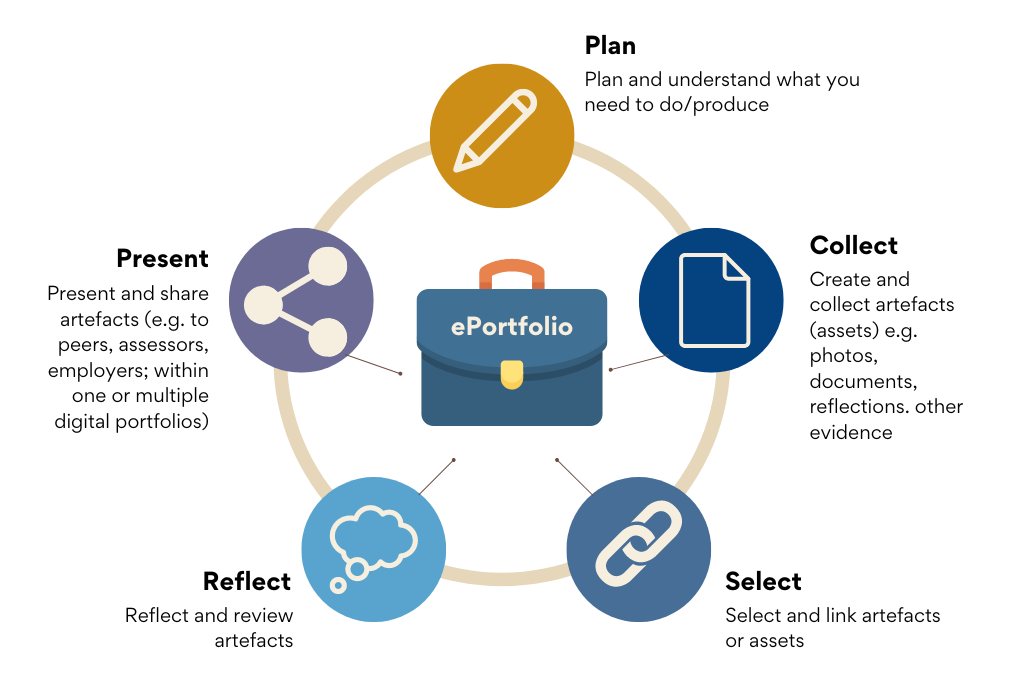
Figure 1
ePortfolio as a novel assessment tool
Novel assessment practices, such as ePortfolios, offer an opportunity to address long-standing issues of equity and accessibility in education. Traditional assessment methods often fail to accommodate diverse learning styles and needs, particularly for students with disabilities or those from non-traditional educational backgrounds (Nellums, 2021). Rezadoust Siah Khaleh Sar et al. (2024) further indicate that ePortfolios are inherently flexible, allowing for personalised assessment methods that can cater to individual learning paths. For example, students can submit multimedia projects, written reflections, and digital artefacts that demonstrate their learning, enabling them to express their knowledge in ways that suit their strengths. This flexibility benefits students with specific learning needs and promotes inclusivity by acknowledging the diverse ways students engage with the curriculum. Van Wyk (2017) supports this view by asserting that ePortfolios enhance self-directed learning, personal growth, and professional development among students.
The need for novel assessment practices in higher education has never been clearer, as the pandemic has underscored the limitations of traditional assessment methods (Broadbent et al., 2023). By integrating ePortfolios, lecturers can better capture the full scope of student learning and offer more personalised, equitable, and future-ready assessments. These practices align with the digitalisation of education and enhance the resilience of higher education institutions in the face of future crises. The ongoing evolution of assessment strategies holds the potential to redefine how learning is measured and supported, ensuring that students are equipped with the skills they need to thrive in an increasingly complex world (Akour et al., 2022). ePortfolios also enable students to track their own learning over time, documenting both formal and informal learning experiences (Le Quang Dung, 2024). This means ePortfolios allow students to see whether they are making progress in their learning journey, which is important for improvements if necessary. Developing an ePortfolio differs from traditional assessments, as students do not have the same opportunity to evaluate their progress and improve their work. Consequently, Mudau (2021) views ePortfolios as a method enabling students to advance beyond learning for learning’s sake and instead apply their knowledge, skills, and values in real-world situations.
Additionally, assessing students through ePortfolios is seen as a continuous process of evaluation that promotes engagement between students and lecturers. Majola (2023) argues that ePortfolios can be used as formative assessments to help students learn the content. ePortfolios should be designed to assist students in developing understanding, thereby deepening their knowledge and achieving the learning outcomes (Majola, 2023). Similarly, Hinojosa-Pareja et al. (2021) emphasised that ePortfolios encourage better use of assessment for learning, as students can use them for collaboration with their peers and communication with their lecturers. This suggests that ePortfolios can facilitate students’ learning during the teaching and learning process rather than focusing solely on graded assessments. Prashanti and Ramnarayan (2019) encourage lecturers to use ePortfolios to promote active learning among students and provide feedback that informs deeper learning. This means lecturers should not perceive ePortfolios merely as assessment tools to gauge students’ performance through grading. This assertion is supported by Akhuledian et al. (2020), who state that ePortfolios are productive assessment tools that enable lecturers to gradually assess, provide feedback, identify weaknesses that need to be developed, and constantly observe the effectiveness of instruction.
Furthermore, ePortfolios have the potential to enhance agency, serve as unique resources for reflective practice, provide relational support for peer-to-peer interaction, and offer a contextual resource for learning-related decision-making (Buchem et al., 2020). In other words, ePortfolios can promote collaborative reflection among students, allowing them to evaluate each other’s work during learning. This enables students to collaboratively create and produce knowledge, which has the potential to strengthen their understanding of the concepts they are learning. Hence, Sitthimongkolchai, Viriyavejakul, and Tuntiwongwanich (2022) emphasised that ePortfolios can promote constructivism, student growth, and critical reflection in learning. Simply put, ePortfolios support collaborative knowledge construction and shared meaning-making as espoused by constructivists. ePortfolios empower students to take ownership of their learning by allowing them to set goals and reflect on their learning processes with minimal lecturer intervention (Le Quang Dung, 2024). This enables students to engage in learning autonomously and seek guidance from their lecturers when necessary. Thus, Modise (2021) advises that students must be provided with appropriate support during each stage and for each element of an ePortfolio, along with relevant feedback, allowing them to make necessary improvements to their work before producing a final product.
Using ePortfolios to assess students’ learning also aligns with authentic assessment, as it evaluates students’ skills and knowledge in a real-world context, mirroring the challenges they will encounter in their future careers (Schulz et al., 2023). This means ePortfolios help to expose students to real-world contexts, which is beneficial when they join the actual labour market, as they will be better prepared to adapt to reality. ePortfolios also enable students to develop skills such as critical thinking and problem-solving, which are crucial in the world of work (Mudau & Van Wyk, 2022). In addition, creating an ePortfolio enhances students’ digital literacy skills, as they work with various media formats (Le Quang Dung, 2024). Students use media formats such as text, images, videos, and audio recordings to compile their ePortfolios (Jahara et al., 2023), thereby likely improving their digital skills. The acquisition of skills by students during the compilation of an ePortfolio may also be facilitated by the connection between the different learning activities contained within it. This is because learning with ePortfolios provides students with the opportunity to evaluate their learning, process their thoughts and experiences, and document their lives and learning in an authentic and meaningful way (Sitthimongkolchai et al., 2022).
Finally, ePortfolios enable lecturers to provide immediate feedback to students. Butakor (2024) supports this view by asserting that lecturers can offer timely feedback on students’ ePortfolios, fostering a continuous learning process and enabling students to track their progress over time. Todorova-Ruskova (2022) added that ePortfolios provide an opportunity for quick access, sharing, and facilitated communication, consultation, and feedback from lecturers. This means students can swiftly share their ePortfolios with their lecturers, allowing them to provide constructive feedback and guidance during the compilation process. This confirms the idea of the ePortfolio as a non-linear and iterative process that allows students to continuously engage in learning while receiving guidance from lecturers. It also supports students’ knowledge construction during the compilation of the ePortfolio, as lecturers support and guide them at every stage. Compiling an ePortfolio while receiving ongoing guidance and feedback from lecturers has the potential to improve students’ learning experiences and assessment (Boholano et al., 2022). This contrasts with traditional assessments, where students individually complete assessments without any support or guidance from lecturers; they are only expected to submit the final product to the lecturer for grading and determination of competence. The introduction of ePortfolios in the higher education context has drastically changed the understanding and administration of assessment in several HEIs in South Africa.
CONCLUSION
The adoption of ePortfolios as an assessment tool appears to be a game changer for many institutions of higher learning in South Africa. This is due to the affordances associated with ePortfolios, from which both students and lecturers benefit. For example, ePortfolios allow lecturers to expose students to authentic assessments, which are important for experiencing learning in real environments. Furthermore, students have the opportunity to reflect on their learning, which helps improve their learning experiences. The adoption of ePortfolios in higher education not only ensures active participation by students but also enhances their learning experiences. ePortfolios enable students to take ownership of their learning process, as they can choose what to include or exclude from their portfolios. Finally, ePortfolios create a conducive environment for regular interaction between lecturers and students during assessment. This represents a remarkable shift from traditional assessment, where there is limited to no interaction between lecturers and students. Nowadays, the interaction, in the form of regular constructive feedback between lecturers and students, is a crucial feature of assessment that ensures the smooth completion and administration of assessments in higher education institutions.
REFERENCES
Afrilyasanti, R., Suhartoyo, E., & Widiati, U. (2025). Researching the use of ePortfolios to promote students thinking in digital age: A qualitative action study. Interactive Technology and Smart Education, 22(1), 25-42. https://doi.org/10.1108/itse-08-2023-0167
Akhuledian, L., Abiatari, I., Dilaverova, T., & Mazmishvili, N. (2020). How to manage the portfolio and use it as the best tool for formative assessment. In ICERI2020 Proceedings (pp. 814-820). IATED. https://doi.org/10.21125/iceri.2020.0242
Akour, M., & Alenezi, M. (2022). Higher education’s future in the era of digital transformation. Education Sciences, 12(11), 784. https://doi.org/10.3390/educsci12110784
Bashir, N. (2024). Teachers’ perceptions of shifting from traditional exams to creative student responses: A study of the Bangladeshi education system (Doctoral dissertation, AUW).
Boholano, H. B., Sanchez, J. M. P., Balo, V. T. M., & Navarro, T. M. M. (2022). Utilization of ePortfolios in teacher education institutions of higher education in Central Visayas, Philippines. International Journal of Information and Education Technology, 12(9), 912-920. https://doi.org/10.18178/ijiet.2022.12.9.1701
Broadbent, J., Ajjawi, R., Bearman, M., Boud, D., & Dawson, P. (2023). Beyond emergency remote teaching: Did the pandemic lead to lasting change in university courses? International Journal of Educational Technology in Higher Education, 20(1), 58. https://doi.org/10.1186/s41239-023-00428-z
Buchem, I., Tur, G., & Salinas, J. (2020). Designing for ownership in technology-enhanced learning (TEL): A core element for learners’ self-regulated learning and agency. Interaction Design and Architecture(s), (45), 5–14. https://doi.org/10.55612/s-5002-045-001psi
Butakor, P. K. (2024). The use of ePortfolios as a teaching, learning and assessment tool in higher education: Differing opinions among Ghanaian pre-service teachers and nurses. European Journal of Education and Pedagogy, 5(6), 35-45. https://doi.org/10.24018/ejedu.2024.5.6.858
Chostelidou, D., & Manoli, E. (2020). ePortfolio as an alternative assessment tool for students with learning differences: A case study. International Journal for Innovation Education and Research, 8(5), 507-24. https://doi.org/10.31686/ijier.vol8.iss5.2369
Cook, K. S., Fogelberg, K., Butterbrodt, P., Jolley, K., Raghavan, M., & Smith, J. R. (2023). Assessing student learning: Exams, quizzes, and remediation. Educational Principles and Practice in Veterinary Medicine, 287-312. https://doi.org/10.1002/9781119852865.ch10
Dunagan, L., & Larson, D. A. (2021). Alignment of competency-based learning and assessment to adaptive instructional systems. In International Conference on Human-Computer Interaction (pp. 537–549). Cham: Springer International Publishing. https://doi.org/10.1007/978-3-030-77857-6_38
Enslin, P., & Hedge, N. (2024). Decolonizing higher education: The university in the new age of Empire. Journal of Philosophy of Education, 58(2-3), 227-241. https://doi.org/10.1093/jopedu/qhad052
Farley, I. A., & Burbules, N. C. (2022). Online education viewed through an equity lens: Promoting engagement and success for all learners. Review of Education, 10(3), e3367. https://doi.org/10.1002/rev3.3367
Germain-Rutherford, A., Karamifar, B., Bañados, E., Ernest, P., Heiser, S., Hopkins, J., & Uličná, K. (2024). Impact of the pandemic on language education: Voices from across the world. The Bloomsbury Handbook of Language Learning and Technology, 48.
Haipinge, E., Kadhila, N., & Josua, L. M. (2022). Using digital technology in transforming assessment in higher education institutions beyond COVID-19. Creative Education, 13(7), 2157-2167. https://doi.org/10.4236/ce.2022.137136
Hinojosa-Pareja, E., Gutiérrez-Santillán, E., & Gamis-Sanchez, V. (2021). Construction and validation of a questionnaire on ePortfolios in higher education (QEPHE). International Journal of Research & Method in Education, 44(1), 53-66. https://doi.org/10.1080/1743727X.2020.1735335
Hj. Ebil, S., Salleh, S. M., & Shahrill, M. (2020). The use of ePortfolio for self-reflection to promote learning: A case of TVET students. Education and Information Technologies, 25(6), 5797–5814. https://doi.org/10.1007/s10639-020-10248-7
Hooda, M., Rana, C., Dahiya, O., Rizwan, A., & Hossain, M. S. (2022). Artificial intelligence for assessment and feedback to enhance student success in higher education. Mathematical Problems in Engineering, 2022(1), 5215722. https://doi.org/10.1155/2022/5215722
Jahara, S. F., Kumar, T., & Abdelrady, A. H. (2023). ePortfolios to foster creative innovation and communication technology management in undergraduate engineering learners. International Journal of Intellectual Property Management, 13(3-4), 283-301. https://doi.org/10.1504/IJIPM.2023.134055
Kelly, A., Moore, C., & Lyons, E. (2022). Traditional exams, 21st-century employability skills and COVID-19: Disruptive opportunities for rethinking assessment design in higher education. Comparative & International Education Series, 67-79. https://ojed.org/cies/article/view/2927
Khoo Mei Sui, L., Maor, D., & Schibeci, R. (2011). The engineering ePortfolio: Enhancing communication, critical thinking and problem solving and teamwork skills. World Academy of Science, Engineering and Technology, 77. https://researchportal.murdoch.edu.au/view/pdfCoverPage?instCode=61MUN_INST&filePid=13136893690007891&download=true
Kunnari, I., & Laurikainen, M. (2017). Collection of engaging practices on ePortfolio process. Hämeenlinna: HAMK Publications. Retrieved from https://eepeu.wordpress.com/publications
Le Quang Dung, V. H. V. (2024). ePortfolio in higher education: An accessory for e-learning in the digital age. Conference on Applied Linguistics-Transformative Trends in the Asia-Pacific Region– APCAL HANU.
Lo, N. P. K. (2024). The confluence of digital literacy and eco-consciousness: Harmonising digital skills with sustainable practices in education. Platforms, 2(1), 15–32. https://doi.org/10.3390/platforms2010002
Majola, X. M. (2023). Thinking ‘out of the box’ when designing formative assessment activities for the ePortfolio. Journal of Curriculum Studies Research, 5(3), 113-130. https://doi.org/10.46303/jcsr.2023.34
Makumbe, D. (2020). E-learning in times of a pandemic: Exposing the economic disparities between the ‘haves’ and the ‘have-nots’. Journal of Public Administration, 55(4), 621–641. https://hdl.handle.net/10520/ejc-jpad-v55-n4-a4
Markey, K., Graham, M. M., Tuohy, D., McCarthy, J., O’Donnell, C., Hennessy, T., … & O’Brien, B. (2023). Navigating learning and teaching in expanding culturally diverse higher education settings. Higher Education Pedagogies, 8(1), 2165527. https://doi.org/10.1080/23752696.2023.2165527
Meylani, R. (2024). A comparative analysis of traditional and modern approaches to assessment and evaluation in education. Western Anatolia Journal of Educational Sciences, 15(1), 520-555. https://doi.org/10.51460/baebd.1386737
Mhlanga, D., Denhere, V., & Moloi, T. (2022). COVID-19 and the key digital transformation lessons for higher education institutions in South Africa. Education Sciences, 12(7), 464. https://doi.org/10.3390/educsci12070464
Miller, E., & Konstantinou, I. (2022). Using reflective, authentic assessments to embed employability skills in higher education. Journal of Work-Applied Management, 14(1), 4-17. https://doi.org/10.1108/JWAM-02-2021-0014
Modise, M. P., & Mudau, P. K. (2023). Using ePortfolios for meaningful teaching and learning in distance education in developing countries: A systematic review. The Journal of Continuing Higher Education, 71(3), 286–298. https://doi.org/10.1080/07377363.2022.2067731
Modise, M. P. (2021). Postgraduate students’ perception of the use of ePortfolios as a teaching tool to support their learning in an open and distance education institution. Journal of Learning for Development, 8(2), 283-297.
Mudau, P. K. (2021). Lecturers’ views on the functionality of ePortfolios as alternative assessment in an open distance e-learning. International Journal of Educational Methodology, 8(1), 81-90. https://doi.org/10.12973/ijem.8.1.81
Mudau, P. K., & Van Wyk, M. M. (2022). ePortfolio alternative assessment strategy enhancing higher-order thinking skills in an open distance learning environment. Multidisciplinary Journal of Distance Education Studies, 1(1), 1-12.
Nellums, K. P. (2021). How we teach versus how we test: Analysis of the relationship between alternative teaching methods and standardized test outcomes in middle schools (Doctoral dissertation, Northcentral University).
Ngema, D. (2024). A critical review of the purposes and authenticity of e-assessment policies and practices. Open Books and Proceedings, 134–153. https://doi.org/10.38140/obp2-2024-10
Opesemowo, O. A. G., & Adekomaya, V. (2024). Harnessing artificial intelligence for advancing sustainable development goals in South Africa’s higher education system: A qualitative study. International Journal of Learning, Teaching and Educational Research, 23(3), 67-86. https://doi.org/10.26803/ijlter.23.3.4
Papadakis, S. (Ed.). (2024). IoT, AI, and ICT for educational applications: Technologies to enable education for all. Springer Nature.
Pika, S. T. (2024). Humanising digital pedagogy for equitable learning in South African rural universities. SD and ES [Edited Book] Prof. Badar Iqbal 2024 for Walter Sisulu University [SA}-18-248, 106.
Prashanti, E., & Ramnarayan, K. (2019). Ten maxims of formative assessment. Advances in Physiology Education, 43(2), 99-102. https://doi.org/10.1152/advan.00173.2018
Quinn, D. (2023). It’s like you’re a detective in your own story: Teacher and student experiences of teaching and learning with ePortfolio-based learning in the context of a DEIS post-primary school (Doctoral dissertation, Dublin, National College of Ireland). https://norma.ncirl.ie/id/eprint/7059
Rezadoust Siah Khaleh Sar, H., Khalili Sabet, M., Mahdavi Zafarghandi, A., & Hassaskhah, J. (2024). Iranian teachers’ and learners’ attitudes towards the use of ePortfolio in second language speaking assessment. Language Testing in Asia, 14(1), 61. https://doi.org/10.1186/s40468-024-00335-8
Schulz, W., Fraillon, J., Losito, B., Agrusti, G., Ainley, J., Damiani, V., & Friedman, T. (2023). IEA international civic and citizenship education study 2022 assessment framework (p. 133). Springer Nature. https://library.oapen.org/handle/20.500.12657/62968
Sims, D., Lundie, S., Titus, S., & Govender, R. (2023). Shifting assessment paradigms in South African higher education: Evolving towards transformative approaches to policy development. Scholarship of Teaching and Learning in the South, 7(3), 138-170. https://doi.org/10.36615/sotls.v7i3.334
Singh, J., Evans, E., Reed, A., Karch, L., Qualey, K., Singh, L., & Wiersma, H. (2022). Online, hybrid, and face-to-face learning through the eyes of faculty, students, administrators, and instructional designers: Lessons learned and directions for the post-vaccine and post-pandemic/COVID-19 world. Journal of Educational Technology Systems, 50(3), 301-326. https://doi.org/10.1177/00472395211063754
Sitthimongkolchai, N., Viriyavejakul, C., & Tuntiwongwanich, S. (2022). Blended Experiential Learning with ePortfolios Learning to Enhance Creative Imagination. Emerging Science Journal, 6, 25-39. http://dx.doi.org/10.28991/ESJ-2022-SIED-03
Sokhanvar, Z., Salehi, K., & Sokhanvar, F. (2021). Advantages of authentic assessment for improving the learning experience and employability skills of higher education students: A systematic literature review. Studies in Educational Evaluation, 70, 101030. https://doi.org/10.1016/j.stueduc.2021.101030
Todorova-Ruskova, L. (2022). ePortfolios as an assessment tool in ESP online learning. Годишник Чужди езици и култури, (3), 111-128.
Van Wyk, M. M. (2017). An ePortfolio as an empowering tool to enhance students’ self-directed learning in a teacher education course: A case of a South African university. South African Journal of Higher Education, 31(3), 274–291.
Yadav, S. (2024). Designing effective ePortfolios for authentic assessment: Encouraging reflection and promoting student ownership. In Cases on authentic assessment in higher education (pp. 235-258). IGI Global.
Yang, M., Wang, T., & Lim, C. P. (2023). ePortfolios as digital assessment tools in higher education. In Learning, design, and technology: An international compendium of theory, research, practice, and policy (pp. 2213-2235). Cham: Springer International Publishing.
AUTHORS
Dr. Nduduzo Brian Gcabashe is a lecturer in the Department of Curriculum and Instructional Studies, School of Teacher Education, College of Education, University of South Africa (UNISA). He has close to 10 years teaching experience in both Basic Education and Higher Education level. Dr. Gcabashe previously taught at the University of the Free State before joining UNISA. His research interest is on Business Education, ICT integration in education and teacher education. Dr. Gcabashe has published several articles on Business Education, ICT integration in education and in teacher education. He has also presented in a number of national conferences. Dr. Gcabashe also serves as the reviewer for several accredited journals in South Africa and internationally.
Email: gcababn@unisa.ac.za
Dr. Halalisani Mngomezulu is a Senior Lecturer in the Department of Mathematics, Science, and Technology Education at the University of Johannesburg. He holds a PhD in Science Education from the same institution and is recognized as a leading scholar in formative assessment in science education. His research interests include formative assessment practices and professional teacher development, with a focus on improving science teaching and learning. Dr. Mngomezulu has published extensively in national and international journals and has presented at several prominent academic conferences. He is an active reviewer for multiple high-impact journals, including Social Sciences and Humanities Open, The International Journal of Assessment and Evaluation, Science Journal of Education, and the African Journal of Mathematics, Science and Technology Education. Through his research, teaching, and peer review contributions, Dr. Mngomezulu plays a significant role in advancing science education and supporting the development of effective assessment and instructional practices in South Africa and beyond.
Email: halalisanim@uj.ac.za