
6 Transforming Education Through ePortfolios: Key Takeaways from the Pandemic – A Bibliometric and Systematic Review
Nomfundo Radebe, Millicent Motheogane, and Fatima Makda
University of the Witwatersrand, South Africa
ABSTRACT
The Covid-19 pandemic accelerated the shift to virtual teaching and online learning, highlighting the value of ePortfolios as tools for assessment, engagement, and professional development. ePortfolios enabled personalised feedback, documentation of learning, and online assessment during this period. However, their rapid adoption also revealed challenges related to access, digital literacy, and institutional support. This study explores key lessons from the use of ePortfolios during the pandemic by providing a holistic understanding of the current state and future direction of ePortfolio use in education. A bibliometric analysis and systematic review were conducted using Scopus-indexed publications from 2001 to 2024. VOSviewer was used to map the literature, identify thematic trends, and highlight knowledge gaps in ePortfolio use during the pandemic. Findings suggest that while ePortfolios promoted students’ engagement and reflective practice, their impact was often limited by digital inequality, insufficient training, and a lack of systemic support. Despite these barriers, the pandemic provided valuable insights into effective ePortfolio implementation. The study provides recommendations that aim to optimise the integration of ePortfolios into diverse educational and professional contexts, ensuring their sustainability in both traditional and virtual learning environments.
Keywords: ePortfolios, Digital Pedagogy, Digital Literacy, Covid-19, Technology Acceptance Model (TAM), Unified Theory of Acceptance and Use of Technology (UTAUT)
INTRODUCTION
ePortfolios continue to be recognised as valuable tools for both learning and assessment. Lorenzo et al. (2005) define an ePortfolio as a digitised collection of artefacts including demonstrations, resources, and accomplishments that represent an individual, group, or institution. These collections may include text-based, graphic, or multimedia elements archived on websites or electronic media. Light et al. (2011) expand this view, describing ePortfolios as a learning process encompassing digital artefacts, written reflections on formal and informal learning, collaborative assignments, community engagement, research activities, and achievements. Thus, ePortfolios are more than static collections; they are dynamic tools for learning and reflection.
According to Lorenzo et al. (2005), ePortfolios also serve administrative functions by organising work created through various applications while managing access and visibility. They promote reflective learning and support interaction, feedback, and personal growth. Modise and Mudau (2023) further emphasise that the power of ePortfolios lies in their support for reflective learning, self-assessment, and co-construction of knowledge, leading to self-regulated learning. Self-regulated learning refers to a learner’s ability to manage and control their learning process, including goal setting, self-monitoring, and self-reinforcement (Shuy, 2010). ePortfolios foster autonomous competence (Mogas et al., 2023) and lifelong learning through collaboration and peer engagement (Mudau & Modise, 2022).
Although there is a growing body of research widely acknowledging ePortfolios as powerful tools for learning, assessment, and professional development, bibliometric evidence mapping the trajectory of ePortfolio scholarship remains limited. This lack of macro-level insight hinders the identification of dominant patterns, gaps, and emerging areas of innovation. At the same time, few systematic reviews have synthesised the qualitative dimensions of ePortfolio use, including the challenges faced by educators and students and the pedagogical strategies that support effective implementation. This study addresses these gaps in research by combining a bibliometric analysis with a systematic review to provide a holistic understanding of the current state and future direction of ePortfolio use in education. This study aims to uncover both the patterns in the literature and the insights that can inform sustainable and innovative practices. As such, the following overarching research question is addressed: What does literature reveal about the current state and future direction of ePortfolio use in education, particularly in response to the Covid-19 pandemic?
To address this overarching research question, the study answers the following sub-questions:
- How is ePortfolio research distributed in Scopus in terms of publication year, document type, publication venue, major contributors, and commonly used research methods and data collection techniques?
- What challenges did educators and students face in implementing ePortfolios, and how can these be mitigated in the future?
- What insights do emerging trends in ePortfolio research offer for future exploration and innovation?
LITERATURE REVIEW
The Role of ePortfolios in Supporting Learning
ePortfolios have been in use prior to the Covid-19 pandemic, particularly in developing countries where limited access to in-person learning positioned them as a critical tool for teaching and learning in distance education (Modise & Mudau, 2023). However, their relevance surged during the pandemic, as institutions rapidly transitioned to remote learning, revealing gaps in traditional pedagogical and assessment models (McCarthy et al., 2022). This shift necessitated innovative approaches, and ePortfolios emerged as a viable alternative to conventional instructional and assessment methods.
The integration of ePortfolios into hybrid learning environments where online and face-to-face instruction are blended enabled students to create personalised learning experiences aligned with their pace and preferences (Laksana et al., 2023). Digital platforms further supported autonomy and self-regulated learning, which are essential competencies in contemporary education (Modise & Mudau, 2023; Recalde et al., 2023).
ePortfolios also enhanced teacher-student interactions, encouraging more collaboration than traditional paper-based systems (Hardiyanti et al., 2022). This collaborative engagement supported progress tracking and fostered a positive, communicative learning environment. Embedding reflective practices within ePortfolio activities allowed students to take ownership of their learning, promoting resilience and adaptability (Modise & Mudau, 2023).
Beyond their immediate relevance during the pandemic, ePortfolios have become integral to a more flexible, accessible, and learner-centred educational framework (Peng & Tur, 2024; Ismailov & Laurier, 2021; Zhang & Tur, 2024). They provide a foundation for authentic assessment by offering students opportunities for self-exploration and critical reflection. Through a variety of artifacts, students can demonstrate their competencies and track their learning progression over time (Greviana et al., 2020; Misdi, 2020; Ngui et al., 2022).
Research also shows that ePortfolios improve writing skills and learning attitudes by promoting personalised, reflective engagement (Muin et al., 2021; Ngui et al., 2022). For example, in a clinical dentistry programme, ePortfolios helped students develop lifelong learning habits and reflective professional identities (Greviana et al., 2020). As formative assessment tools, they enable richer feedback and deeper evaluation of student skills, fostering critical thinking, self-regulation, and the development of reflective, critical student-writers (Misdi, 2020; Muin et al., 2021).
The Pedagogical Value of ePortfolios in Education
The rise of ePortfolios in education has not only transformed assessment and learning processes but also played a critical role in supporting the broader pedagogical shift toward reflective and student-centred learning. This shift became more pronounced during the Covid-19 pandemic, which disrupted traditional teaching models and demanded more flexible, student-focused approaches. ePortfolios provided an effective response to this challenge by enabling both educators and students to engage in meaningful reflection and collaborative learning (Kayama & Okamoto, 2002; Modise & Mudau, 2023).
Reflective practice, long recognised as a foundation for professional growth, gained renewed importance during this period. Simpson et al. (2023) highlighted that when educators engage in reflective practices, they are better able to critically evaluate and improve their teaching methods. ePortfolios facilitated this process by offering a digital space for documenting teaching experiences, recording feedback, and tracking pedagogical adjustments over time. For students, ePortfolios encouraged ownership of their learning journeys. By compiling and reflecting on a range of artifacts such as written work, projects, and peer feedback, students were able to monitor their progress and engage more deeply with course content. This supported the development of key skills such as self-assessment, critical thinking, and self-regulation (Greviana et al., 2020; Muin et al., 2021; Ngui et al., 2022). Through this reflective engagement, ePortfolios contributed to the cultivation of student agency and adaptability (Modise & Mudau, 2023; Recalde et al., 2023).
The shift to online teaching and learning further amplified the value of ePortfolios. As noted by Chaka (2020), digital platforms became central to learning during emergency remote teaching, opening new pathways for collaboration and reflection. In higher education, this transformation supported active learning strategies such as the flipped classroom model, which relies on students engaging with content independently before class and using class time for deeper discussions (Sari et al., 2023). ePortfolios complemented these approaches, providing spaces for pre-class reflections and post-class feedback that deepen understanding.
Moreover, ePortfolios helped redefine the roles of both educators and learners. Deluca et al. (2022) found that integrating self-assessment through ePortfolio activities enhanced reflective thinking in pre-service teachers and contributed to more equitable, inclusive classrooms. Similarly, Liang et al. (2020) introduced the idea of students as partners in the learning process, which ePortfolios supported by encouraging collaboration, peer feedback, and shared responsibility. Earlier work by Kayama and Okamoto (2002) further illustrated how ePortfolios promote collaborative learning by allowing students to share their work, receive feedback, and engage in group activities.
In essence, the pedagogical value of ePortfolios lies in their ability to support reflection, foster active learning, and promote student-centred practices. Far from being a temporary solution during a crisis, ePortfolios have become integral to modern education helping students and educators adapt, reflect, and thrive in evolving learning contexts.
ePortfolios as Tools for Professional Growth
ePortfolios not only enhance students’ learning experiences but also play a crucial role in their professional development (Siddiqui et al., 2022). Educators who engage with ePortfolios report increased awareness of their professional development trajectories, facilitating clearer planning for future growth (Siddiqui et al., 2022). As noted by Siddiqui et al., the versatility of ePortfolios allows them to be used across various educational contexts, contributing to the development of essential competencies that enhance employability skills among graduates (Siddiqui et al., 2022). The incorporation of ePortfolios in teaching practices also allows educators to reflect critically on their pedagogical strategies and effectiveness over time. As educators engage in this reflective process, they develop new teaching methods and enhance their understanding of how to effectively guide students through their learning processes (Keshmiri & Mehrparvar, 2023).
Despite the recognised benefits, the successful implementation of ePortfolios can be complex and requires intentional planning, as highlighted by Modise (2021). Ensuring that both students and educators have adequate support and resources is vital for overcoming barriers in the adoption process and enhancing the pedagogical affordances these
THEORETICAL FRAMEWORK
The Technology Acceptance Model (TAM) and its extension, the Unified Theory of Acceptance and Use of Technology (UTAUT), were applied, providing a comprehensive lens to interpret the research findings for this chapter. The foundational TAM posits that a user’s intention to adopt a new technology is primarily determined by two core beliefs:: (1) Perceived Usefulness (PU), which is the belief that using the technology will enhance performance, and (2) Perceived Ease of Use (PEOU), which is the belief that using it will be free of effort (Davis, 1989). In the context of our chapter on ePortfolios, PU relates to the perceived value for assessment and professional development, while PEOU connects directly to challenges such as digital literacy and platform usability.
The rapid, institution-wide adoption of ePortfolios seen during the Covid-19 pandemic encouraged us to also draw upon the Unified Theory of Acceptance and Use of Technology (UTAUT). UTAUT expands on the TAM by incorporating external factors like (1) social influence, the perceived pressure from peers and institutions to use ePortfolios, and (2) facilitating conditions, the availability of the necessary infrastructure and support (Venkatesh et al., 2003). Applying the TAM/UTAUT framework allowed us to move beyond a descriptive account of ePortfolio use during the Covid-19 pandemic to a deeper and more explanatory analysis. It frames the observed challenges of digital inequality, insufficient training, and a lack of systemic support as inhibitors to PEOU and Facilitating Conditions, while framing successful outcomes as evidence of high PU. This theoretical approach provides a structure for understanding the lessons learnt and for developing evidence-based recommendations for sustainable ePortfolio integration.
METHODOLOGY
A bibliometric analysis and systematic review were employed to rigorously explore existing literature on ePortfolios in education during the Covid-19 pandemic. The bibliometric method, following Donthu et al. (2021), provided a quantitative overview of publication trends, influential authors, and evolving keyword clusters. The systematic review offered qualitative insight into recurring themes and content across studies. This mixed-methods approach ensured both breadth and depth in addressing the research questions of the study.
Scopus was used as the primary data source due to its extensive peer-reviewed coverage and bibliometric metadata, allowing for a comprehensive and unbiased mapping of scholarly contributions in this field. The search was conducted on March 27, 2025, using the following search string applied to the “Title, Abstract, and Keywords” fields: (TITLE-ABS-KEY (“ePortfolio*” OR “electronic portfolio*” OR “digital portfolio*” OR “Online portfolio*”) AND TITLE-ABS-KEY (“education” OR “learning” OR “teaching” OR “higher education” OR “online learning” OR “Distance learning” OR “Remote Learning” OR “Virtual Learning” OR “e-learning” OR “Elearning” OR “Virtual teaching” OR “Remote Teaching” OR “Distance Teaching” OR “Distance Education” OR “blended learning” OR “Collaborative learning” OR “collaboration” OR “Reflection” OR “digital education” OR “assessment” OR “e-assessment” OR “eAssessment” OR “Best practice*” OR “trend*” OR “Challenge*” OR “Innovation”) AND TITLE-ABS-KEY (“COVID-19” OR “pandemic*” OR “Epidemic” OR “Epidemiology” OR “coronavirus” OR “SARS-Cov” OR “remote learning” OR “remote teaching” OR “post-pandemic”)) AND PUBYEAR > 2000 AND PUBYEAR < 2025 AND (LIMIT-TO (LANGUAGE , “English”))
The publication window was set from January 1, 2000, to March 27, 2025, to capture two decades of evolving literature on ePortfolios before, during, and after the Covid-19 pandemic. While recent studies offer valuable insights into pandemic-driven changes, earlier literature was included to establish a baseline of pre-pandemic practices and theoretical foundations. Only English-language articles were selected to ensure consistency and academic rigour, and no disciplinary filters were applied to reflect the interdisciplinary use of ePortfolios. This search yielded 70 records.
The bibliometric analysis was conducted using VOSviewer for network visualisation, particularly keyword co-occurrence mapping, and the Scopus Analysis Tool for descriptive statistics. Key metrics included publication trends, leading authors, institutions, countries, and journals. The co-occurrence mapping revealed dominant research themes by visualising keyword relationships, thereby highlighting the intellectual structure of the field.
Building on these quantitative insights, a systematic review was conducted to explore the literature more deeply. Following PRISMA guidelines (Page et al., 2021), titles and abstracts were screened using predefined inclusion and exclusion criteria to select studies focused on ePortfolios in education during the pandemic. Full texts of the selected articles were then reviewed for relevance and quality. Data were extracted on study design, pedagogical approaches, findings, and outcomes. An inductive thematic synthesis was performed to identify patterns in the implementation and affordances of ePortfolios. Analysis was guided by the TAM and UTAUT models to understand adoption patterns. This qualitative exploration complemented the bibliometric analysis, offering a well-rounded, evidence-based understanding of ePortfolio research and practice in the context of the Covid-19 pandemic.
FINDINGS
- Distribution and Trends in ePortfolio Research in Scopus
Theme 1.1: Documents by Year
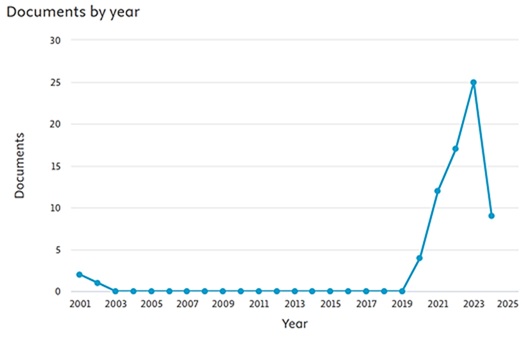
The analysis of publication trends reveals that while research on ePortfolios in education existed over the past two decades, its publication volume remained relatively low until the onset of the Covid-19 pandemic. A significant surge in relevant literature is observed starting from 2020, demonstrating that the global health crisis acted as a critical catalyst, dramatically accelerating scholarly interest and output. This upward trajectory continued and intensified in the post-pandemic period, indicating a sustained academic focus on the role and implications of ePortfolios in digital education transformation.
Figure 1
Documents per year
Theme 1.2: Documents by Country
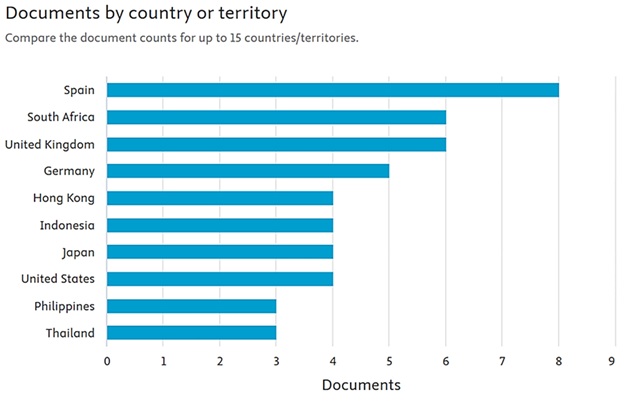
The analysis of documents by country reveals Spain as the leading contributor, closely followed by South Africa. South Africa’s prominent position can be largely attributed to the prolific output from the University of South Africa (UNISA), a major distance education South African institution. While ePortfolios are extensively used in distance learning environments like UNISA, their adaptability extends to face-to-face institutions, particularly within blended or virtual instructional delivery modes, highlighting their versatility across various educational contexts.
Figure 2
Documents by country
Theme 1.3: Documents by Affiliation
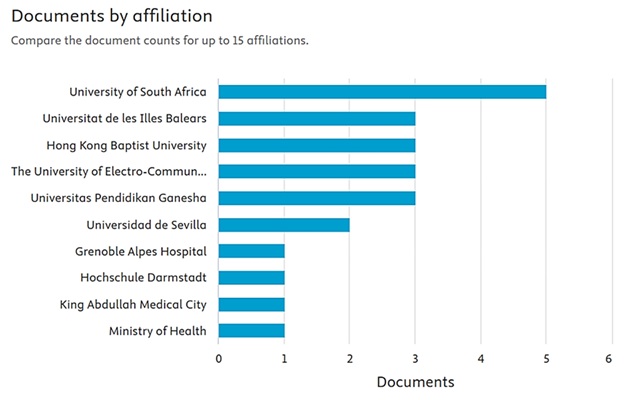
The analysis of documents by affiliation shows that the University of South Africa is a leading contributor to ePortfolios research. This prominence is particularly significant given that the University of South Africa (UNISA) is a distance education institution, thereby highlighting its extensive experience in using ePortfolios for teaching and learning.
Figure 3
Documents by affiliation
Theme 1.4: Documents by Author
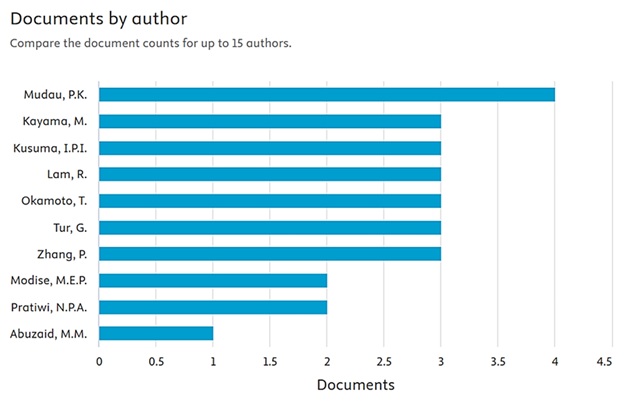
The analysis of authorship indicates that the most prolific author, Mudau, P.K., in this domain is affiliated with the UNISA, reinforcing the institution’s significant contribution to ePortfolio research. This highlights UNISA’s central role, particularly from a South African perspective, in advancing research on ePortfolios, likely driven by its extensive experience in distance education and innovation in instructional delivery.
Figure 4
Documents by author
Theme 1.5: Documents by Subject Area
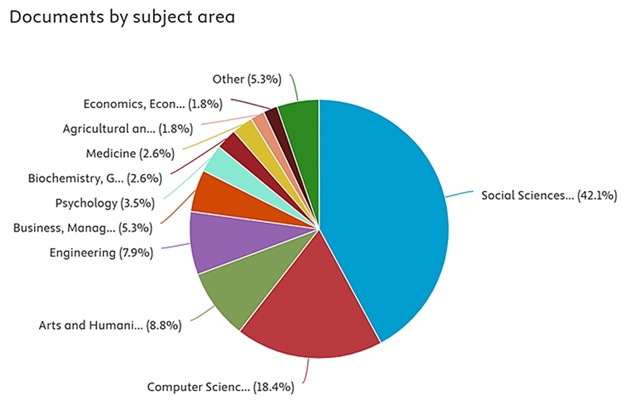
An examination of subject areas reveals that “Social Sciences” constitutes the largest disciplinary cluster, indicating the strong connection between ePortfolio research and the broader fields of education and learning. This dominance highlights the pedagogical and human-centred aspects of ePortfolio implementation. “Computer Science” emerges as the second most prominent subject area, indicating the crucial technological foundation and development aspects inherent in ePortfolio systems. This dual prominence reflects the interdisciplinary nature of bridging educational theory with technological innovation.
Figure 5
Documents by subject area
Theme 1.6: Keyword analysis – Clusters
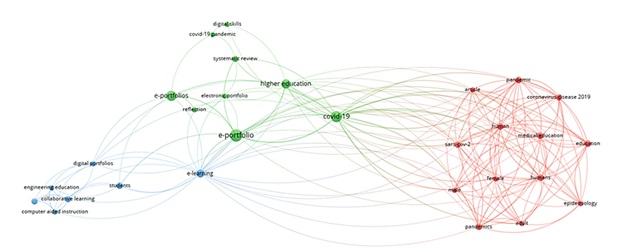
The co-occurring keyword analysis involved examining the frequency with which certain keywords appear together in the existing extracted literature (Donthu, 2021). The predefined minimum number of co-occurring keywords was set to three. The analysis revealed a total number of 369 keywords, with 29 meeting the threshold, grouped into three clusters.
Figure 6
Keyword Analysis – Clusters
Theme 1.5.1: Cluster 1 – Pandemic’s Educational Impact on Students
The first cluster (red) of co-occurring keywords like “adult,” “article,” “corona disease,” “education,” “epidemiology,” “human,” “pandemic,” and “SARS-CoV-2.” This cluster strongly reflects the immediate and pervasive impact of the COVID-19 pandemic (indicated by “pandemic,” “corona disease,” and “SARS-CoV-2”) on education. The presence of “epidemiology” further solidifies the link to the health crisis and its widespread effects, which directly necessitated rapid changes in educational instructional delivery. This cluster, therefore, highlights research that specifically investigated how ePortfolios, or indeed education in general, adapted to or was affected by the pandemic’s demands on students, possibly exploring shifts in learning environments or pedagogical strategies, as we move to the second cluster.
Theme 1.6.2: Cluster 2 – ePortfolios, Digital Skills, and Reflection in Higher Education
This cluster (green) centres on the application and impact of ePortfolios within higher education during the COVID-19 pandemic. The prominent inclusion of “COVID-19 pandemic” immediately sets the context. The core term of “ePortfolio” indicates the central subject matter. Crucially, “digital skills” highlights a key competency that became more vital during virtual teaching and online learning, often facilitated by ePortfolios. The presence of “the keyword “reflection” shows a fundamental pedagogical component of ePortfolios, emphasising their role not just as digital repositories but as tools for reflection and cognitive processing and learning. This cluster represents exploring how ePortfolios were leveraged to develop digital literacies and foster reflective learning practices within HEIs during the crisis.
Theme 1.6.3: Cluster 3 – Digital Learning Environments and Collaborative Student Development
This cluster (blue) appears to focus on the pedagogical and technological underpinnings of digital learning environments, with a clear emphasis on student engagement and knowledge construction. “Digital portfolios,” like ePortfolios, are central, positioning them as tools within these environments. Keywords like “e-learning” and “computer-aided instruction” highlight the digital instructional delivery methods. Crucially, “collaborative learning” indicates an active, interactive pedagogical approach, while “knowledge management” suggests the broader processes of creating, sharing, and using knowledge, often facilitated by digital tools. This cluster likely represents research exploring how digital portfolios support students in collaborative online learning, facilitate the organisation and application of knowledge, and contribute to effective computer-aided instructional strategies.
Theme 1.7.1: Keyword Analysis – Time
The analysis of keywords over time reveals an interesting evolution in ePortfolio research. Earlier studies predominantly appeared in disciplines where portfolio assessment was already a well-established practice, such as engineering education, suggesting an initial focus on digitising existing pedagogical tools within specific professional fields.
Figure 7
Keyword analysis – time
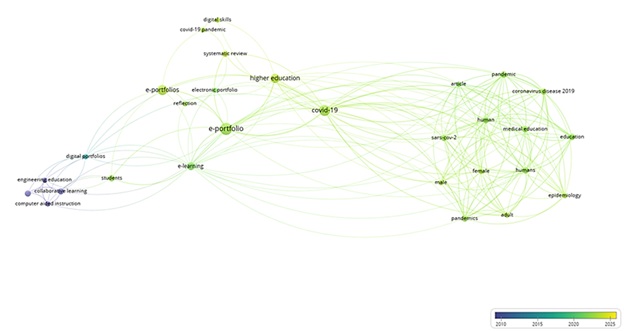
The concept of “ePortfolio” then broadened, being significantly influenced by the growth of “e-learning,” indicating a shift towards its integration within wider digital learning environments. In more recent years, there has been a discernible increase in research on “medical education,” signifying the expanding adoption of ePortfolios for clinical skill development and professional competency tracking. Consistently across the timeline, “higher education” keywords appear more frequently than “school level,” reinforcing that ePortfolios have found greater and more widespread application and study at the HEI level.
Theme 1.8.2: Keyword Analysis – Density
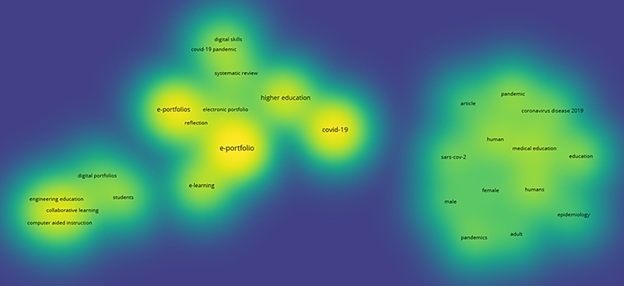
The high density observed around keywords such as “collaborative learning,” “computer-aided instruction,” and “ePortfolio” is particularly insightful. This interconnectedness suggests that research is moving beyond the traditional view of ePortfolios primarily as tools for assessment. But it indicates a significant emphasis on their role in facilitating active learning processes. This shows a crucial shift in focus, highlighting ePortfolios as versatile platforms for constructive learning experiences and interactive knowledge building, rather than just summative evaluation.
Figure 8
Keyword – density
2. Challenges and mitigation strategies for ePortfolio implementation
Theme 2.1: Technical and Infrastructure Barriers
The implementation of ePortfolios has been hindered by various infrastructure-related challenges, including poor or unreliable internet connectivity, frequent power outages (e.g., load-shedding in South Africa), and limited access to appropriate devices and up-to-date and/or easy-to-use software (Chisango, 2024; Modise & Mudau, 2023; Nagle et al., 2024 ; Useche et al., 2022). Many institutions lacked dedicated ePortfolio systems (Zhang & Tur, 2022; Koris & Pál, 2021), resulting in the mislabelling of standard document submissions as ePortfolios (Mudau & Modise, 2022). Even when ePortfolio platforms were available, they were not always user-friendly, causing navigation and interface design frustration (Modise, 2021; Nagle et al., 2024; Zhang & Tur, 2022). Additionally, students reported inadequate access to technical support (Chisango, 2024; Modise, 2021; Nagle et al, 2024; Useche et al., 2022; Zhang & Tur, 2022).
These challenges highlight the need for institutions to prioritise both the accessibility and usability of ePortfolio platforms. Infrastructure support must also be strengthened, including ensuring access to reliable internet connectivity, a consistent power supply, appropriate devices, up-to-date software and platforms, and adequate technical support. Moreover, given the prevalence of power outages in contexts like South Africa, it is essential to explore platforms with offline functionality to ensure uninterrupted access and usage.
Theme 2.2: Limited Training and Digital Competence
The implementation of ePortfolios has also been hindered by the lack of formal training for both teachers and students. Many have not been adequately prepared to use ePortfolio platforms, design reflective tasks, or manage digital workflows (Modise & Mudau, 2023; Boholano et al., 2022; Koris & Pál, 2021; Modise, 2021; Mudau, 2022). As a result, students often mistook basic document submissions (such as PDFs or Word files) for actual web-based ePortfolios (Mudau & Modise, 2022). Additionally, limited digital literacy and low confidence in using technology further impacted effective use, as both educators and students were unsure of how to navigate the platforms (Mogas et al., 2023; Nagle et al., 2024). To support successful implementation, it is essential to provide proper orientation and training for both students and teachers on how to effectively use ePortfolios. Institutions should also invest in continuous professional development and digital literacy initiatives to build confidence and competence in using these tools.
Theme 2.3: Institutional and Pedagogical Readiness
The sudden shift to online teaching and learning due to Covid-19 left many institutions without a clear strategy for integrating ePortfolios into their curricula. As a result, educators were unsure about what exactly an ePortfolio is, how to assess them fairly, and how to align them with learning outcomes and assessment criteria (Mudau & Modise, 2022; Zhang & Tur, 2024). Educators needed clear guidelines, time to create learning materials, and institutional support to ensure the sustainable use of ePortfolios. It is, therefore, crucial for institutions to create standardised guidelines, provide supporting resources, and involve educators in developing effective and pedagogically sound ePortfolio models. Establishing a shared understanding of what constitutes an ePortfolio and how it should be used is essential for consistency and quality in implementation.
3. Emerging trends and directions for future research
Theme 3.1: ePortfolios as Tools for Lifelong and Professional Learning
ePortfolios are increasingly recognised as valuable tools for lifelong and professional learning. In fields such as teacher training and clinical education, they are used to track reflective cases, clinical skills, and professional growth (Abuzaid et al., 2021; Das, 2021). Beyond academic settings, ePortfolios play a key role in career preparation by showcasing students’ competencies to potential employers (Holtzman et al., 2021). They support ongoing self-assessment (Das, 2021; Koris & Pál, 2021), thereby helping individuals to shape their professional identity over time. As a result, there is a growing emphasis on promoting ePortfolios not just as academic assignments, but as tools for continuous personal and professional development (Zhang & Tur, 2024; Al Aamri et al., 2023; Rodriguez et al., 2022; Modise, 2021). The shift toward using ePortfolios as tools for continuous development suggests a need to reimagine their design, implementation, and evaluation. This opens opportunities for cross-sector collaboration, longitudinal studies, and innovations as part of the digital transformation of education and professional learning systems.
Theme 3.2: Integration with Digital Pedagogies and Reflective Learning
An important emerging trend in ePortfolio research is their integration with digital pedagogies that prioritise reflective learning, a practice that fosters deep reflection, critical thinking, and learner autonomy (Chisango, 2024; Habbash et al., 2024; Nagle et al., 2024; Modise & Mudau, 2023; Useche et al., 2022; Chavis et al., 2021). This trend is particularly relevant within the broader context of digital transformation in education, where institutions are actively seeking innovative ways to improve learning through technology-enhanced environments.
In design, engineering, and writing, for example, ePortfolios are being used not merely as repositories of completed tasks but as dynamic spaces where students can document their creative processes, evaluate their work, and make interdisciplinary connections (Chisango, 2024; Rostoka et al., 2023; Tucker et al., 2021; Zambrano et al., 2023). This positions ePortfolios as essential tools for enabling more meaningful, personalised, and integrated learning experiences.
A key aspect of this trend is the use of ePortfolios to support a cyclical learning process involving experience, reflection, conclusion, and application. This model aligns with both constructivist and experiential learning theories, making ePortfolios particularly effective for fostering deep engagement and student-centred learning (Modise, 2021; Mudau & Modise, 2022; Rodriguez et al., 2022; Tucker et al., 2021). The increasing integration of ePortfolios with reflective and digital pedagogies indicates that they should no longer be viewed solely as assessment tools but rather as integral components of transformative teaching and learning in the digital era.
Theme 3.3: Enhanced Feedback and Collaboration Mechanisms
One of the most valued aspects of ePortfolio use is the opportunity for students to receive ongoing, personalised feedback from both educators and peers. Through peer assessments, collaborative reflections, and shared ePortfolio spaces, these interactions have been shown to enhance student engagement and learning (Modise, 2021; Mudau & Modise, 2022; Rodriguez et al., 2022; Tucker et al., 2021). This underscores the importance of embedding structured feedback systems, such as a clear rubric, guided reflection prompts, and tools for peer review, directly into ePortfolio platforms. These features not only support academic development but also foster dialogue, critical thinking, and co-construction of knowledge among students (Mudau & Modise, 2022). Therefore, as ePortfolios continue to evolve, enhancing feedback and collaboration mechanisms will be essential to transforming them from static repositories into interactive, community-driven learning environments that support reflection, dialogue, and growth.
DISCUSSION
The findings of this study align strongly with the principles of the Technology Acceptance Model (TAM) and its extension, the Unified Theory of Acceptance and Use of Technology (UTAUT). According to TAM, two key factors; Perceived Usefulness (PU) and Perceived Ease of Use (PEOU); shape users’ acceptance of technology (Davis, 1989). In the context of ePortfolio implementation, PU reflects educators’ and students’ belief that ePortfolios can enhance teaching, learning, and assessment, while PEOU relates to the ease with which users can navigate the platforms. Many of the reported challenges, such as low digital literacy, complex systems, and lack of training (Trust & Whalen, 2020; Mudau, 2022), directly inhibited PEOU, thereby limiting broader adoption.
The broader institutional issues observed, including inadequate infrastructure, minimal ICT support, and unclear implementation strategies, can be further explained through UTAUT. This model introduces additional factors such as social influence (e.g., peer or institutional pressure to adopt ePortfolios) and facilitating conditions (e.g., availability of resources and support systems) (Venkatesh et al., 2003). For example, institutions that lacked clear strategic planning or digital policy frameworks struggled to create favourable facilitating conditions (Keshmiri & Mehrparvar, 2023; Lam, 2020). Conversely, where robust support systems, training, and strategic planning were in place, educators were more likely to adopt ePortfolios meaningfully with long-term impact, thereby demonstrating high PU and effective facilitating conditions.
By analysing both macro-level trends and qualitative insights through the lens of TAM and UTAUT, this study provides both theoretical and practical guidance. For instance, the review found that educators often struggled with integrating ePortfolios into pedagogy due to lack of training and workload concerns, highlighting a mismatch between perceived benefits and actual implementation conditions. At the same time, emerging research on innovative practices, such as using ePortfolios for peer feedback, career readiness, and reflective learning (DeLuca et al., 2023; Mathur et al., 2024), demonstrates their potential when enabling conditions are met. Interpreting these findings through TAM and UTAUT further shows that challenges such as limited access to devices or internet, inadequate technical support, and absence of structured professional development are more than logistical problems; they are systemic inhibitors that significantly affect the acceptance and effective integration of ePortfolios.
Therefore, institutions aiming for the sustainable integration of ePortfolios must go beyond simply providing access to digital platforms. They need to intentionally design and implement systems that are not only easy to use but also demonstrably beneficial to teaching, learning, and professional development. According to the Technology Acceptance Model (TAM), these two factors; Perceived Ease of Use (PEOU) and Perceived Usefulness (PU); are critical in influencing user acceptance. Furthermore, insights from the Unified Theory of Acceptance and Use of Technology (UTAUT) suggest that external enablers—such as reliable digital infrastructure, comprehensive staff and student training, and consistent leadership support—play a vital role in encouraging adoption and sustained use. Without these institutional supports, even the most well-designed ePortfolio tools may fail to achieve their full potential in educational settings.
CONCLUSION
The findings reveal that while ePortfolios are widely recognised as transformative tools for learning, assessment, and professional development, their successful integration depends on more than technological availability. Drawing on the TAM and UTAUT, the study highlights that ease of use, perceived usefulness, social influence, and facilitating conditions are key factors influencing adoption. Systemic challenges, such as limited infrastructure, inadequate training, and lack of institutional support, continue to inhibit their full potential. However, when these barriers are addressed, ePortfolios support learner agency, reflective practice, and collaboration, making them sustainable solutions for meeting the future education demands. As education moves beyond emergency digital solutions post-pandemic, the insights from this study can inform strategic policy and practice aimed at embedding ePortfolios meaningfully within pedagogical frameworks.
REFERENCES
Abuzaid, M. M., Elshami, W., & Noorajan, Z. (2021). The impact of clinical practice ePortfolio in radiology education during COVID-19 outbreak. International Journal of Current Research and Review, 13(6), 115.
Adedoyin, O. B., & Soykan, E. (2023). Covid-19 pandemic and online learning: the challenges and opportunities. Interactive learning environments, 31(2), 863-875.
Al Aamri, S. M., Gabarre, C., & Gabarre, S. (2023). Improving Novice EFL Teachers’ TPACK With Padlet Self-Reflective ePortfolios: Synchronous Online Teaching Delivery Continuous Professional Development Program. In Integrating TPACK and CALL in English Language Teaching (pp. 96-127). IGI Global.
Boholano, H. B., Sanchez, J. M. P., Balo, V. T. M., & Navarro, T. M. M. (2022). Utilization of ePortfolios in teacher education institutions of higher education in Central Visayas, Philippines. International Journal of Information and Education Technology, 12(9), 912-920.
Chavis, J., Wong, K., & Linden, M. L. (2021). Online Portfolio: An Alternative to a Research Paper as a Final Assessment. Journal of Microbiology & Biology Education, 22(1), 10-1128.
Chisango, G. (2024). Exploring the effectiveness of ePortfolios in a first-year undergraduate Project Management course. Scholarship of Teaching and Learning in the South, 8(3), 25-43.
Das, S. (2021). Preparing e‐portfolio as an element of online training by clinical chemistry residents in the COVID‐19 era. Biochemistry and Molecular Biology Education, 49(3), 316.
Davis, F. D. (1989). Perceived usefulness, perceived ease of use, and user acceptance of information technology. MIS Quarterly, 13(3), 319–340. https://doi.org/10.2307/249008
DeLuca, C., Willis, J., Dorji, K., & Sherman, A. (2023). Cultivating reflective teachers: Challenging power and promoting pedagogy of self-assessment in Australian, Bhutanese, and Canadian teacher education programs. Power and Education, 15(1), 5–22.
Donthu, N., Kumar, S., Mukherjee, D., Pandey, N., & Lim, W. M. (2021). How to conduct a bibliometric analysis: An overview and guidelines. Journal of Business Research, 133, 285–296. https://doi.org/10.1016/j.jbusres.2021.04.070
Fabunmi, K. O. and Ogunlade, O. O. (2023). Developing electronic portfolios to align with diverse national standards to showcase students’ and teachers’ performance: a design approach. Innovare Journal of Education, 35-41. https://doi.org/10.22159/ijoe.2023v11i6.49207
Greviana, N., Mustika, R., & Soemantri, D. (2020). ePortfolio system development for undergraduate clinical dentistry: an action research study in one university. Padjadjaran Journal of Dentistry, 32(2). https://doi.org/10.24198/pjd.vol32no2.25055
Habbash, F., Salah, A. B., Shehata, M. H., Makarem, B., Chlif, S., Almarabheh, A., … & Jawad, J. S. (2024). Implementation and evaluation of a mentorship program in clinical master in family medicine during the COVID-19 pandemic at the Arabian Gulf University: a longitudinal study. BMC Medical Education, 24(1), 751.
Hardiyanti, W. E., & Alwi, N. M. (2022). Analisis kemampuan literasi digital guru PAUD pada masa pandemik COVID-19. Jurnal Obsesi: Jurnal Pendidikan Anak Usia Dini, 6(4), 3759–3770. https://doi.org/10.31004/obsesi.v6i4.1657
Holtzman, D. M., Kraft, E. M., & Small, E. (2022). Use of ePortfolios for making hiring decisions: A comparison of the results from representatives of large and small businesses. Journal of Work-Applied Management, 14(1), 18–34.
Ismailov, M., & Laurier, J. (2022). We are in the “breakout room.” Now what? An ePortfolio study of virtual team processes involving undergraduate online learners. E-Learning and Digital Media, 19(2), 120–143.
Kayama, M., & Okamoto, T. (2002). Collaborative learning in the internet learning space: A framework for a learning environment and knowledge management in the educational context. Industry and Higher Education, 16(4), 249–259.
Keshmiri, F. and Mehrparvar, A. H. (2023). The experiences of preparation and engagement of educators in teaching ePortfolio. BMC Medical Education, 23(1). https://doi.org/10.1186/s12909-023-04642-1
Koris, R., & Pál, Á. (2021). Fostering learners’ involvement in the assessment process during the COVID-19 pandemic: Perspectives of university language and communication teachers across the globe. Journal of University Teaching and Learning Practice, 18(5), 1-22.
Lam, R. (2020). ePortfolios: what we know, what we don’t, and what we need to know. RELC Journal, 54(1), 208-215. https://doi.org/10.1177/0033688220974102
Laksana, I. P. Y., Yuliantini, N. N., Suciani, N. K., Purandina, I. P. Y., & Boyce, G. P. (2021). Employing ePortfolio based learning in improving self-efficacy of students’ speaking ability. Journal of Advanced Scientific Letters, 5(2), 229–236. https://doi.org/10.31940/jasl.v5i2.229-236
Liang, Y., Dai, K., & Matthews, K. E. (2020). Students as partners: A new ethos for the transformation of teacher and student identities in Chinese higher education. International Journal of Chinese Education, 9(2), 131–150.
Mathur, M., Samuel, S., Mathur, N., Kaur, M., & Badyal, D. K. (2024). ePortfolio in learning and assessment of community medicine for medical undergraduate students. International Journal of Applied and Basic Medical Research, 14(4), 266–272.
McCarthy, A., Mitchell, K., & McNally, C. (2024). ePortfolio practice for student well-being in higher education: A scoping review. Journal of University Teaching and Learning Practice. https://doi.org/10.53761/7xwpq305
Modise, M. E. P. (2021). Postgraduate students’ perception of the use of ePortfolios as a teaching tool to support their learning in an open and distance education institution. Journal of Learning for Development, 8(2), 283–297.
Modise, M. E. P., & Mudau, P. K. (2023). Using ePortfolios for meaningful teaching and learning in distance education in developing countries: A systematic review. The Journal of Continuing Higher Education, 71(3), 286–298.
Mogas, J., Cea Álvarez, A. M., & Pazos-Justo, C. (2023). The contribution of digital portfolios to higher education students’ autonomy and digital competence. Education Sciences, 13(8), 829.
Mudau, A. (2022). Lecturers’ views on the functionality of ePortfolio as alternative assessment in an open distance e-learning. International Journal of Educational Methodology, 8(1), 81–95. https://doi.org/10.12973/ijem.8.1.81
Mudau, P. K., & Modise, M. M. (2022). Using ePortfolios for active student engagement in the ODeL environment. Journal of Information Technology Education: Research, 21, 425–438.
Muin, C. F., Hafidah, H., & Daraini, A. M. (2021). Students’ perceptions on the use of ePortfolio for learning assessment. AL-ISHLAH: Jurnal Pendidikan, 13(1), 497-503. https://doi.org/10.35445/alishlah.v13i1.485
Nagle, L., Walsh, F., & Farrelly, T. (2024). Student Experiences of ePortfolios within an Irish University. Journal of Educators Online, 21(2).
Ngui, W., Pang, V., & Hiew, W. (2022). Implementing ePortfolio as an assessment tool for academic writing in higher education. International Journal of Academic Research in Progressive Education and Development, 11(3). https://doi.org/10.6007/ijarped/v11-i3/15402.
Page, M. J., McKenzie, J. E., Bossuyt, P. M., Boutron, I., Hoffmann, T. C., Mulrow, C. D., Shamseer, L., Tetzlaff, J. M., Akl, E. A., Brennan, S. E., Chou, R., Glanville, J., Grimshaw, J. M., Hróbjartsson, A., Lalu, M. M., Li, T., Loder, E. W., Mayo-Wilson, E., McDonald, S., McGuinness, L. A., … Moher, D. (2021). The PRISMA 2020 statement: An updated guideline for reporting systematic reviews. BMJ, 372, n71. https://doi.org/10.1136/bmj.n71
Rodriguez, R., Martinez-Ulloa, L., & Flores-Bustos, C. (2022). ePortfolio as an evaluative tool for emergency virtual education: Analysis of the case of the University Andres Bello (Chile) during the COVID-19 pandemic. Frontiers in Psychology, 13, 892278.
Rostoka, M., Cherevychnyi, G., & Kuzmenko, O. (2022, September). ePortfolio as a Component of the Information and Analytical System of Scientific Staff Training. In International Conference on Interactive Collaborative Learning (pp. 528-535). Cham: Springer International Publishing.
Sari, W., Saputro, A., & Safitri, T. (2023). Flipped classroom and reflective practice for active learning during online class: An experience in engineering drawing module. Journal of Educational Science and Technology, 9, 144.
Sapsed, C. (2022). Transitioning ePortfolio implementation from early adoption to widespread use. ASCILITE Publications, e22201. https://doi.org/10.14742/apubs.2022.201
Simpson, J., Jones, A., & Smith, R. (2023). Identifying and shifting educators’ failure pedagogical mindsets through reflective practices. British Journal of Educational Psychology. https://doi.org/10.1111/bjep.12658
Siddiqui, Z. S., Fisher, M. B., Slade, C., Downer, T., Kirby, M., McAllister, L., … & Wilson, C. B. (2022). Twelve tips for introducing ePortfolios in health professions education. Medical Teacher, 45(2), 139-144. https://doi.org/10.1080/0142159x.2022.2053085
Trust, T., & Whalen, J. (2020). Should teachers be trained in emergency remote teaching? Lessons learned from the COVID-19 pandemic. Journal of Technology and Teacher Education, 28(2), 189–199.
Tucker, T., Wolf, A. R., Dancholvichit, N., & Liebenberg, L. (2021, July). Transforming an engineering design course into an engaging learning experience using a series of self-directed mini-projects and ePortfolios: Face-to-face versus online-only instruction. In 2021 ASEE Virtual Annual Conference Content Access.
Useche, A. C., Galvis, Á. H., Díaz-Barriga Arceo, F., Patiño Rivera, A. E., & Muñoz-Reyes, C. (2022). Reflexive pedagogy at the heart of educational digital transformation in Latin American higher education institutions. International journal of educational technology in higher education, 19(1), 62.
Venkatesh, V., Morris, M. G., Davis, G. B., & Davis, F. D. (2003). User acceptance of information technology: Toward a unified view. MIS Quarterly, 27(3), 425–478. https://doi.org/10.2307/30036540
Zambrano, C., Rojas, D., & Friz, M. (2023). Scale ePortfolio for Higher Education. Journal of Higher Education Theory and Practice, 23(3), 188-194.
Zhang, P., & Tur, G. (2024). A systematic review of ePortfolio use during the pandemic: Inspiration for post-COVID-19 practices. Open Praxis, 16(3), 429–444.
AUTHORS
Nomfundo Radebe is a lecturer in the School of Education at the University of the Witwatersrand, South Africa. She holds a Doctor of Philosophy (PhD) and a Master of Education (MEd) from the same institution, with a specialization in Science
and Technology Education. As an early-career researcher and science educator, her work is grounded in advancing STEM education and teacher development, particularly in underserved and rural contexts. Her research contributes to the advancement of equitable and contextually responsive science education in South Africa, with a strong emphasis on addressing systemic barriers and promoting inclusive, sustainable teaching practices. By exploring various dimensions of teaching and learning, she aims to empower teachers and learners, especially in marginalized communities, to improve science education outcomes and engagement.
Email: nomfundo.radebe2@wits.ac.za
Millicent Motheogane is the Deputy Head of the Academic Information and Systems Unit at the University of the Witwatersrand (Wits). Her academic journey includes a PhD in Education from Wits, a thesis titled digital technology
enabled education, exploring digital affordances on student performance. She holds a National Diploma in Information Technology from the University of South Africa, a BTech in Information Technology, and an MTech in Information Systems from Tshwane University of Technology. Her current research interests focus on digital technology enabled education, digital pedagogies, digital transformation and equitable access to digital education. She co-authored journal articles, book chapters
and conference proceedings. She is known for her strong work ethic and deep passion for advancing education.
Email: millicent.motheogane@wits.ac.za
Fatima Makda is an Associate Lecturer in the Science and Technology Division at the Wits School of Education, University of the Witwatersrand. She holds a PhD from the University of the Witwatersrand, with a focus on creating a virtual
teaching and online learning ecosystem that harnesses the power of digital education for equitable educational experiences. Her current research interests are centred on the intersection of education and technology, with a focus on digital education, digital pedagogies, digital transformation and equitable access. Her work explores the practicalities of creating accessible and sustainable education in diverse contexts. She has co-authored several publications, including journal articles, book
chapters and conference proceedings. She is involved in community projects and other relevant educational initiatives aimed at promoting equitable access to quality education for all. Through her research and teaching, Fatima Makda contributes to
the discourse on how digital innovations can be leveraged to create more inclusive and equitable education systems. She considers herself to be a professional who lives to make a difference and loves to learn.
Email: Fatima.makda@wits.ac.za