
1 Empowering Digital Resilience: Strategies for Success through ePortfolios
Marga Botha
Academy Training and Studies, South Africa
ABSTRACT
In an era marked by rapid technological transformation and educational disruption, digital resilience has emerged as a critical competency for thriving in dynamic digital environments. This chapter explores digital resilience as a set of technical skills as well as a multidimensional construct encompassing adaptability, emotional regulation, critical thinking, and identity formation. Drawing on Resilience Theory, Transformative Learning Theory, and Self-Determination Theory, the chapter positions e-portfolios as powerful tools for cultivating digital resilience in higher education. Through structured reflection, student agency, collaborative learning, and inclusive practices, ePortfolios foster both the psychological and strategic capacities
needed to navigate uncertainty. The chapter offers four practical strategies for embedding digital resilience into teaching practice and provides illustrative case studies at the student, lecturer, and institutional levels. These narratives demonstrate how e-portfolios can transform digital adversity into growth opportunities. The final sections present institutional and policy implications, arguing for a systemic commitment to resilience-building through inclusive infrastructure, curricular integration, and staff development. By reimagining ePortfolios as dynamic platforms for resilience, this chapter contributes a timely and actionable framework for
equipping students and educators to flourish in a fast-changing digital world.
Keywords: digital resilience, ePortfolios, Transformative Learning, Student Agency, Inclusive Education, Higher Education
INTRODUCTION
“In times of change, learners inherit the earth, while the learned find themselves beautifully equipped for a world that no longer exists.”
-Eric Hoffer (1963,p.6)-
In an era defined by rapid technological shifts, educational disruptions, and an increasingly digital society, the ability to adapt, recover, and grow amid uncertainty is essential. This capacity is known as digital resilience, and it represents more than digital literacy or technological proficiency. It is about navigating digital disruption with agility, maintaining well-being, and cultivating purpose and identity in digital contexts.
This chapter explores the concept of digital resilience as a multidimensional and future-facing competency for students, lecturers, and institutions. While many studies have focused on digital tools and online learning, this chapter makes a distinct contribution by highlighting how ePortfolios serve not merely as containers of learning artifacts but as strategic instruments for developing digital resilience. By fostering reflective practice, identity construction, emotional regulation, and adaptability, ePortfolios enable individuals to thrive in complex digital environments.
Three theoretical lenses frame our argument: Resilience Theory, which explains how adaptive capacity is built through challenge; Transformative Learning Theory, which emphasizes growth through reflection and meaning-making; and Self-Determination Theory, which underscores the importance of autonomy, competence, and relatedness. Through these lenses, we show how ePortfolios uniquely cultivate resilience during digital disruptions like the COVID-19 pandemic and beyond.
The chapter unfolds in six parts. It begins by conceptualizing digital resilience, then connects this concept to ePortfolio practice in higher education. We then look at four practical strategies educators can use to build resilience through ePortfolios, followed by illustrative case studies. Finally, we examine the institutional and policy implications necessary for sustainable digital transformation. In doing so, we offer not only a conceptual contribution but also a set of actionable insights for educators, administrators, and policymakers committed to equipping future-ready learners.
Understanding Digital Resilience
Digital resilience refers to an individual’s capacity to adapt, recover, and ultimately thrive when faced with digital disruptions. These disruptions may include cyber threats, information overload, technical malfunctions, or sudden transitions to new digital platforms (Howard, Tondeur, Ma, & Yang, 2023). As the digital environment becomes increasingly complex, digital resilience has emerged as a critical skill for navigating both expected and unforeseen challenges in educational, professional, and personal contexts.
At its core, digital resilience is multidimensional. It encompasses a range of competencies such as emotional regulation, critical thinking, digital confidence, and self-directed learning (Weng, Li, & Zhang, 2025). These competencies enable individuals not only to cope with digital adversity but also to actively learn from it and enhance their long-term digital engagement.
It is important to distinguish digital resilience from related concepts such as digital literacy. While digital literacy primarily involves the technical and functional use of digital tools—such as operating devices, navigating software, or managing digital content—digital resilience extends further. It focuses on psychological preparedness and strategic responses to digital pressures and uncertainties, emphasizing a learner’s or educator’s ability to remain competent and composed in high-stress digital situations (Gupta & Pathak, 2021).
Table 1
The difference between digital literacy and digital resilience (created by Author)
|
Aspect
|
Digital Literacy
|
Digital Resilience
|
|
Focus |
Functional use of technology |
Psychological and strategic response to digital challenges |
|
Skills Emphasized |
Operating digital tools, accessing information, evaluating content |
Emotional regulation, critical thinking, digital confidence, self-directed learning |
|
Typical Contexts |
Everyday digital tasks, routine navigation of tools and platforms |
High-pressure scenarios, unexpected disruptions, long-term digital adaptability |
|
Goal |
Competence in using digital technology |
Thriving amid digital disruption and uncertainty |
|
Educational Application |
Teaching how to use technology effectively |
Preparing learners to respond flexibly and ethically under digital stress |
By fostering digital resilience, educational institutions can equip students and staff with the tools necessary to engage meaningfully, ethically, and confidently in the evolving digital landscape. This foundation not only supports immediate problem-solving but also promotes lifelong adaptability in a world where digital transformation is constant.
Historical Emergence of Digital Resilience
The dawn of the digital age ushered in unprecedented opportunities as well as profound challenges. As early as the 1990s, the rapid adoption of the internet began reshaping how societies communicated, worked, and learned (Leiner et al., 2003). Yet, even as access to technology expanded, so too did the complexity of navigating digital spaces. Donegan (2012) further elaborates that individuals, confronted with challenges ranging from unstable dial-up connections to early forms of cyberbullying and complex new software, were often left without clear frameworks to navigate digital adversity.
The concept of digital resilience began to gain traction as a response to these early tensions, though it remained under-theorized until more recently. The COVID-19 pandemic marked a watershed moment, catapulting digital resilience into the educational spotlight. Institutions worldwide pivoted to online learning nearly overnight, revealing not only the strengths but also the fragilities of digital infrastructure, digital pedagogy, and user readiness (Howard et al., 2021; Martin & Polly, 2020). For many students and lecturers, the crisis was not merely technological; it was psychological and pedagogical. In this moment of upheaval, digital resilience emerged as a crucial competence: the capacity to adapt to digital disruption, recover from failure, and continue progressing in dynamic, often uncertain environments.
Core Components of Digital Resilience
Digital resilience is more than just technical proficiency; it is a multidimensional construct. At its core, it involves adaptability, problem-solving, and critical digital literacy (see Figure 1).
Figure 1
Core Components of Digital Resilience
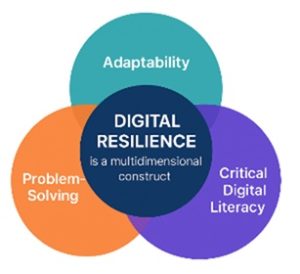
Adaptability refers to the ability to adjust quickly to new tools, platforms, and environments. This trait is particularly evident during educational disruptions. Problem-solving encompasses both technical troubleshooting and strategic thinking under pressure, while critical digital literacy enables individuals to question, analyze, and act ethically in digital spaces.
Importantly, these components are not innate but cultivated over time through experience, reflection, and structured learning. For example, students who learn to navigate a learning management system independently during a technical failure develop not only problem-solving skills but also digital confidence. Similarly, lecturers who experiment with various platforms to engage learners online often grow in adaptability and creativity. These traits are foundational to thriving in an ever-evolving digital world and align with broader frameworks of 21st-century competencies (Redecker & Punie, 2017).
Although digital resilience is important, there are still challenges that make it difficult to develop. One major issue is unequal access to technology, often called the digital divide. The digital divide refers to the gap between individuals, households, businesses, and geographic areas at different socio-economic levels regarding their opportunities to access and effectively use information and communication technologies (ICTs). This divide encompasses disparities in internet connectivity, device availability, digital skills, and the affordability of digital services. Such inequalities can lead to unequal opportunities for information access, education, employment, and participation in the digital economy (OECD, 2001). Another challenge is technophobia, or the fear of using technology, which can reduce motivation and limit learning opportunities (Rehman, Mahmood, Bashir, & Iqbal, 2023). These barriers show why it is essential to create inclusive and supportive strategies that help all individuals build digital resilience.
Theoretical Perspectives
Understanding digital resilience requires a strong conceptual foundation. This section draws on three interrelated theories: Self-Determination Theory; Transformative Learning Theory; and Resilience Theory. These theories are used as a lens to explain how digital resilience is developed, supported, and sustained, particularly through reflective and adaptive digital practices (Table 1.2).
Table 2
Theoretical Foundations of Digital Resilience (created by Author)
|
Theory
|
Key Focus
|
Role in Digital Resilience
|
|
Resilience Theory (Greenhill et al., 2020) |
Adaptive capacity is developed through engagement with challenges |
Builds strength through repeated digital adversity |
|
Self-Determination Theory (Ryan & Deci, 2000) |
Autonomy, competence, and relatedness support intrinsic motivation |
Motivates students to persist in digital environments |
|
Transformative Learning Theory (Mezirow, 2000) |
Critical reflection leads to rethinking assumptions and learning from disruption |
Enables students to respond meaningfully to change |
The Resilience Theory
Finally, Resilience Theory, originally rooted in developmental psychology, has evolved to encompass the digital domain. As Greenhill, Holmes, and Miller (2020) note, resilience in digital contexts involves an individual’s ability to build adaptive capacity through repeated exposure to digital challenges. Rather than avoiding stressors, resilient students actively engage with uncertainty, develop coping mechanisms, and become more capable over time. This adaptive process is often supported by educational practices that allow space for failure, reflection, and recovery, which are key elements in fostering sustainable digital competence. The extension of resilience theory into digital learning highlights the importance of designing environments that not only teach technical skills but also encourage learners to navigate setbacks constructively.
The Self-Determination Theory
Self-Determination Theory (SDT), developed by Ryan and Deci (2000), emphasizes the psychological needs of autonomy, competence, and relatedness as essential for intrinsic motivation and well-being. In the context of digital learning environments, tools such as ePortfolios can serve as vehicles for meeting these needs. Autonomy is supported when students have control over the design and content of their digital workspaces. Competence is fostered as students build and demonstrate digital skills through iterative practice and feedback. Relatedness emerges when students engage in collaborative projects and peer reflection, creating meaningful social connections. Together, these elements contribute to a motivational climate that encourages students to persist through digital challenges, thereby cultivating digital resilience.
The Transformative Learning Theory
Transformative Learning Theory, introduced by Mezirow (2000), provides a powerful lens for understanding how individuals adapt to disruptive digital contexts. According to this theory, learning occurs most profoundly when individuals engage in critical reflection that challenges their previously held beliefs, assumptions, or habits of mind. In digital environments, reflective practices such as those embedded in ePortfolios, offer structured opportunities for students to process change, uncertainty, or failure. By revisiting past experiences, reassessing their understanding, and generating new meaning, learners develop not only cognitive flexibility but also emotional resilience. This reflective process is essential for navigating the rapidly shifting demands of technology-enhanced education and work.
These three theoretical perspectives offer complementary insights. SDT explains the motivational conditions that support digital engagement; Transformative Learning Theory illuminates the reflective processes that enable growth through disruption; and Resilience Theory underscores the value of gradual, experiential adaptation. Together, they provide a holistic framework for understanding and fostering digital resilience in educational contexts.
In summary, digital resilience has emerged as an essential capability in the face of rapid technological change and digital disruption. Rooted in theories such as resilience theory (Masten, 2014), transformative learning theory (Mezirow, 1997), and self-determination theory (Ryan & Deci, 2000), it encompasses key competencies such as adaptability, problem-solving, critical digital literacy, and emotional regulation. While digital resilience enables individuals to thrive in uncertain and dynamic digital environments, various barriers, including unequal access and technophobia, continue to limit its development. Addressing these challenges requires not only awareness of the theoretical underpinnings but also practical tools and strategies that support growth. The next section will explore one such tool: ePortfolios. It will examine how ePortfolios function as dynamic platforms for cultivating digital resilience in both students and educators, particularly during periods of disruption and transformation.
EPORTFOLIOS: A TOOL FOR BUILDING DIGITAL RESILIENCE
As we have previously seen, simply possessing technical skills is no longer enough. Students and lecturers must also cultivate digital resilience, which is the ability to adapt, reflect, and thrive in ever-changing digital environments. ePortfolios are digital platforms where individuals collect, reflect on, and showcase their learning, skills, and growth over time. While their use in higher education is well-established for assessment, professional development, and employability, the focus of this chapter is on how ePortfolios uniquely foster digital resilience.
Unlike traditional assessments, ePortfolios empower students and lecturers to take ownership of their learning. They enable users to document personal experiences, critically reflect on challenges, experiment with digital tools, and construct a meaningful digital identity. These actions support several key dimensions of digital resilience
ePorfolios During Digital Disruptions
The global COVID-19 pandemic served as a stark reminder of the vulnerability of traditional education systems to unexpected disruptions. During this period, ePortfolios gained renewed significance as tools that could bridge gaps in continuity, communication, and assessment. With remote learning becoming the norm, many institutions turned to ePortfolios not only as substitutes for classroom-based evaluation but also as instruments for fostering connection and engagement.
Students used ePortfolios to document their learning journeys, reflect on emotional and academic challenges, and remain connected to their academic identity even when physically distant from educational institutions (Martin & Polly, 2020). Lecturers, similarly, utilized ePortfolios to maintain academic presence, share resources, and model reflective practice. This process aligned closely with the core features of digital resilience, which are to respond positively to change, maintain a sense of control, and learn from disruption.
Furthermore, the asynchronous and customizable nature of ePortfolios allowed for greater autonomy and flexibility, essential characteristics of resilient students and lecturers. The ability to control the pacing, format, and focus of their portfolios enabled students to adapt learning to personal contexts, especially in times of crisis. Thus, ePortfolios functioned not only as repositories of work but also as adaptive tools that supported well-being, motivation, and persistence in the face of digital adversity.
ePortfolios and Core Digital Resilience Skills
ePortfolios support the development of several core competencies associated with digital resilience, particularly reflection, adaptability, critical thinking, and ownership of learning. Reflective practice is at the heart of e-portfolio design, especially in higher education. Structured reflection prompts, journal entries, and personal narratives within ePortfolios provide students with opportunities to make sense of their experiences, build emotional awareness, and reframe challenges as growth opportunities (Galeucia, Gogan, & McKee, 2023).
Adaptability is cultivated through iterative e-portfolio processes that require students to engage with diverse digital tools, revise their work, and navigate feedback loops (Masten, 2014). The non-linear, evolving structure of ePortfolios encourages users to respond to new challenges, technological changes, and shifting educational goals. In doing so, students build confidence in managing uncertainty and complexity, which are both hallmarks of digital resilience. Critical thinking is also advanced through the evaluative nature of e-portfolio tasks. Users must make intentional choices about what to include, how to present their work, and how to communicate its relevance. These decisions require analysis, synthesis, and strategic thinking, which are key cognitive skills needed in a digital age characterized by information overload and rapid change.
Importantly, ePortfolios foster ownership of learning by placing control in the hands of the student. Unlike standardised assessments, ePortfolios empower students and lecturers to document unique journeys, interests, and strengths. This sense of agency aligns with Self-Determination Theory, which posits that autonomy and competence are vital for intrinsic motivation and resilience (Ryan & Deci, 2000).
Another essential contribution of ePortfolios to digital resilience is the development of digital identity. Digital identity refers to the collection of electronically captured and stored attributes and credentials that can be used to represent and authenticate an individual within digital systems. These attributes may include personal information, behavioural data, and credentials that are utilized to access services, perform transactions, and establish one’s presence in the digital realm (Nadim & Sylvester, 2023). As students curate their online presence through portfolios, they engage in the process of constructing a professional and academic persona. This process not only enhances self-awareness and confidence but also supports strategic thinking about how individuals wish to be seen in digital spaces (Cambridge, 2010). A resilient digital identity is one that can evolve, adapt, and respond to new challenges while remaining authentic and purposeful.
Figure 2
ePortfolios and Digital Resilience: Core Competencies
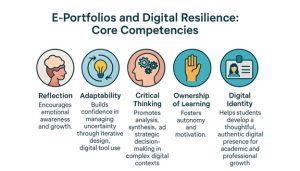
In summary, ePortfolios are far more than digital filing systems. They are dynamic spaces that cultivate key resilience-building skills. By fostering reflection, adaptability, critical thinking, and digital identity formation, ePortfolios prepare students and lecturers to thrive amid disruption and change. In the next section, the focus will shift from theory to practice. Section 4 will present practical strategies for embedding digital resilience through e-portfolio use, offering concrete guidance for educators, institutions, and learners alike.
PRACTICAL STRATEGIES TO FOSTER DIGITAL RESILIENCE THROUGH EPORTFOLIOS
As digital technologies continue to reshape educational landscapes, the intentional development of digital resilience has become an essential pedagogical goal. While earlier sections explored the theoretical foundations and conceptual value of ePortfolios, this section offers four practical strategies that directly support the cultivation of digital resilience. Each strategy is anchored in real experiences drawn from the authors’ own teaching contexts and aims to move from theory to transformative classroom practice.
These strategies focus on fostering emotional regulation, adaptability, critical thinking, self-awareness, and equitable access—core dimensions of digital resilience.
Figure 3
Strategies for incorporating ePortfolios
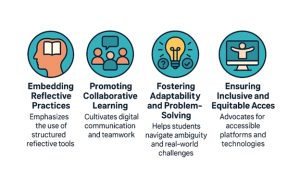
Embedding Reflective Practices
Digital resilience competency: Emotional regulation and critical digital self-awareness
The first strategy focuses on the use of structured reflective tools. Activities such as reflective journals, as well as providing them with narrative prompts, encourage students to critically examine their learning process and their own pedagogical practices as well. Motivating students to reflect is foundational to building resilience, as it enables them to process challenges and manage setbacks (Amoadu, Hagan, Obeng, Agormedah, Srem-Sai & Schack, 2025). This transformation from passive experience to active learning is aligned with Mezirow’s (1997) transformative learning theory, which posits that critical reflection fosters new perspectives and adaptive thinking.
Reflection is at the heart of resilience. When students critically process their digital experiences, they begin to recognize both personal and academic growth. In our own work with final-year education students, we implemented reflective journaling via ePortfolios during teaching practicum modules. Students were asked to respond to prompts such as:
- Describe a time when you encountered a digital challenge this week (e.g., slow Wi-Fi, platform failure). How did you respond emotionally and practically?
- What did you learn about your own teaching or learning approach through this disruption?
These prompts helped students move from passive frustration to active meaning-making, fostering emotional regulation and critical insight.
In conclusion, encouraging reflection strengthens students’ pedagogical identity, specifically for those training as future educators or lecturers. As students document and critique their own teaching strategies or learning approaches, they gain insight into their professional development (Ardi, Widiati, Suryati & Wulyani, 2025). This process supports both personal growth and the construction of a digital identity grounded in resilience and continuous improvement.
Promoting Collaborative Learning
Digital resilience competency: Relatedness, digital communication, and peer support
The second strategy, Promoting Collaborative Learning, emphases on cultivating digital communication and teamwork. through group-based projects and peer feedback practices within ePortfolios. In this regard Doolan et al. (2023) state that students are encouraged to actively participate in shared tasks such as co-creating multimedia presentation, contributing to a practical task or commenting on peers’ reflections.
For example, in one teacher training course, students were divided into small digital “pods” where they: Co-created lesson plans using Google Docs, uploaded their plans to a shared portfolio space, gave structured feedback using comment features and a rubric focused on clarity, creativity, and inclusion. This strategy supported relatedness and digital confidence, as students reported feeling “less alone” in facing challenges and more open to experimenting with digital tools.
Collaboration not only enhances learning but also equips students with the social and technological skills necessary to thrive in uncertain digital environments (Abrami & Barrett, 2005).
Fostering Adaptability and Problem-Solving
Digital resilience competency: Flexibility, creative problem-solving, and confidence in uncertainty
Third, Fostering Adaptability and Problem-Solving involves designing e-portfolio activities that require students to navigate uncertainty, select appropriate digital tools, and solve pedagogical problems. These tasks help develop the confidence and flexibility needed to manage the complex, fast-changing digital landscape (Masten, 2014).
Adaptability is not only about reacting to change; it is about developing the cognitive flexibility and emotional resilience to manage uncertainty Bonanno, Chen, Bagrodia & Galatzer-Levy, 2024). This becomes especially crucial in the 21st-century learning environment, where technologies, teaching methods, and student needs are continually evolving. By integrating complex tasks that reflect real-world teaching scenarios or learning dilemmas, students are encouraged to think critically, test solutions, and adapt their strategies as needed.
Ensuring Inclusive and Equitable Access
Digital resilience competency: Confidence through equity and ethical use of technology
Finally, Ensuring Inclusive and Equitable Access involves addressing structural and technological barriers that may hinder student participation. This strategy advocates for the use of accessible platforms, assistive technologies, and multilingual interfaces to support the diverse needs of all students. However, implementing such inclusive measures can be challenging, particularly given the socio-economic disparities that exist across different regions of the country.
Redcker and Punie (2017) plead that higher education institutions should find plausible solutions to lessen the gap where inclusion can take place, seeing that this is a critical component of digital resilience, as equity of access lays the foundation for sustained engagement and success in digital learning spaces (Redecker & Punie, 2017). By offering these four practical strategies, this section provides lecturers and institutions with a roadmap for operationalising digital resilience through ePortfolios. The goal aim is to bridge the gap between theory and practice, equipping all role-players with the tools needed to nurture resilient, future-ready students.
CASE STUDIES AND EXAMPLES
While theory and strategy give us a solid foundation for understanding digital resilience through ePortfolios, it’s the real-life stories that show how this actually plays out in practice. In this section, you’ll find three case studies: one from a student, one from a lecturer, and one from an institution. They are all navigating their own digital journeys.
Each of these case studies brings a different perspective to the table: one from a student navigating a competitive job market, another from a lecturer embracing professional growth in a digital world, and a third from an institution rethinking its approach to education during a time of disruption. Together, they show just how flexible ePortfolios can be, no matter the context. More importantly, they highlight the value of practices that are reflective, adaptable, and inclusive, which are the key ingredients for building true digital resilience.
Together, these cases serve as exemplars of digital resilience in action. They bridge the gap between theory and practice, offering valuable insights for lecturers, administrators, and policymakers seeking to create responsive, future-ready learning environments.
Student Case Study
Thandi, a final-year education student at a South African university, entered her final year uncertain about her professional future. She had strong academic results, but struggled to translate her experiences into a compelling personal narrative. As part of a practical module, she was introduced to an e-portfolio platform where she had to gather evidence of her learning, reflect on her teaching experiences, and give a clear picture of how she was growing as a future teacher.
Guided by structured prompts, Thandi used the e-portfolio to include lesson plans, video recordings of her teaching, peer feedback, and personal reflections. Over time, the e-portfolio evolved into more than a course requirement; it became a space where she shaped her digital identity, linking academic growth to her passion for inclusive education.
After graduation, she used the e-portfolio during job interviews to showcase her teaching philosophy and digital competence. One principal described her e-portfolio as “a window into her thinking and professional development.” Thandi not only secured employment but continued updating her e-portfolio as a reflective tool.
Thandi’s experience illustrates the principles of Self-Determination Theory: autonomy in design, competence through evidence of skills, and relatedness via peer engagement (Ryan & Deci, 2000; Galeucia et al., 2023). It also highlights how ePortfolios cultivate digital resilience by helping students reflect, adapt, and take ownership of their learning journeys
Lecturer Case Study
Dr. Johan van Zyl, a senior lecturer in curriculum studies, faced a career crossroads when his university began restructuring academic programs to align with digital education trends. With over two decades of teaching experience but limited exposure to e-learning platforms, he initially felt overwhelmed. However, encouraged by a faculty development initiative, he began using an e-portfolio to document his professional learning journey.
Dr. van Zyl put together a collection of digital evidence, such as his reflections on teaching, recordings of online lessons, student feedback, and examples of lessons where he used technology creatively. In doing so, he didn’t just learn new digital tools; he reshaped how he saw himself as a lecturer. His e-portfolio became a clear reflection of how his work aligned with the university’s goals, showed his ability to adapt, and highlighted his commitment to thinking deeply about his teaching.
Within two years, he leveraged his e-portfolio to apply for a leadership position in the university’s new Centre for Digital Pedagogy. His successful application emphasized the power of ePortfolios as instruments of career mobility and professional storytelling.
The case illustrates Transformative Learning Theory in action—Dr. van Zyl’s assumptions about digital teaching were critically reassessed and replaced through reflective engagement (Mezirow, 2000). It also affirms how ePortfolios support lifelong learning and enhance lecturer resilience in times of transition (Greenhill et al., 2020).
Institutional Case Study
During the COVID-19 pandemic, Midlands University, a medium-sized institution in South Africa, faced a crisis when traditional assessments and classroom practices were disrupted overnight. In response, the institution initiated a rapid integration of ePortfolios across all undergraduate programs to ensure continuity and engagement.
The roll-out began with professional development workshops for staff and the adoption of a user-friendly platform aligned with the university’s learning management system. ePortfolios were integrated into both formative and summative assessment practices, encouraging students to document their learning, reflect on challenges, and demonstrate competencies in flexible formats.
One year later, internal reviews indicated higher levels of student engagement and improved learning ownership. Lecturers reported greater insight into student thinking, and faculty collaboration around assessment design increased. The e-portfolio model was institutionalised post-pandemic, with policy frameworks and dedicated support structures put in place.
This case exemplifies an institution’s ability to foster system-wide digital resilience by creating structures that support both staff and students. It aligns with Resilience Theory, which highlights the value of adapting through challenge and building capacity over time (Greenhill et al., 2020). The university’s experience offers a model for strategic, inclusive, and sustainable digital transformation in higher education.
Reflective Questions
Reflective questions help us stop for a moment and think about what we’re doing and why it matters. Based on the case studies, the questions below are meant to guide lecturers and institutions in considering how ePortfolios are being used to support growth, flexibility, and meaningful learning for both students and staff.
- How am I using digital tools such as ePortfolios to help students reflect, grow, and take ownership of their learning journeys?
- In what ways am I intentionally documenting my own professional development, and how might a curated e-portfolio support my career growth or teaching identity?
- How has our institution supported staff and students in building digital resilience during times of disruption, and what lessons have we learned that could shape future strategies?
- Are we creating inclusive and adaptable systems that allow all students to meaningfully engage with e-portfolio practices and develop a confident digital identity?
These case studies remind us that digital resilience isn’t built overnight; it grows through real experiences, reflection, and intentional support. Whether it’s a student shaping her future, a lecturer navigating change, or an institution rethinking its approach, ePortfolios offer a practical and powerful way to adapt and thrive. When used well, they do more than showcase work; they tell stories of growth, identity, and the ability to keep moving forward in a fast-changing digital world.
IMPLICATIONS FOR EDUCATIONAL INSTITUTIONS AND POLICY
As education continues to move within a fast-changing digital landscape, institutions carry a growing responsibility to build and sustain digital resilience. This section explores what that means in practice by highlighting how ePortfolios can become part of the very fabric of how institutions teach, support, and prepare students for an uncertain future.
Creating a Culture of Digital Resilience
To develop digital resilience, institutions should start with cultivating a culture where adaptability, reflection, and innovation are welcomed. Digital resilience cannot be seen as an optional skill but must be treated as a core attribute for both academic staff and students. Howard, Tondeur, Ma, and Yang (2023) agree and state that this shift in mindset involves reimagining learning environments to stimulate emotional regulation, critical thinking, and digital engagement.
To create such a culture, leadership must prioritize resilience as part of institutional identity (as discussed earlier). During the COVID-19 pandemic, institutions that demonstrated a strong digital culture were better equipped to pivot, communicate, and support staff and students through disruption (Martin & Polly, 2020).
Institutions should further focus on psychological safety, where students and staff feel empowered to take risks and learn from mistakes, which will ultimately lead to digital resilience. ePortfolios provide an ideal platform for this by providing private and public spaces for reflection and identity development. As Greenhill, Holmes, and Miller (2020) suggest, institutions that support the co-construction of digital identity through authentic, student-driven learning pathways tend to produce more adaptive, future-ready graduates.
Institutional and Policy Recommendations
A culture where digital resilience flourishes asks for clear policies, which must be embedded through institutional practice. The following three areas need attention to achieve the latter:
Figure 4
Cultivating Digital Resilience
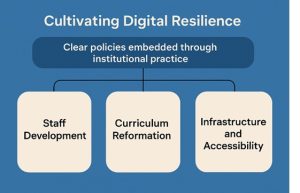
Staff Development
Institutions need to provide professional development opportunities for lecturers to build their digital confidence in teaching, assessing, and reflective learning. Moreover, Howard et al. (2023) elaborates by saying that training should not only focus on tools, but on pedagogy – that is to use digital platforms to develop deeper learning and resilience in students.
Curriculum Reformation
ePortfolios should be integrated through all modules and programs. The focus should not be only on assessment tools but also on developmental platforms that trace students’s growth (Biswas, 2024; Jaidamrong & Mahapoonyanont, 2024). This requires rethinking learning outcomes and assessment standards. Modules need to restructured to include structured reflection tasks, collaborative digital projects, and personalized learning experiences (Yang & Wong, 2024).
Infrastructure and Accessibility: Institutions must invest in scalable digital platforms that support e-portfolio implementation. These platforms should be accessible, multilingual, and compatible with assistive technologies to ensure equity. Students from marginalized communities must have access to devices, connectivity, and ongoing technical support (OECD, 2001; Redecker & Punie, 2017).
Policy frameworks at the national and regional level must support these initiatives by mandating digital resilience development as a graduate attribute, funding capacity-building efforts, and embedding ethical digital citizenship education. As the boundaries between digital and physical realities continue to blur, policies must also attend to issues of digital well-being, data privacy, and psychological safety.
Building Sustainable Digital Strategies
To ensure long-term impact, institutions must think beyond temporary solutions and develop digital resilience strategies that are future-proof and adaptable. This involves not only allocating resources but also designing monitoring and evaluation systems that measure resilience-building over time. Some of these strategies should include:
Integration of ePortfolios from first-year orientation to final-year practical modules;
Institutional platforms that track digital engagement and student growth across resilience competencies;
Student support systems such as peer mentoring, help desks, and digital resilience workshops;
Cross-institutional collaborations to share best practices and co-develop open-access e-portfolio tools.
In conclusion, building digital resilience is not a one-off intervention but a continuous, institution-wide commitment. ePortfolios are a powerful vehicle for this journey, but only if they are supported by intentional culture, clear policy, and inclusive infrastructure. As higher education faces an increasingly complex digital future, institutions must lead with courage, clarity, and compassion by preparing competent lecturers and graduates.
CONCLUSION
Digital resilience is no longer a peripheral competency; it is central to success in contemporary education and work. Unlike digital literacy, which focuses on operational skills, digital resilience encompasses emotional adaptability, critical engagement, self-directed learning, and strategic identity management. This chapter has argued that ePortfolios are powerful, underutilized tools for fostering digital resilience, especially when used intentionally to support reflective, adaptive, and student-centered learning.
We have shown how ePortfolios align with foundational learning theories and offer practical strategies for developing key resilience competencies such as reflection, adaptability, and digital identity. Case studies across student, lecturer, and institutional contexts have illustrated how real experiences can become springboards for growth when supported by e-portfolio practice.
As higher education institutions look toward a future marked by ongoing technological disruption, this chapter urges a shift in perspective: ePortfolios should not be seen merely as assessment tools but as resilience-building platforms that prepare students and lecturers to navigate change with confidence and integrity. We call on educators to design reflective prompts, model vulnerability, and prioritize student agency. We invite institutions to foster inclusive access, rethink assessment cultures, and embed resilience as a graduate attribute.
In the end, empowering digital resilience is not a one-time intervention, it is a long-term investment in human potential. Through thoughtful integration of ePortfolios, we can cultivate not only digital competence, but the inner strength and flexibility needed to thrive in a fast-changing world.
REFERENCES
Amoadu, M., Hagan, J. E., Jr., Obeng, P., Agormedah, E. K., Srem-Sai, M., & Schack, T. (2025). Academic resilience and motivation as predictors of academic engagement among rural and urban high school students in Ghana. Youth, 5(1), 11. https://doi.org/10.3390/youth5010011
Ardi, P., Widiati, U., Suryati, N., & Wulyani, A. (2025). EFL pre-service teachers’ professional identity construction through reflective mentoring during teaching practicum. LLT Journal: A Journal on Language and Language Teaching, 28(1), 87–105. https://doi.org/10.24071/llt.v28i1.9601
Biswas, S. (2024, December 4). Using the power of ePortfolios to enhance student engagement. Faculty Focus. https://www.facultyfocus.com/articles/online-education/online-student-engagement/using-the-power-of-ePortfolios-to-enhance-student-engagement/
Bonanno, G. A., Chen, S., Bagrodia, R., & Galatzer-Levy, I. R. (2024). Resilience and disaster: Flexible adaptation in the face of uncertain threat. Annual Review of Psychology, 75, 573–599. https://doi.org/10.1146/annurev-psych-011123-024224
Bozkurt, A., & Sharma, R. C. (2020). Emergency remote teaching in a time of global crisis due to Coronavirus pandemic. Asian Journal of Distance Education, 15(1), 1–6. https://doi.org/10.5281/zenodo.3778083
Bryant, L. H., & Chittum, J. R. (2023). ePortfolios as a holistic assessment strategy in higher education: A review of evidence and practice. Assessment & Evaluation in Higher Education, 48(2), 180–196. https://doi.org/10.1080/02602938.2022.2080210
ChatGPT. (2025, May 20). Case studies on digital resilience through ePortfolios [Large language model]. OpenAI. https://chat.openai.com/
Donegan, R. (2012). Bullying and cyberbullying: History, statistics, law, prevention and analysis. The Elon Journal of Undergraduate Research in Communications, 3(1), 33–42.
Doolan, K., & Honan, E. (2023). Integrating ePortfolios to facilitate collaborative learning and assessment in higher education. Journal of University Teaching & Learning Practice, 20(1), Article 6. https://files.eric.ed.gov/fulltext/EJ1383525.pdf
Galeucia, A., Gogan, B., & McKee, A. (2023). Using ePortfolios to help students reframe, reflect, and integrate learning. Across the Disciplines, 20(1), 1–19. https://wac.colostate.edu/docs/atd/volume20/galeuciaetal.pdf
Greenhill, A., Holmes, K., & Miller, H. (2020). Digital resilience in higher education: The role of digital capability and identity. Australasian Journal of Educational Technology, 36(6), 92–106. https://doi.org/10.14742/ajet.6096
Gupta, S., & Pathak, G. S. (2021). Digital resilience: A critical competency for thriving in the post-pandemic digital world. Journal of Educational Technology Systems, 50(1), 53–69. https://doi.org/10.1177/00472395211024523
Hoffer, E. (1963). Ordeal of Change. Harper & Row.
Howard, S. K., Tondeur, J., Ma, J., & Yang, D. (2023). Building digital resilience in education: Strategies for navigating change and disruption. Computers & Education, 200, 104809. https://doi.org/10.1016/j.compedu.2023.104809
Howard, S. K., Tondeur, J., Ma, J., & Yang, D. (2023). Building digital resilience in education: Strategies for navigating change and disruption. Computers & Education, 200, 104809. https://doi.org/10.1016/j.compedu.2023.104809
Howard, S. K., Tondeur, J., Ma, J., & Yang, J. (2021). What to teach? Strategies for building digital competence. Computers & Education, 165, 104149. https://doi.org/10.1016/j.compedu.2021.104149
Jaidamrong, N., & Mahapoonyanont, N. (2024). The development of an e-portfolio platform for undergraduate students: A case study. Library Progress (International), 44(3), 1–12. https://bpasjournals.com/library-science/index.php/journal/article/view/3089
Leiner, B. M., Cerf, V. G., Clark, D. D., Kahn, R. E., Kleinrock, L., Lynch, D. C., Postel, J., Roberts, L. G., & Wolff, S. (2003). A brief history of the Internet. ACM SIGCOMM Computer Communication Review, 39(5), 22–31.
Martin, F., & Polly, D. (2020). Digital learning: Building digital resilience in students. Educational Technology Research and Development, 68(6), 3119–3133. https://doi.org/10.1007/s11423-020-09850-2
Mezirow, J. (2000). Learning as transformation: Critical perspectives on a theory in progress. San Francisco, CA: Jossey-Bass.
Nadim, T., & Sylvester, R. (2023). Digital identity: An approach to its nature, concept, and functionalities. International Journal of Law and Information Technology, 31(1). https://doi.org/10.1093/ijlit/eaae019
OECD. (2001). Understanding the digital divide. https://www.oecd.org/content/dam/oecd/en/publications/reports/2001/01/understanding-the-digital-divide_g17a1b56/236405667766.pdf
Pitts, W., & Ruggirello, R. (2022). ePortfolios and reflective practice: Supporting metacognition and self-regulated learning in higher education. International Journal of EPortfolio, 12(1), 15–28.
Rehman, A. U., Mahmood, A., Bashir, S., & Iqbal, M. (2023). Technophobia as a technology inhibitor for digital learning in education: A systematic literature review. Journal of Educators Online, 20(1), 1–20. https://files.eric.ed.gov/fulltext/EJ1427597.pdf
Ryan, R. M., & Deci, E. L. (2000). Self-determination theory and the facilitation of intrinsic motivation, social development, and well-being. American Psychologist, 55(1), 68–78. https://doi.org/10.1037/0003-066X.55.1.68
Weng, X., Li, Y., & Zhang, H. (2025). Navigating digital worlds: A scoping review of skills and strategies for enhancing digital resilience among higher education students on social media platforms. Education and Information Technologies, 30(2), 123-145.
Yang, H., & Wong, R. (2024). An in-depth literature review of e-portfolio implementation in higher education: Processes, barriers, and strategies. Issues and Trends in Learning Technologies, 12(1), 65–101. https://doi.org/10.2458/itlt.5809
AUTHOR
Dr Marga Botha is a senior lecturer in the Department of Biblical Studies,
Philosophy, and Life Skills at Aros, a private Christian higher education institution committed to faith-integrated teacher training. With more than fifteen years of experience in Senior Phase teaching, particularly in Afrikaans and Life Orientation, she brings practical classroom insight into her academic work. Dr Botha holds a PhD in Humanities Education from the University of Pretoria, where her research focused on teacher well-being, with a particular emphasis on the complexities of stress, burnout, and sustainable professional flourishing. Her current research continues to explore these themes within the broader framework of Christian education, while also advancing scholarship in life skills education for intermediate phase student teachers. Passionate about inclusive education and pedagogical innovation, Dr Botha is dedicated to equipping future educators to teach with both competence and conviction, rooted in a biblical worldview.
Email: Marga.botha@aros.ac.za