
31 ePortfolios for Academic Induction: Enhancing Professional Growth and Reflective Practice for New Lecturers
Mashango Phillemon Sithole, University of Limpopo
Cebo Nyondo and Phiwayinkosi R Gumede
Mangosuthu University of Technology, South Africa
ABSTRACT
This chapter critically examines the role of electronic portfolios (ePortfolios) in academic induction programmes as tools for promoting reflective practice and professional identity development among early-career lecturers. Through a thematic analysis of twelve ePortfolios developed during a six-month induction at a Historically Disadvantaged Institution (HDI) in South Africa, the study situates ePortfolio engagement within the broader dynamics of academic socialisation under neoliberal imperatives. The findings reveal that ePortfolios facilitate structured reflection across three temporal modalities: reflection-in-action, reflection-on-action, and reflection-for-action. They enable lecturers to question their pedagogical choices and theoretical orientations. Moreover, ePortfolios function as narrative spaces in which participants negotiate the tensions of disciplinary and performative expectations while constructing emergent academic identities. The identified challenges include gaps in digital literacy, limited time, and surface-level engagement. These issues were mitigated through scaffolded interventions, peer collaboration, and deliberate reflective support. The chapter argues for a reconceptualisation of academic induction as a reflexive, dialogic and contextually situated process rather than a procedural rite of passage. This chapter offers praxis-oriented recommendations for embedding ePortfolios in ways that nurture critical reflexivity, communities of scholarly practice, and sustained professional growth.
Keywords: Academic Induction; Reflective Practice; Professional Identity Formation; ePortfolios; Academic Professional Development.
INTRODUCTION
Newly appointed academics in South African higher education institutions are expected to undergo structured academic induction during their first year of employment. These programmes are intended to support early career academics (ECAs) as they navigate the complex demands of university teaching. As Derek Bok once remarked, “Academia is the only professional system that doesn’t instruct its newcomers in how to do what they will spend most of their time doing.” This observation underscores a historical tension within academic culture: the assumption that disciplinary mastery automatically translates into teaching competence. However, as Reddy et al. (2016) convincingly argue, empirical evidence suggests otherwise; disciplinary expertise does not necessarily equate to pedagogical proficiency. Ssempebwa et al. (2016) revealed that many ECAs at Makerere University rely on informal strategies, such as emulating past teachers or engaging in self-directed reading, due to the lack of formal pedagogical training. This lack of systemic support left ECAs grappling with challenges in curriculum design, classroom delivery, and student evaluation.
In response, several South African universities have reconceptualised their academic induction practices. The New Academics Transitioning into Higher Education Project (NATHEP), launched in 2018 under the University Capacity Development Grant from the Department of Higher Education and Training (DHET), is a notable initiative. Involving ten universities, NATHEP emphasised the development of context-sensitive and humanising approaches to academic induction (Behari-Leak, 2024). Complementing this, DHET’s Framework for Enhancing Academics as University Teachers (2018) called for mentoring, critical reflection, and professional development as central to teaching excellence.
Other institutions, such as the University of KwaZulu-Natal (UKZN), have implemented their own comprehensive induction programmes. Reddy et al. (2016) described a modular approach that encompasses curriculum design, research supervision, assessment, and teaching practice. Despite these efforts, academic development remains a contested area. Some academics view pedagogical training as an encroachment on disciplinary autonomy, raising questions about the balance between compliance and professional growth. Nonetheless, the need to support ECAs, especially amid increasing student diversity, curriculum transformation, and massification, remains urgent. Within this shifting landscape, ePortfolios have emerged as a promising tool in academic induction. Initially conceived as digital repositories, ePortfolios are now recognised as dynamic spaces for reflection, identity construction, and scholarly engagement. Their affordances, multimodal representation, ongoing feedback, and adaptability make them suitable for promoting reflective teaching practices and professional growth.
In contexts such as the MUT, a historically disadvantaged institution (HDI) where resource constraints, institutional transformation, and staff development converge, the e-portfolio offers a particularly generative mechanism for embedding scholarly teaching as both a reflective and identity-forming praxis. More than an archive of compliance, it becomes a pedagogical space where lecturers articulate teaching philosophies, reflect on practice, and engage with theoretical frameworks. The ePortfolio thus enables lecturers not only to document what they do but also to critically consider why they do it and what kind of academics they are becoming in the process.
ACADEMIC INDUCTION FOR NEW LECTURERS: CONTEXT AND CHALLENGES
The imperative for academic induction cannot be extricated from contemporary higher education’s broader epistemological and institutional dynamics. As Ndebele (2013) asserts, induction must be understood not merely as orientation. Instead, they should be seen as embedded in a social and pedagogical process through which new academics come to understand the university’s values, policies, and cultures (Ndebele 2013). Jeske and Olson (2021) similarly conceptualised the academic induction as a process of initiation, onboarding, and professional socialisation. That is, one that is constitutive of identity formation and institutional belonging. From this perspective, induction is not simply an administrative protocol but a formative site where knowledge, power, and pedagogy intersect. Similarly, Nkoana (2010) frames induction as a process aimed at imparting essential knowledge and skills for competent task performance, while Billot and King (2017) highlight the heterogeneity of induction practices across institutions, ranging from brief orientation sessions to comprehensive pedagogical training programmes. What unites these conceptions is an emphasis on acculturation into the institution, not only as a workplace but as an epistemic and affective space where scholarly identities are formed and negotiated.
The practical importance of induction is underscored by Wadesango and Machingambi (2011), who argue,
“Such programme are vital for enabling new staff to understand the culture of the university and how they can be most effective in it, become familiar with departmental practices, policies, and guidelines, appreciate and understand fully the expectations of their role, and understand the duties and activities of the job and begin to perform them effectively.” (P1)
Moreover, Ndebele (2023) found that newly appointed lecturers reported overwhelmingly positive perceptions of structured induction. The lecturers particularly value opportunities to engage with senior management and access information on institutional support systems. The induction programme was thus perceived as instrumental in equipping academics with the pedagogical, administrative, and research-related knowledge required to navigate the university’s complex ecology. In this sense, induction becomes both a technical and ontological enterprise, orienting staff to institutional procedures while simultaneously inviting them to inhabit new roles as scholar-educators.
Despite these positive affirmations of induction, at a conceptual level, the professional development of academics must be understood not merely as a functional necessity. It should be seen as an ontological project grounded in the cultivation of scholarly agency. As Boud and Brew (2013) argue, academic development should be situated within the affective, relational, and epistemic lifeworld of academics. This approach enables transformation through critical engagement with the self, institution, and disciplinary tradition. In this framing, academic induction assumes the status of a structured and epistemically situated intervention in this context. It thus mediates the often-disjunctive transition from disciplinary expertise to pedagogical competence and from professional practice to academic identity.
This transition is rarely seamless. New lecturers often find themselves straddling multiple subjectivities, those shaped by doctoral study, clinical practice, or professional industry, while being thrust into the pedagogical domain with minimal preparation or guidance. The result is a dual burden: mastering teaching mechanics while simultaneously constructing a coherent academic identity. This dissonance is frequently marked by what Carr (2019) and Mathieson et al. (2020) describe as professional culture shock, a psychic and epistemological rupture that reveals the academy’s hidden curriculum. Carr’s (2019) study of nurse lecturers transitioning into academia highlights the affective labour involved in reconciling professional selfhood with the normative expectations of scholarly teaching. In the South African context, the historical legacies of apartheid and the persistent inequalities that shape the higher education sector further compound these tensions. For instance, issues of access, equity, and epistemic justice. These are not peripheral considerations; they are the structural and material conditions through which academic induction is mediated.
Despite their proliferation, pedagogical orthodoxies that reproduce normative assumptions about teaching and learning often constrain academic induction programmes. Dominant frameworks such as constructive alignment (Biggs & Tang, 2007) tend to privilege a universalist rationality that flattens the epistemic and sociocultural diversity of the academy. As Ashwin (2008) and Haggis (2009) caution, this epistemological flattening risks divorcing academic development from the lived complexity of institutional cultures and disciplinary formations. The result is a form of induction that becomes prescriptive rather than transformative, a script for what teaching ought to be rather than a reflection of what it is in practice. Fanghanel (2004) observes that such frameworks often misalign with departmental cultures.
This misalignment generates a schism between taught pedagogies and those enacted in context. This disconnect is not simply pedagogical; it is existential, for it affects the formation of academic identity and the emergence of scholarly agency. In response, the approach adopted in this study positions academic induction not as a mechanistic transmission of competencies. Instead, it positions it as a reflexive, dialogic, and contextually responsive process. This orientation is anchored in the view that transformation arises not from compliance with externally imposed standards, but from meaningful engagement with the contested terrains of pedagogy, selfhood, and institutional life.
CONCEPTUALISING EPORTFOLIOS
Like many constructs in contemporary higher education, the concept of the ePortfolio defies singular definition. Its polyvalence is symptomatic of broader epistemological tensions in educational discourse: tensions between instrumentalism and reflection and between compliance and criticality. As such, Modise and Vaughan (2024) rightly observe that definitions of ePortfolios in the literature are as diverse as the functions they are meant to serve. As the practice of ePortfolio development gained currency, Farrell (2020, p. 292) contends that educators began to “articulate, theorise, and develop the concept of electronic portfolio assessment in higher education,” thereby shifting it from the realm of technological novelty into the domain of pedagogical significance.
At its most elemental, the ePortfolio is a digital tool to document and demonstrate learning, development, and identity over time (Babaee et al., 2021; Hampe & Lewis, 2013). Lam (2023) conceptualises the ePortfolio not merely as a digital container of academic artefacts, but as a pedagogical dispositif marked by connectivity, synchronization, and multimodality. Through this lens, it is embedded within a community of practice. Yet, such definitions, while technically accurate, are epistemologically thin. To reduce the ePortfolio to a functional archive is to miss its ontological import: that it serves as a site of academic self-fashioning, a discursive and reflective space wherein the novice academic engages in the praxis of becoming. Here, they are actively shaping their ‘selfhood,’ or the way they perceive and craft their identity as university teachers. In this framing, the ePortfolio transcends its technological infrastructure to become a dynamic interface through which teaching identities are constructed, shared, and legitimised.
The affordances of ePortfolios are manifold. From a utilitarian standpoint, they offer space-saving alternatives to voluminous paper portfolios (Babaee et al., 2021). As stated by Hampe and Lewis (2013), this ensures ease of retrieval and a form of digital permanence that surpasses traditional documentation. Yet, these technological conveniences are not without caveats. The ePortfolio’s efficacy is invariably tethered to the socio-material conditions within which it is deployed. Its use presupposes a baseline of digital literacy, access to reliable internet connectivity, and the availability of technological devices. These conditions are not universally guaranteed, particularly within contexts of resource disparity. As such, the ePortfolio’s potential as an egalitarian pedagogical tool is contingent upon the resolution of infrastructural inequities that continue to characterise both the global South and under-resourced institutions globally.
Moreover, the typologies of ePortfolios reflect the historical evolution and epistemic positioning of the tool within higher education. To this effect, Yancey (2004) delineates three dominant forms: (1) digitised print portfolios, which simply transpose physical documents into electronic form, and (2) institutional online assessment systems. They are typically embedded within Learning Management Systems (LMS) and used for compliance and performance monitoring; and (3) open-source or web-based portfolios, which offer greater user agency, flexibility, and creative affordances. Each typology carries with it particular logics of use. They range from bureaucratic instrumentality to pedagogical liberation. As such, their uptake within academic induction contexts should be critically evaluated against the objectives of reflective practice, academic identity formation, and participatory professional development.
However, the promise of the ePortfolio is not without its contradictions. Sebolao’s (2019) study within a South African university reveals that many academics engage with teaching portfolios, whether digital or otherwise, not as instruments of reflexivity but as artefacts of compliance. Her findings indicate that a significant proportion of participants viewed the portfolio primarily as a bureaucratic obligation. These perceptions echo a wider concern in the global literature: that when reflective tools are co-opted by performative cultures of surveillance and summative assessment, their developmental intent is undermined (Sutherland et al., 2010). The ePortfolio risks being rendered epistemically mute in such contexts, a curated showcase of competence devoid of the critical tensions that constitute real learning.
Academic developers are increasingly reclaiming the ePortfolio as a formative and dialogic practice to counteract this erosion of pedagogical integrity (Modise, 2024). This reclamation demands a radical shift: from the portfolio as an endpoint of evaluation to the portfolio as a process of inquiry. Therefore, the deployment of ePortfolios within the academic induction must therefore be situated within this deeper epistemic terrain. Induction, as discussed elsewhere in this chapter, is not merely a transitory stage in the career of an academic; it is a formative crucible wherein identity, agency, and epistemic authority are negotiated. The ePortfolio assumes a dual function within this context. On the one hand, it responds to institutional imperatives of accountability, probation, and performance appraisal. On the other hand, and more critically, it offers an emancipatory potential as a reflexive mirror that enables early-career academics to trace, interrogate, and articulate their pedagogical evolution. In this reframing, the ePortfolio becomes a pedagogical common. It is a space where early-career lecturers not only document what they do but also reflect on who they are and what kind of university teachers they aspire to become.
Nonetheless, such aspirations must contend with the broader systemic conditions within which induction occurs. Billot and King (2017) warn that many higher education institutions fail to adequately monitor or support the developmental impact of induction programmes. This neglect inadvertently renders the ePortfolio vulnerable to instrumentalisation. Within an increasingly neoliberal academic regime, where performance metrics, massification, and managerialism prevail (Dawo & Sika, 2021), the ePortfolio can become yet another mechanism of surveillance unless its critical possibilities are safeguarded. This necessitates a pedagogical ethic that resists reductionism, foregrounds relationality, and recognises the ePortfolio as a living document of professional agency rather than a static ledger of achievements.
THEORETICAL LENSES: REFLECTIVE PRACTICE AND PROFESSIONAL IDENTITY FORMATION
To apprehend the pedagogical efficacy of ePortfolios within the context of academic induction, the discourse must be anchored within two intersecting theoretical lenses: reflective practice and professional identity formation. These conceptual frameworks do not merely provide explanatory tools. Herein, they function as epistemic scaffolds that render the transformative potential of ePortfolios in the development of new lecturers intelligible.
Reflective Practice as a Foundation
The concept of reflective practice, now widely heralded as a foundational tenet in the cultivation of pedagogical competence, finds its intellectual provenance in the seminal work of Donald Schön. In The Reflective Practitioner (1983), Schön challenged the orthodoxy of technical rationality that had long dominated professional education. Schön argued for a paradigm wherein learning is grounded not solely in prescriptive knowledge but in the reflexive engagement with lived experience. Central to this framework is the distinction between reflection-in-action and reflection-on-action. Chan and Lee (2021) and Korthagen and Nuijten (2022) affirm the significance of distinguishing reflection according to its timing and cognitive orientation. Reflection-in-action denotes real-time, adaptive thinking during the act of teaching itself, where immediate adjustments are possible. In other words, it concerns the capacity to think critically and adaptively in the midst of practice.
On the other hand, reflection-on-action involves critical thinking about past teaching experiences to evaluate and inform future practice (Chan & Lee, 2021; Korthagen & Nuijten, 2022). In essence, it is a retrospective interrogation of one’s actions after the event. This bifurcation speaks not merely to cognitive processing but to an epistemology of practice wherein knowledge is constituted through the recursive interplay between action, observation, and critique. Subsequent scholarship has elaborated upon these temporalities of reflection.
Extending Schön’s original typology, Van Manen (1991) introduced the concept of reflection-for-action, or “prelection.” This conception involves anticipatory reflection prior to pedagogical engagement. For example, thinking through potential challenges, envisaging possible scenarios, and planning responses before teaching starts. In this scenario, these modes of reflection constitute a comprehensive framework for understanding how academics engage with the complexities of teaching. Accordingly, Van Manen’s (1991) approach offers a temporal and epistemological structure through which professional growth can be systematically cultivated.
This conceptual architecture acquires profound relevance within the context of academic induction. New lecturers, particularly those entering academia from doctoral programmes and professional sectors, must not only acquire pedagogical techniques but also reconfigure their identities as academics. This requires more than training; it demands reflective agency. To be a reflective practitioner in this scene is to resist the inertia of routine. Instead, it requires engagement in a praxis wherein feedback, theory, and self-awareness continuously interrogate, recalibrate, and inform teaching. Therefore, the reflective lecturer becomes a cartographer of their own pedagogical terrain. They map the contours of classroom dynamics, student engagement, and curriculum enactment in ways that are both evidence-based and context-sensitive.
However, Schön’s model, while groundbreaking, is further enriched by Mezirow’s theoretical intervention, whose transformative learning theory offers a critical deepening of the reflective project. Mezirow (1991) posits that authentic learning is not merely adaptive but transformative; it involves a fundamental shift in the individual’s frame of reference. Such transformation is precipitated by critical reflection, which is the rigorous questioning of taken-for-granted assumptions, often triggered by disorienting dilemmas that unsettle prior beliefs. For the novice academic, this might mean confronting inherited epistemologies of teaching rooted in prior schooling, disciplinary dogma, or professional convention and arriving, through reflection, at a reconstituted pedagogical identity aligned with scholarly inquiry and emancipatory practice.
In this regard, ePortfolios serve not simply as digital repositories of performance but as reflection technologies, sites where the dialectic of professional becoming unfolds. This is exemplified by Modise and Mudau (2023, p. 286), who state that “the strength of ePortfolios lies in the extensive use of reflective learning practices” because they offer structured spaces for lecturers to articulate, scrutinise and evolve their teaching philosophies over time. The empirical work of Kitchenham and Chasteauneuf (2009) is instructive here: they uncovered significant evidence of critical self-reflection by applying Mezirow’s typology of reflection to the analysis of teacher candidates’ ePortfolios. This suggests that when appropriately scaffolded, the ePortfolio can catalyse the very transformation Mezirow theorised. Such findings challenge reductive interpretations of the ePortfolio as merely administrative. It reaffirms its potential as a reflective common, a dialogical space for critical reflexivity, narrative inquiry, and professional identity construction. Reflective practice resonates with Kolb’s (1984) model of experiential learning when scaffolded by ePortfolios, which conceptualises learning as a cyclical process involving experience, reflection, conceptualisation and experimentation. In this schema, the ePortfolio functions not merely as an archive of reflection but also as a medium of epistemic synthesis, in which distinct teaching moments are abstracted into broader pedagogical insights.
ePortfolios and Reflexive Construction of Professional Identity
This study also addresses the enduring question of how academics construct their professional identities as university teachers. As Billot and King (2017) observe, newly appointed lecturers frequently receive limited support in reconstituting their identities during induction. This is even more acute due to the performative pressures that increasingly govern teaching, assessment, and research outputs (Vos & Page, 2020) in higher education. In resisting the agenda of performativity, scholarly attention has shifted towards understanding the socio-cultural dimensions of induction, wherein informal learning, disciplinary socialisation and collegial interaction emerge as crucial sites for the formation of identity and agency (Roxå & Mårtensson, 2015; Trowler & Knight, 2000). Within this view, academic identity is no longer seen as a fixed attribute but as a dynamic and contested process of ongoing construction, deconstruction, and reconstruction (Fitzmaurice, 2013; Sheridan, 2013).
Furthermore, academic identity, while fluid and multifaceted, is anchored simultaneously in disciplinary affiliation and the institutional context (Smith & Rattray, 2016). It is shaped through participation in specific scholarly communities as well as through negotiation with institutional expectations and structures. Browning et al. (2014) argue that a strong alignment must be forged between an institution’s strategic drive for academic productivity and the support provided to new staff during their transition to become effective practising academics. Without such alignment, the formation of a coherent professional identity risks becoming fractured or superficial.
This precariousness is intensified by broader shifts within the higher education sector. Academic identity is now increasingly fragmented, not only in terms of the multiplicity of roles—researcher, teacher, administrator, and community engager—but also in the multiplicity of subjectivities demanded by shifting institutional and market logics (Clegg, 2008; Harris, 2005; Henkel, 2005; Henkel, 2012). Whereas previously academics enjoyed relative autonomy to cultivate strengths and interests across a range of spaces, often privileging some roles over others, the rise of New Public Managerialism, for instance, has imposed new regimes of uniformity and standardisation. Consequently, academics are now expected to develop consistently across ever-expanding roles. This is often driven by audit cultures and accountability mechanisms that prioritise institutional needs over individual agency. In this regard, the formation of academic identity is not a neutral evolution but a negotiated and contested struggle. It thus makes the scaffolding provided by academic induction programmes become even more critical in supporting emerging academics to navigate, contest, and strategically inhabit their professional roles.
Scholars such as Remmik et al. (2011) and Sutherland (2018) advocate for tailored induction practices grounded in collegial networks that acknowledge the diverse capacities of new academics. Central to this approach is the cultivation of critical spaces, intellectual and institutional, where new lecturers can reflect on their evolving roles (Mathieson, 2011). However, much of this literature privileges participants’ perspectives, with less attention given to how academic developers actively structure these reflexive and social learning opportunities. At the centre of this identity formation is Wenger’s (1998) theory of Communities of Practice, which frames identity as a lived experience forged through participation in shared cultural and professional practices. New lecturers enter higher education as peripheral participants, gradually moving toward fuller membership as they internalise the discourses and practices of the academic community. This process is dialogic and dynamic, shaped by mentorship, peer feedback, and the negotiation of meaning.
In this context, ePortfolios serve as a potent mediating tool in this process of becoming. Far from being neutral repositories of artefacts, ePortfolios offer a reflexive medium for articulating a professional narrative for new lecturers. They chronicle not only what they do, but who they are becoming as academics. Coker and Redford (2016) show how structured ePortfolio activities enabled pre-service teachers to synthesise their past, present, and projected futures as pedagogical actors. Likewise, in academic induction, ePortfolios scaffold the movement of lecturers from novice to participating members in a community of teaching practice. In a sense, the ePortfolio can function as an “identity portfolio,” for it showcases the lecturer’s evolving teaching philosophy, values, and competencies. When shared within peer or mentorship circles, ePortfolios also encourage micro-communities of practice (Lim & Lee, 2014), allowing new academics to see their development mirrored in others. Such communal reflection affirms identity while cultivating a sense of scholarly belonging.
INSTITUTIONAL CONTEXT AND RATIONALE FOR IMPLEMENTING EPORTFOLIOS
The integration of ePortfolios within the academic induction programme at MUT must be understood in relation to the institution’s strategic anchor with a distinct mandate for equity, redress, and scholarly engagement. In this context, MUT has foregrounded a teaching and learning ethos that not only prioritises pedagogical excellence but also responds to the developmental imperatives of its predominantly disadvantaged student body. Within this frame, as seen earlier, the university recognises the urgent need to professionalise teaching through structured academic induction and reflective capacity-building mechanisms.
To achieve this, MUT developed and approved the Academic Induction Charter to enable a structure for transforming induction (Gumede, Chili & Toni, 2024). Thus, the academic induction programme at MUT is conceptualised as a dialogic and developmental process that attends to the institution’s pedagogical, structural, and cultural particularities. The programme is structured around a series of workshops and facilitated engagements in key areas such as curriculum design, assessment theory and practice, scholarly teaching, and institutional systems of support. At the centre of this developmental architecture is the teaching ePortfolio, a formative tool designed to scaffold reflective practice and a summative artefact that marks the culmination of the induction process. The portfolio is not merely a collection of tasks; it is a mirror of becoming, a reflective technology through which the novice academic encounters themselves as both practitioner and scholar.
As the institutional custodian of academic development at MUT, the Teaching and Learning Development Centre (TLDC) initiated the implementation of teaching ePortfolios as a core component of the academic induction programme. The decision was informed by the imperative to embed critical reflection, self-authorship, and scholarly identity construction into the developmental trajectories of newly appointed academics. To this end, the TLDC produced comprehensive Teaching Portfolio Guidelines. The guidelines frame the teaching portfolio not merely as a repository of pedagogical artefacts, but as a narrative instrument through which academics document, interrogate, and refine their teaching practice.
The selection of Google Sites as the digital platform for ePortfolio development was strategic and context-sensitive. As an open-access, user-friendly platform, Google Sites requires minimal technical skills, making it an inclusive tool for academics with varied levels of digital fluency. Its web-based format allows for easy integration of multimedia artefacts (videos, PDFs, audio files), hyperlinks, and embedded documents, enabling lecturers to curate a richly layered and multimodal representation of their teaching journey. Furthermore, the cloud-based architecture of the platform supports real-time collaboration, feedback, and sharing with mentors, peers, and institutional reviewers, functions that are essential in promoting communities of reflective practice within and across faculties. The platform’s adaptability to the MUT context is equally important. Given that infrastructural constraints remain a concern across South African higher education sectors, Google Sites offered a solution that required no additional licencing. It was mobile-responsive and could be supported through the institution’s existing Google Workspace environment.
DESIGN AND STRUCTURE OF THE EPORTFOLIO
The design of the ePortfolio was underpinned by key pedagogical principles drawn from constructivist and experiential learning theories, which view knowledge construction as an active, iterative, and reflective process. Central to this approach was the notion that professional development is most impactful when it is authentic, dialogic, and embedded in context. Accordingly, the ePortfolio was structured not as a checklist of compliance tasks but as a developmental framework that scaffolded reflective engagement across multiple dimensions of teaching practice.
To support participation, we implemented a series of structured workshops that provided training on both the technical and pedagogical aspects of ePortfolio development. Importantly, the workshops were not confined to procedural training; they were dialogical spaces that encouraged critical conversation about teaching philosophies, classroom experiences, and institutional roles. Through this iterative, scaffolded model of support, new academics were empowered not only to develop digital portfolios but also to engage meaningfully in the reflective practices that underpin scholarly teaching and identity formation.
The design of the ePortfolio adhered to both a vertical (Figure 1) and horizontal layout (Figure 2), allowing for intuitive navigation and structured progression across the various domains of academic practice. The template provided to participants included core components designed to reflect the multifaceted nature of scholarly teaching. These comprised a Home Page, Biographical/Profile section, Teaching Philosophy, Approaches to Teaching (including sub-sections on assessment and feedback), Curriculum Development, Professional Development, and Scholarly Activities. This framework was intended to scaffold reflection while maintaining alignment with the institution’s vision for academic excellence and the DHET’s national guidelines for university teaching. Importantly, participants were afforded autonomy to customise their portfolios, adding, modifying, or renaming sections, as they deemed appropriate for their own pedagogical identities and disciplinary contexts. This flexibility enabled a balance between institutional coherence and individual expression.
Figure 1
Vertical layout of ePortfolios
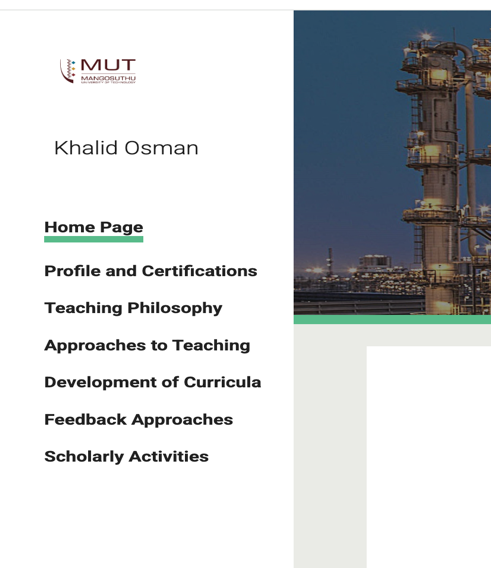
Figure 2
Horizontal layout of ePortfolios

METHODS AND MATERIALS
This study adopted a qualitative, document-based analytic approach. It is grounded in the interpretive tradition, the quest of which was to examine the ePortfolios developed as part of the academic induction programme at MUT during the 2023 academic year. A total of twenty-two (n=22) participants, drawn from a heterogeneity of disciplinary fields, enrolled in the programme. Participants engaged in a sequenced series of developmental workshops. These engagements culminated in the construction of individualised ePortfolios using the Google Sites platform. At the end of the induction programme, fifteen (n=15) participants submitted ePortfolios. However, preliminary evaluation revealed that three (n=3) portfolios were skeletal: they consisted predominantly of placeholder pages, devoid of substantive reflective narratives, critical incidents, or pedagogical documentation. These portfolios, failing to meet the minimum threshold of analytic adequacy, were excluded from subsequent analysis. The final analysis comprised twelve (n=12) ePortfolios that satisfied the inclusion criteria, namely: (1) the presence of an articulated teaching philosophy; (2) documented examples of pedagogical engagement; and (3) evidence of critical reflection that linked praxis to theoretical constructs. Portfolios that manifested merely procedural compliance, without demonstrable critical reflexivity, were systematically excluded.
Thematic analysis, drawing on both inductive and deductive strategies, constituted the principal method of analysis. To support the development of reflective practice, participants were guided through structured reflection prompts embedded in workshops. These prompts were aligned with Schön’s (1983) reflective typology and Van Manen’s (1991) pre-reflective framing and were intended to scaffold critical thinking across multiple teaching dimensions. For instance, the prompts included:
Reflection-in-Action: “What did you notice about your students’ responses during the lesson? How did you adapt your approach in the moment?”
Reflection-on-Action: “Describe a recent classroom experience that challenged your expectations. What happened, and what did you learn from it?”
Reflection-for-Action: “How would you design or modify your next lesson to improve student engagement based on your previous experience?”
Critical Pedagogical Reflection: “How do your teaching strategies align with your philosophy of teaching and the broader goals of higher education?”
Professional Identity Prompt: “How has your perception of yourself as a university teacher evolved during this induction period?”
These prompts were supplemented with exemplar reflections and feedback activities to deepen engagement and move participants beyond surface-level description towards analytical and transformative reflection as they developed their ePortfolios.
An initial phase of open coding enabled immersion within the textual corpus, thus identifying emergent patterns and meaning structures. This was followed by a deductive mapping of the data onto the conceptual schema underpinning the study: ePortfolios as mechanisms for reflective practice and professional identity formation. Particular analytic attention was devoted to the presence of structured reflection, integration of theoretical frameworks into practice, narrative constructions of professional becoming, and articulations of agency and pedagogical maturity. Verbatim excerpts were curated to exemplify thematic findings, ensuring that the authentic voices of participants remained foregrounded in the analytic narrative.
All ethical considerations were rigorously adhered to in line with MUT’s research ethics protocols. Confidentiality was assured through the anonymisation of participant identities and the de-identification of institutional references. For instance, portfolios were named Portfolio 1 to Portfolio 12.
EMPIRICAL ANALYSIS
In this section, we present an empirical analysis of the 12 ePortfolios developed as part of the summative assessment for the academic induction. It is arranged along two main thematic areas: ePortfolios as tools for reflection and ePortfolios and professional identity development.
Table 1
Thematisation (created by Authors)
|
Theme
|
Analytical Summary
|
|
Structured reflection |
Across portfolios, ePortfolios facilitated structured opportunities for reflection, particularly through their design as longitudinal digital narratives. Participants used them to record evolving classroom practices and critical incidents. One lecturer wrote, “This platform allows me to return to a lesson and analyse not just what happened, but why it happened.” |
|
Linking theory to practice |
Several lecturers used the ePortfolio to explicitly connect practice with theoretical concepts, often referencing induction content. A typical reflection reads, “After reviewing my approach to assessment, I adjusted the rubric in line with constructive alignment.” This suggests that the act of digital reflection reinforced theoretical understanding. Another reflected: “My teaching philosophy is strongly influenced by constructivism, shaped by the synergy between my experience as an instructor in higher education, a professional skills trainer, and my background in the construction industry.” |
|
Challenges in reflection |
Despite the benefits, initial reflections were often superficial. Common challenges included time constraints and uncertainty about what constitutes deep reflection. As one participant confessed, “In the beginning, I was just describing what I did; later I realised I needed to reflect on why I chose certain methods.” Guided prompts and examples were pivotal in elevating reflection quality. |
|
Narrating professional growth |
Portfolios became narrative spaces where lecturers chronicled their professional journeys. Teaching philosophies, reflective statements and evidence of practice were framed as stories of becoming. One lecturer remarked, “Writing my teaching philosophy helped me consolidate who I am as an academic.” Another reckoned: “My teaching philosophy has evolved over time. I began with trying to replicate the way in which I was taught, which was a paradigm of teacher-centred learning where I as a teacher disseminated knowledge to students.” |
|
Communities of practice |
Some lecturers noted that peer sharing and review within workshops created a sense of scholarly community. “Reading my colleagues” reflections showed me we face similar challenges,” one wrote. Such interactions contributed to identity co-construction through shared meaning-making. |
|
Evidence of identity shift |
Several ePortfolios displayed an evolution in the lecturers’ sense of self. Participants initially described themselves as “new lecturers” but later embraced terms like “academic”. A reflection noted, “At first, I felt like an outsider. Now, I feel I belong in the academic space.” |
|
Integration with professional trajectory |
Participants saw the ePortfolio not as a terminal project but a developmental platform. “I plan to expand this portfolio when I apply for a teaching award,” said one. The structure and content of portfolios suggest their continued use as artefacts of ongoing professional development. |
EPORTFOLIOS AS TOOLS FOR REFLECTIVE PRACTICE
Structured reflection
Across the reviewed 12 ePortfolios, one of the most prominent features was the use of structured reflection to facilitate pedagogical introspection. The design of the portfolios, framed through curated sections such as Teaching Philosophy, Approaches to Teaching, and Professional Development, created an architecture that encouraged lecturers to revisit and interrogate their teaching experiences in a systematic manner. Evidence suggests that the continuous reflective entries and section-based narratives functioned as temporal anchors for deeper analysis. One participant reflected, “This platform allows me to return to a lesson and analyse not just what happened, but why it happened.” This exemplifies the movement from descriptive recounting towards analytical engagement. As such, the structure did not merely house artefacts of practice but framed them within an evolving critical narrative of teaching-as-inquiry.
Linking theory to practice
All the twelve (12) analysed ePortfolios exhibited an explicit linkage of teaching and learning theories to practice. Lecturers routinely referenced pedagogical frameworks introduced during the induction workshops. Their reflections demonstrated integration of these insights into their reflections on teaching approaches and classroom experiences. Concepts such as constructivism, constructive alignment, student-centred learning, Bloom’s taxonomy, experiential learning, and Universal Design for Learning (UDL) featured prominently in participants’ analyses of their teaching strategies. Bloom’s Taxonomy, a hierarchical framework for categorising educational goals, was often used to guide the design of learning outcomes, assessments, and activities across cognitive levels such as remembering, understanding, applying, analysing, evaluating, and creating (Bloom et al., 1956). UDL, on the other hand, is a framework aimed at creating inclusive learning environments by offering multiple means of engagement, representation, and expression (CAST, 2018).
For instance, one lecturer remarked, “After revisiting the notion of constructive alignment, I redesigned my assessment task to ensure that it matched the intended outcomes and the learning activities.” Such reflections suggest that the ePortfolio served not merely as a tool for recording teaching moments but as a site where theoretical constructs were actively mobilised to inform and transform practice. This is in tandem with Ndebele (2013), where academics expressed that certain sessions were enlightening and prompted reflection on their teaching practices. This suggests the program contributed to their professional growth.
Challenges in Reflection
Despite the affordances of structured and theory-informed reflection, participants acknowledged a few challenges in engaging with the ePortfolio. Chief among these were time constraints, uncertainty about what constituted meaningful reflection, and unfamiliarity with reflective writing conventions. This was attested by two portfolios, which were just skeleton sites with pages but without content, suggesting that the lecturers could have been overwhelmed. One lecturer admitted, “In the beginning, I was just describing what I did; later I realised I needed to reflect on why I chose certain methods.” This transition from surface-level description to critical reflection was often catalysed by peer exemplars, rubric-based criteria, and mentorship.
The use of reflective scaffolds, such as prompting questions and exemplar portfolios, was particularly effective in cultivating higher-order reflection. Over time, lecturers began to demonstrate greater depth, employing frameworks like Bain’s 5Rs (Reporting, Responding, Relating, Reasoning, Reconstructing) and Schön’s reflection-in-action model to guide their entries. As a result, reflection moved beyond individual practice towards a sustained engagement with pedagogical purpose.
EPORTFOLIOS AND PROFESSIONAL IDENTITY DEVELOPMENT
Narrating Professional Growth
The ePortfolio emerged as a narrative space in which lecturers could articulate and trace their evolving professional identities. This was apparent in sections like Teaching Philosophy and Professional Development, where participants constructed coherent accounts of their beliefs, values, and transformations as educators. These narratives were not static affirmations of practice but dynamic accounts of becoming. One participant captured this sentiment aptly: “Writing my teaching philosophy helped me consolidate who I am as an academic.” In these entries, lecturers positioned themselves as agents of their own development, often juxtaposing initial uncertainties with newly acquired confidence and pedagogical clarity. The ePortfolio thus functioned as both a reflective and identity-formative artefact.
Communities of practice
Beyond individual reflection, several lecturers emphasised the relational dimension of ePortfolio development, particularly in its capacity to foster collegial dialogue and a sense of community. The sharing of portfolios during induction workshops or peer feedback sessions was identified as a pivotal moment in developing a scholarly teaching identity. One lecturer noted, “Reading my colleagues’ reflections showed me we face similar challenges,” a remark that underscores the ePortfolio’s function as a conduit for communal meaning-making. These interactions resonate with Wenger’s (1998) theory of communities of practice, wherein identity is forged through participation in shared practices. The notion of CoP is further buttressed in Ndebele (2013), whose study highlighted the importance of interaction and socialisation, noting that the academic induction program facilitated networking with colleagues and understanding of university culture, which eased their adaptation process. In this respect, the ePortfolio thus acted as both a personal and relational text, a medium through which individual insights were situated within a broader community of academic practice.
Evidence of identity shift
Compelling evidence of identity transformation was present in how lecturers described themselves over the course of the portfolio project. Initially, many framed their reflections through the lens of inexperience, referring to themselves as “new lecturers,” “industry practitioners,” or “novices.” However, by the culmination of the induction process, a more assertive professional lexicon emerged. Lecturers began to identify as “educators,” “academic professionals,” or “university teachers,” signalling a shift in both epistemic confidence and pedagogical agency. As one participant wrote, “At first, I felt like an outsider. Now, I feel I belong in the academic space.” This linguistic and conceptual evolution affirms the portfolio’s function in facilitating not just technical competence but ontological transformation.
Integration with professional trajectory
Perhaps most significantly, lecturers did not view the ePortfolio as a finite task confined to the induction period but as a living document aligned with long-term professional development. Several participants expressed intentions to adapt their portfolios for teaching awards, promotions, or ongoing reflection. One participant remarked, “I plan to expand this portfolio when I apply for a teaching award,” highlighting the perceived continuity between the portfolio’s formative use in induction and its summative utility in institutional recognition. This future-oriented orientation underscores the ePortfolio’s role as a bridge between novice academic induction and lifelong scholarly practice. Rather than existing as a bureaucratic artefact, the ePortfolio was reimagined by its users as an evolving testament to teaching identity, professional values, and pedagogical growth.
DISCUSSION
As evidenced in the analysis, the deployment of ePortfolios within academic induction reveals both the pedagogical promise and conceptual tensions. At one level, the ePortfolio offers a structured and scaffolded space through which novice academics begin to cultivate reflective dispositions. In particular, linking theory to practice and articulating their evolving academic identities. As Schön’s (1983) reflective practitioner model and Van Manen’s (1991) typology of reflection underscore, such structured reflection, across reflection-in-action, on-action, and for-action, enables practitioners to interrogate their pedagogical actions and epistemological assumptions. In the cases analysed, participants’ engagement with frameworks such as constructivism, constructive alignment, and experiential learning. This demonstrated the ePortfolio’s function as a metacognitive tool that supports both cognitive and ontological growth. Yet, this reflective turn is not spontaneous; as Mezirow (1991) contends, critical reflection emerges from disorienting dilemmas and dialogic support, not from compliance mechanisms alone. Thus, reflection here is not ideologically neutral but mediated by institutional culture, policy pressures, and individual epistemic agency. That is, the capacity to act on and make sense of knowledge (epistemology) in relation to one’s evolving professional identity (ontology).
The analysis further reveals a critical tension between performative compliance and authentic engagement. While participants largely embraced the ePortfolio as a developmental space, its framing as a summative requirement within the induction programme raises questions about surveillance and performativity. As Sebolao (2019) and Sutherland et al. (2010) caution, when reflective tools are embedded in bureaucratic accountability frameworks, often referred to as performative cultures that value surface-level compliance over authentic learning, they risk becoming curated displays of competence rather than dialogic sites of inquiry. However, this view must be tempered with growing evidence that ePortfolios, when scaffolded with mentoring, exemplars, and peer dialogue, can foster meaningful pedagogical development.
For instance, Krishnan and Yunus (2017) show that structured ePortfolio activities supported teachers in moving from descriptive to critical reflection, while Michos and Petko (2024) highlight the influence of peer and mentor engagement in deepening teacher self-efficacy. For instance, several participants in this study initially approached the portfolio as “just another task,” a finding that aligns with the critique of instrumentalised reflection in audit-driven contexts. What enabled a shift from compliance to criticality was the pedagogical design of the induction programme itself. Dialogic workshops, peer exemplars, and structured reflective prompts as shown earlier mirrored Schön’s reflective cycle and Mezirow’s transformative learning conditions. This suggests that pedagogic intentionality, rather than bureaucratic mandate, is key to unlocking the developmental potential of the ePortfolio (Modise & Mudau, 2023).
The prominence of professional identity formation within the portfolios underscores the ePortfolio’s ontological function as a “technology of the self” (Foucault, 1988). Through narrative reflection, participants were not merely documenting their teaching; they were constituting themselves as academics. In line with Wenger’s (1998) theory of communities of practice and Fitzmaurice’s (2013) work on academic identity, the portfolio became a site where participants negotiated belonging, legitimacy, and epistemic voice. For instance, the writing of teaching philosophies and reflections on practice thus functioned as discursive acts through which new lecturers inscribed their presence into the institution. This is especially salient in historically disadvantaged contexts such as MUT, where ePortfolios offer counter-discursive spaces to contest inherited hierarchies of knowledge and belonging (Behari-Leak, 2024; Ndebele, 2023).
Yet, this process is uneven and conditioned by varying levels of digital literacy, reflective fluency, and institutional support. While Google Sites offered a relatively accessible platform, the quality of reflection was closely linked to participants’ prior exposure to academic writing. Moreover, their confidence in technology and the institutional culture surrounding vulnerability and critique. The emergence of deeper reflection often occurred in response to facilitator feedback or peer exemplars, affirming that reflection is not a solitary exercise but a social and dialogic practice (Lim & Lee, 2014; Kitchenham & Chasteauneuf, 2009). This finding resonates with Wenger’s notion of legitimate peripheral participation, wherein identity is formed through interaction, imitation, and progressive integration into a community of practice.
Crucially, the deployment of ePortfolios cannot be disentangled from the broader political economy of academic labour. As Boud and Brew (2013) argue, professional development initiatives risk becoming sites of academic domestication if they fail to engage with the structural and affective conditions under which teaching is performed. Participants in this study often constructed their portfolios amid competing demands of probation, teaching, curriculum development, and research output. While many expressed pride in their portfolios, such affective investment should not obscure the invisible labour. In this regard, literature reminds us that academic becoming is not only a cognitive project but a labouring one (Vos & Page, 2020; Carr, 2019), situated within regimes of precarious employment, massification, and managerialism.
The post-induction uptake of ePortfolios as tools for teaching awards, promotions, or continued reflection affirms their potential as lifelong learning artefacts. However, realising this potential requires their institutionalisation beyond induction. As Roxå and Mårtensson (2015) suggest, academic development must be understood as a longitudinal, institutionally embedded process that recognises identity as emergent and always in negotiation. In this light, the ePortfolio emerges not merely as a container of evidence but as a reflective common. It is a space through which early-career lecturers articulate pedagogical agency, scholarly identity, and epistemic courage across the academic life cycle.
BEST PRACTICES AND RECOMMENDATIONS
The successful integration of ePortfolios into academic induction is not merely a function of technological implementation but of careful pedagogical and institutional design. As such, this section presents a synthesis of principles and practices that can guide institutions in leveraging ePortfolios as transformative tools for academic development.
Design principles
The success of any ePortfolio initiative begins with intentional and pedagogically sound design. Clear objectives must be established, aligning the ePortfolio with institutional teaching philosophies, programme learning outcomes, and national professional standards. The structure should include core components such as teaching philosophy, pedagogical reflections, evidence of teaching practice, and future development plans. Using user-friendly platforms, such as Google Sites or similar open-source tools, can enhance accessibility, especially in resource-constrained contexts. Design must also attend to issues of privacy, ownership, and data security, ensuring that lecturers feel safe to share authentic reflections without fear of surveillance or misuse.
Structured support
Support structures are equally indispensable. The provision of continuous mentorship, as Masaiti et al. (2023) noted, is that the process of induction cannot be complete without mentorship. Facilitated workshops and technical assistance ensure that new academics are not left to navigate the reflective process in isolation. Moreover, a scaffolded approach is essential. This entails beginning with descriptive entries and gradually progressing to critical and analytical reflections, which can support varying levels of digital and pedagogical literacy.
Encouraging engagement
Engagement with ePortfolios is more likely to be meaningful when lecturers understand their relevance and feel supported in the process. In this logic, institutions can promote engagement by integrating the portfolio into reward structures. These could include recognition for exemplary portfolios, eligibility for teaching awards, or showcasing success stories in faculty seminars. This can inculcate a collegial culture and position the portfolio as a shared scholarly endeavour. Most importantly, the institutional environment must remain non-judgmental, supportive, and developmental rather than punitive. When new lecturers are assured that the ePortfolio is a space for learning and exploration rather than performance surveillance, they are more likely to engage with integrity and depth.
Evaluating impact
Evaluation is critical not only for accountability but also for continuous improvement. Institutions should develop mechanisms to measure the impact of ePortfolios on lecturer development. These might include pre- and post-participation surveys on reflective skills and teaching confidence, content analysis of portfolio entries to track reflective depth over time, or longitudinal studies linking portfolio engagement with career progression (e.g., retention, promotion, award nominations). Evaluative data can inform enhancements to the design and implementation of the induction programme and can be leveraged to advocate for further investment in academic development infrastructure.
CONCLUSION
The integration of ePortfolios into academic induction programmes represents a critical reimagining of how newly appointed lecturers are supported in their transition into the complex lifeworld of higher education. Far from being mere repositories of evidence or administrative artefacts, ePortfolios function as reflexive spaces where pedagogical practice, theoretical engagement, and scholarly identity are recursively constituted. Through structured reflection, encompassing reflection-in-action, reflection-on-action, and reflection-for-action, participants moved beyond surface-level documentation. As such, this process enabled more critical engagements with their teaching philosophies, curriculum practices, and broader professional trajectories. Yet the promise of ePortfolios is not automatically realised. Their effectiveness is contingent upon the presence of supportive structures. These structures ought to scaffold critical reflection and encourage and enable dialogic engagement. They should resist reducing reflective practice to a performative compliance exercise.
In contexts marked by differentiated institutional capacities and neoliberal pressures, the ePortfolio emerges as a counter-discursive tool. It is a medium through which lecturers can assert agency, craft scholarly identities, and embed reflective praxis within the rhythms of academic life. This chapter has argued for a conceptualisation of academic induction as a developmental, context-sensitive, and relational endeavour. In embedding ePortfolios within such a framework, institutions can cultivate not only competent university teachers, but also reflective, critical, and engaged scholars equipped to navigate and transform the evolving landscapes of higher education.
REFERENCES
Behari-Leak, Kasturi, ed. (2024). New Academics Transitioning into Higher Education: A Case for Critical Professional Development and Contextualised Induction Practices. Cape Town: UCT Libraries Press.
Billot, J., & King, V. (2017). The missing measure? Academic identity and the induction process. Higher Education Research & Development, 36(3), 612-624.
Bloom, B. S., Engelhart, M. D., Furst, E. J., Hill, W. H., & Krathwohl, D. R. (1956). Taxonomy of educational objectives: The classification of educational goals. Handbook I: Cognitive domain. Longmans, Green & Co.
Boud, D., & Brew, A. (2013). Reconceptualising academic work as professional practice: Implications for academic development. International Journal for Academic Development, 18(3), 208-221.
Boulton, H. (2011). Developing reflective practice for new academics using an ePortfolio. Proceedings of the SEDA Spring Teaching, Learning and Assessment Conference, Edinburgh, UK. Learning,
Carr, H. (2019). Academic induction: Perceptions of newly appointed university lecturers in nurse education: An interpretive phenomenological inquiry. (Doctoral dissertation). University of Chester, United Kingdom.
CAST. (2018). Universal Design for Learning Guidelines Version 2.2. Wakefield, MA: CAST. https://udlguidelines.cast.org/
Coker, H., & Redford, M. (2016). Student Teacher ePortfolios: The emergence of student agency through structured dialogue and critical engagement. Paper presented at the British Educational Research Association (BERA) Annual Conference, Leeds, UK.
Dawo, J. I., & Sika, J. (2021). Higher education in an evolving world: accelerating the pace of change in teaching for learning. European Journal of Education Studies, 8(12).
Department of Higher Education and Training (DHET). (2018). National Framework for Enhancing Academics as University Teachers. Pretoria, South Africa: Government Printer.
Erkaboyeva, S. Y. (2025). How Electronic Portfolios Enable Teachers to Develop Professionally. Mental Enlightenment Scientific-Methodological Journal, 6(02), 144-152.
Fitzmaurice, M. (2013). Constructing professional identity as a new academic: A moral endeavour. Studies in Higher Education, 38, 613-622.
Gumede, P.R., Chili, M.M., and Toni, N. 2024. Transformation of an Academic Induction Programme at Mangosuthu University of Technology. In New Academics Transitioning into Higher Education: A Case for Critical Professional Development and Contextualised Induction Practices, edited by Kasturi Beharil-Leak, 1-19. Cape Town.
Hampe, N., & Lewis, S. (2013). ePortfolios support continuing professional development for librarians. The Australian Library Journal, 62(1), 3-14.
Jeske, D., & Olson, D. (2022). Onboarding new hires: recognising mutual learning opportunities. Journal of Work-Applied Management, 14(1), 63-76.
Kitchenham, A., & Chasteauneuf, C. (2009). An application of Mezirow’s critical reflection theory to electronic portfolios. Journal of Transformative Education, 7(3), 230-244.
Krishnan, V. N. G., & Yunus, M. M. (2017). Reflective practice with ePortfolio. Malaysian Journal of ELT Research, 13(1), 43-54.
Lam, R. (2023). ePortfolios: What we know, what we don’t, and what we need to know. RELC Journal, 54(1), 208-215.
Lim, C. P., & Lee, J. C. (2014). Teaching ePortfolios and the development of professional learning communities (PLCs) in higher education institutions. The Internet and Higher Education, 20, 57-59.
Masaiti, G., Mukalula-Kalumbi, M., & Mwelwa, K. (2023). Zambian higher education and induction of early career academics: Current status and way forward. Makerere Journal of Higher Education, 12(1), 28-41.
Mathieson, S., Black, K., Allin, L., Hooper, H., Penlington, R., Mcinnes, L., & Anderson, E. (2024). New academics’ experiences of induction to teaching: using Cultural Historical Activity Theory (CHAT) to understand and improve induction experiences. International Journal for Academic Development, 29(3), 322-336.
Mathieson, S. (2011), Developing academic agency through critical reflection: a sociocultural approach to academic induction programmes. International Journal for Academic Development, 16:3, 243-256.
Michos, K., & Petko, D. (2024). Reflection using mobile portfolios during teaching internships: tracing the influence of mentors and peers on teacher self-efficacy. Technology, Pedagogy and Education, 33(3), 291-311.
Modise, M. E. P., & Mudau, P. K. (2023). Using ePortfolios for Meaningful Teaching and Learning in Distance Education in Developing Countries: A Systematic Review. The Journal of Continuing Higher Education, 71(3), 286-298.
Modise, M. E., & Vaughan, N. (2024). ePortfolios: A 360-Degree Approach to Assessment in Teacher Education. Canadian Journal of Learning and Technology, 50(4), 1-18.
Schön, D. A. (1983). The Reflective Practitioner: How Professionals Think in Action. New York: Basic Books.
Sebolao, R. (2019). Enhancing the use of a teaching portfolio in higher education as a critically reflexive practice. The Independent Journal of Teaching and Learning, 14(2), 68–83.
Sheridan, V. (2013). A risky mingling: Academic identity in relation to stories of the personal and professional self. Reflective Practice: International and Multidisciplinary Perspectives, 14, 568-579. doi:10.1080/14623943.2013.810617
Smith, J., & Rattray, J. (2016). Preface: Mapping the terrain of identity-work research. In J. Smith, J. Rattray, T. Peseta, & D. Loads (Eds.), Identity work in the contemporary university (pp. vii–xiii). Rotterdam: Sense.
Ssempebwa, J., Teferra, D., & Bakkabulindi, F. E. K. (2016). ‘Swim or sink’: state of induction in the deployment of early career academics into teaching at Makerere University. Studies in Higher Education, 41(10), 1854-1868.
Sung, Y. T., Chang, K. E., Yu, W. C., & Chang, T. H. (2009). Supporting teachers’ reflection and learning through structured digital teaching portfolios. Journal of Computer Assisted Learning, 25(4), 375-385.
Tigelaar, D. E., Dolmans, D. H., De Grave, W. S., Wolfhagen, I. H., & Van der Vleuten, C. P. (2006). Portfolio as a tool to stimulate teachers’ reflections. Medical Teacher, 28(3), 277-282.
Wadesango N, Machingambi S 2011. What’s the use of induction courses? A case study of three South African Universities. Journal of Social Sciences, 26(1): 1-9.
Wenger, E. (1998). Communities of Practice: Learning, Meaning, and Identity. Cambridge, UK: Cambridge University Press.
AUTHORS
Dr. Mashango Phillemon Sithole (PhD) is an Academic Development Practitioner at the University of Limpopo, South Africa. His previous roles include Senior Specialist in Curriculum Development and Assessments, Lecturer, and Short Courses Coordinator. His research focuses on academic professional development, pedagogy, tutorship and technology-enhanced learning and inclusive teaching practices. His academic work engages with themes such as e-portfolios, professional identity, and curriculum co-design in the age of AI. Sithole also served an Editor for the Focus Conference proceedings and has published in accredited national and international journals.
Email: mashango.sithole@ul.ac.za
Cebo Nyondo is an eLearning and Educational Technology specialist who serves as Deputy Director of eLearning at Mangosuthu University of Technology (MUT). With a strong background in ICT and higher education, he leads institutional initiatives in blended learning, instructional design, and academic staff development. His work focuses on promoting inclusive technology-enhanced learning environments in higher education.
Dr. Phiwayinkosi Richmond Gumede (PhD), also known as Siphiwe, is the Deputy Director in the Teaching and Learning Development Centre at MUT. He boasts a wealth of experience from diverse sectors, including government, non-governmental organisations, and higher education, with over 19 years dedicated to the higher education sector. Dr. Gumede holds a PhD in Environmental Science from the University of KwaZulu-Natal and has consistently contributed to academic development, institutional quality enhancement, and transformative education initiatives.