
2 Research Basics

Learning Objectives for Chapter
- Identify different ways of knowing and why research methods are beneficial to add credibility to stories.
- Recognize the different steps within the research process.
- Identify the difference between basic and applied research.
- Identify the difference between exploratory, descriptive and explanatory research.
- Identify the difference between qualitative and quantitative research approaches.
- Describe the benefits of research triangulation.
Introduction
If I were to claim that the world is flat, you would likely recognize that I’m mistaken. But how do you know I’m wrong? And why did people once believe in a flat Earth? Presumably, the shape of the Earth didn’t change drastically from the time we believed one thing to the time we knew another; something changed our minds. Understanding what changed our minds and how can provide insights into our knowledge, beliefs, and the nature of truth.
This chapter aims to explore different ways of knowing, demonstrate the importance of research methods in adding credibility to stories, and cover key concepts such as the research process steps, basic versus applied research, types of research (exploratory, descriptive, and explanatory), qualitative versus quantitative approaches, and the benefits of research triangulation
Exploring Different Ways of Knowing
There are many different ways we acquire knowledge. Some key ones are outlined below.
- Informal Observation: We often know things from our direct experiences, but this observation process isn’t always reliable without systematic assessment. Imagine you’ve always believed that spicy food causes stomach ulcers because you’ve experienced discomfort after eating spicy meals. However, without systematically studying the relationship between spicy food and ulcers, your belief may not be accurate. Informal observation based on personal experience can sometimes lead to incorrect conclusions.
- Selective Observation: Sometimes we only see patterns we want to, assuming they apply in all contexts. For example, someone might generalise about all men based on one experience. Suppose you believe that all politicians are corrupt because you’ve seen several news stories about politicians involved in scandals. However, this belief is an example of selective observation because it focuses only on instances that confirm your preconceived notion while ignoring instances of honest politicians.
- Overgeneralization: People may assume what they’ve always known to be true based on authority figures or tradition, like the urban legend of a woman cutting the ends off ham because her mother did so without realising the reason. An example of overgeneralization is when someone believes that all millennials are lazy because they know a few millennials who struggle to find employment. This assumption ignores the diversity within the millennial generation and unfairly applies a broad stereotype based on limited observations.
- Relying on Authority: We often trust information from authorities like parents, public figures, or media sources without critically evaluating it. Imagine a person who believes a conspiracy theory simply because a well-known public figure or celebrity endorses it without critically evaluating the evidence. This reliance on authority can lead to misinformation and reinforce false beliefs without considering alternative perspectives or evidence.
Recognizing the limitations of these methods, we turn to a systematic research process to acquire knowledge. Research methods provide a structured approach to gathering information, helping us move beyond hunches and develop credible insights.
This chapter introduces these methods, aiming to show their importance in making storytelling efforts more credible and compelling for media professionals.
Understanding the Research Process: A Quick Visual
In journalism and broadcasting, a practitioner often aims to find and distil existing knowledge. With research methods, as the previous sections noted, the aim typically is to discover new knowledge to challenge existing approaches.
Below is a look at the general dynamics of the research process that allows investigators to achieve this aim.
Figure 2:1
The Research Process
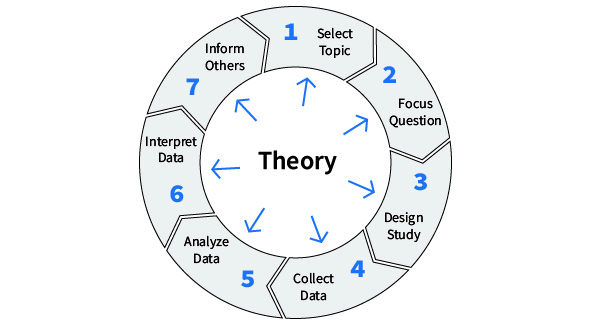
How and where does this process differ or resemble what you do as a media professional when producing a story, a podcast, a documentary, or other communication product for the general public? One key difference that might come to mind for you is the role that theory plays.
As you can see in this diagram, theory lies at the centre of the research process cycle. Just as researchers might examine the same topic from different levels of inquiry, media professionals could investigate the same topic from various theoretical perspectives. Although their research questions may be the same, the way they make sense of the phenomenon they are investigating will be shaped in large part by the theoretical assumptions underlying their approach.
Differentiating between Basic versus Applied Research Knowledge
Similar to the social sciences, effective communication involves uncovering truths in society and conveying them to the public in an organised manner. Research translation is crucial in shaping society, from highlighting issues in government policy to addressing social oppression and informing treatments for conditions like addiction or diabetes.
Storytelling and research translation rely on multiple quality research studies to lend credibility to narratives. However, not all research offers the same level of credibility. Understanding the distinction between basic and applied research is essential for research translation.
Basic research, driven by curiosity, expands our understanding of the natural world without immediate practical applications. It aims to advance knowledge, explore theoretical concepts, and contribute to scientific understanding, often involving theoretical exploration, experimentation, and observation.
Applied research focuses on solving specific problems or addressing practical issues using existing scientific knowledge. It aims to address real-world challenges, make improvements, or develop practical applications based on existing knowledge, often yielding more immediate and tangible outcomes.
In essence, basic research expands theoretical understanding, while applied research addresses practical challenges and creates useful applications. Both approaches are crucial for advancing science and improving our quality of life.
Let’s consider examples of basic and applied research within communication studies:
Basic Research Example:
Research Question: What underlying cognitive processes influence how people interpret ambiguous visual messages in advertising?
In a basic research study, communication researchers might investigate the cognitive mechanisms involved in interpreting ambiguous visual messages, contributing to theoretical understanding without direct practical applications.
Applied Research Example:
Research Question: How can social media campaigns be designed to effectively promote healthy eating habits among adolescents?
In an applied research study, communication researchers might design and implement a social media campaign to promote healthy eating habits, aiming to address real-world issues and provide actionable insights. It can often serve an external client.
In summary, as shown in Table 2:1 below, basic research explores theoretical aspects of communication processes, while applied research addresses practical challenges or develops strategies for specific communication goals, contributing to advancing the field and addressing real-world communication issues.
Table 2: 1
Key Differences Between Basic and Applied Research
|
Aspect |
Basic Research |
Applied Research |
|
Purpose |
To expand theoretical understanding |
To address practical challenges or solve problems |
|
Goal |
To contribute to knowledge and theory development |
To develop practical solutions or applications |
|
Motivation |
Driven by curiosity and desire for knowledge |
Driven by solving specific problems or needs often for a client |
|
Timing of Results |
May take longer to yield tangible outcomes |
Often yields more immediate and tangible results |
|
Approach |
Focuses on theoretical exploration |
Focuses on practical problem-solving often for a client |
|
Application |
Often lacks direct real-world applications |
Directly applicable to real-world situations |
|
Examples |
Studying fundamental principles of physics |
Developing a new vaccine or medical treatment |
|
|
Exploring underlying cognitive processes |
Designing a social media campaign for public health |
|
|
Investigating the origins of the universe |
Evaluating the effectiveness of a marketing strategy |
This table summarises the fundamental differences between basic and applied research in terms of purpose, goal, motivation, timing of results, approach, and examples.
Understanding the Difference Between Qualitative or Quantitative Research Approaches
Qualitative and quantitative research represent two distinct methodologies in the field of research, each characterised by its unique approaches and goals.
Qualitative research primarily focuses on understanding the complex nuances of human behaviour, experiences, and social phenomena. It delves into the underlying meanings and motivations that drive individuals or groups. This type of research often involves collecting non-numerical data, such as textual narratives, images, or observations. Researchers use methods such as interviews, focus groups, participant observation, and textual analysis to gather data. The analysis process in qualitative research is interpretive, identifying themes, patterns, and narratives within the data. Results are typically presented descriptively to capture the richness and depth of the studied phenomenon.
On the other hand, quantitative research seeks to quantify relationships, patterns, and trends by employing numerical data and statistical analysis. Its focus lies in objective measurements and the establishment of statistical relationships. This type of research often involves structured surveys, experiments, and content analysis. Statistical analysis plays a crucial role, as researchers utilise various statistical tests to identify correlations, differences, and patterns among variables. Quantitative research results are communicated through statistical tables, graphs, and charts, facilitating the presentation of trends, predictions, and statistical significance.
The choice between qualitative and quantitative research hinges on the research question, objectives, and the nature of the phenomena under investigation. Qualitative research is well-suited for exploring complex and context-dependent aspects of human behaviour and experience, providing in-depth insights into motivations and meanings. In contrast, quantitative research excels in quantifying relationships and generating objective, numerical data that can be statistically analysed to establish patterns and trends. Both methodologies contribute to advancing knowledge in their respective domains and are valuable tools in the research toolkit. Here is a quick summary of these differences.
Table 2: 2
Key Differences Between Qualitative and Quantitative Research
|
Aspect |
Qualitative Research |
Quantitative Research |
|
Focus |
Understanding human behaviour, experiences, and social phenomena |
Quantifying relationships, patterns, and trends using numerical data |
|
Data Collection |
Non-numerical data (e.g., textual narratives, images, observations) |
Numerical data (e.g., surveys, experiments, measurements) |
|
Methods |
Interviews, focus groups, participant observation, textual analysis |
Surveys, experiments, content analysis, standardised instruments |
|
Analysis |
Interpretive, identifying themes, patterns, and narratives |
Statistical, identifying correlations, differences, and patterns among variables |
|
Presentation of Results |
Descriptive, capturing the richness and depth of the studied phenomenon |
Statistical tables, graphs, and charts, presenting trends and statistical significance |
To illustrate, let’s take an example topic within communication studies: the influence of social media on body image.
For a qualitative research project, the question might be: “How do young adults perceive their body image as influenced by social media platforms?” Researchers would aim to explore the subjective experiences of young adults through in-depth interviews and focus groups, uncovering the multifaceted ways in which social media contributes to body image perceptions.
In contrast, for a quantitative research project on the same topic, researchers might ask: “What is the correlation between social media usage and adolescent body dissatisfaction?” They would administer a survey to a representative sample of adolescents to assess their social media habits and self-reported levels of body dissatisfaction. Statistical analyses would determine the strength and direction of the relationship between social media usage and body dissatisfaction.
Both the qualitative and quantitative research projects address the impact of social media on body image perception, but they do so in distinct ways. The qualitative project delves into nuanced experiences, providing depth and context, while the quantitative project focuses on establishing a statistical relationship, offering a quantitative assessment of the correlation.
It’s worth noting that qualitative and quantitative methods are complementary rather than competing; they have different goals, strengths, and weaknesses. We will explore both approaches in more depth in the chapters that follow.
Differentiating between Exploratory, Descriptive and Explanatory Research
In research, both qualitative and quantitative researchers undertake different types of inquiries. Exploratory research aims to explore new areas, descriptive research focuses on describing characteristics, and explanatory research seeks to understand causes and effects. Let’s dig a little deeper.
Exploratory research aims to explore new areas or phenomena where little is known or understood. It is often used when researchers are trying to gain insights into a problem or identify potential research questions. This type of research is typically qualitative and is not aimed at providing definitive answers, but rather at generating hypotheses or understanding complex phenomena.
An Example in Communication
Research Topic: The Impact of Social Media on Adolescents’ Mental Health
Conducting interviews or focus groups with adolescents to understand their experiences with social media and its effects on their mental well-being. The goal would be to explore the various ways in which social media use influences their emotions and behaviours. It could be qualitative or quantitative.
Descriptive research aims to describe characteristics of a population or phenomenon. It focuses on answering questions about who, what, when, where, and how, without necessarily explaining why something is happening. Descriptive research often involves collecting data through surveys, observations, or existing datasets and analysing it to identify patterns or trends. This type of research is typically qualitative.
An Example in Communication
Research Topic: Television Viewing Habits of College Students
Administering a survey to college students to gather information about their television viewing habits, including the types of programs they watch, the amount of time spent watching, and their preferred viewing platforms. The results would provide a snapshot of the television consumption patterns among this demographic.
Explanatory research seeks to identify the causes and effects of a phenomenon. It goes beyond describing what is happening to explain why it is happening. This type of research often involves hypothesis testing and statistical analysis to establish relationships between variables and understand underlying mechanisms.
An Example in Communication
Research Topic: The Influence of News Framing on Public Opinion
Conducting an experiment where participants are exposed to different news articles on the same topic but framed in different ways (e.g., positively or negatively). The researcher would then measure changes in participants’ attitudes or opinions to determine how the framing of news articles influences public perception.
In summary, when deciding between descriptive, exploratory, and explanatory research, it’s important to consider your research question. What does your question ask? Are you seeking to understand the fundamentals of a new area, define and describe an activity or concept, or establish a causal relationship?
Triangulation in Acquiring Research Knowledge
Up to this point, we have discussed research design as an either/or proposition. Either you will collect qualitative data or you will collect quantitative data. In truth, you don’t necessarily have to choose one approach over another. Some of the most highly regarded social scientific investigations combine approaches in an effort to gain the most complete understanding of their topic possible. Using a combination of multiple and different research strategies is called triangulation.
There are several types of triangulation, the key of which are outlined below.
Table 2: 3
Types of Triangulation
|
Triangulation Type |
Description |
Example |
|
Data Triangulation |
Using multiple sources of data to study a single research question. |
A researcher gathers data on a topic through interviews, surveys, and observations. |
|
Methodological Triangulation |
Employing multiple research methods to investigate the same phenomenon. |
Combining qualitative and quantitative methods within the same study. |
|
Theoretical Triangulation |
Drawing on multiple theories or perspectives to analyse and interpret data, providing a richer understanding of the phenomenon. |
A researcher uses different theoretical frameworks to analyse data collected from interviews, surveys, and observations. |
|
Investigator Triangulation |
Involving multiple researchers to collect, analyse, and interpret data, bringing diverse perspectives and biases for a more balanced analysis. |
A research team consists of researchers with different backgrounds and expertise working together on a project. |
|
Time Triangulation |
Studying the same phenomenon at different points in time to understand how it changes or remains constant over time. |
A longitudinal study tracks the development of a behaviour or trend over several years to observe changes and patterns. |
The benefits of research triangulation include reducing bias, increasing reliability, and enhancing the validity of research findings. By approaching a research question from different angles, researchers can identify patterns, discrepancies, and areas of convergence, leading to a more robust and nuanced understanding of the topic.
Triangulation also requires careful planning and consideration, as it can be time-consuming and resource-intensive. Researchers must ensure that the different methods, data sources, or perspectives chosen for triangulation are relevant to the research question and effectively complement each other.
Reflection Question
How do the distinctions between qualitative and quantitative research impact the studies favoured by media professionals for knowledge translation to the public? Is there a societal preference for numerical data over rich, descriptive research, and for practical solutions over curiosity-driven inquiries among media professionals? How might this preference impact the stories they choose to tell? Document your thoughts in a 200-300 word post.
Key Chapter Takeaways
- There are several different ways that we know what we know but research methods are a much more reliable source of knowledge than most of our other ways of knowing.
- Theory lies at the centre of the research process cycle. Just as researchers might examine the same topic from different levels of inquiry, so, too, could they investigate the same topic from different theoretical perspectives.
- Basic research seeks to expand knowledge and understanding for its own sake, while applied research aims to use that knowledge to address practical challenges and create tangible benefits.
- While qualitative research delves deep into the qualitative aspects of human experiences, capturing the richness and complexity of individual stories, quantitative research focuses on quantifiable patterns and statistical relationships within larger datasets.
- Exploratory research is conducted at the beginning of an investigation to understand the topic generally. Descriptive research aims to describe or define the topic, while explanatory research seeks to explain why particular phenomena work the way they do.
- Triangulation allows researchers to take advantage of the strengths of various methods and at the same time work to overcome some of each method’s weaknesses.
Key Terms
Informal observation: An experiential perception lacking a structured assessment process, and therefore not inherently dependable as a representation of truth.
Selective observation: The act of recognizing desired patterns while disregarding other aspects, leading to presumptions of universality based on limited exposure.
Overgeneralization: The assumption of broad patterns from a narrow range of observations.
Authority: A recognized source of knowledge within a society that can influence our beliefs regarding truths.
Research methods: a systematic process of inquiry applied to learn something about our social world.
Research translation: Refers to the process of taking scientific findings, discoveries, and knowledge generated through research and effectively translating them into practical applications, policies,
or interventions that benefit society, industries, or specific communities.
Basic research: Scientific exploration driven by intrinsic curiosity, where researchers investigate subjects of personal interest.
Applied research: Scientific investigation pursued for purposes beyond or supplementary to a researcher’s personal curiosity, often with a focus on practical applications.
Theory: A structured framework of educated conjectures about the functioning of phenomena.
Qualitative methods: Approaches for data collection that yield descriptive outcomes, such as textual or visual information, frequently involving activities like focus groups or interviews.
Quantitative methods: Data collection methods that can be expressed and condensed into numerical forms, frequently involving surveys and statistical figures.
Exploratory Research: Conducted at the outset of an investigation to gain a general understanding of a topic, often used to generate hypotheses or identify research questions.
Descriptive Research: Aims to describe or define a topic, focusing on answering questions about who, what, when, where, and how without necessarily explaining why.
Explanatory Research: Seeks to explain why particular phenomena occur in the way they do, aiming to establish causal relationships and understand underlying mechanisms.
Triangulation: Employing a blend of diverse research techniques to enhance the robustness validity and reliability.
Further Reading and Resources
Neuman, W. L. (2007). Basics of social research. https://scholar.google.ca/scholar_url?url=https://www.academia.edu/download/53066428/Basics_of_Social_Research_Neuman.pdf&hl=en&sa=X&ei=yWt7ZryTHqyXy9YP3bmtyAE&scisig=AFWwaebGRiAIrnCG_L4fz8EfCxiY&oi=scholarr
SA (2011, May 31). Qualitative VS quantitative research [Video]. Youtube. https://www.youtube.com/watch?v=ddx9PshVWXI
USU Libraries. (2018, Jan 18). Empirical Studies: Qualitative vs. quantitative [Video]. Youtube. https://www.youtube.com/watch?v=RZcfmA1l6cE