
6.3 Diversity
DIVERSITY
INTRODUCTION
Canada is a country brimming with a rich mix of cultures, languages, and religions. In the early 20th century, an influx of immigrants from Europe brought fresh cultural perspectives to Canada. Immigration remains robust today, but with a vast difference in culture, language, and religion. Approximately 80% of new immigrants are arriving from non-European countries, where the majority aren’t of Caucasian descent. On average, these newcomers are younger than most Canadians and have neither English nor French as their first language (RNAO, 2007, p. 19) It’s crucial for our healthcare system to adapt and evolve to meet the needs of these new members of the Canadian community.
Multiculturalism in Canada
Media 6.5. The Canadian Culture and Traditions [Online video]. Copyright 2018 by Farid Haq
Canada stands proud as a multicultural nation where a diverse array of cultures coexists, each retaining its unique identity. This entails not only acknowledging but also respecting and embracing the differences among cultures (Potter, P., Perry, A., et al., 2019).
Canada has implemented policies that actively promote and prioritize multiculturalism. These policies have empowered multiple cultures to integrate into Canadian society armed with rights and freedoms, with the hopes of eliminating ethnocultural discrimination.
In 1971, the Canadian government introduced the Multiculturalism Policy. Its key objectives were these:
- to assist cultural groups to retain and foster their identity;
- to assist cultural groups to overcome barriers to their full participation in Canadian society (thus, the multiculturalism policy advocated the full involvement and equal participation of ethnic minorities in mainstream institutions, without denying them the right to identify with select elements of their cultural past if they so chose);
- to promote creative exchanges among all Canadian cultural groups; and
- to assist immigrants in acquiring at least one of the two official languages (Brosseau, L., & Dewing, M., 2018, p. 7)
This policy was intended to facilitate ways for cultural minority groups to integrate and participate in Canadian society as equal members by eliminating racial barriers.
The multicultural heritage of Canadians was further recognized in 1982 with the adoption of the Canadian Charter of Rights and Freedoms in the Constitution. The Charter promoted fairness to all Canadians regardless of race or ethnicity. It states:
Every individual is equal before and under the law and has the right to the equal protection and equal benefit of the law without discrimination and, in particular, without discrimination based on race, national or ethnic origin, colour, religion, sex, age or mental or physical disability (Brosseau, L., & Dewing, M., 2018. pg. 8)
To further illustrate Canada’s commitment to multiculturalism, the Canadian Multiculturalism Act was adopted by Parliament in 1988. Canada was a leader in developing the first multicultural law in the world. The act recognized multiculturalism as a fundamental part of Canada’s national identity with the intent of preserving and enhancing multiculturalism and reducing discrimination through cultural sensitivity and acceptance. (Brosseau, L., & Dewing, M., 2018)
Working in healthcare settings, you’ll find yourself interacting with clients from various cultural backgrounds. It’s crucial to take on the responsibility of being open-minded and accepting of their cultural differences, attitudes, and perspectives.
ETHNICITY AND CULTURE
When working in healthcare anywhere in Canada you will encounter people of many ethnic origins and different cultures. Ethnicity refers to the sharing of a common history, language, geography, national origin, religion, or identity (Wilk, M., 2022). Examples of ethnic groups include the Italian, the Cree, and the Nigerian. According to the 2021 Canadian Census 450 ethnic groups were self-reported living in Canada (Statistics Canada, 2021. ) This rich tapestry of ethnicities is something Canadians can take pride in, recognizing that ethnicity is just one facet of culture.
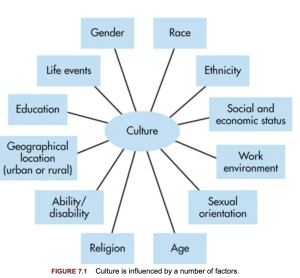
Culture is defined as “a pattern of shared attitudes, beliefs, self-definitions, norms, roles, and values that can occur among those who speak a particular language or live in a defined geographical region” (Giddens, J. p 29). When working in healthcare, we acknowledge people’s ethnicity, and look beyond that to understand ‘who they are’. Our focus is on setting aside any biases, judgments, or discrimination and instead concentrating on their unique cultural attributes. When encountering individuals with different ethnic backgrounds, it’s crucial to be aware of the various factors influencing their culture.
People may have been raised in one culture but exposed to many others throughout their lives. They might belong to several groups (e.g. family, school, work, and sports) each maintaining a culture of its own. Every interaction with others shapes who they are and who they become.
For instance, consider a family that immigrated from Ukraine to Canada. While they may speak Ukrainian at home and follow Ukrainian customs and values, spending time in Canada exposes each family member to different religions, languages, customs, and cultures from the diverse people around them. Consequently, their culture evolves and changes from when they first arrived in Canada.
As individuals assimilate different cultures into their lives, in addition to their own, it’s essential to understand that everyone’s experiences are unique and play a significant role in shaping who they become; therefore, we can never assume that all people of an ethnic group share the same culture customs and norms. It is our responsibility to listen to who they say they are, what they believe in, and what they need from us. “You cannot apply the cultural behaviours of a given culture to all members of the group. Individuals may not follow every belief and practice of their culture and religion. Each person is unique.” (Wilk, M., 2022, p. 108 )
Table 6.1 Culture is influenced by many factors. We need to consider this when caring for others (Wilk, M.,& Skehon, N., 2022, p. 99).
CULTURAL COMPETENCE AND CULTURAL SAFETY
While it’s nearly impossible to be familiar with every culture, it’s our duty in healthcare to actively expose ourselves to different cultures and aspire to learn from them. Cultural competence is “ the ability of a person to interact effectively with people from diverse cultural, gender, or socioeconomic backgrounds”(Wilk, M., 2022, p. 101). We can enhance our understanding of patients by acquiring knowledge from written resources like journals and novels, participating in ethnic festivities, and engaging in conversations with individuals from various cultures. This process enables us to overcome biases and judgments, fostering meaningful and open interactions while appreciating cultural differences.
Recognizing that many cultural groups we encounter have shared experiences of social injustices allows us to gain insight into their human experiences. Social justice can be defined as “fair treatment regardless of one’s economic status, race, ethnicity, age, citizenship, disability, or sexual orientation” (Habibzadeh, H., et al, 2021, p. 2 ). Unfortunately, we have seen many instances of social injustice where healthcare services are not distributed equally among all people. For example, “Indigenous individuals, families, communities, and nations experiencing inequities in the social determinants of health are more likely to carry an additional burden of ill health as well as be restricted from access to resources that might ameliorate these concerns.” (Loppie, C., 2022, p. 11) Understanding social justice and providing respectful and equal care to all patients contributes to creating healthcare environments where clients feel comfortable sharing their personal journeys (Giddens, J).
Becoming aware of our own cultural identity and mediating how we perceive different cultures sets the stage for delivering effective, culturally competent care. By recognizing the variations in how clients respond and being sensitive and accepting of their diverse views, we open the door to building trusting relationships. It’s crucial to reflect on our own culture, beliefs, and values and understand how they shape our behaviour. Acknowledging that each person’s culture and experiences impact how they approach healthcare allows us to be open and flexible in our approaches. By setting aside our own beliefs and values and listening to our client’s personal definitions of health, we can fully engage in their experiences and collaboratively establish mutually agreed-upon goals of care.
Cultural safety is “ actively inviting and creating a space for cultural expression within health care.” It involves including clients in their care by asking them if they have specific preferences or customs they would like to observe” (Wilk, M., p. 101). For example, in Denmark, when a person nears death, a window is opened to allow the person’s ‘soul’ to pass through once they die ( Harris, T., n.d.). By acknowledging and incorporating cultural traditions into care, we are respecting and appreciating cultural expression. In addition, cultural safety incorporates healthcare workers addressing healthcare inequities and supporting the health of minority groups. (Stanhope, M., Lancaster, J, et al. p. 191) This approach promotes the well-being of vulnerable populations, allowing them to define their own healthcare and receive appropriate care.
References
Introduction
Brosseau, L., & Dewing, M. (2018). Canadian multiculturalism background paper. Library of Parliament. https://lop.parl.ca/sites/PublicWebsite/default/en_CA/ResearchPublications/200920E
Potter, P., Perry, A., Stockert, P., Hall, A., Astle, B., & Duggleby, W. (2019). Canadian Fundamentals of Nursing. In B. Astle, S. Barton, L. Johnson, J. Mills (Eds.), Global Health. Elsevier Canada.
Registered Nurses’ Association of Ontario (2007). Embracing cultural diversity in health care: Developing cultural competence. https://rnao.ca/sites/rnao-ca/files/Embracing_Cultural_Diversity_in_Health_Care_-_Developing_Cultural_Competence.pdf
Ethnicity and Culture
Giddens, J. (2017). Concepts for nursing practice (2nd ed.). In S. Caplan (Ed.), Culture (pp. 29-38). Elsevier Inc.
Statistics Canada. (2024). Census of population. https://www12.statcan.gc.ca/census-recensement/index-eng.cfm
Wilk, M. (2022). Sorrentino’s Canadian textbook for the support worker (5th ed.). Elsevier.
Cultural Competence and Cultural Safety
Giddens, J. (2017). Concepts for nursing practice (2nd ed.). In S. Caplan, Culture (pp. 29-38). Elsevier Inc.
Habibzadeh, H., Madineh, J., & Hosseinzadegan, F. (2019). Social justice in health system: A neglected component of academic nursing education: A qualitative study. BMC Nursing, 16(20).
https://bmcnurs.biomedcentral.com/articles/10.1186/s12912-021-00534-1
Harris, T. (n.d.). An open window for the soul after death. Guideposts. http://Guideposts https://guideposts.org/positive-living/health-and-wellness/life-advice/coping-with-grief/an-open-window-for-the-soul-after-death/
Loppie, C., & Wien, F. (2022). Understanding Indigenous health inequalities through social determinants model. National Collaborating Center for Indigenous Health. https://www.nccih.ca/Publications/Lists/Publications/Attachments/10373/Health_Inequalities_EN_Web_2022-04-26.pdf
Stanholpe, M., Lancaster, J., Jakubec, S., & Pike-MacDonald, S. (2017). Community health nursing in Canada. In L. Bourque Bearskin & S., Jakubec, Diversity and Relational Practice in Community Nursing (pp. 173-207). Elsevier Canada.
Wilk, M. (2022). Sorrentino’s Canadian textbook for the support worker (5th ed.). Elsevier.
Videos
The Canadian Culture and Traditions [Online video]. Copyright 2018 by Farid Haq.
Images
Wilk, M. (2022). Sorrentino’s Canadian textbook for the support worker (5th ed.). Elsevier.