
Flavocetraria & Foveolaria
Flavocetraria (Bellardi) Kärnefelt & A. Thell, 1994 & Foveolaria (L.) Chesnokov, Prokopiev, Konoreva & Davydov, 2023
| Common name | Snow Lichens |
 |
|---|---|---|
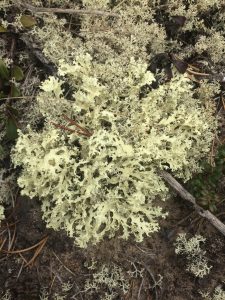
| Field Characters | Leafy, yellow chlorolichens that resembles fruticose lichens. Thalli of erect narrow lobes with ruffled margins, sparsely branching. Fovoelaria is wrinkled while Flavocetraria is inrolled, to 8 cm tall. Upper and lower cortices pale yellow, with marginal pycnidia. Pseudocyphellae punctiform on the lower cortex. Apothecia rare, terminal, with brown discs. Lacking soredia or isidia. Flavocetraria lobes have a purplish base, with Fovoelaria lobes have an orange base. | |
| Similar species & genera |
None provincially. Similarly shaped, co-occurring species are different colors. Cetraria species are brown. Vulpicida tilesii is bright yellow. | |
| Ecology | Terricolous, on soil or moss, often mixed with other lichens. Occasional across all forested, subalpine and alpine regions in Alberta, rare in the parkland, absent from the grassland. | |
| Chemistry | Cortices C–, K–, KC+ yellow, PD– (usnic acid, ± isousnic acid. Flavocetraria: medulla C–, K–, KC–, PD–, UV- (±gryrophoric acid, ± aliphatic acids such as protolichesterinic acid, lichesterinic acid, and alloprotolichesterinic acid detectable by TLC), with purple anthraquinones in the senescing, lower thallus. Foveolaria: medulla C–, K–, KC–, PD–, UV- or UV+ blue-white (±squamatic acid). | |
| Molecular support |
Strong for both genera. As originally conceived, the genus Flavocetraria was shown to be polyphyletic in multiple studies. Chesnokov et al. (2023) formally described new genera to resolve this, including Foveolaria. Both genera are currently monotypic, and fall within the “Nephromopsis” clade, while the third species previously included in Flavocetraria (F. minuscula) was moved to the newly described genus Cladocetraria, in the “Cetraria” clade. | |
| Links |
Species recorded in Alberta: 2
- Flavocetraria cucullata ((Bellardi) Kärnefelt & A. Thell Syns.: Nephromopsis cucullata, Allocetraria cucullata, Cetraria cucullata
- Foveolaria nivalis (L.) Chesnokov, Prokopiev, Konoreva & Davydov Syn.: Allocetraria nivalis, Cetraria nivalis, Flavocetraria nivalis, Nephromopsis nivalis.
DICHOTOMOUS KEY
1a. Thallus straw yellow, leathery, not brittle, medulla white, on acid soil……2
1b. Thallus golden yellow, brittle or leathery, medulla yellow, on twigs or calcareous soil…..See Vulpicida
2a. Lobes cucullate (curled, inrolled), smooth, base of lobes purplish…..Flavocetraria cucullata
2b. Lobes flattened, wrinkled and reticulate, base of lobes orangish….. Foveolaria nivalis
Resources
Brodo, I. M. 2016. Keys to the lichens of North America. Revised and Expanded. Yale University Press, in collaboration with the Canadian Museum of Nature.
Brodo, I. M., S. D. Sharnoff, and S. Sharnoff. 2001. Lichens of North America. Yale University Press, New Haven and London.
Chesnokov, S. V., E. A. Davydov, L. A. Konoreva, I. A. Prokopiev, L. N. Poryadina, E. V. Zheludeva & A. L. Shavarda. 2023. The monotypic genus Flavocetraria and two new genera: Cladocetraria and Foveolaria, in the cetrarioid core. Plant Systematics & Evolution 309: https://doi.org/10.1007/s00606-023-01862-2
Goward, T., B. McCune, and D. Meidinger. 1994. The Lichens of British Columbia Illustrated Keys. Part 1 – Foliose and Squamulose Species. Ministry of Forests Research Program, Province of British Columbia.
McMullin, R. T. 2023. Lichens. The macrolichens of Ontario and the Great Lakes Region of the United States. Firefly Books, Richmond Hill, Ontario.