
Candelaria
Candelaria A. Massal., 1852
| Common name | Candleflame Lichens |
 |
|---|---|---|
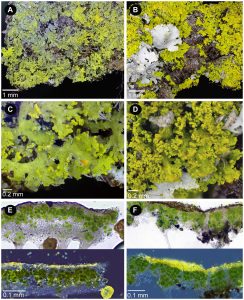
| Field Characters | Minute leafy, yellow chlorolichens. Thalli appressed to ascending, varying from well-formed rosettes to loose aggregations of dissolving lobes. Lobes minute, typically less than 0.5 mm across, branching dichotomously, sometimes dissolving . Upper cortex bright yellow, matte, lacking pruina or pseudocyphellae. Lower cortex either white and well-developed with abundant, well-formed, simple rhizines, or poorly formed to lacking with hapters. Sorediate/blastidiate, with granular soredia or blastidia along margins. Apothecia rare in species present in Alberta. | |
| Similar species & genera |
Polycauliona: orange, cortex K+ purple. | |
| Ecology | Epiphytic and on downed wood. Most common in the central boreal region, but occasional across all Alberta natural regions. | |
| Chemistry | Upper cortex K- (or K+ deeper yellow), C-, KC-, P-. Medulla K-, C-, KC-, P- (calycin, pulvinic dilactone). | |
| Molecular support |
||
| Links |
Species recorded in Alberta: 2
- C. concolor (Dickson) Stein (ACIMS)
- C. pacifica M. Westb. & Arup (Westberg & Arup 2011) (ABMI)
DICHOTOMOUS KEY
1a. Lobes branching, typically ascending with granular ‘buds’ (blastidia) at tips; lacking a lower cortex and well developed rhizines; 8 spores/ascus; common in Alberta…..Candelaria pacifica
1b. Lobes branching, typically appressed with blastidia/soredia at tips; lower cortex white, well developed, with easily-observed rhizines; >8 (to 100?) spores per ascus; in Alberta relatively rare, to date found sporadically in urban and eastern regions…..Candelaria concolor
Resources
Stapper, N. J. 2012. Illustrierte Bestimmungshilfe zur Unterscheidung von Candelaria concolor und Candelaria pacifica. Archive for Lichenology 7: 1–12.
Westberg, M. & U. Arup. 2011. Candelaria pacifica sp. nova (Ascomycota, Candelariales) and the identity of Candelaria vulgaris. – In S.T. Bates, F. Bungartz, R. Lücking, M.A. Herrera-Campos & A. Zambrano (eds), Bibliotheca Lichenologica 106. Biomonitoring, ecology, and systematics of lichens. Recognizing the lichenological legacy of Thomas H. Nash III on his 65th birthday. Volume 106, E. Schweizerbart Science Publishers: 353–364.
Westberg, M., U. Arup & I. Kӓrnefelt. 2007. Phylogenetic studies in the Candelariaceae (lichenized Ascomycota) based on nuclear ITS DNA sequence data. Mycological Research 111: 1277–1284.
Westberg, M., C. A. Morse & M. Wedin. 2011. Two new species of Candelariella and a key to the Candelariales (lichenized Ascomycetes) in North America. The Bryologist 114: 325–334.
Westberg, M. & T. H. Nash III. 2002. Candelaria. – In T.H. Nash III, B.D. Ryan, C. Gries and F. Bungartz (eds), Lichen Flora of the Greater Sonoran Desert Region Volume 1: 116–118.