
Usnea
Usnea Dill. ex Adans., 1763
| Common name | Beard Lichens |
 |
|---|---|---|
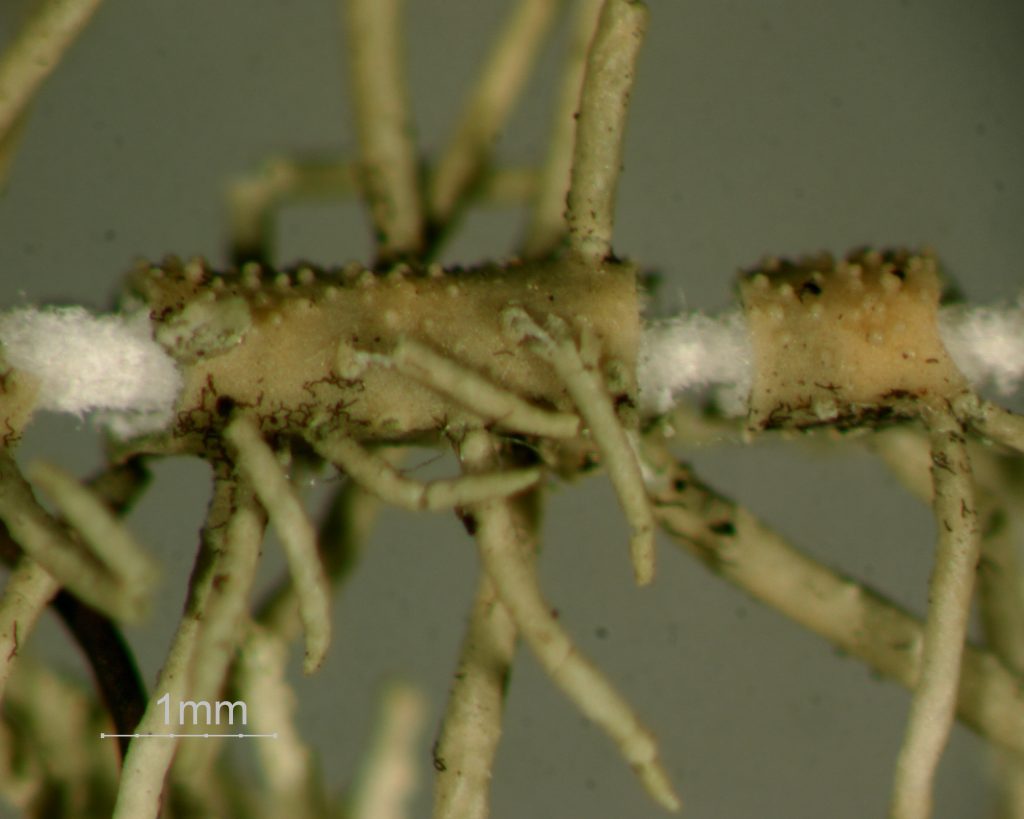
| Field Characters | Fruticose, hair-like chlorolichens. Pale yellow thalli branch extensively, and form either shrubby, erect and tufted or long, pendant colonies. Either attaching with a single holdfast or in some species, no attachments are found and the thalli drape over the substrate. In Alberta sorediate and isidiate species are common, with apothecia rarely found. Elsewhere apotheciate species may be common. Cortex compact, dull to shiny, may have raised bumps called papillae. Medulla cottony, varies from loose to dense and compact. A central, elastic, cartilaginous cord is a defining feature of the genus. Isidia either arise from punctiform soralia (minute holes in the cortex) or can develop alongside soredia in well-delimited soralia that span at least half the width of the branch. Apothecia when present are lecanorine, with spines projecting from the margin. Often parasitized by lichenicolous fungi and other chlorolichens, giving the branches a scruffy appearance. | |
| Similar genera |
Alectoria: lacks a cartilaginous central cord, cortex dull with raised pseudcyphellae.
Ramalina: lacks a cartilaginous central cord, cortex appearing combed or striate. |
|
| Ecology | Largely epiphytic or on downed wood, reaching highest abundance and biomass in forests with good air quality, high humidity and high light. Omnipresent in forested regions of Alberta. Much rarer in parklands and grassland tree copses. Rare and often compact or malformed in urban settings (Haughland et al. 2022). | |
| Chemistry | Cortex PD-, UV-, K- or K+ pale Y, KC+ oily yellow (usnic acid, but spot tests may be negative if the concentration is low). Medullary chemistry varies. | |
| Molecular support |
High as a monophyletic genus. Species continue to be lumped or split, and the taxonomy we have adopted to date requires molecular verification. | |
| Links |
Species recorded in Alberta: 9? Maybe more. Easy to get to genus, unfortunately difficult to discriminate the species. Most authors lump U. lapponica and U. substerilis under U. perplexans; we have resisted lumping these morphotypes/species pending molecular work, as there are many other soredioisidiate, shrubby Usnea that may be under our U. substerilis ‘umbrella’.
- U. cavernosa Tuck.
- U. cf. cornuta Körb.
- U. dasopoga (Ach.) Nyl. (Arcadia 2013)
- U. glabrata (Ach.) Vainio
- U. glabrescens (Nyl. ex Vainio) Vainio
- U. hirta (L.) Weber ex F. H. Wigg.
- U. lapponica Vainio
- U. scabrata Nyl.
- U. subfloridana Stirton
- U. substerilis Motyka
RENR Students: Know U. hirta and U. scabrata – be able to key them out or recognize them (also covered in Brodo et al. 2001 and Goward 1999).
Click here for a pdf key to the Usnea of Alberta v2025
Gallery
-
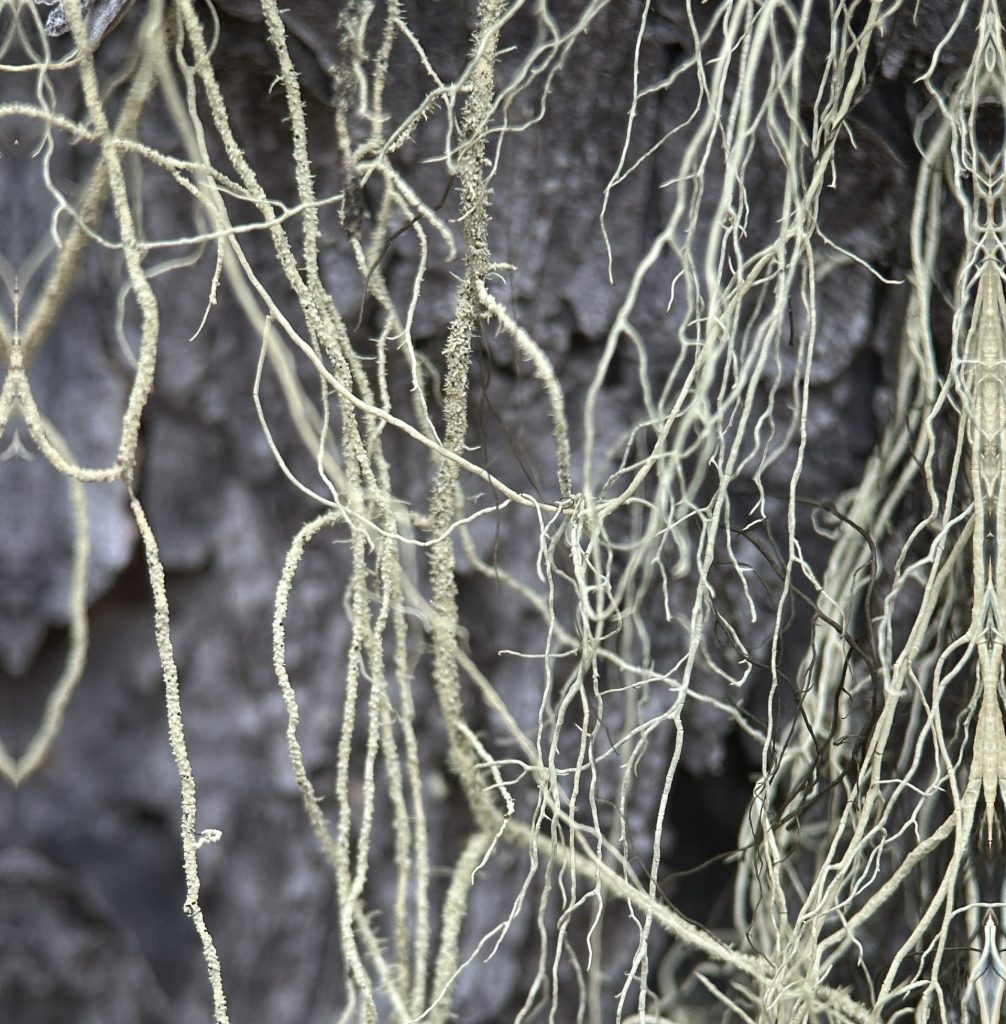
- Usnea scabrata thallus, near Lac La Biche, AB
-
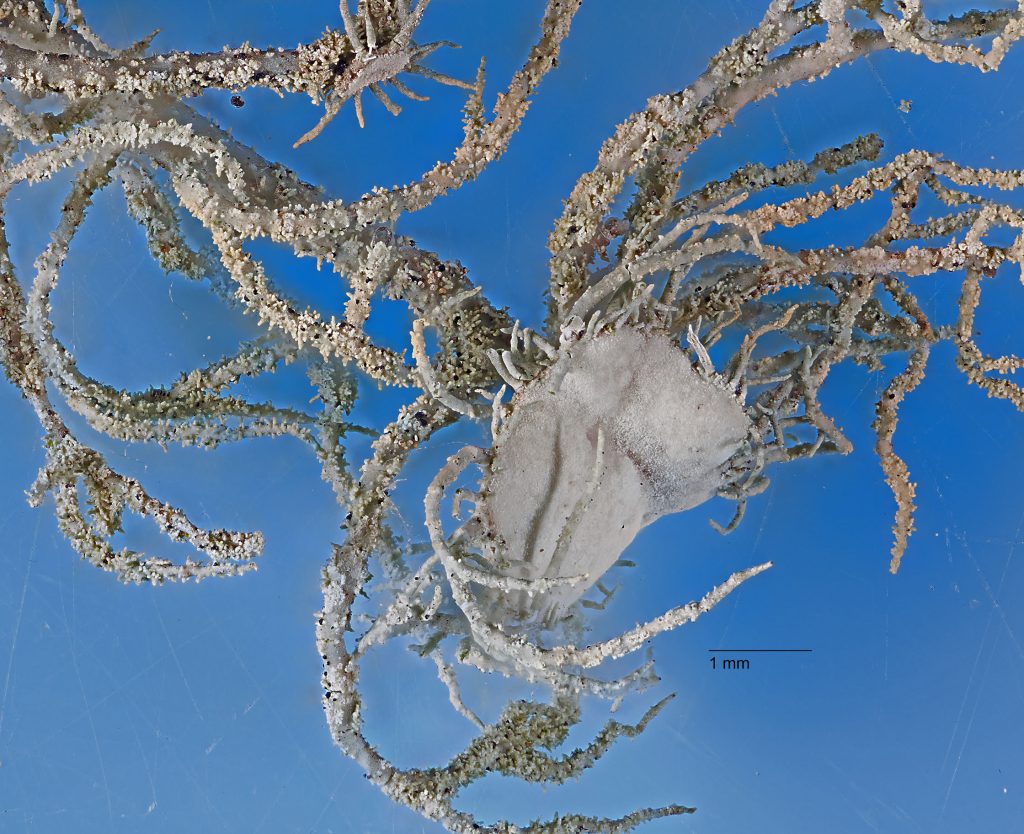
- Usnea hirta apothecium, ABMI collection
-
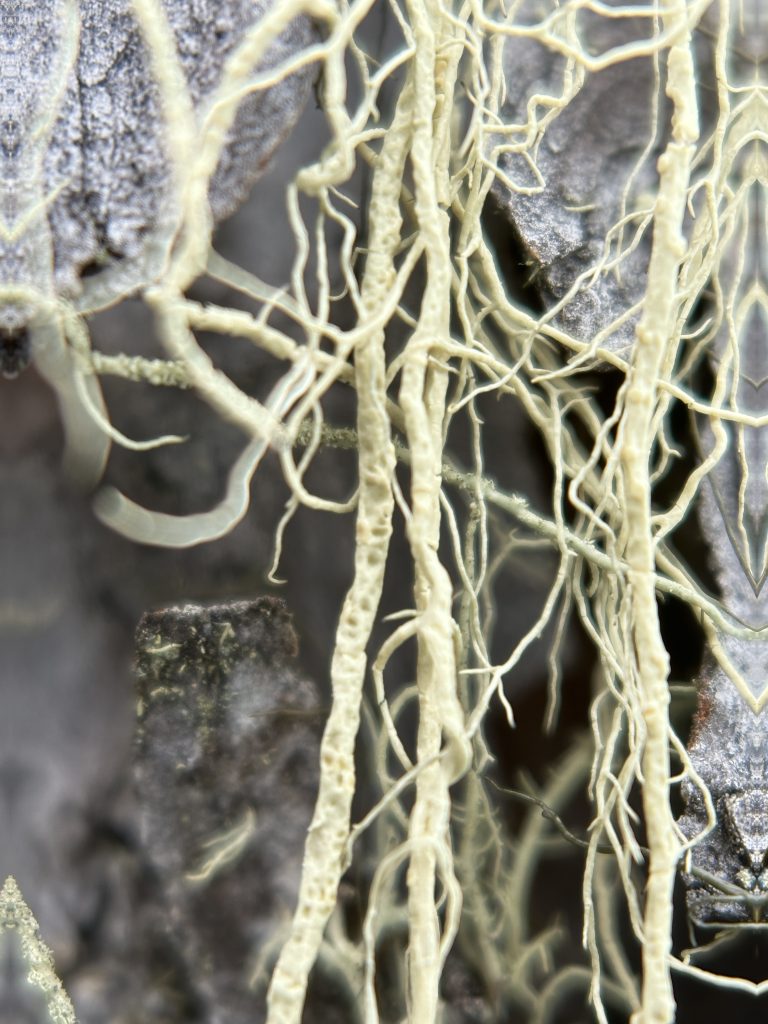
- Usnea cavernosa branches with foveoles, near Lac la Biche, AB
Resources
Clerc, P. 2011. Usnea. – in A. Thell and R. Moberg (eds), Nordic Lichen Flora 4: 107-127.
Halonen, P., P. Clerc, T. Goward, I. M. Brodo & K. Wulff. 1998. Synopsis of the genus Usnea (Lichenized ascomycetes) in British Columbia, Canada. The Bryologist 101:36-60.
McCune, B. & L. Geiser. 2009. Macrolichens of the Pacific Northwest. 2nd edition. Oregon State University Press, Corvallis, OR, USA