
Bryoria
Bryoria Brodo & D. Hawksw., 1977
| Common name | Horsehair Lichens |
 |
|---|---|---|
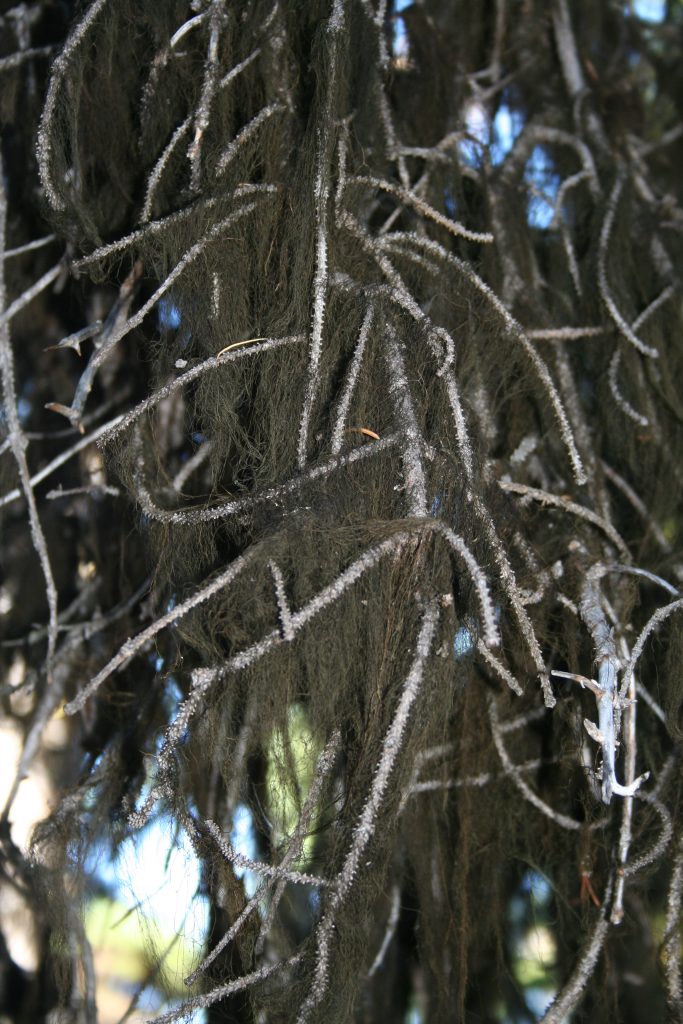
| Field Characters | Fruticose, hair-like chlorolichens. Most species are brown, a few are pale grey to cream, and one has yellow pigments in the soralia. Branches thin, varying from springy to fragile, branching extensively. Thalli short and tufted to long and pendant. Most species in Alberta are sorediate or isidiate, rarely fertile. | |
| Similar species |
Alectoria: has angular branches, tougher texture, less friable and prone to breakage when handling.
Usnea: has an elastic central cord. |
|
| Ecology | Epiphytic, mainly on conifers in boreal, foothills, and mountain regions, occasionally on the ground in alpine/tundra environments. Bryoria is found in every forested region of Alberta. In the mountains it is an important winter food for caribou. | |
| Chemistry | Variable. Some species have fumarprotocetraric acid (B. fuscescens, B. furcellata), some lack metabolites (B. simplicior), and others have diverse depsidones (B. pseudofuscescens varieties). | |
| Molecular support |
||
| Links |
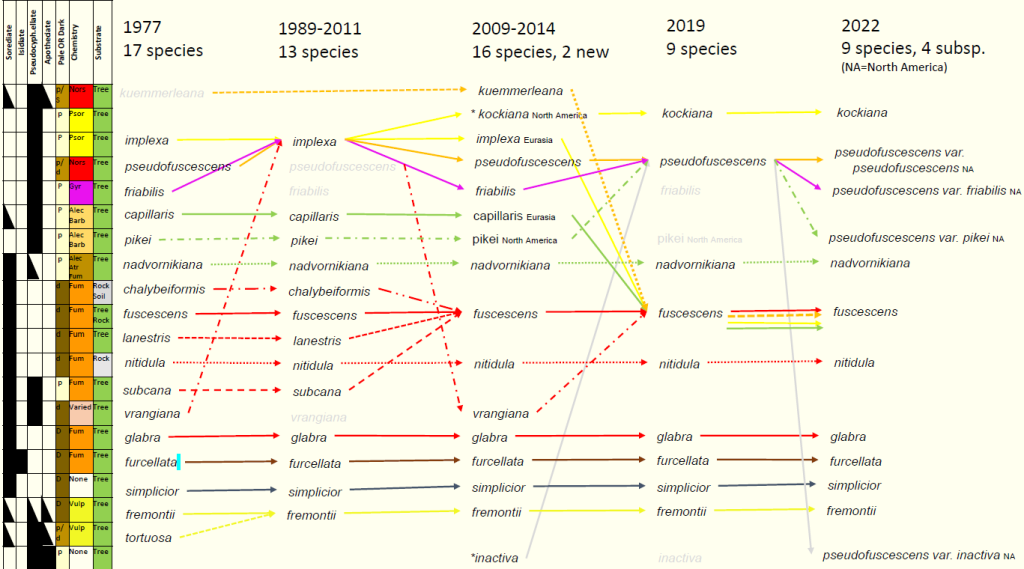
Reconciling molecular data and the historical taxonomy of Bryoria has been messy. Sympatric species previously discriminated based on chemistry and color were found to be genetically similar. Conversely, samples from different continents that appeared similar morphologically and chemically were genetically distinct. Only five species survived unscathed, their taxonomy consistent since the monumental treatment of Brodo and Hawkesworth (1977): B. furcellata, B. nadvornikiana, B. nitidula, and B. simplicior.
Below is an attempt to trace the fate of the species present in Alberta, from their description in Brodo and Hawkesworth’s monograph to present day. Grey text indicates names that were synonymized at a one time, only to be resurrected (sometimes as a variety, and sometimes only for a short time) later on. The columns on the left provide a brief summary of key traits, with black squares indicating a trait is present, and black triangles indicating it is present sometimes. Dominant metabolites are summarized in the chemistry column and are colored mainly by their reaction to PD, except in the case of vulpinic acid which is colored by the hue it imparts to the medulla. Abbreviations: alec/barb=alectorialic & barbatolic acids, fum=fumarprotocetraric acid, gyr=gyrophoric acid, none=no metabolites detected, nors=norstictic acid, psor=psoromic acid, vulp=vulpinic acid.
In our provincial biodiversity monitoring program (ABMI), we continue to track varieties that can be separated by chemistry. Why? It appears those varieties occupy different niches, some occurring in moister, older forests with less disturbance. For other species, we sometimes are obligated to lump them. Given the difficulty in distinguishing chemically- and morphologically-similar B. fuscescens from B. glabra, those two species are currently lumped, even though they likely have different niches. Molecular work is needed to test our species discrimination.
Species recorded in Alberta: 9 species and 3 subspecies
- B. fremontii (Tuck.) Brodo & D. Hawksw. Syns.: Bryoria tortuosa, Alectoria fremontii, A. corneliae, A. tenerrima (ACIMS, RAM)
- B. furcellata (Fr.) Brodo & D. Hawksw. Syns.: Alectoria nidulifera, Cornicularia fibrillosa
- B. fuscescens (Gyelnik) Brodo & D. Hawksw. Syns.: Alectoria fuscescens, A. positiva, Bryopogon pacificus, vrangiana (Gyelnik) Brodo & D. Hawksw. (Velmala et al. 2014) (ACIMS, RAM)
- B. glabra (Motyka) Brodo & D. Hawksw. Syn.: Alectoria glabra (AB; NA/UBC, RAM, ACIMS)
- B. kockiana Velmala, Myllys & Goward (Velmala et al. 2014) Syn. Bryoria implexa in North Ameria
- B. nadvornikiana (Gyelnik) Brodo & D. Hawksw. Syns.: Alectoria nadvornikiana, A. altaica (ACIMS)
- B. nitidula (Th. Fr.) Brodo & D. Hawksw. Syns.: Alectoria nitidula, A. irvingii, A. lanea auct. (ACIMS)
- B. pseudofuscescens var. friabilis Brodo & D. Hawksw.
- B. pseudofuscescens var. pseudofuscescens(Gyelnik) Brodo & D. Hawksw. Syns.: Alectoria achariana, A. norstictica nom. nudum, A. subtilis nom.nudum (ACIMS)
- B. pseudofuscescens var. pikei Brodo & D. Hawksw. Syn: pikei Brodo & D. Hawksw. Syns.: Alectoria cana, North American reports of Bryoria capillaris & A. setacea
- B. simplicior (Vainio) Brodo & D. Hawksw. Syns.: Alectoria simplicior, A. nana nom. nudum (ACIMS)
Click for pdf Key to Bryoria, Bryocaulon & Nodobryoria of Alberta v.2025
RENR Students: Know Bryoria furcellata – be able to key this species out or recognize it (it is also covered in Brodo et al. 2001 and Goward 1999).
Gallery
-
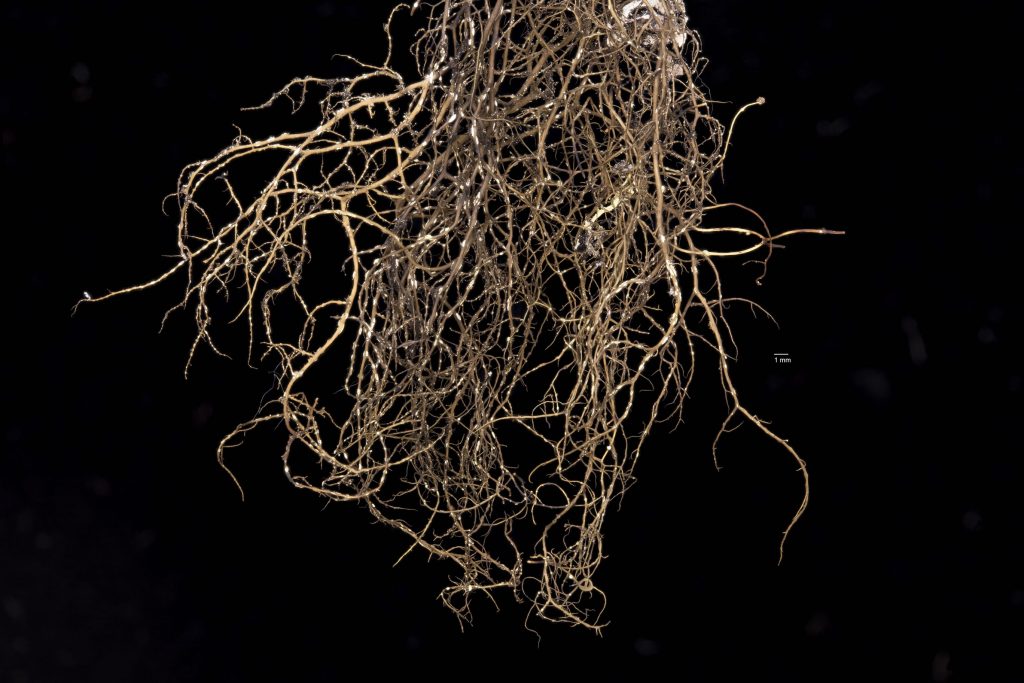
- Bryoria furcellata, ABMI specimen
-
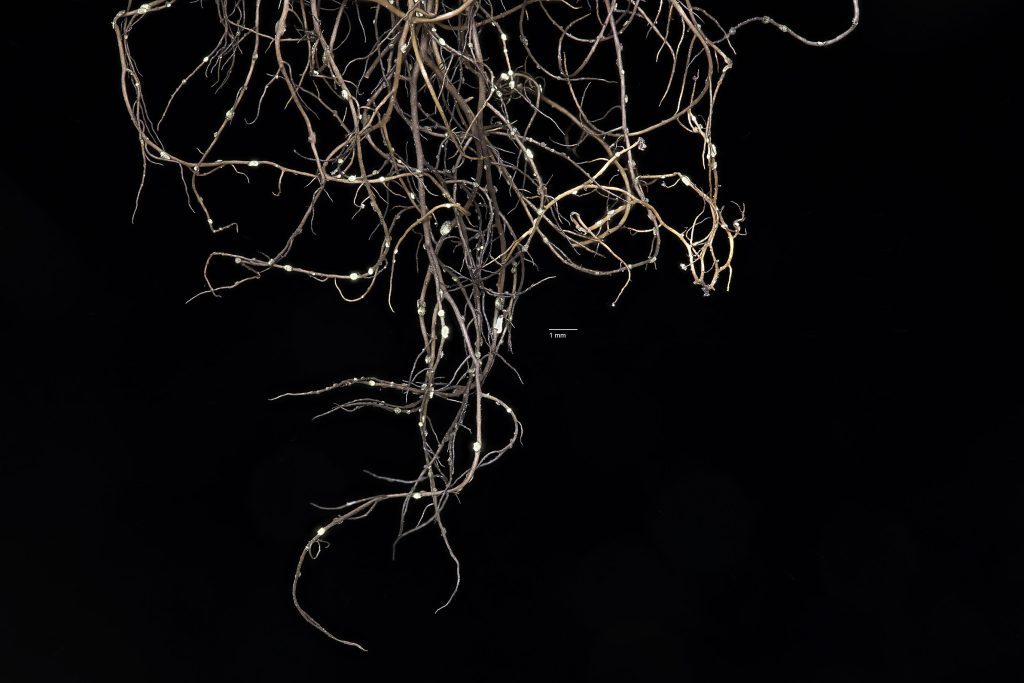
- Bryoria simplicior, ABMI collection
-
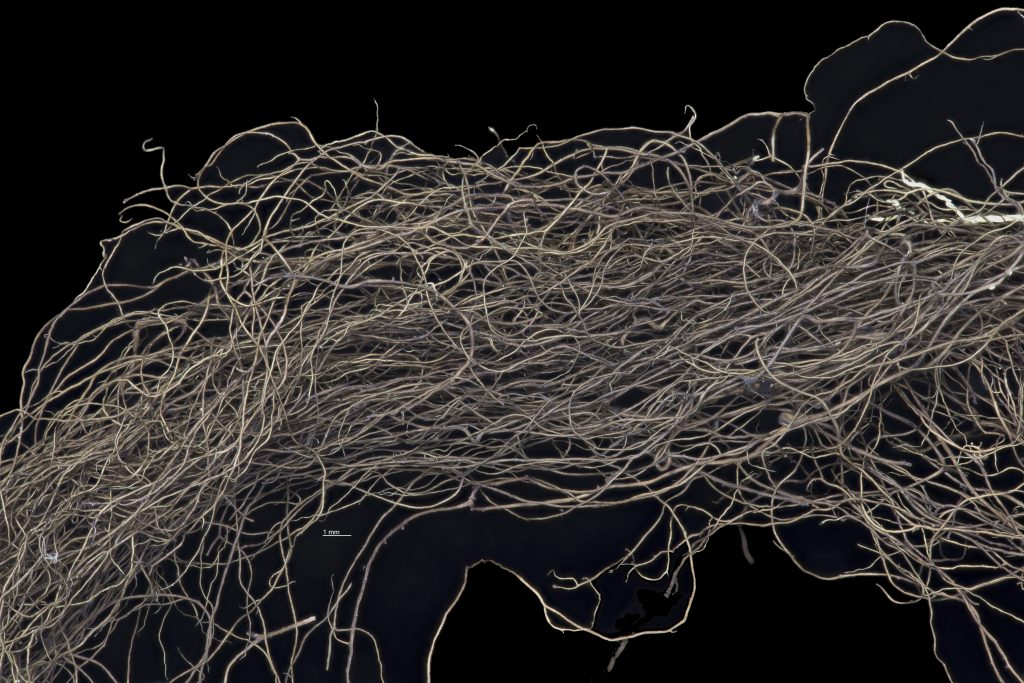
- Bryoria pseudofuscescens, ABMI collection
Resources
Myllys, L., S. Velmala, R. Pino-Bodas & T. Goward. 2016. New species in Bryoria (Parmeliaceae, Lecanoromycetes) from north-west North America. Lichenologist 48: 355-365.
Velmala, S., L. Myllys, T. Goward, H. Holien & P. Halonen. 2014. Taxonomy of Bryoria section Implexae (Parmeliaceae, Lecanoromycetes) in North America and Europe, based on chemical, morphological and molecular data. Annales Botanici Fennici 51:345-371.