"

7.3. Participant Feedback

“As a doctoral student and a teacher of future teachers, these ideas felt like a clear call to action. We’re at a “Ctrl+Alt+Del” moment for our teaching methods. Our role is changing. We are no longer the sole gatekeepers of information. Instead, we are becoming the architects of learning experiences that build the uniquely human skills that AI can’t copy. We must teach our students, and their students, to be the critical thinkers who can challenge an algorithm’s answer and the emotionally intelligent leaders who can navigate human connection.”

Raisa Jivani, EdD in Post-Secondary Leadership (Candidate), Werklund School of Education, UCalgary

What is one takeaway from this event that you would like to implement in your education context?

Feedback summaries categorized into four themes:

1. AI Literacy and Awareness

  • More awareness in students, how to use AI better
  • Principles uses of AI
  • Help students learn how to do literature searches through AI
  • The 2×2 grid proposed by lighting talk speaker for when to use AI

2. Human-AI Interaction & Balance

  • AI is like first contact with aliens
  • The continued (increase) importance of human contact! (reflection / feedback)
  • AI can augment us!
  • Social connection within AI era

3. Pedagogical Challenges & Opportunities

  • Think about what to do for large classes, especially async online
  • The learning journey is satisfying / rewarding in itself
  • For my perspective, AI education companion, I love the idea of personalized self-evaluation or language support through AI

4. Trust and Attitudes Toward AI

  • Also, I found that there were some speakers who had more faith in the system (as a whole beyond AI) than I do
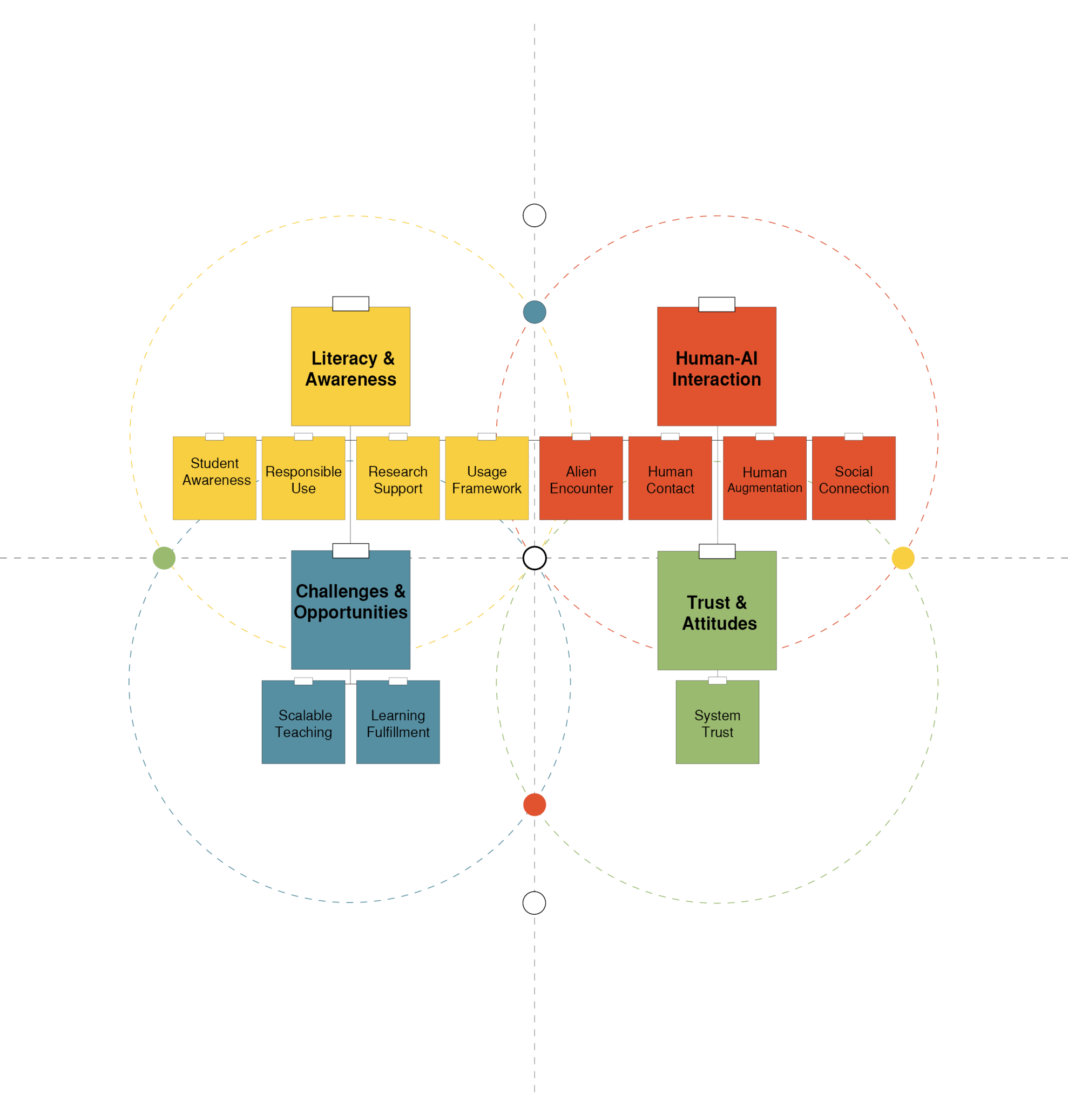
A 4-layer venn diagram overlaid on a quadrant diagram highlighting four main participant feedback themes - literacy and awareness, human-AI interaction, challenges and opportunities, trust and attitudes. Under each are additional feedback themes. For literacy and awareness are student awareness, responsible use, research support, usage framework. For human-AI interaction are alien encounter, human contact, human augmentation, social connection. For challenges and opportunities are scalable teaching and learning fulfillment. For trust and attitudes is system trust.
Figure 6. Feedback Diagram
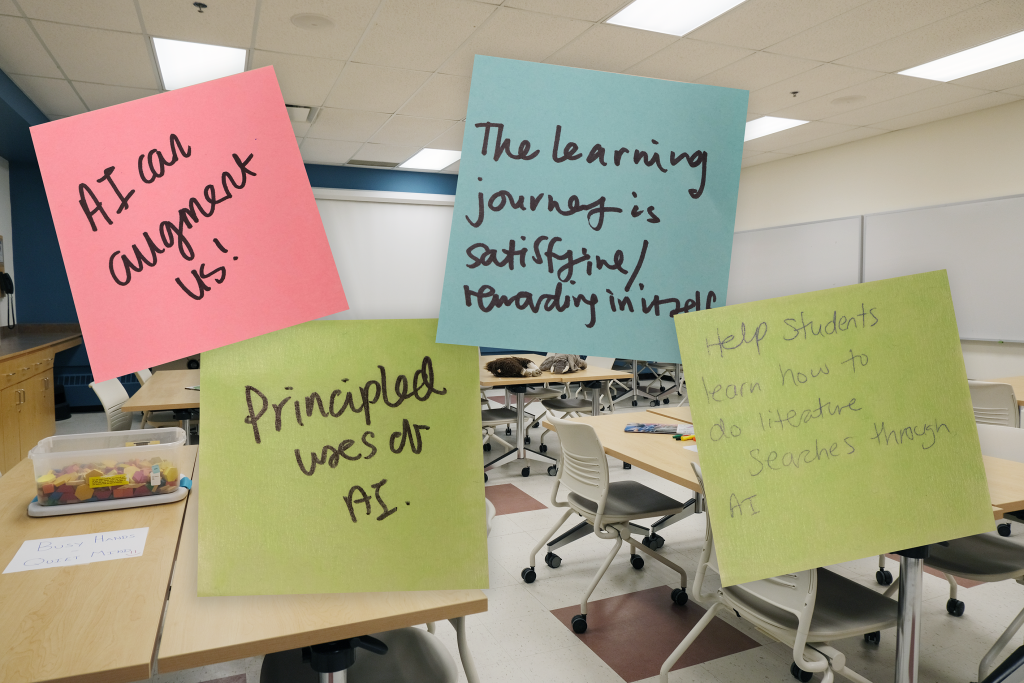
Empty classroom with light wood tables, white roller chairs, and white boards on two walls, overlaid with four post-it notes with feedback comments. Comments include "AI can augment us!," "the learning journey is satisfying/rewarding in itself," "principled uses of AI," and "help student learn how to do literature searches through AI."
Figure 7. Participant Feedback
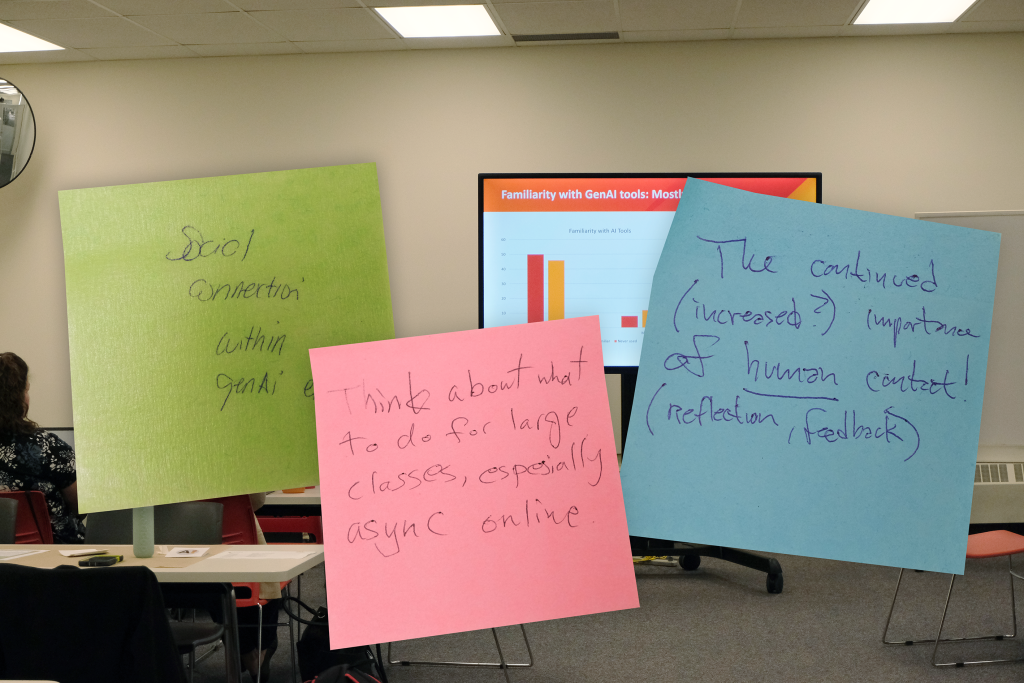
Lecture-style laid out classroom with individuals facing the front large TV screen showing a slide on "familiarity with GenAI tools," with three overlaid post-it notes with feedback comments. Comments include "social comment within GenAI," "think about what to do for large classes, especially async online," and "the continued (increased?) importance of human contact! (reflection, feedback)."
Figure 8. Participant Feedback

License

Icon for the Creative Commons Attribution-NonCommercial-ShareAlike 4.0 International License

AI in Higher Education Innovation Exchange Copyright © 2025 by Sandra Abegglen, Barbara Brown, Patrick Hanlon, Leeanne Morrow, Fabian Neuhaus, Soroush Sabbaghan, Alexandra Poppendorf, Mohammadmahdi Zanjanian, and Bridgette Crabbe is licensed under a Creative Commons Attribution-NonCommercial-ShareAlike 4.0 International License, except where otherwise noted.